GitHub Next's Proof-Driven Development Kit Asks Rust's Verus Verifier to Check AI-Written Code, Not a Reviewer
GitHub Next and Microsoft Research's Proof-Driven Development Kit turns a plan into a formal Verus spec, then proves agent-written Rust code matches it, falling back to tests and computer-use agents when a proof isn't possible.
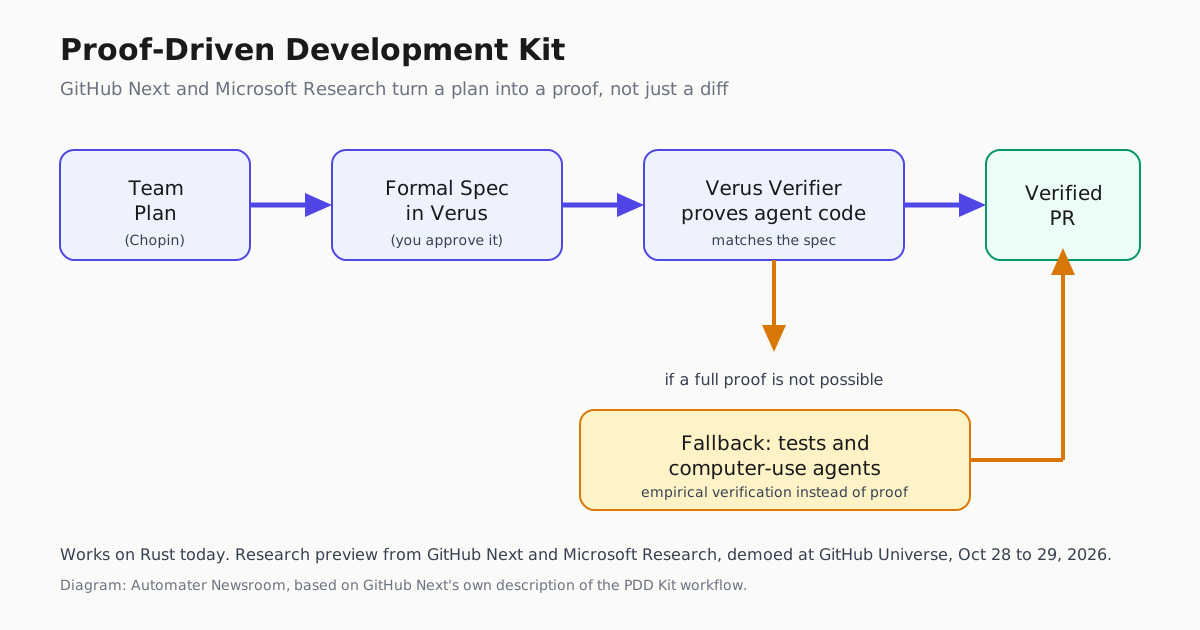
Reviewing AI-generated pull requests has become the real bottleneck of agentic coding: agents can write diffs far faster than a human can read them for correctness. On October 21, 2026, GitHub Next and Microsoft Research proposed a different fix for one language family — instead of asking a person to review the code, ask a theorem prover to check it.
What the PDD Kit actually does
GitHub Next’s announcement (@GitHubNext) describes the Proof-Driven Development Kit (PDD Kit) as a tool that “helps turn your plan into a formal spec, then proves the agent’s code meets that spec for every input.” The workflow, as GitHub Next lays it out for a sample login flow, runs like this:
| Step | What happens |
|---|---|
| 1. Plan | A team plans the feature together inside Chopin, GitHub Next’s agentic planning tool |
| 2. Spec | PDD Kit discusses the code, infers intent, and proposes a formal specification written in Verus, a proof language for Rust |
| 3. Approve | A human approves the spec, not the code |
| 4. Prove | The Verus verifier automatically proves the agent’s generated code satisfies that spec for every input |
| 5. Fallback | Where a full proof is not possible, PDD Kit falls back to tests and computer-use agents (CUAs) for empirical verification |
| 6. Ship | A verified pull request is produced |
PDD Kit is integrated with Chopin so a team can do that planning step together rather than solo, and GitHub Next says the kit “works on Rust today,” with “no new language, no change in how you produce the underlying code.” The explicit framing in the announcement: the goal is “a verified software factory, where engineers review specifications instead of code.”
GitHub’s own account restated the stakes more bluntly the same afternoon: Chopin plus PDD Kit, it said, “enable teams to ship AI-generated code to production without reviewing it line by line, with stronger assurance than code review and testing alone,” and the pairing is “now in research preview” (@github). That is GitHub’s own framing of what its tool is meant to demonstrate, not an independently audited result — read it as the vendor’s claim about research-preview access, not a settled finding.
Why Rust, and why Verus
Verus is a separate, existing open-source proof framework for Rust, not something GitHub built from scratch for this launch. Microsoft Research’s own verus-proof-synthesis repository shows the groundwork: it hosts two LLM-driven systems, AutoVerus and VeruSAGE, built specifically to generate and repair Verus proofs — AutoVerus for small algorithmic code and VeruSAGE for proof work inside large systems projects, benchmarked against 150 and 849 verification tasks respectively (github.com/microsoft/verus-proof-synthesis).
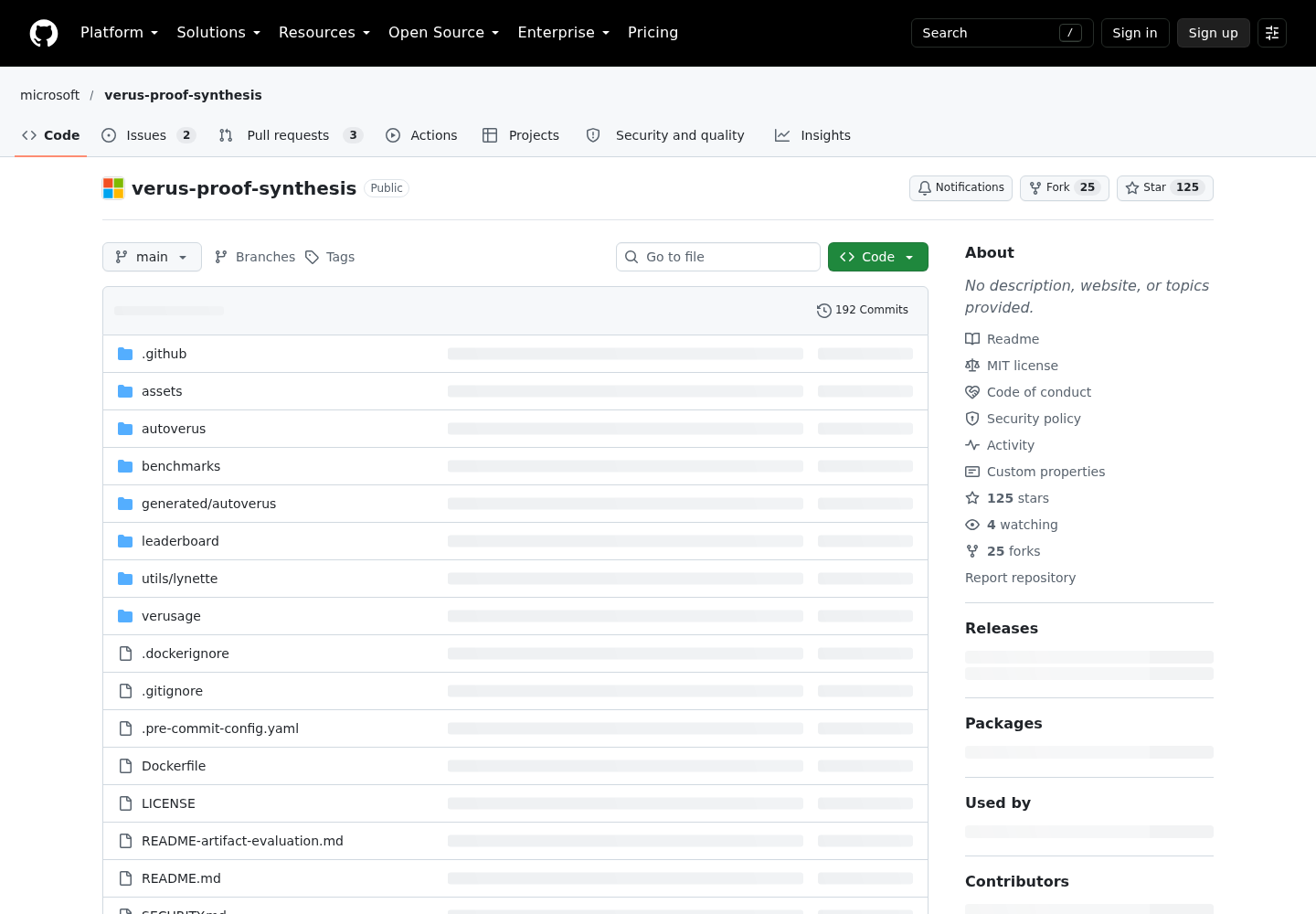
Based on GitHub Next’s announcement and Microsoft’s public research repository, PDD Kit appears to be the first time that proof-synthesis research line has been packaged into a planning-to-PR product workflow rather than a standalone benchmark exercise.
That dependency is also the kit’s real limit. Verus only checks Rust, and only code that can be expressed as a provable specification in the first place; anything outside that — UI behavior, most I/O-heavy logic, anything where “correct” isn’t a formal property — still needs the fallback path of tests and computer-use agents, which is exactly where today’s review burden already lives.
Still an early-stage prototype
Chopin itself, the planning environment PDD Kit depends on, is listed on GitHub Next’s own projects page as a “Research Prototype” dated September 2026 — a “real-time multiplayer, agentic planning environment,” one of four projects GitHub Next currently has active (githubnext.com/projects). PDD Kit inherits that status: both are research previews, not shipped Copilot features, and GitHub Next’s track record shows plenty of prototypes — Repo Mind, Project Copernicus, SpecLang among them — that never reached general availability.
GitHub Next says it will demo PDD Kit live at GitHub Universe, October 28–29, 2026, at a “Speakeasy” session — the first point where outside engineers can see the spec-approval and proof steps run against real code rather than a scripted announcement thread.
What Rust teams can take from this now
If your agents already write Rust and you’re drowning in diff review, the practical move isn’t to wait for a GA announcement — it’s to start separating your codebase into “provable” and “not provable” categories now. Business logic with clear input/output contracts (parsers, state machines, data-structure invariants) is exactly where Verus-style proof already works today, independent of PDD Kit, via the open-source Verus toolchain. PDD Kit’s bet is that an agent can write that formal spec for you instead of a human doing it by hand, which has been formal verification’s practical bottleneck for decades. For everything else — most front-end code, most multi-language systems — the fallback path makes clear that tests and human review aren’t going away; PDD Kit is narrowing the slice of code that needs them, not eliminating the review problem itself.
For teams outside Rust, there’s nothing to install yet. The useful signal is directional: a major agent vendor is explicitly betting that the next step past “more code review tooling” is proof, not more reviewers, for the parts of a codebase where proof is tractable. Our spec-driven development piece covers the broader shift from prompts to contracts that this plugs into, and our agentic software testing guide covers what the fallback path — tests plus computer-use agents — still has to catch.
Sources
- GitHub Next on X: "How do you _guarantee_ your agent's code is correct? You prove it. Introducing Proof Driven Development Kit (PDD Kit) from @MSFTResearch. PDD Kit helps turn your plan into a formal spec, then proves the agent's code meets that spec for every input. No vibe verification. PDD Kit…
- GitHub on X: "Chopin + Proof-Driven Development Kit from @GitHubNext and @MSFTResearch enable teams to ship AI-generated code to production without reviewing it line by line, with stronger assurance than code review and testing alone. Now in research preview ⬇️" / X
- Projects
- GitHub - microsoft/verus-proof-synthesis · GitHub