Asymptote Labs Raises $5.5M Seed for Beacon, a Cross-Harness Memory Layer for Coding Agents
Asymptote Labs raised a $5.5M seed for Beacon, the MIT-licensed telemetry layer it open-sourced in May, which normalizes Claude Code, Codex, Cursor and 20+ coding-agent sessions into one event model, then turns solved problems into reusable skills agents can retrieve through MCP.
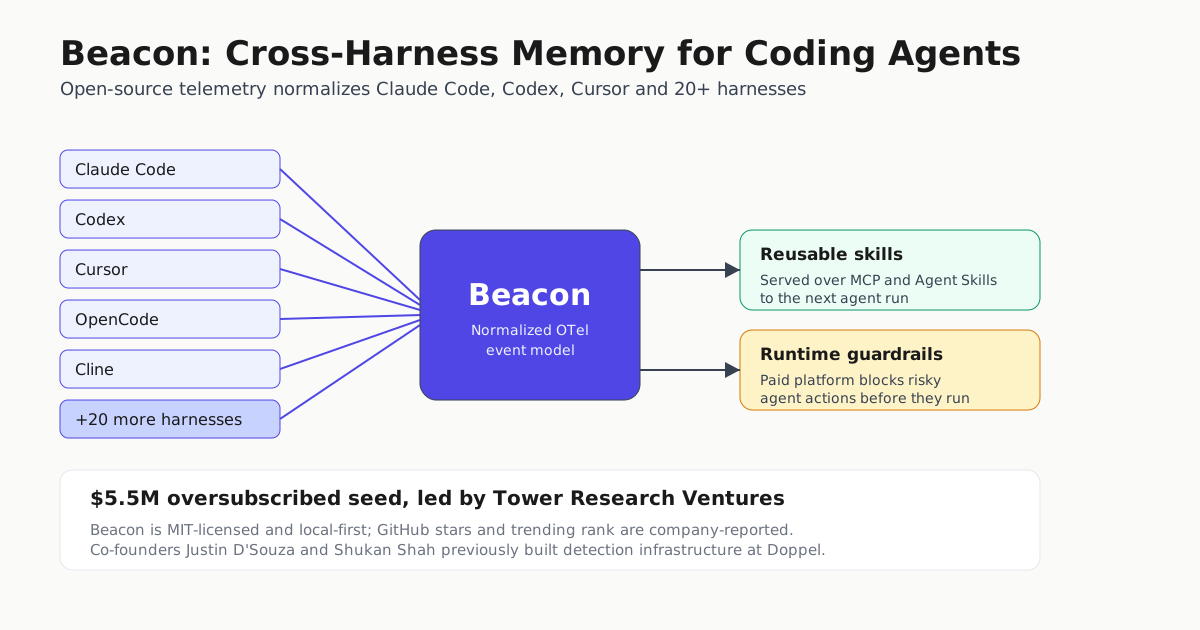
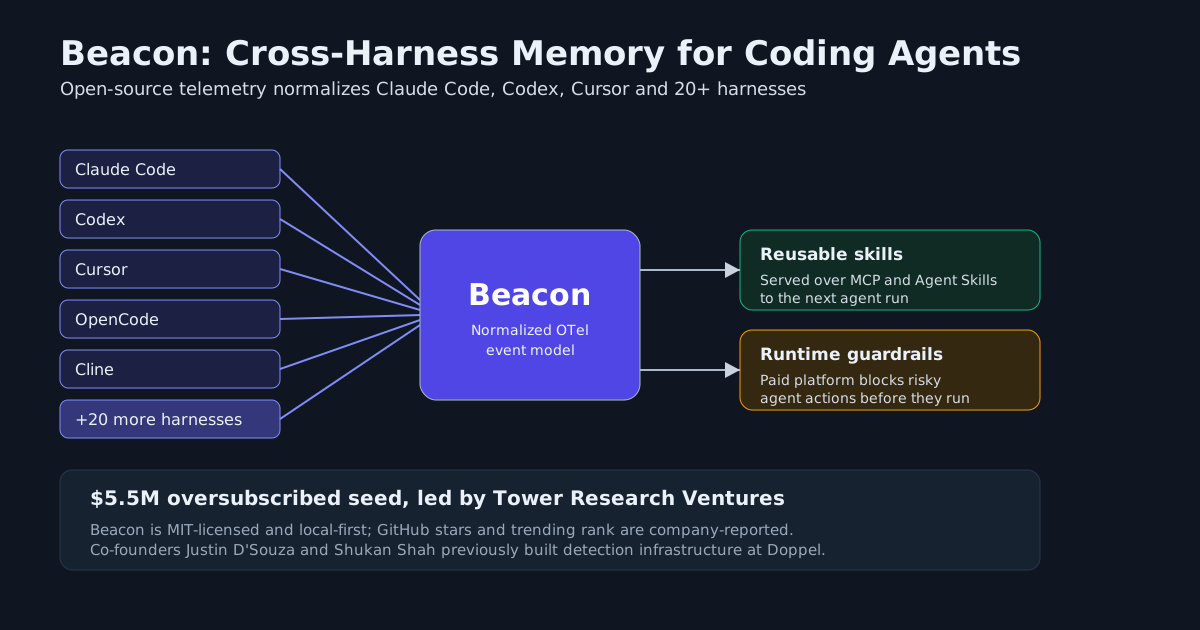
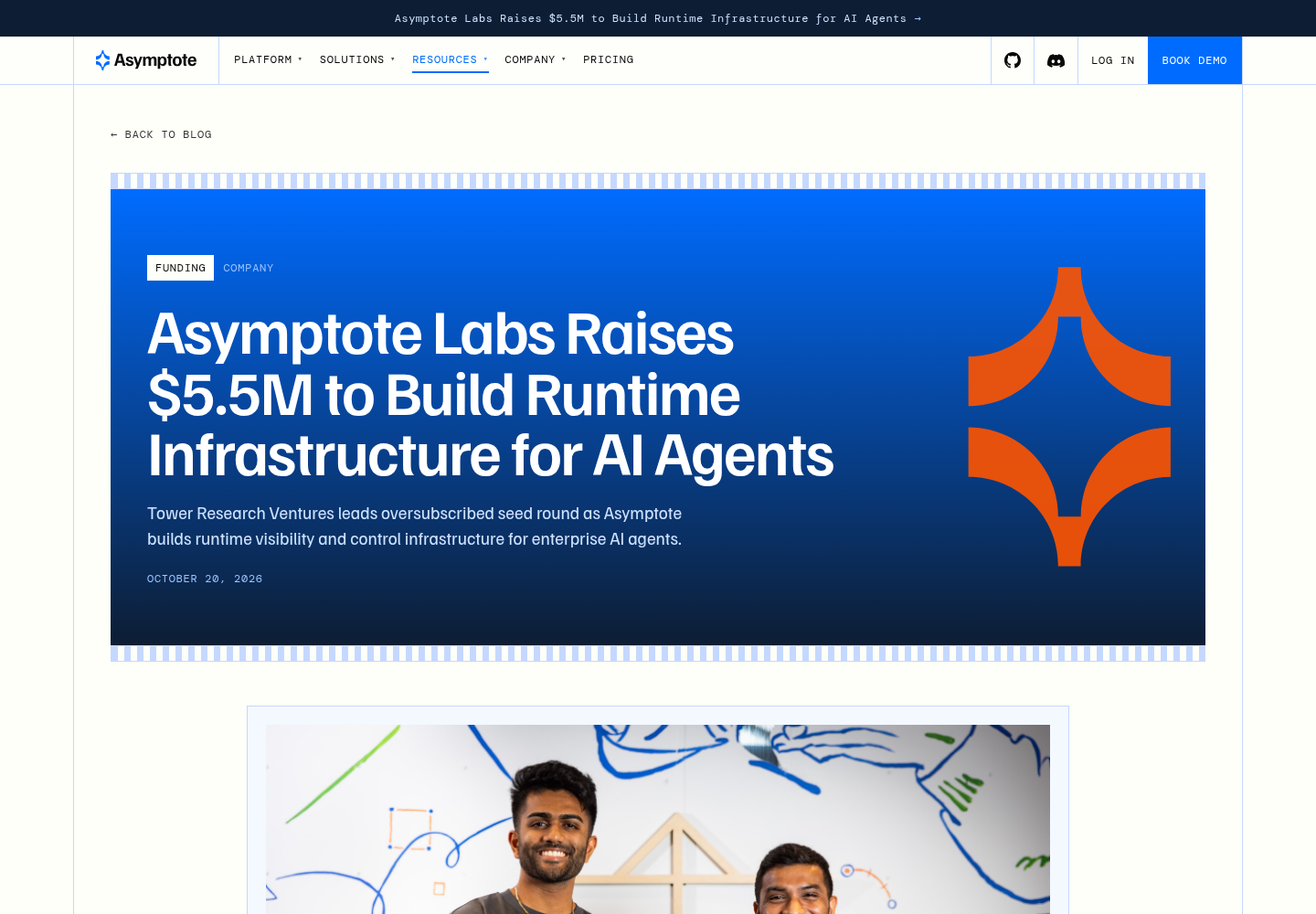
Asymptote Labs, a New York startup co-founded by former Doppel engineers Justin D’Souza and Shukan Shah, announced on October 20, 2026 that it closed an oversubscribed $5.5 million seed round led by Tower Research Ventures, the venture arm of Tower Research Capital, with Lytical Ventures, 1984 Ventures and South Park Commons also participating (Asymptote Labs). The capital funds engineering, product and go-to-market work around Beacon, the company’s free, MIT-licensed, open-source telemetry layer for AI coding agents, which launched in May 2026 and was named one of Help Net Security’s hottest open-source cybersecurity tools of June 2026.
The problem: context that dies at the harness boundary
Teams increasingly run more than one coding agent: Claude Code for one task, Codex for another, Cursor for a third. Each harness keeps its own session history, so a fix one agent learns the hard way has to be re-explained to the next tool from scratch. Beacon targets that gap directly. It captures agent activity, including prompts, tool calls, commands, file edits, approvals, MCP activity and token usage, across Claude Code, Codex, Cursor, OpenCode and more than 20 other harnesses, then normalizes everything into a single event model that extends the OpenTelemetry standard rather than inventing a proprietary format.
| Harness | Collection method | Prompt/tool/command capture | Skills install path |
|---|---|---|---|
| Claude Code | OTLP + hooks + poll | Full | Plugin |
| Codex CLI | OTLP + hooks + poll | Prompts, tools and commands; no file or MCP capture | Plugin |
| Cursor | Hooks + poll | Full | Plugin |
| OpenCode | Plugin + poll | Full | skills CLI |
| Cline | Plugin + poll | Full | .cline/skills |
Source: the agent-beacon README’s runtime coverage table.
How a fix turns into memory
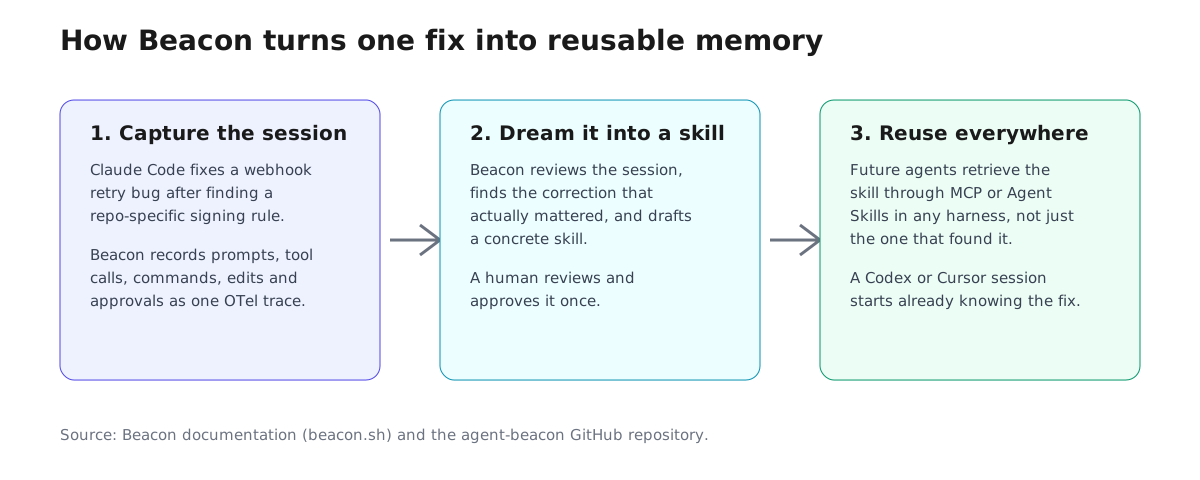
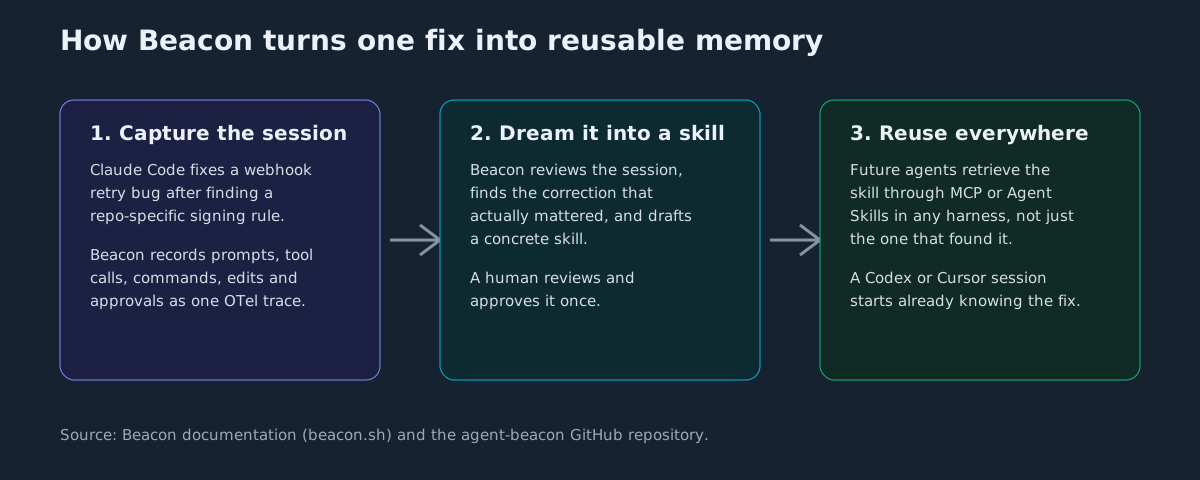
Beacon’s documentation describes the workflow as ‘dreaming’: the system reviews finished sessions, picks out the correction or debugging pattern that actually mattered, and drafts it into a concrete, reusable skill, which a human reviews once before it ships (beacon.sh). The company’s own example is a webhook retry bug fixed after an agent discovers a repository-specific signing rule; instead of that fix living only inside one Claude Code transcript, it becomes a skill that a later Codex or Cursor session can retrieve through MCP or Agent Skills the next time the same question comes up.
Installation is a short install (brew install beacon followed by beacon endpoint install on macOS, a checksum-verified .deb/.rpm via an install script or manual verification on Linux, or an MSI on Windows), and the project is explicitly local-first: it writes durable JSONL by default and only forwards data after you confirm its preselected Beacon Cloud destination (Local is the opt-out) or point it at infrastructure you already run, including Splunk, Datadog, Elastic, Microsoft Sentinel or your own S3 bucket (agent-beacon on GitHub). That means a team can adopt the shared trace format for portability without handing session data to Asymptote at all.
Where the paid product starts
Beacon itself is free telemetry. Asymptote’s revenue comes from an enterprise platform built on top of it that intercepts live agent activity and enforces policy-driven guardrails at the prompt and tool level, aiming to block data leakage, insider-threat patterns and risky AI supply-chain actions before they execute (Asymptote Labs). TheNextWeb’s coverage frames the split plainly: Beacon records what agents did, while the paid layer is what can stop an action in progress (TheNextWeb).
Unite.AI’s analysis pushes on that distinction further, noting that recording an action after the fact and enforcing a decision before it proceeds are genuinely separate engineering problems, and that Asymptote has not published a coverage matrix or a blocking-accuracy benchmark showing how often the enterprise platform actually stops an unauthorized action (Unite.AI). That’s a reasonable caveat for any team evaluating the guardrail tier rather than just the open-source telemetry.
Adoption numbers, with the right caveat
Asymptote says Beacon’s GitHub stars grew more than 460% in September and that the project reached No. 3 on GitHub’s global trending repositories that month (Asymptote Labs). Those are company-reported growth figures, not independently verified metrics, and they say nothing about detection accuracy or paying-customer counts. Tower Research Ventures says it discovered Asymptote through that open-source traction and is now evaluating Beacon on its own security team’s endpoints, which is evaluation by an investor’s organization, not a disclosed commercial deployment.
What to actually do with it
For a team already running a multi-harness coding-agent fleet, Beacon is worth trying for one narrow reason: it gives you one trace format and one local JSONL file instead of five incompatible session logs. That’s useful even if you never touch Asymptote’s paid tier, and it fits the broader push toward memory that survives a switch between CLIs. Before wiring reviewed skills into a production fleet, apply the same scrutiny you’d give any shared-memory system: track who approved each skill and where it came from, per the write-provenance rules for shared agent memory, and run your own before/after comparison the way you would for any other agent memory layer rather than taking star-growth numbers as a proxy for quality.
Sources
- Asymptote Labs Raises $5.5M to Build Runtime Infrastructure for AI Agents | Asymptote
- GitHub - Asymptote-Labs/agent-beacon: The cross-harness, self-improving memory layer for AI agents. Join our community: https://discord.com/invite/zdNChS2fBu · GitHub
- Beacon | Open Source Self-Improving Memory for Coding Agents
- Asymptote Labs raises $5.5M to track and control what AI agents do
- Asymptote Labs Raises $5.5M Seed to Monitor and Control Enterprise AI Agents – Unite.AI