
Notion Rebuilds Its Agents for 24-Hour Tasks and Moves Business Seats to Standard and Select Credits
Notion's October 19, 2026 announcement pairs a sixth-generation agent harness that can run single tasks for 24+ hours with metered AI pricing: 1,500 Standard and 500 Select credits per Business and Enterprise seat monthly, live for new workspaces and reaching existing ones November 2.
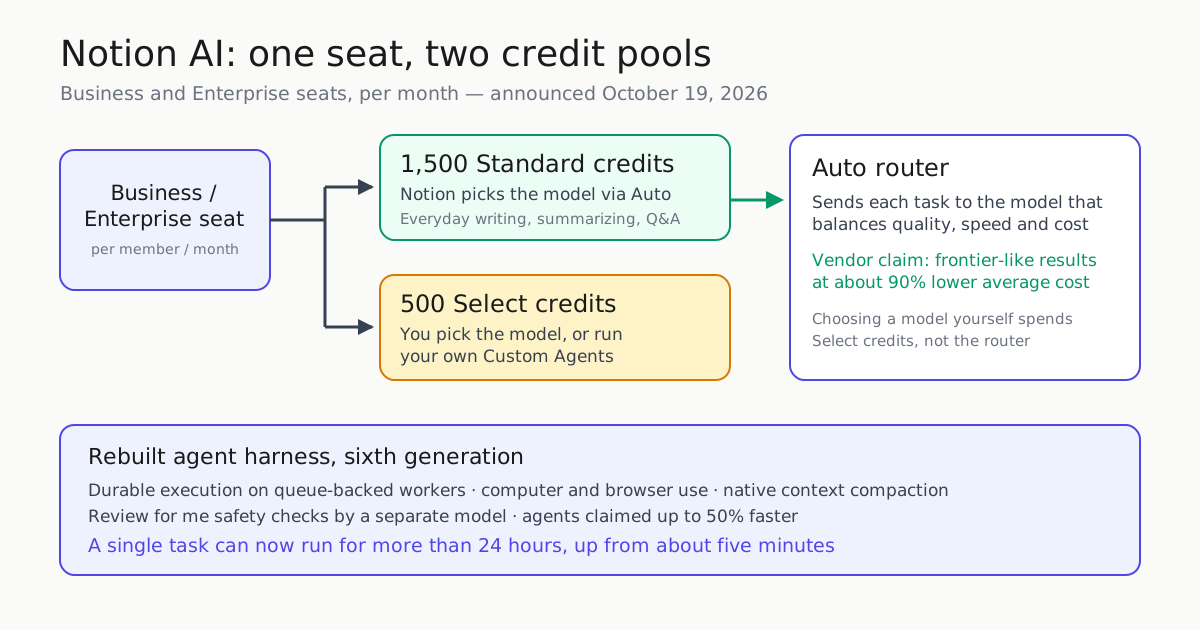
Notion co-founder Akshay Kothari used October 19, 2026 to announce two linked changes to Notion AI: a sixth-generation agent harness that can keep a single task running for more than 24 hours, up from about five minutes, and a new metered credit system. Business and Enterprise seats will now include 1,500 Standard credits and 500 Select credits per month. The change went live for new customers on announcement day; existing workspaces migrate on November 2. The primary source is Notion’s post “Agents, rebuilt to do more for less”.
For teams running agents inside Notion, this is a capability story and a budget story at once. AI on business tiers stops being flat-rate and becomes two metered pools plus admin-purchased top-ups — the shift Copilot users watched from the sidelines, as we covered in The Subscription Squeeze.
Two pools per seat, and what spends them
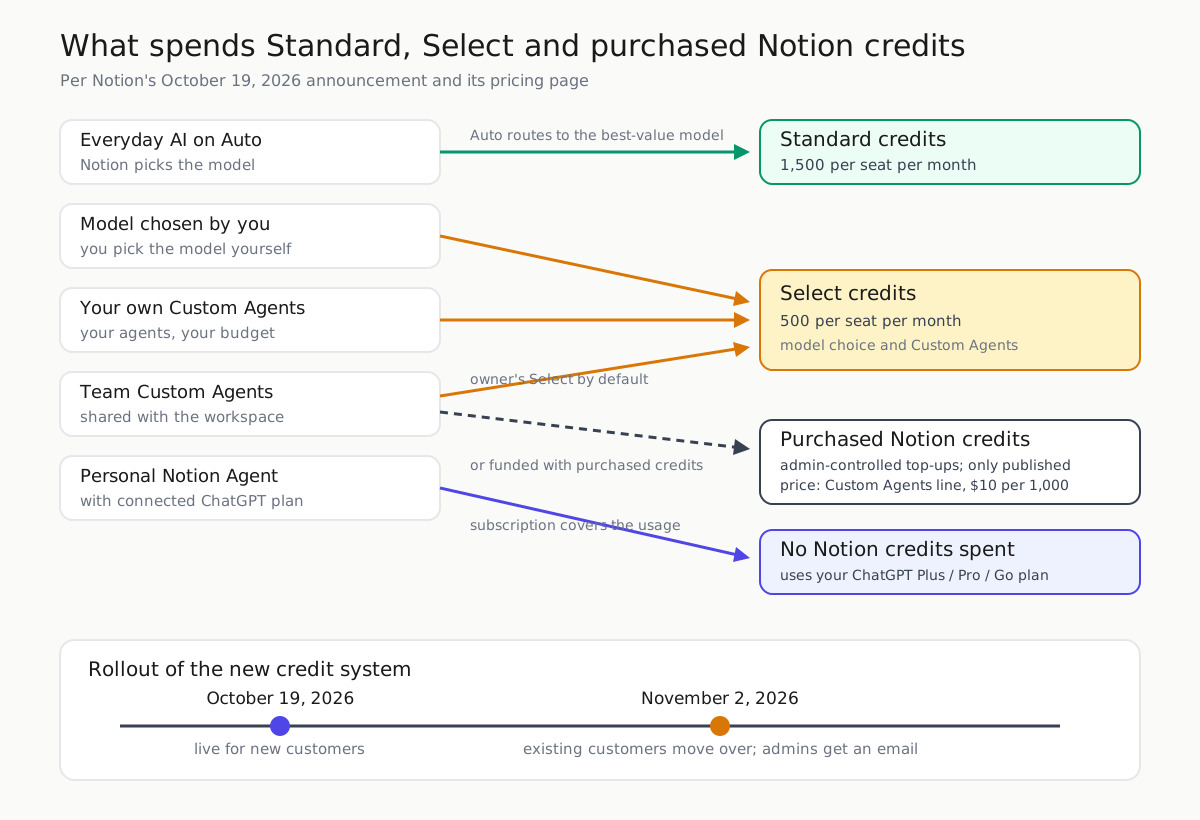
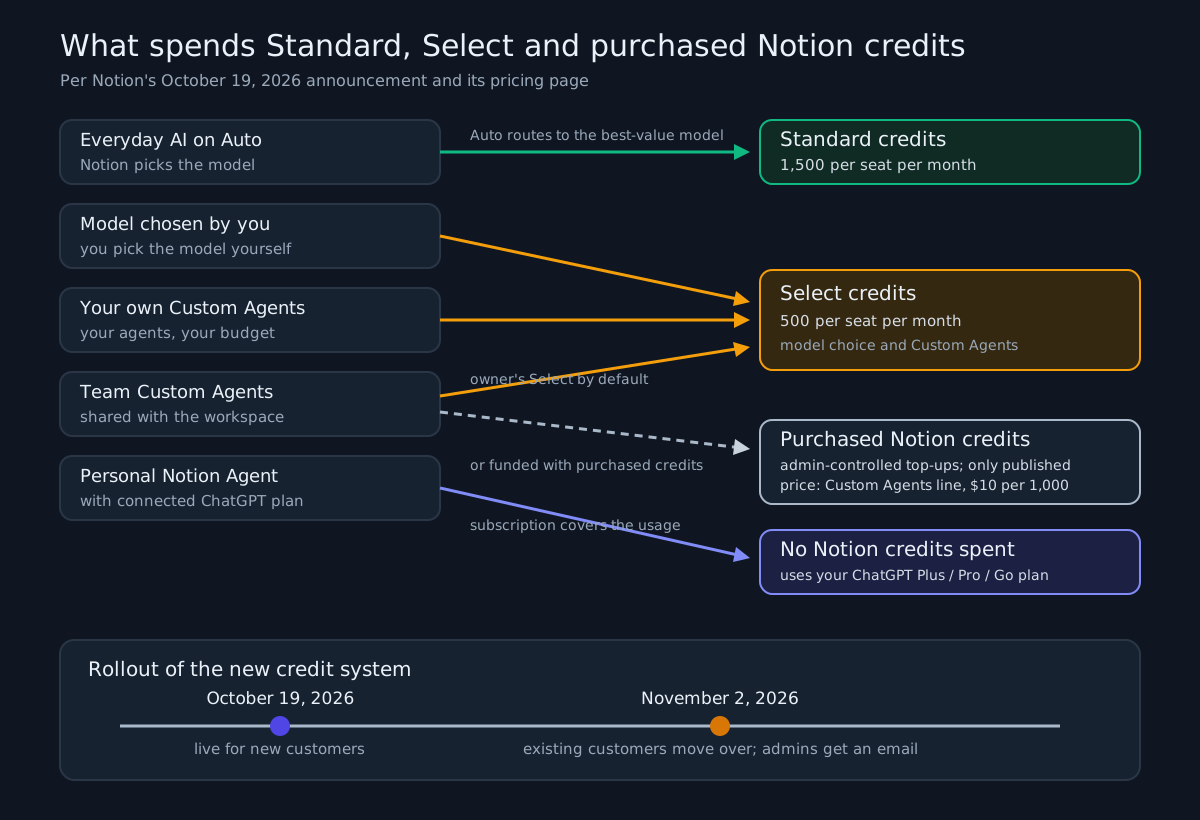
Standard credits cover work where Notion picks the model: its Auto router sends each task to the model that “best balances quality, speed, and cost.” Select credits cover work where you pick the model or run Custom Agents. Your own agents spend your Select credits, and team Custom Agents spend the creator’s Select credits by default even when other members use them — admins can instead fund them with purchased credits. Notion’s pricing page publishes one credit price, on its Custom Agents line: “Free to try, then $10 per 1,000 monthly Notion credits.” The announcement itself sets no separate overage price for admin-purchased top-ups, so treat $10 per 1,000 as the published reference point rather than a guaranteed top-up rate. Business seats remain $20 per member per month.
| Work in Notion | What it spends |
|---|---|
| Everyday AI on Auto | Standard — 1,500 per seat per month |
| Manually chosen model | Select — 500 per seat per month |
| Your own Custom Agents | Your Select credits |
| Team Custom Agents | Owner’s Select, or purchased credits |
| Personal Notion Agent with connected ChatGPT plan | No Notion credits |
Notion says “the vast majority of users are unlikely to run out of credits” thanks to router efficiency — an estimate, not a guarantee. Heavy agent users should treat the 500 Select credits as the number to model against November 2, and log them alongside every other meter, the way AI Credits vs Tokens recommends.
The harness behind the 24-hour claim
The headline capability is durable execution: every agent session runs on a dedicated service with a queue-backed worker loop, so work survives restarts. That is how a single task now runs 24+ hours. The rebuilt harness also adds computer and browser use, so agents can write short scripts instead of spending tokens; context compaction using each model provider’s native compaction, with large tool results offloaded rather than flooding the context window; and a “Review for me” mode in which a separate model checks whether an action is safe before the agent takes it.
Notion claims agents run up to 50% faster on web and mobile, infrastructure uptime exceeds 99.9%, and Custom Agent runs cost about 30% less in its own testing. All three are vendor figures with no independent verification published alongside them.
Auto router economics: a claim to test
Notion says upgraded Auto delivered results similar to Opus 5.5 and Astra across 20+ common use cases at about 90% lower average cost — credits going roughly 10x further — and that it re-routes when a model stops making progress. The 90% figure is a vendor benchmark over Notion’s chosen use cases. Before trusting the multiplier, price the router on your own workloads; the discipline in Routers You Can’t See Inside applies: savings arrive only when your workload mix matches the vendor’s.
Bring your own AI: shipped versus announced
- Live now: connect ChatGPT Plus, Pro or Go and use it in your personal Notion Agent instead of spending credits. Custom Agents are excluded for now.
- Private alpha: Bring Your Own Key for Enterprise customers, via account teams.
- Improved: an overhauled Notion MCP syncs memories and connects outside agents — Notion names ChatGPT, Claude, Grokbot and Muse — with Skills via MCP “coming soon.” Notion calls the MCP its fastest-growing product ever, with connectors reaching hundreds of tools, up from a few dozen earlier this summer. Seven new models arrived in the past month from Anthropic, OpenAI and open-weight providers.
- Announced, not available: the AI Command Center, promising usage dashboards by member, feature and agent; spending limits; model allowlists; near-limit alerts; and controls over who can create, pause or archive Custom Agents. The post says “soon,” so admins cannot budget November around controls that do not yet exist.
Notion’s blog index frames the release inside a wider engineering cadence — 160 new app connections in three weeks, shared agent memory, an agent skills library — infrastructure build-out rather than a single feature drop.
What admins should do before November 2
- Inventory Select-credit consumers: every manually chosen model and every Custom Agent draws from a 500-credit monthly pool per seat.
- Decide who funds team agents. They default to the owner’s Select credits; admin-purchased credits are the alternative, with the pricing page’s Custom Agents line ($10 per 1,000 monthly credits) the only published rate.
- Test Auto on representative tasks before assuming the 90% savings claim transfers.
- Where policy allows, connect ChatGPT plans for personal agents — the one credit-meter escape hatch shipping today.
- Treat the migration email as the trigger to snapshot current usage, and watch for the AI Command Center rollout.
Notion’s argument is that efficiency and metering must arrive together: long-running agents would “blow through credits” without the harness gains, in its head of AI’s words. Whether 1,500 plus 500 credits cover a team’s month is now a question each admin answers with real usage data — before the meter starts.