
Greptile Raises $50M Series B at $750M as AI Code Review Checks Over 1% of GitHub PRs Daily
Greptile raised a $50M Series B at $750M; its AI code reviewer now checks over 1% of all PRs opened on GitHub daily for teams including Nvidia, Coinbase and Vanta.
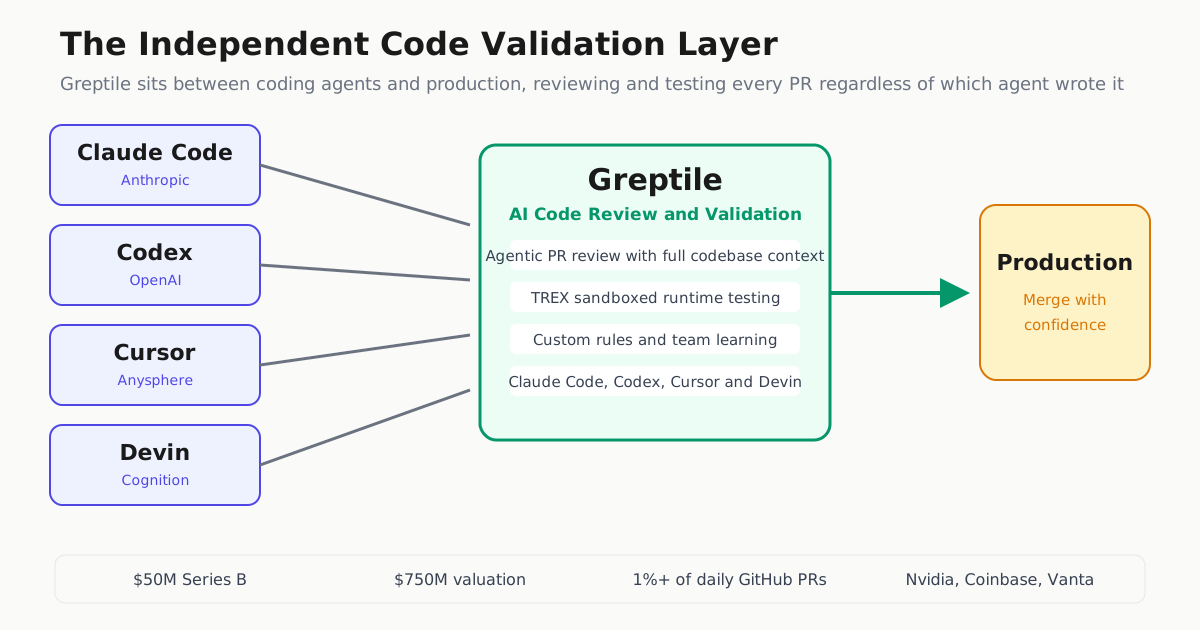
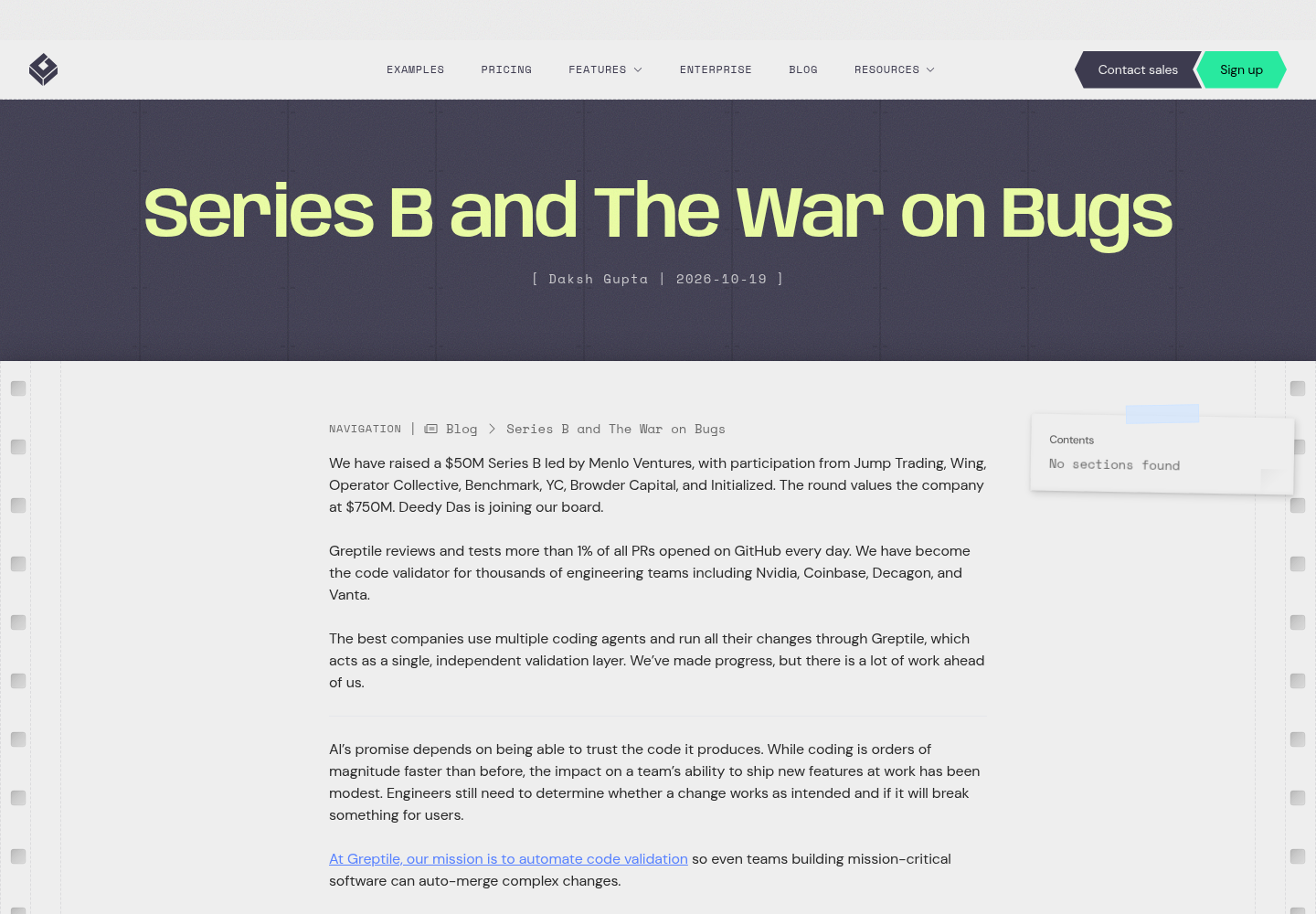
Greptile announced a $50 million Series B led by Menlo Ventures on October 19, valuing the AI code review company at $750 million. The round includes participation from Jump Trading, Wing, Operator Collective, Benchmark, Y Combinator, Browder Capital, and Initialized, with Deedy Das joining the board.
The company says its AI reviewer now checks more than 1% of all pull requests opened on GitHub every day, serving thousands of engineering teams including Nvidia, Coinbase, Decagon, and Vanta. Greptile has become what it calls a “code validator” — an independent layer that reviews and tests code regardless of which coding agent produced it.
Why an independent validation layer matters now
The premise is straightforward but increasingly urgent. Engineering teams are running multiple coding agents — Claude Code, OpenAI Codex, Cursor, Devin, and others — simultaneously. Each agent writes code differently, with different strengths and blind spots. Without a shared review layer, every PR potentially carries unknown risks that vary by which agent authored it.
Greptile’s answer is positioning itself as the single validation gate across all of them. According to its product page, the platform indexes a codebase into a graph of files, functions, and dependencies, then uses a swarm of parallel agents to review changes, assess impact beyond the visible diff, and flag issues ranging from style violations to multi-file logical bugs and security risks.
TREX and the move beyond static review
In June 2026, Greptile shipped TREX, an execution layer that runs PR branches in sandboxes rather than just reading diffs. TREX catches runtime bugs that static analysis misses — the kind that only surface when code actually executes. This shifts Greptile from a reviewer that reads code to a validator that tests it, a meaningful step toward the company’s stated mission of automating code validation so teams can auto-merge complex changes with confidence.
The product integrates directly into existing workflows. Engineers can send issue context from Greptile to Claude Code, Cursor, Codex, or Devin with one click. A Claude Code plugin lets the agent automatically read and resolve Greptile comments. A /greploop command lets any coding agent iterate with Greptile until all flagged issues are resolved.
The broader trend: review as its own category
Greptile’s raise signals that AI code review and validation is hardening into its own venture-backed category, separate from AI code generation. This mirrors activity across the ecosystem — Claude Code Review went GA for Team and Enterprise plans in September with per-repository Quick, Standard, and Deep review levels, and Cloudflare disclosed in August that it cut its own AI code review inference bill by 68% through cache optimization rather than buying bigger models.
Greptile’s positioning as an agent-agnostic layer is a calculated bet that no single coding agent vendor wins the market outright. If teams keep mixing agents by task — fast models for scaffolding, frontier models for architecture — an independent reviewer that works across all of them becomes more valuable, not less.
Scale and trajectory
The 1% of GitHub PRs figure underscores the scale of AI-generated code already flowing into production pipelines. The company’s blog archive chronicles a maturing AI startup playbook: a $4.1 million seed in June 2024, a $25 million Series A led by Benchmark in September 2025 alongside Greptile v3, and now a $50 million Series B roughly a year later. Each round coincided with a major product release — v3 brought an agentic approach, v4 reached a 43% comment acceptance rate with 74% more addressed comments, and v5 shipped in August 2026.
The validation-layer thesis extends beyond code review. Greptile frames its long-term goal as automating code validation entirely, where review is just the first surface. If coding agents eventually produce most new code, independent validation — not generation — becomes the bottleneck, and the company that owns that bottleneck has leverage over every agent vendor’s output pipeline.
That remains an ambitious bet. But with $50 million in fresh capital, a $750 million valuation, and what CEO Daksh Gupta describes as “a lot of work ahead of us,” the independent validation layer category now has serious funding and real scale behind it.
The company offers self-hosted deployment for air-gapped environments, SOC 2 compliance, and enterprise features including SSO and audit logs. Pricing starts with a free tier for one active developer and scales through Pro at $30 per seat per month, with review tiers priced in credits from one credit per base review up to 10 for Apex-level deep analysis.