
Exa 3.0 Claims #1 on Every Search Benchmark and Adds a $4 per 1,000 Requests Lite Tier for AI Agents
Exa 3.0 claims #1 on every search benchmark, makes Dynamic Highlights GA with 95% token reduction, adds billions of structured data documents, and launches a $4-per-1k-requests Lite tier for cost-sensitive AI agents.
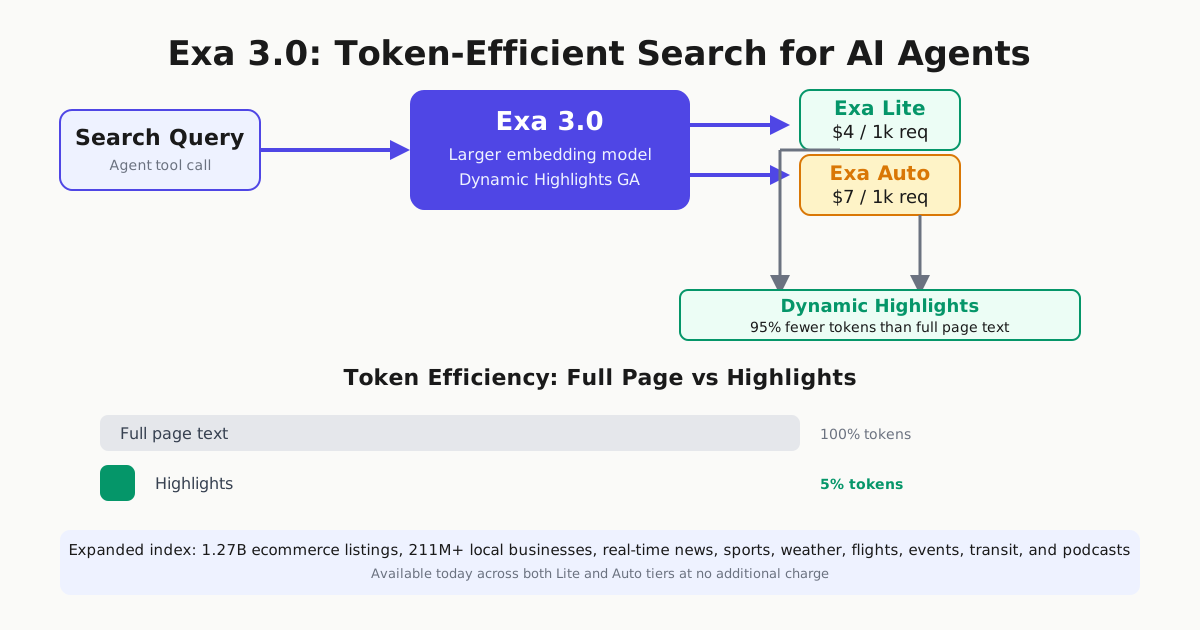
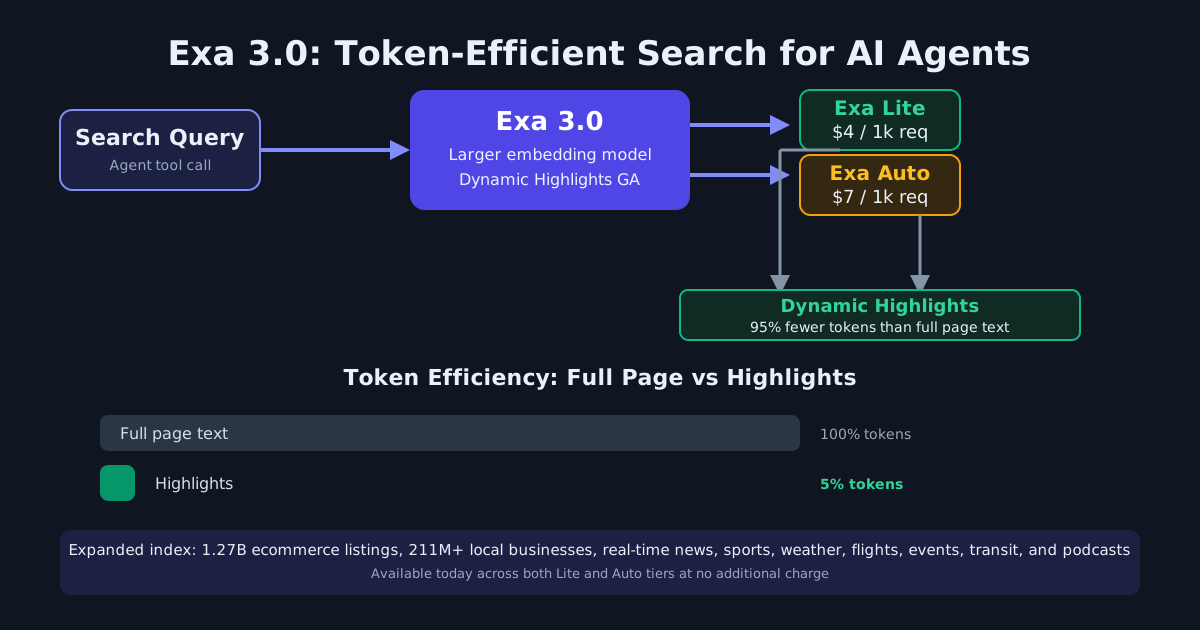
Exa shipped version 3.0 of its search API on October 19, claiming the top spot on every benchmark it tested — from public agentic-search evaluations like BrowseComp, DSQA, and WideSearch to vertical-specific tests for coding, finance, and go-to-market intelligence. Alongside the quality leap, the company launched Exa Lite at $4 per 1,000 requests, a new pricing tier that sits below its existing $7 Auto plan and opens the API to cost-sensitive agent workloads that previously could not justify per-call search spend.
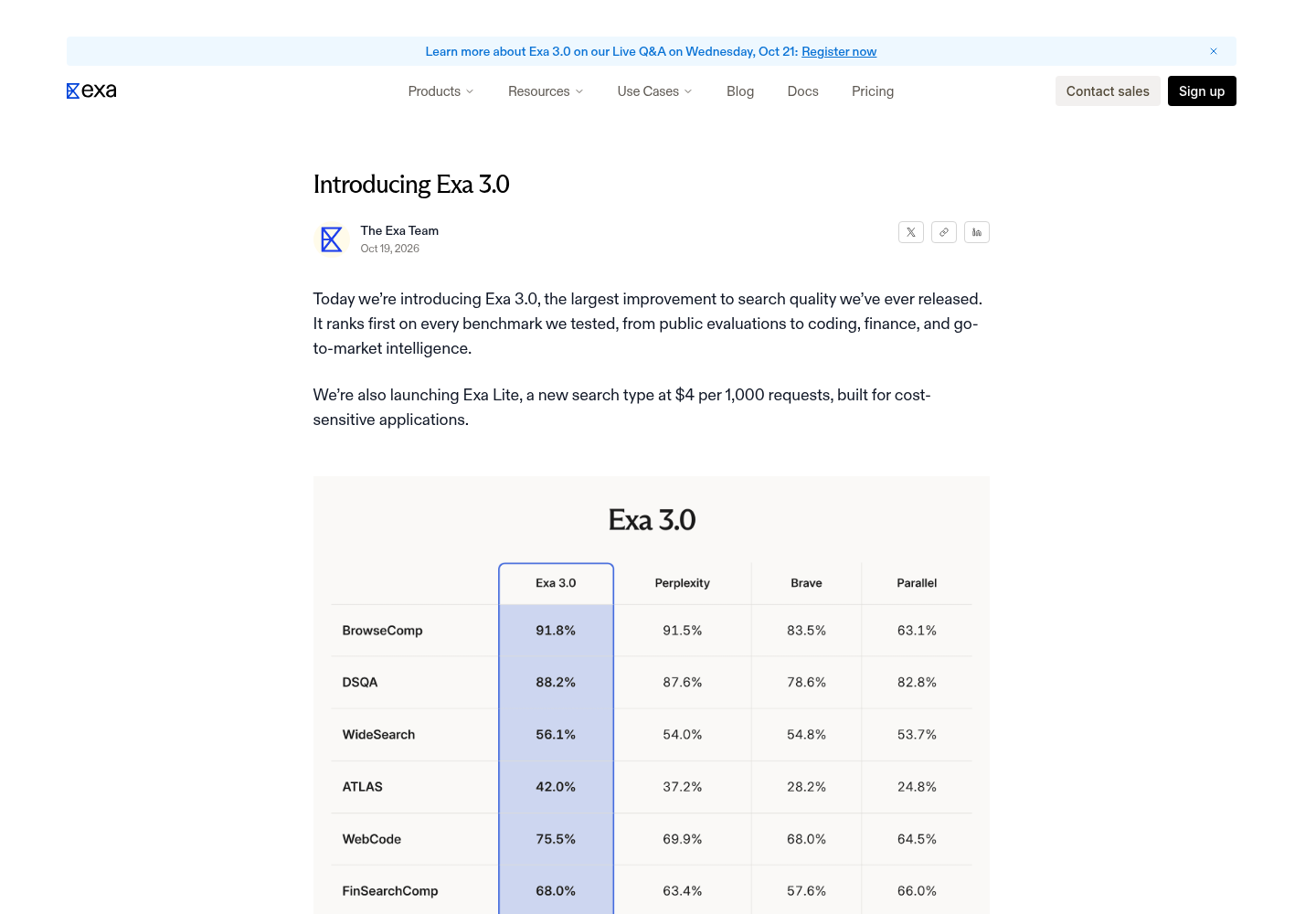
Three Retrieval Upgrades Power the Benchmark Sweep
Exa credits three changes to its retrieval stack for the across-the-board improvements. First, the company trained a larger embedding model using more compute and data than any previous Exa model. Second, Dynamic Highlights — a research-preview feature that extracts the most relevant excerpts instead of returning full page text — is now generally available at no additional charge. The upgraded highlights model selects tokens across all search results holistically rather than extracting per-page, giving more tokens to the best pages while cutting repeated information. Exa reports this approach uses 95% fewer tokens than full page text while improving answer quality. Third, Exa expanded its independent index with billions of new documents across structured data types that matter to personal AI assistants and agentic workflows: 1.27 billion ecommerce listings with prices and availability, more than 211 million local businesses with hours and ratings, and real-time feeds for news, sports, weather, flights, local events, transit, and podcasts.
The highlights improvement matters more than it might sound. Agents that search the web mid-task pass retrieved text directly into a language model’s context window. Full page text burns tokens fast — a single Wikipedia article can consume thousands of tokens before the model even begins reasoning about it. By cutting retrieved content to 5% of the original page size while preserving the most salient excerpts, Dynamic Highlights shrinks the context window footprint and the per-request LLM cost simultaneously. Exa reports that up to 25 trillion of the tokens passed to models each week are concise excerpts powered by highlights, making the cumulative savings across customer fleets substantial.
Exa Lite: Search at $4 per 1,000 Requests
The new Lite tier runs on the same underlying index as Auto and supports the same search verticals — web, news, companies, research, people, and financials — but uses less compute across candidate generation, highlights, and ranking. Auto remains at $7 per 1,000 requests for workloads where accuracy justifies the premium. Together, the two tiers create what Exa calls a new Pareto frontier: developers can trade cost for quality along a defined curve, choosing Lite for latency-sensitive loops inside coding agents and Auto for deep research runs where precision is worth the extra $3 per thousand calls.
For agent builders running fleets, the combined economics are compelling. A coding agent that makes thirty search calls during a session now pays $0.12 for search at the Lite tier instead of $0.21 at Auto — and the 95% token reduction from Dynamic Highlights means the language model receiving those results spends far fewer tokens processing them. Both sides of the cost equation — retrieval and reasoning — drop at once. In an ecosystem where every token meter counts, compound savings on search calls add up across long-running agent sessions.
Where Exa Fits in the Agent Search Market
Exa 3.0 arrives at a moment when web search has become a standard tool call across AI coding harnesses, and many of those harnesses now integrate search APIs. DeepSeek opened its own search and fetch APIs at $0.75 per 1,000 calls, and several providers now bundle search with their agent runtimes. Exa differentiates on index depth — it operates its own crawler tracking over 2 trillion URLs and serving 100 billion pages — and on vertical-specific retrieval quality for code, finance, and company intelligence that general-purpose search engines do not optimize for.
The expanded index into ecommerce, local businesses, and real-time data also signals where Exa sees agent demand heading. As personal AI assistants proliferate, the queries they run increasingly look like “find me a flight” or “what restaurants are open near me” rather than “summarize this research paper.” Exa is building the index to serve both.
Exa 3.0 is available today through the API. Lite costs $4 per 1,000 requests, Auto costs $7 per 1,000 requests, and the improved highlights and expanded data are included at no additional charge. Pricing details are available on Exa’s pricing page. The Exa team is hosting a live Q&A on Wednesday, October 21 at 1pm PT.