
Reflection AI Open-Sources 501B Beam Weights and Training Recipes With Day-0 Cloud and vLLM Support
Reflection AI has released the open weights and post-training recipes for Beam, its 501B MoE coding model, under Apache 2.0. Google Cloud, AWS, vLLM, and Ollama delivered day-0 optimizations including DFlash2 speculative decoding, tiered KV caches, and NVFP4 checkpoints.
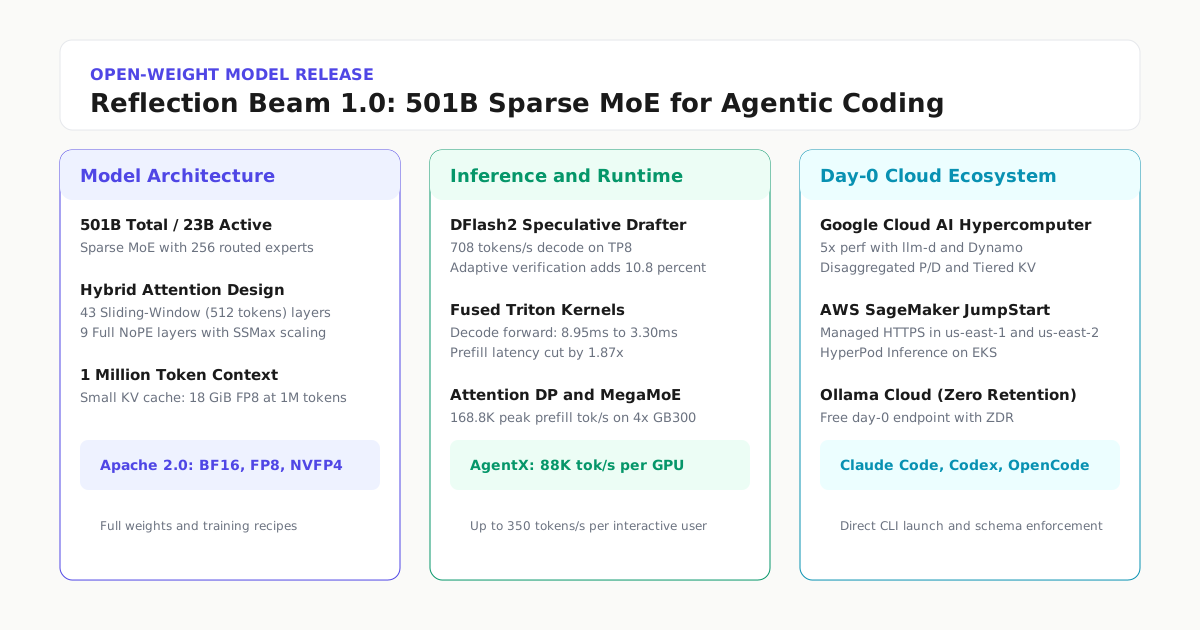
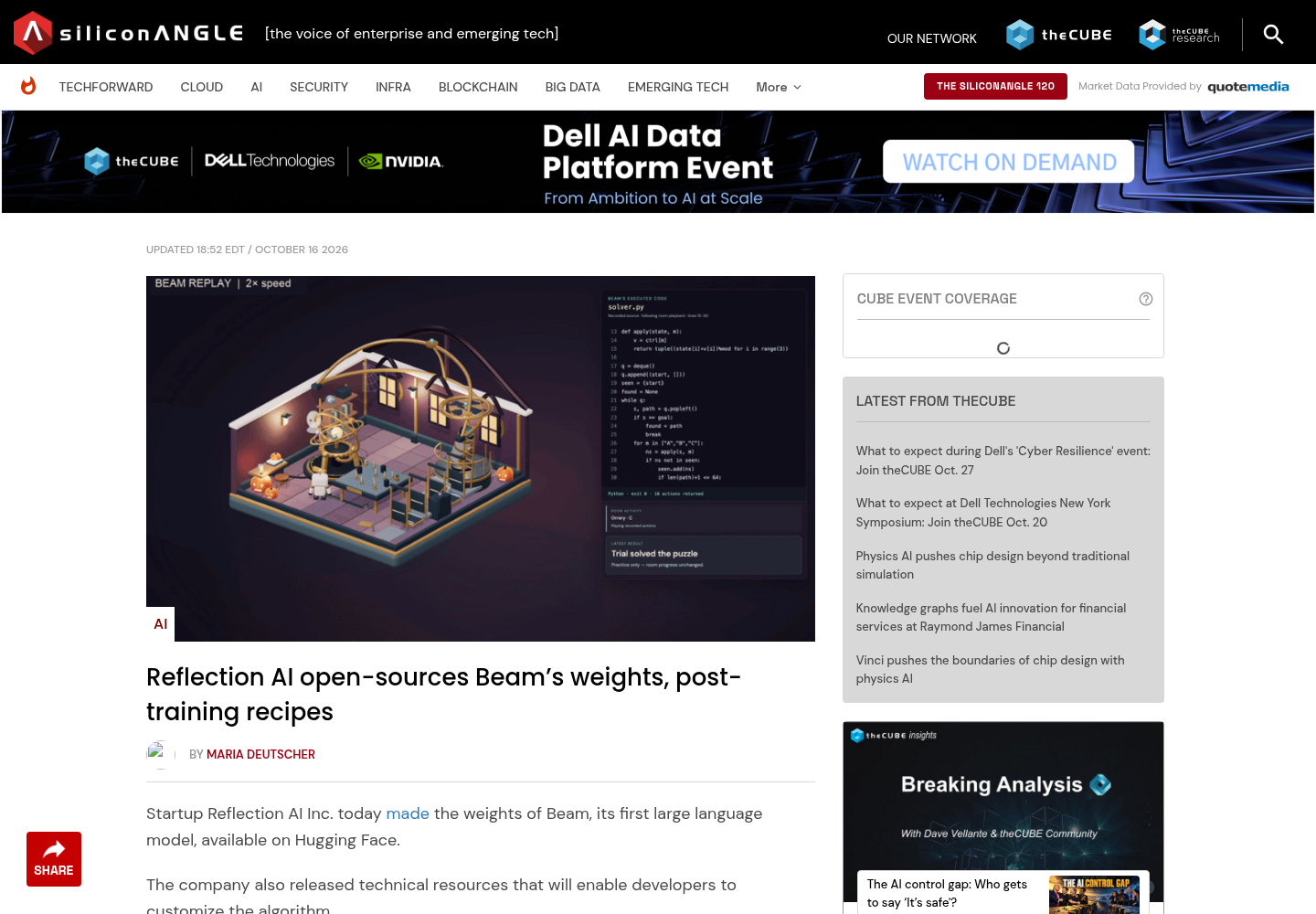
Reflection AI has released the weights and post-training recipes for Beam 1.0, its flagship 501-billion-parameter mixture-of-experts model designed for agentic coding and autonomous software engineering. Distributed under the permissive Apache 2.0 license, the release makes checkpoints available in BF16, FP8, and NVFP4 formats on Hugging Face. While Beam was previewed earlier this month—as reported in Automater’s coverage of Reflection AI Ships Beam 1.0: A 501B-Parameter Open-Weight Model for Coding Agents—today’s open-weights launch marks a pivotal shift for enterprises seeking self-hosted frontier coding intelligence. According to reporting from SiliconANGLE, the release includes fine-tuning recipes, speculative decoding drafters, and immediate infrastructure partnerships across hyperscalers.
Sparse Mixture-of-Experts Architecture and Attention Design
Beam is constructed as a 52-layer sparse mixture-of-experts decoder with a hidden dimension of 5,120. Out of its 501 billion total parameters, only 23 billion are active per token, enabling reasoning compute efficiency 3x to 4x higher than dense counterparts. As detailed by vLLM, the attention subsystem introduces a novel hybrid hierarchy designed specifically to tame long-context key-value (KV) caches during multi-turn coding sessions:
- Sliding-Window Layers: 43 layers use sliding-window attention constrained to the trailing 512 tokens with rotary position embeddings (RoPE).
- NoPE Attention Layers: 9 layers (every sixth layer plus the final layer) attend across the entire 1-million-token context without positional encodings (NoPE), using an SSMax function that scales query projections by
(1 + p/2048)^0.1to sharpen attention as sequences expand. - Grouped-Query Attention (GQA): Employs 48 query heads and 8 key-value heads with per-head RMS normalization and a sigmoid output gating mechanism that modulates individual heads on a token-by-token basis.
Because only the 9 full-attention layers preserve historical KV cache entries, the entire 1-million-token context requires only 18 GiB of KV storage in FP8 (or 36 KiB per token in BF16), eliminating the memory cliffs typical of long-horizon coding tasks. The feed-forward network incorporates 256 routed experts governed by DeepSeek-V3-style sigmoid scoring and group routing, preceded by dense SwiGLU layers in the initial three layers.
Inference Acceleration: Speculative Decoding and Kernel Fusion
Running a 501-billion-parameter MoE model interactively requires aggressive runtime optimization. Alongside the base weights, Reflection AI released DFlash2, a parallel block speculative drafter model. Unlike autoregressive drafters that predict a single token per pass, DFlash2 predicts candidate blocks directly from five target hidden layers using grouped convolutions. On 8-way tensor parallel (TP8) configurations, vLLM demonstrated single-stream decoding speeds of 708 tokens per second with an average acceptance length of 3.7 tokens.
Under high concurrent demand, vLLM’s adaptive verification dynamically evaluates drafter logits, raising aggregate output throughput by 10.8% at 128 concurrent streams while cutting p99 time-per-output-token by 9%. Autonomous agentic profiling also fused 104 sublayer boundaries into composite Triton kernels, combining post-normalization, depth-scaled residual addition, and pre-normalization into single operations that slashed decode forward passes from 8.95 ms to 3.30 ms and prefill latency by 1.87x.
| Metric or Specification | Value or Design Choice | Impact on Agentic Workloads |
|---|---|---|
| Total Parameters | 501 Billion | High reasoning capacity for repository-scale context |
| Active Parameters per Token | 23 Billion | Fast per-token FLOP efficiency and interactive latency |
| Context Window | 1,000,000 tokens | Multi-turn retention of diffs, compiler logs, and ASTs |
| Attention Mechanism | 43 Sliding-Window (512 tok) + 9 NoPE Layers | Restricts full KV cache footprint to 18 GiB in FP8 |
| Speculative Drafter | DFlash2 Block Drafter | Delivers 708 tok/s decode on TP8 with 3.7 acceptance length |
| License | Apache 2.0 | Unrestricted private deployment and customization |
Day-0 Cloud Infrastructure: Google Cloud and AWS Implementations
Deploying Beam at cluster scale requires system architectures capable of handling multi-turn agent loops where prompt histories accumulate rapidly across dozens of tool interactions.
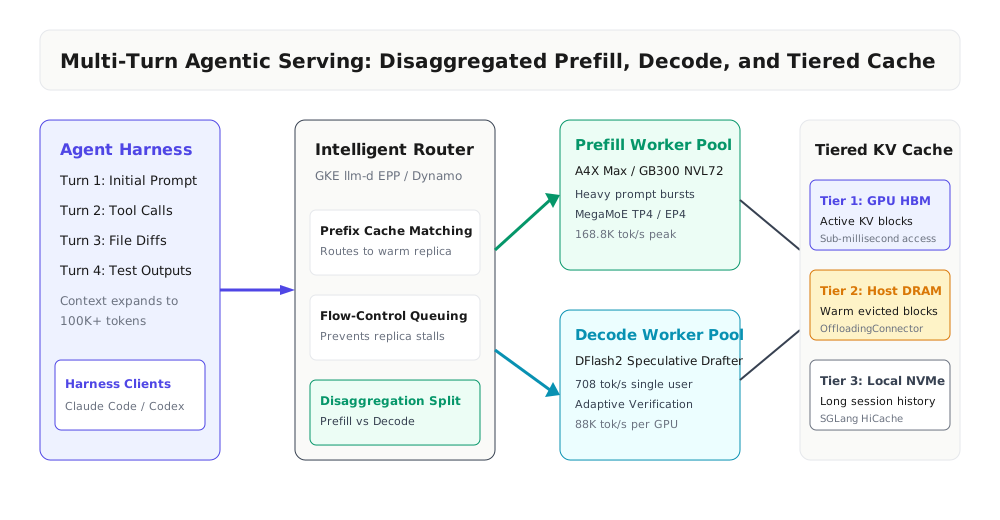
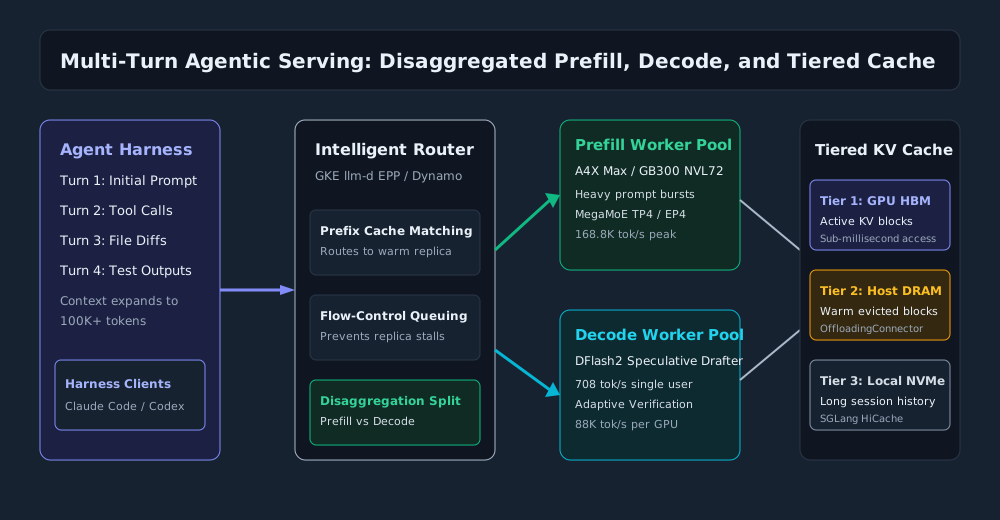
On Google Cloud, day-0 support on AI Hypercomputer pairs Beam with llm-d and NVIDIA Dynamo. By deploying on A4X Max instances (NVIDIA GB300 NVL72) and G4 virtual machines (RTX PRO 6000), Google Cloud demonstrated up to 5x higher throughput and 8x lower latency. The architecture addresses two core bottlenecks in agent workloads:
- Prefix- and Load-Aware Routing: Directs subsequent agent turns back to the worker replica holding warm KV blocks, eliminating redundant prompt precomputation across extended tool sessions.
- Disaggregated Prefill and Decode: Isolates bursty prompt ingestion from active token generation pools, while tiered KV caches overflow into host CPU DRAM and local NVMe SSDs via vLLM’s OffloadingConnector and SGLang’s HiCache.
Simultaneously, AWS Machine Learning Blog announced immediate availability in Amazon SageMaker JumpStart across US East regions, offering managed HTTPS endpoints for BF16, FP8, and NVFP4 checkpoints. For container-level control, teams can deploy on Amazon SageMaker HyperPod Inference orchestrated by Amazon Elastic Kubernetes Service (EKS) across ml.p5 (H100) and ml.p6-b200 (B200) instances, leveraging HyperPod’s local NVMe weight caching and OpenAI-compatible Inference Gateway.
Developer Ergonomics and Zero Data Retention on Ollama
For local exploration and agent harness integration, Ollama launched day-zero hosted cloud access with full Zero Data Retention (ZDR). Developers can invoke Beam directly from terminals or bind it to popular coding agents:
# Launch Beam via Ollama Cloud in popular coding agents
ollama run beam:cloud
ollama launch claude --model beam:cloud
ollama launch codex --model beam:cloud
ollama launch opencode --model beam:cloud
Furthermore, vLLM’s container release provides native support for structured JSON schemas and tool-calling templates, ensuring that coding harnesses receive reliable tool executions:
docker run --gpus all --ipc=host -p 8000:8000 \
  vllm/vllm-openai:reflection-beam \
  reflection/Beam-1.0-501B-A23B-NVFP4 \
  -tp 4 --kv-cache-dtype fp8 \
  --reasoning-parser beam --tool-call-parser beam
These integrations allow engineering teams evaluating open-weight models for agents to drop Beam into existing pipelines without writing bespoke bridge adapters.
Enterprise Implications: Data Sovereignty and Post-Training
The Apache 2.0 release includes complete post-training recipes and reinforcement learning workflows developed in partnership with the SkyRL team. Using Megatron for training and vLLM for inference rollouts, teams can apply LoRA, BF16 full fine-tuning, or MXFP8 reinforcement learning with Rollout Routing Replay (R3). Benchmarks on AIME25 showed accuracy jumping from 61% to 79% in just 100 optimizer updates.
Reflection AI trained Beam over two months across several thousand high-end graphics cards using custom reliability optimization algorithms. By mitigating training-inference mismatches and automatically reverting data quality errors, engineers achieved zero cluster downtime. For enterprises building autonomous development environments, Beam provides an unencumbered, sovereign foundation that eliminates vendor lock-in while competing directly with closed frontier models.
Sources
- Reflection AI open-sources Beam’s weights, post-training recipes - SiliconANGLE
- Day-0 support with 5x perf for Reflection Beam on Google Cloud | Google Cloud Blog
- Introducing Reflection Beam: an open-weight model for agentic coding on AWS | Artificial Intelligence
- Serving Reflection Beam on vLLM from Day 0 | vLLM Blog
- Reflection's Beam is freely available on Ollama for a limited time · Ollama Blog