Kolibri 1.1: Aleph Alpha's Open-Weight Model Makes 1M-Token Context 14x Cheaper to Decode
Kolibri 1.1 ships Apache 2.0 open weights with up to 14x faster decode at 1M-token context, 41% fewer output tokens and far better injection resistance.
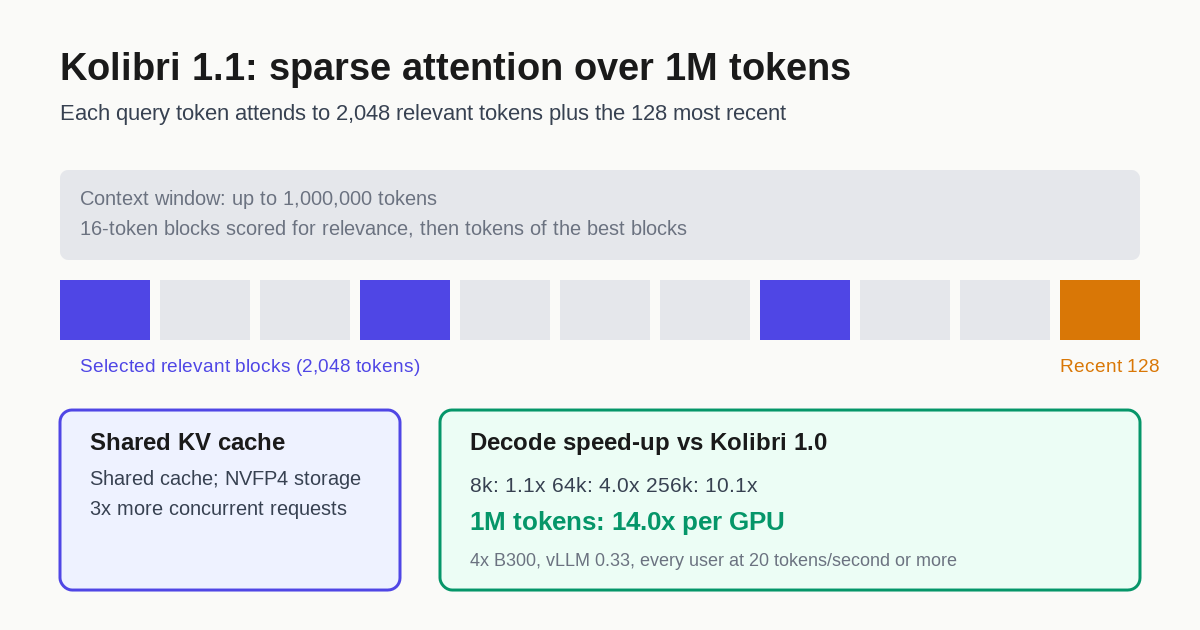
Seven weeks after Kolibri 1.0, Aleph Alpha has shipped Kolibri 1.1 — an English-German MoE with 75B total and 3B active parameters, a 1M-token context window, and Apache 2.0 weights on Hugging Face. For teams running self-hosted coding and retrieval agents, the release matters less for its benchmark lines than for what it does to the two costs that dominate agent bills: attention over long context and tokens spent reasoning.
Sparse attention changes the long-context economics
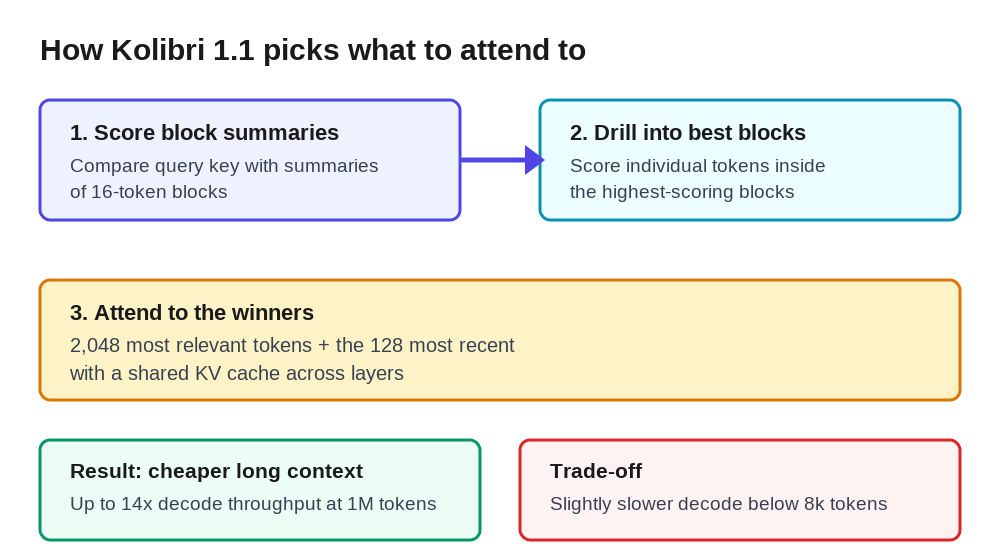
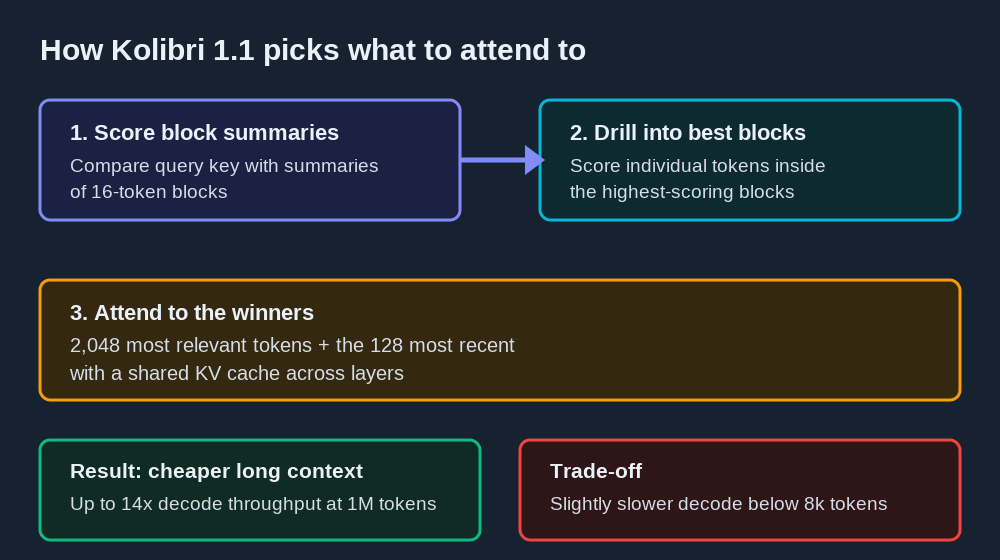
The architectural change is a custom sparse-attention recipe applied from mid-training onward. Each token attends to the 2,048 most relevant tokens plus the 128 most recent ones; relevance is scored first on summaries of 16-token blocks, then on individual tokens within the best blocks. Layers also share their KV cache, and the release checkpoint stores the main and indexer caches in 4-bit NVFP4.
Measured on four B300 GPUs with vLLM, the effect scales with context length:
| Context | Prefill speed-up | Decode speed-up | Concurrent requests per engine |
|---|---|---|---|
| 8k | 1.0x | 1.1x | 1,280 → 1,536 |
| 64k | 1.0x | 4.0x | 304 → 880 |
| 256k | 1.6x | 10.1x | 80 → 272 |
| 1M | 3.9x | 14.0x | 20 → 64 |
At 1M tokens the 14.0x decode figure is the product of 4.4x faster generation per request and 3.2x more concurrent requests on the same GPUs. Time to first token for a full 1M-token prompt drops from 76 seconds to about 17. Below 8k tokens, Kolibri 1.1 actually decodes slightly slower than 1.0 (0.76x at 1k-2k) — short-prompt chat workloads are not the target. Agentic workflows that stuff a repository or document set into context are.
Aleph Alpha models overall cost at 0.208 GPU-hours per 1,000 tasks on an 8x B200 node, versus 0.718 for Kolibri 1.0 — a 3.4x reduction — while the model-card overall score rises from 66.6 to 73.2.
Fewer tokens per task, at every effort level
The second lever is reasoning efficiency. Aggregated the same way as the model-card scores, Kolibri 1.1 emits 41% fewer output tokens per task than 1.0. The gain holds at each reasoning-effort setting — 3.6x fewer tokens at low effort, 1.8x at high — so the cheap settings now buy real latency savings rather than a quality cliff. On the four-benchmark effort sweep, Kolibri 1.1 at low effort (81.1 average score, 4,254 tokens) comes within 0.8 points of Kolibri 1.0 at high effort (81.9, 20,159 tokens) at roughly a fifth of the token spend, and its medium setting (84.2 on 7,632 tokens) beats 1.0’s high-effort score outright.
One honest caveat from Aleph Alpha’s own accounting: the 41% figure includes generations that ran to the context limit. Excluding those, the reduction is 30%.
Agentic and coding gains
The expanded agentic post-training suite moves the practical agent benchmarks: SWE-bench Verified goes from 64.0% to 70.4%, Terminal-Bench 2.1 from 25.8% to 35.6%, and agentic retrieval improves most — BrowseComp-Plus 33.1% to 43.9%, German Agentic Wiki QA 63.9% to 73.7%, MuSiQue 78.3% to 86.4%. Aleph Alpha claims the weight-class lead on all three retrieval benchmarks by 8-19 points, ahead of larger models including GPT-OSS 120B and Mistral Small 4.
The safety jump is the most dramatic single number: on AgentDojo, where injections hide in tool outputs — the exact threat model of an agent reading web pages or issue threads — Kolibri 1.1 resists 99.1% of attempts, up from 30.3% for Kolibri 1.0. CyberSecEval 2 prompt-injection resistance reaches 93.2%. Grounding also improves: the M/A grounding score rises from 26.8 to 34.8, and Nemotron Citation Following from 67.7% to 89.1%.
How to run it
Day-one serving support is real rather than aspirational. With Aleph Alpha’s measured vLLM 0.33 setup and its plugin:
pip install "aleph-alpha-inference>=2"
vllm serve Aleph-Alpha/Kolibri-1.1 \
  --reasoning-parser kolibri1 \
  --tool-call-parser kolibri1 \
  --enable-auto-tool-choice
For local experimentation there are official GGUF quantizations and a llama.cpp implementation covering CPU, NVIDIA CUDA and Apple Metal, with a suggested sampling config of temperature 1.0, top-p 0.99, top-k 128:
llama-server --temp 1.0 --top-p 0.99 --top-k 128 \
  -hf Aleph-Alpha/Kolibri-1.1-GGUF:Q4_K_M
The smallest quantized build runs on GPUs with 24 GB of VRAM, putting a 1M-context agentic model on hardware many operators already own — the same self-hosting territory covered in our open-weight agent model guide and adjacent to Edge0’s single-GPU coding model claim. The Hugging Face org lists both Kolibri-1.1 and Kolibri-1.1-GGUF repositories, and the Kolibri-1 model cards now point to 1.1 as the newer version. The Aleph Alpha blog confirms the 23/11/2026 publication.
What to verify before switching a lane
All benchmarks are vendor-run with Aleph Alpha’s own harnesses, and several suites (the customer-proxy and AA-* benchmarks) are internal. The overall-score claim of “strongest in its weight class” rests on a score definition Aleph Alpha itself maintains. The sparse-attention trade-off also cuts both ways: short prompts decode more slowly, and quality at exactly 1M tokens sits at the edge of the KV cache. An operator evaluating a lane switch should run their own harness — the pattern from Kimi K3.1 Pro’s day-0 vLLM release applies: pin the exact quantization, measure cost per completed task rather than tokens, and keep a fallback frontier lane for the failures.
For agent builders weighing a self-hosted, EU-trained, Apache 2.0 option, Kolibri 1.1’s combination of long-context throughput, token thrift and injection resistance on 24 GB-class hardware makes it worth a benchmark slot — not just a ledger entry.