Lean and Mathlib Communities Certify the Claude-Assisted Riemann Hypothesis Proof as Machine-Checked
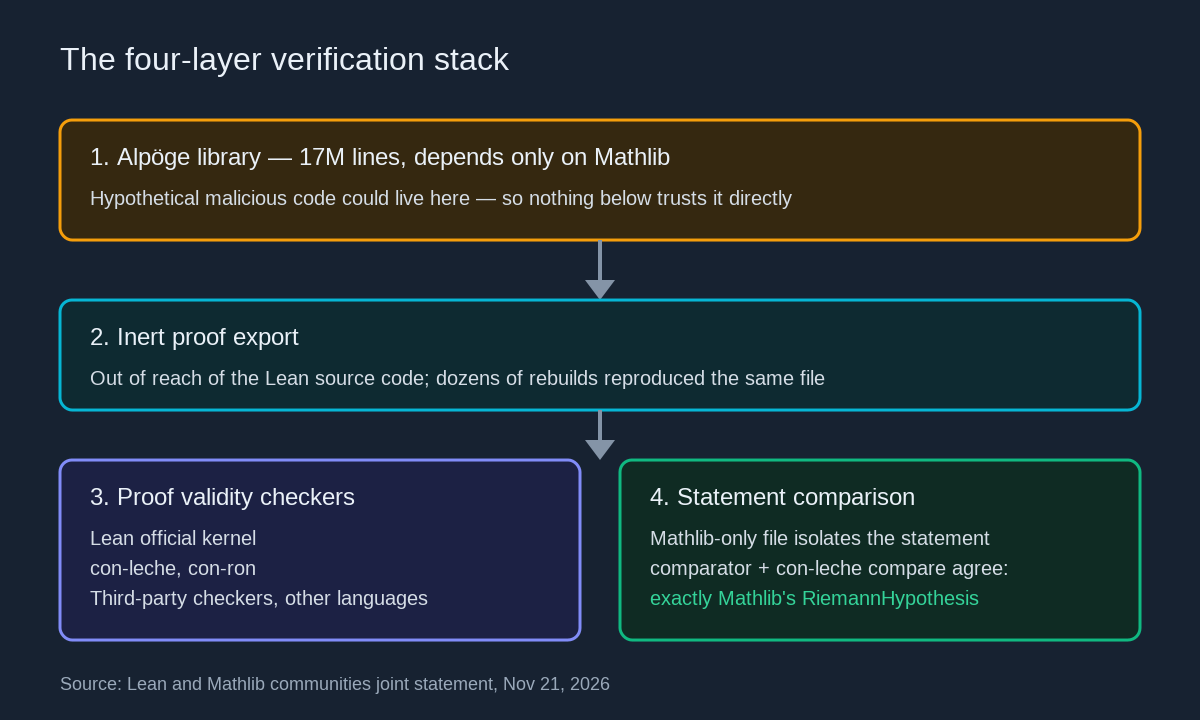
One day after Levent Alpöge released his 17-million-line Lean proof of the Riemann Hypothesis, the Lean and Mathlib communities certified it against four vetting criteria: kernel and independent checker verification, statement comparison against Mathlib, and an inert proof export.
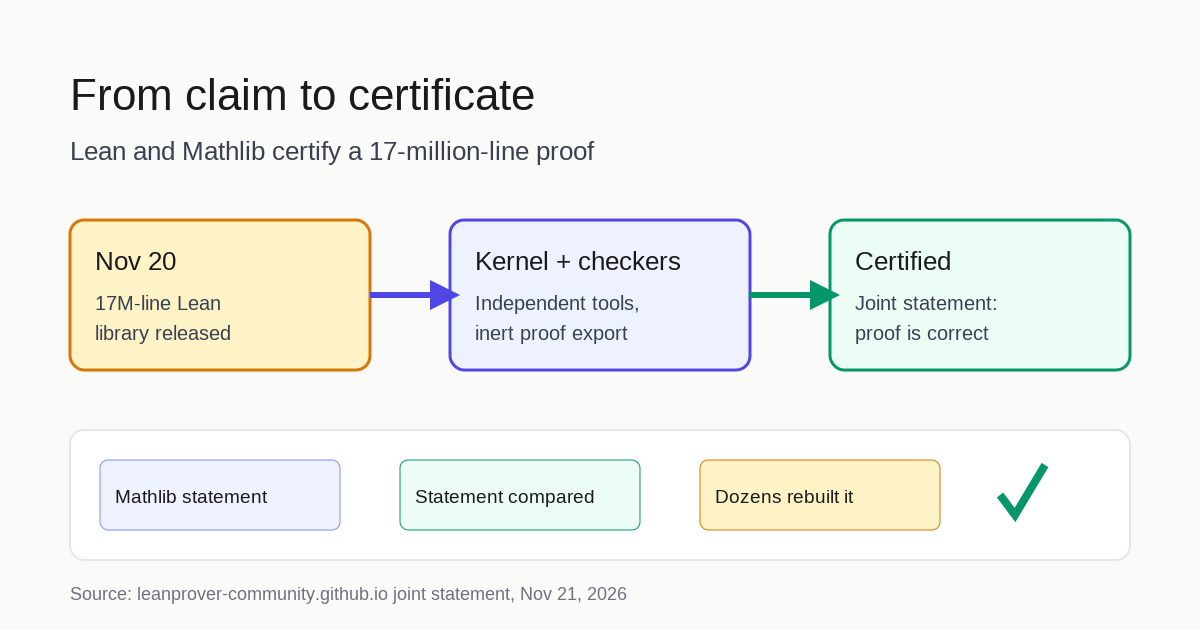
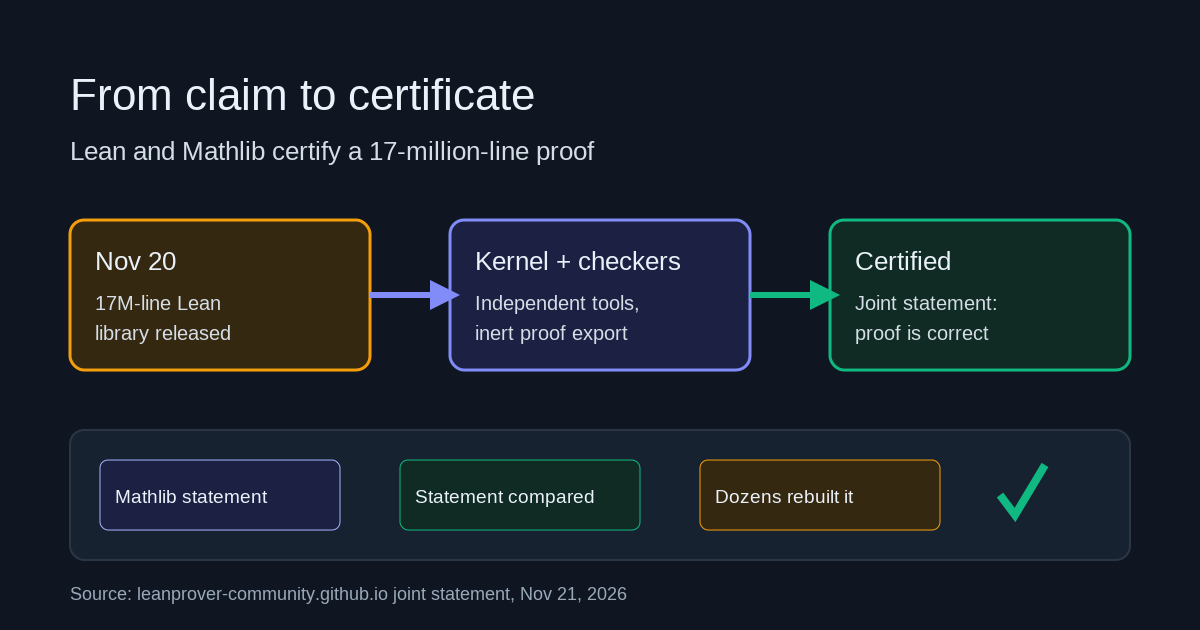
From a claim to a checked result in one day
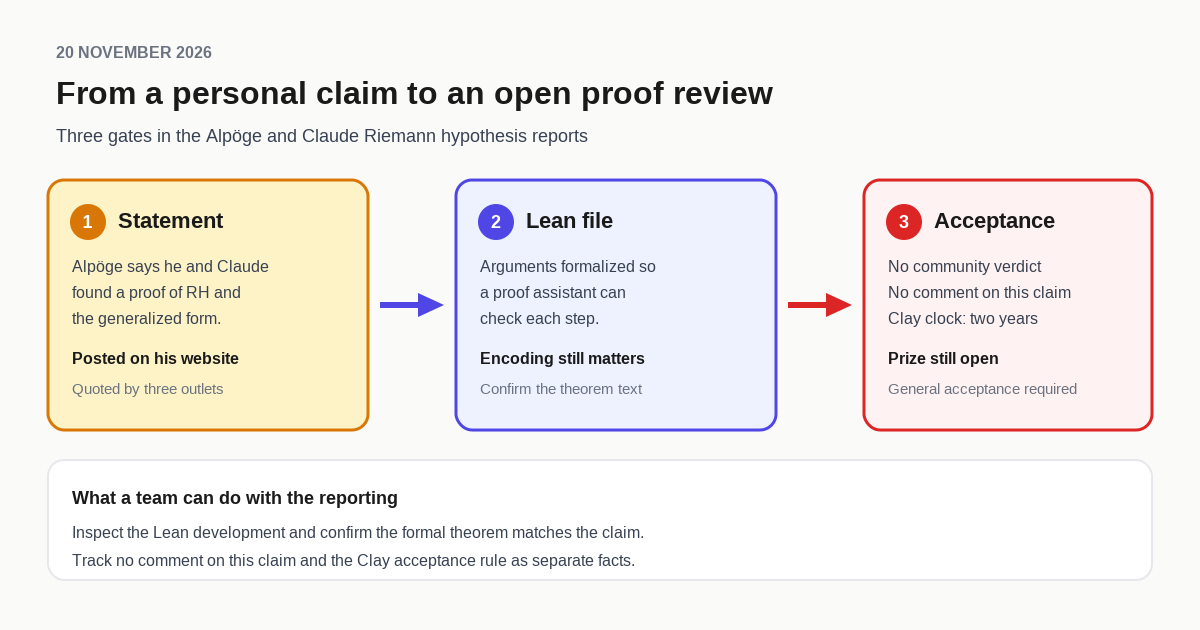
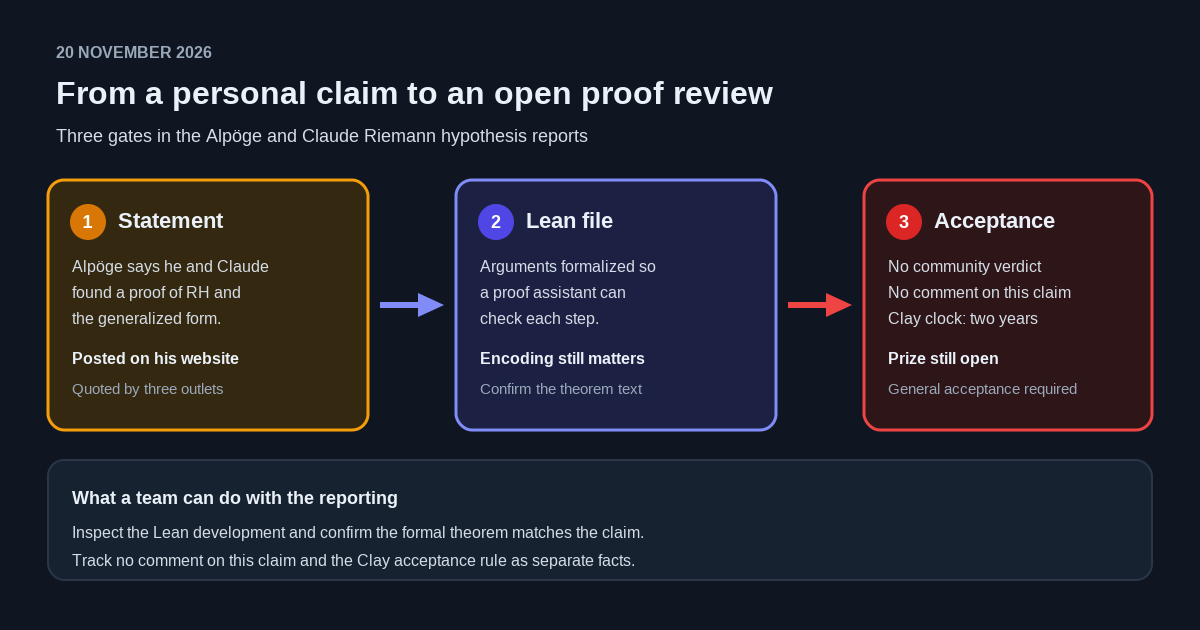
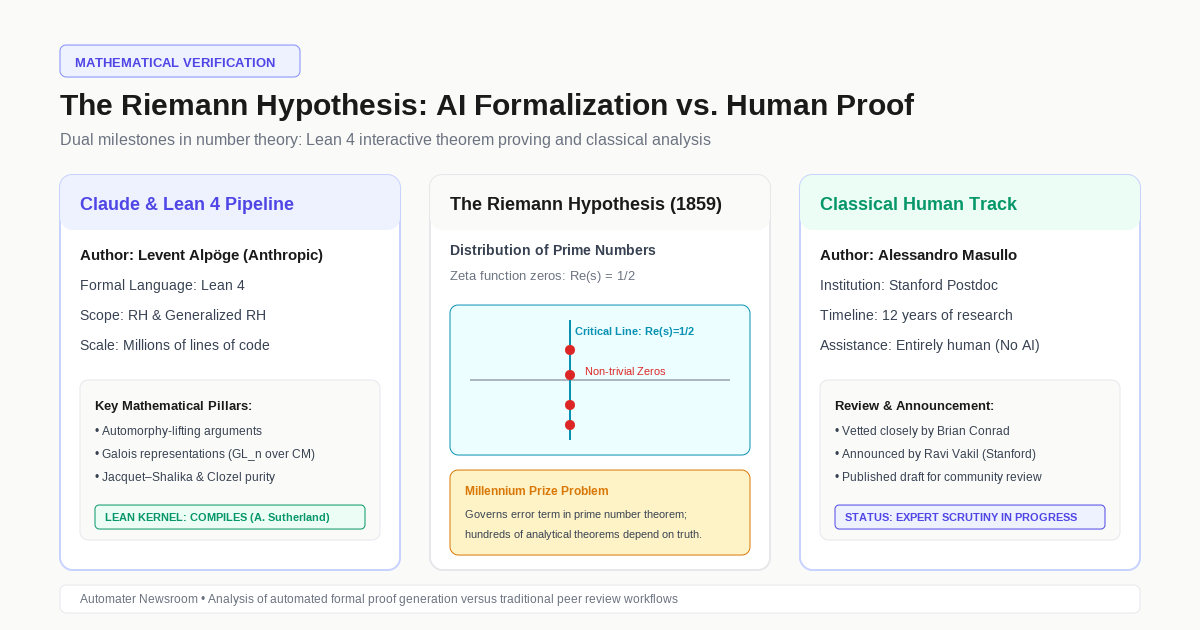
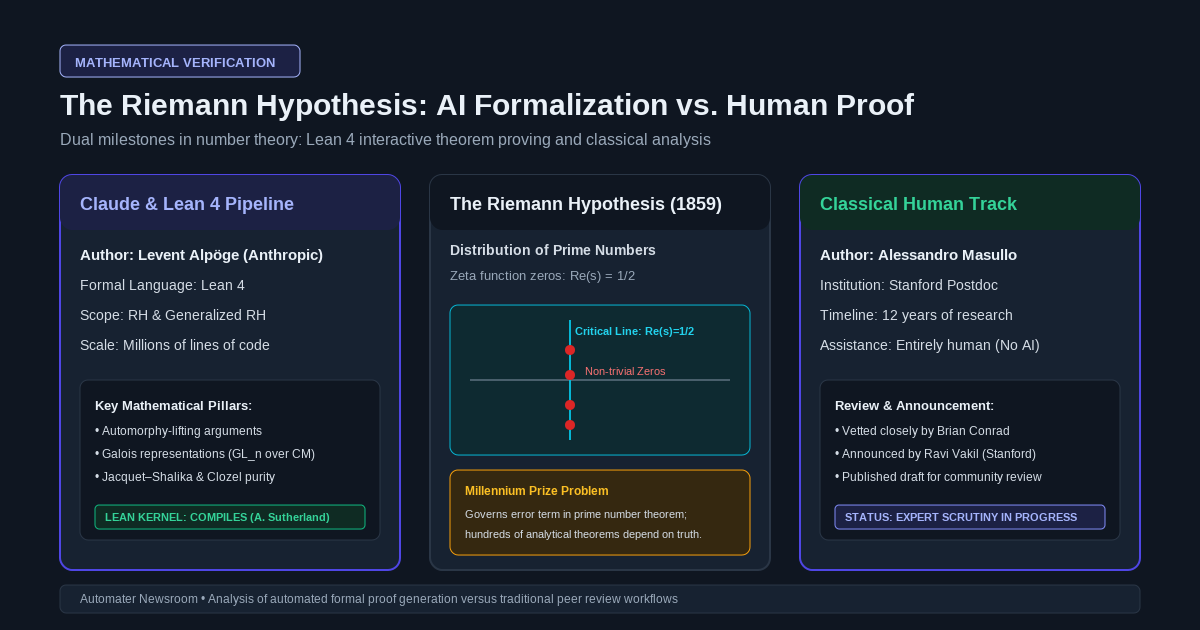
On November 20, 2026, Levent Alpöge released a proof of the Riemann Hypothesis as a Lean library of 17 million lines of code; the joint statement certifying it carries a November 21, 2026 byline. At the time of the release it was a claim — an announcement plus a giant codebase. Now it is something categorically different: a joint statement by the Lean and Mathlib communities, endorsed by the Lean FRO and the Mathlib Initiative, saying “We have full confidence that Alpöge’s proof of the Riemann Hypothesis is correct,” and certifying that both the statement and the proof are correct against the four vetting criteria the Xena Project laid out on November 12.
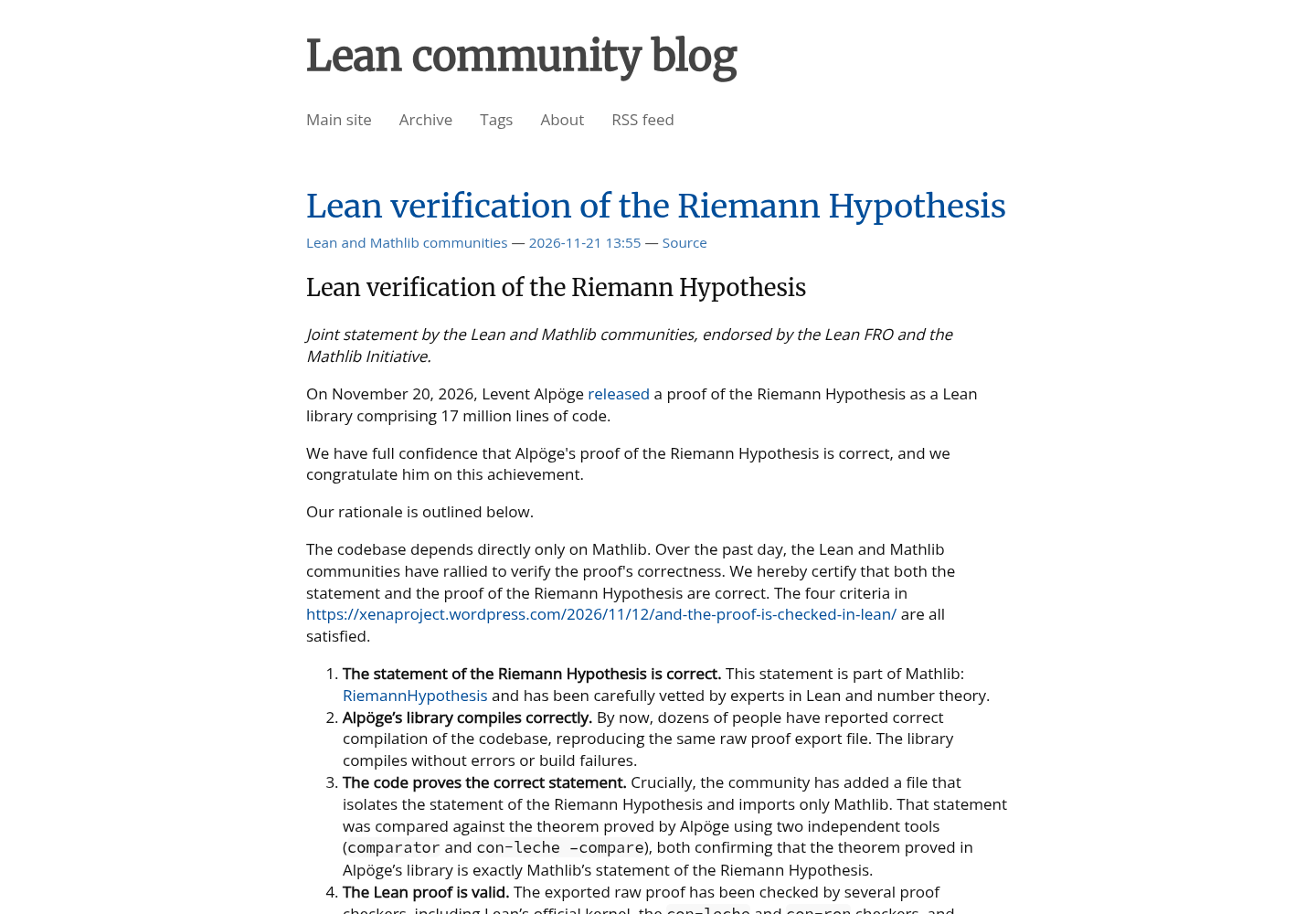
The joint statement is the primary evidence, and its text is precise about what was and was not checked. That matters because the original announcement was covered skeptically — SiliconANGLE noted on November 20 that Anthropic had published no official announcement and that the human-readable proof itself, reportedly more than 250,000 pages, had not been released. The certification changes the evidentiary basis of the story without touching any of those caveats.
What the four criteria actually required
The communities’ statement walks through each criterion:
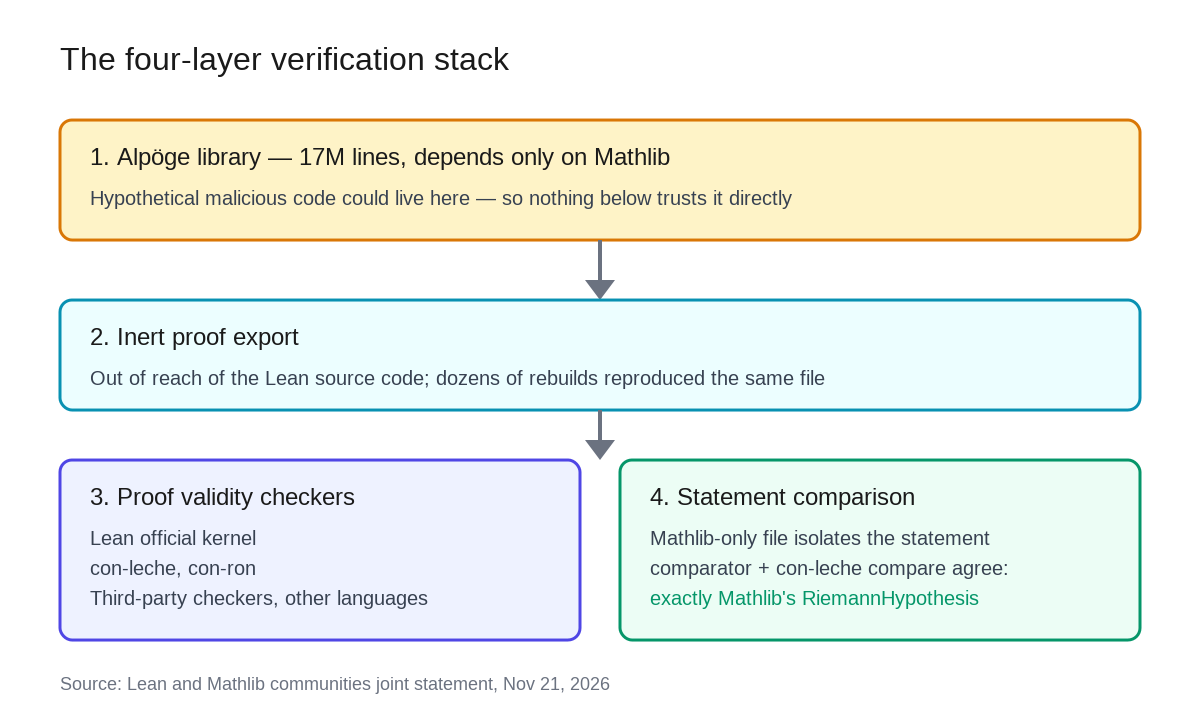
| Criterion | What was verified |
|---|---|
| Correct statement | RiemannHypothesis is already part of Mathlib, vetted by experts in Lean and number theory |
| Library compiles | Dozens of people reported clean compilation, reproducing the same raw proof export file |
| Code proves the statement | A new file importing only Mathlib isolates the statement; two independent tools (comparator and con-leche –compare) confirmed Alpöge’s theorem is exactly Mathlib’s |
| Proof is valid | Lean’s official kernel plus the con-leche and con-ron checkers and several third-party checkers in other languages all accept the inert proof export |
Two design choices in that table deserve attention from anyone who runs verification pipelines.
The statement was pinned to a pre-existing, independently vetted definition. The certification does not rely on Alpöge’s own claim of what he proved. The community wrote a file that imports only Mathlib — the user-maintained Lean 4 math library where the RiemannHypothesis theorem statement already lived — and compared it against what Alpöge’s library proves using two independent tools that agreed. This closes the classic formalization gap where a proof is valid but proves something subtly different from the intended claim.
The proof checkers themselves are checked. Con-leche and con-ron ship with a formal proof, relative to set theory, that they cannot accept a false proof. That addresses the recursion problem of trusting the tool that judges the proof — including concerns that Lean’s logic itself might contain exploitable flaws. And all checks ran on an inert export of the proof, deliberately placed out of reach of hypothetical malicious code in the Lean proof sources. A 17-million-line artifact is exactly the size of codebase where a hidden exploit in the build path would be hardest to find; the verification design routes around it.
An extensive overview of the checks is published at MIT at math.mit.edu/~drew/grh/, and the statement notes that the codebase depends directly only on Mathlib, the library whose roughly 36,000-commit repository underpins nearly all formalized mathematics in Lean 4.
Why this matters beyond mathematics
For anyone deciding whether to trust large AI-generated artifacts, this is the first demonstration at this scale of a complete acceptance gate for agent-produced work:
- A single very large artifact, attributed to human-AI collaboration, was released into a community that did not take the author’s word for it.
- Within about a day, dozens of independent replications of the build produced the same export file — a reproducibility property most commercial codebases do not have.
- Verification was done by tools the artifact cannot influence, including checkers with machine-checked soundness guarantees.
- The conclusion is certificate-grade language: not “looks plausible” but “we hereby certify.”
The parallel for coding-agent operators is direct. When an agent produces thousands of lines overnight, the question is never whether the model is smart; it is what independent process can certify the output. We have previously covered Verus-style proof verification in GitHub Next’s proof-driven development kit, where a verifier rather than a reviewer checks AI-written Rust, and the general pattern of writing a finish line the transcript can prove. The Riemann certification is the extreme end of that spectrum: a verifier stack with formal guarantees, run against an inert artifact, judged against a statement defined outside the artifact. Our earlier coverage traced the claim itself from announcement to Lean 4 release; this is the next stage.
It also sets an expectation. “It compiles and tests pass” is now visibly a weaker bar than what the Lean community achieved in 24 hours on a 17-million-line submission. Teams accepting very large agent outputs can borrow the structure: pin the specification somewhere the generator cannot edit, compare against it with more than one tool, verify on an inert export, and require that independent replications produce identical evidence.
What remains open
Certification proves the theorem is proved in Lean’s logic. It does not make the mathematical ideas legible — the communities explicitly write that they “look forward to all the activity in the mathematical community that will help explain the new ideas in this proof,” meaning human understanding lags machine-checked validity. Nor does Anthropic’s silence change: the company still has published no announcement of its researcher’s result, and the human-readable proof paper has not appeared. What changed on November 21 is narrow and enormous at once: the strongest AI-assisted mathematical claim ever made is now a machine-checked result, and the process that checked it is public, replicated and reusable.