Alpöge Says Claude Helped Formalize a Riemann Hypothesis Proof in Lean
Anthropic mathematician Levent Alpöge says he and Claude formalized a Lean proof of the Riemann hypothesis and its generalized form. Three reports on 20 November 2026 carry the claim. Independent checks and any Clay prize decision are still open.
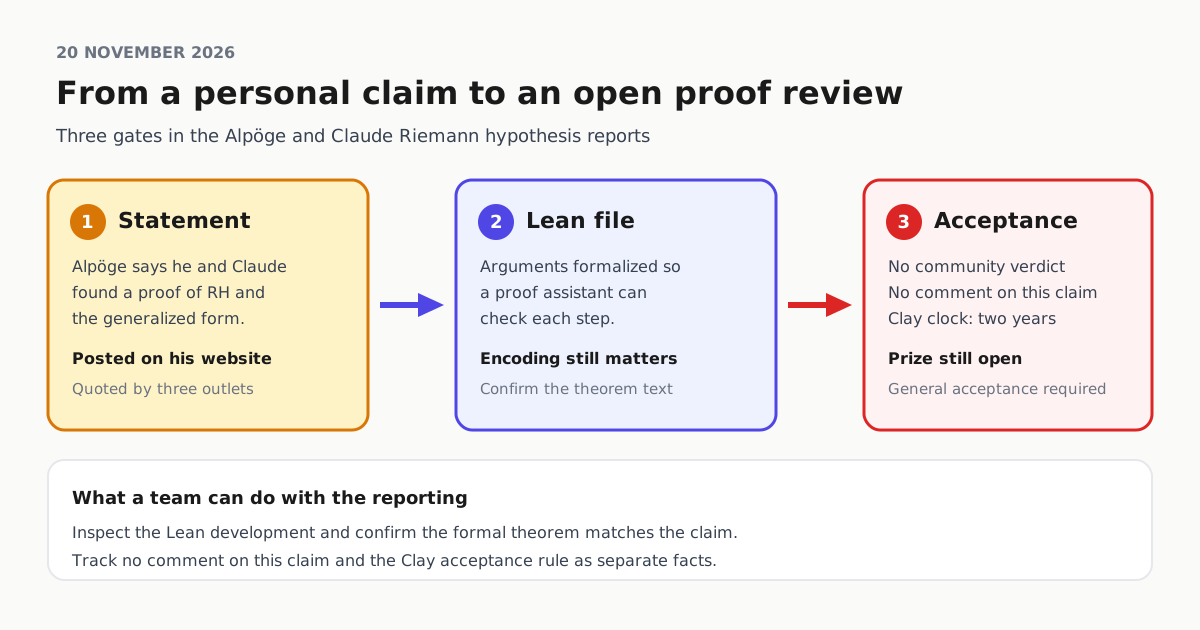
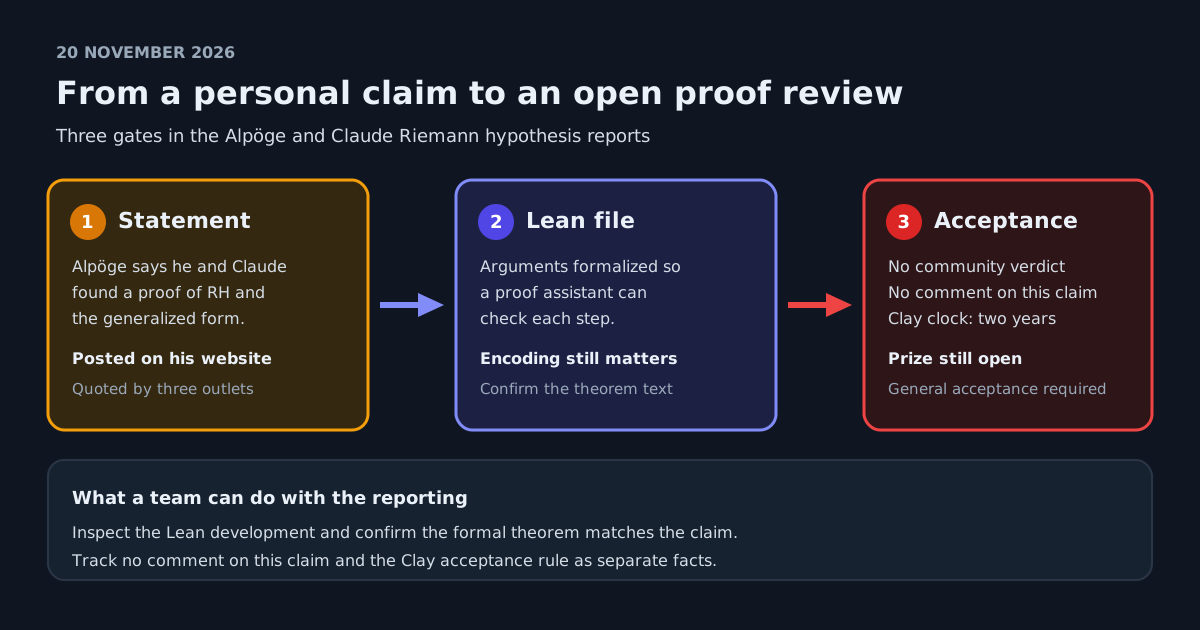
Levent Alpöge, a mathematician employed at Anthropic, said on Friday that work with Claude produced a proof of the Riemann hypothesis and a Lean formalization of the argument. Scientific American, The Verge, and Simon Willison all carried the claim on 20 November 2026. For coding-agent users, the inspectable object is that formalization, while independent mathematical acceptance stays open.
What Alpöge says is proved
Scientific American reports that Alpöge wrote on his website, “I believe I have, working with Claude, discovered a proof of the Riemann Hypothesis.” Bernhard Riemann proposed the hypothesis in 1859. The Verge says it concerns the distribution of prime numbers and how the zeros of a function are involved. Scientific American calls it the most famous open problem in mathematics and notes the Clay Mathematics Institute million-dollar bounty. The Verge identifies it as one of seven Millennium Prize problems.
The statement quoted by The Verge and by Simon Willison reaches past the classical conjecture. Alpöge writes that the method “easily extends much further, resolving the so-called Generalized Riemann Hypothesis,” and that he expects, with more time, the Extended Riemann Hypothesis too. He adds that he and Claude “formalized the arguments without assumptions.” Scientific American reports that he says the proof confirms the Generalized Riemann Hypothesis.
Willison’s quotation, posted 20 November 2026, attributes the text to alpo.ge/remark.pdf. It includes Alpöge’s line that Claude “far outpaced me near the finish line.”
Three different gates
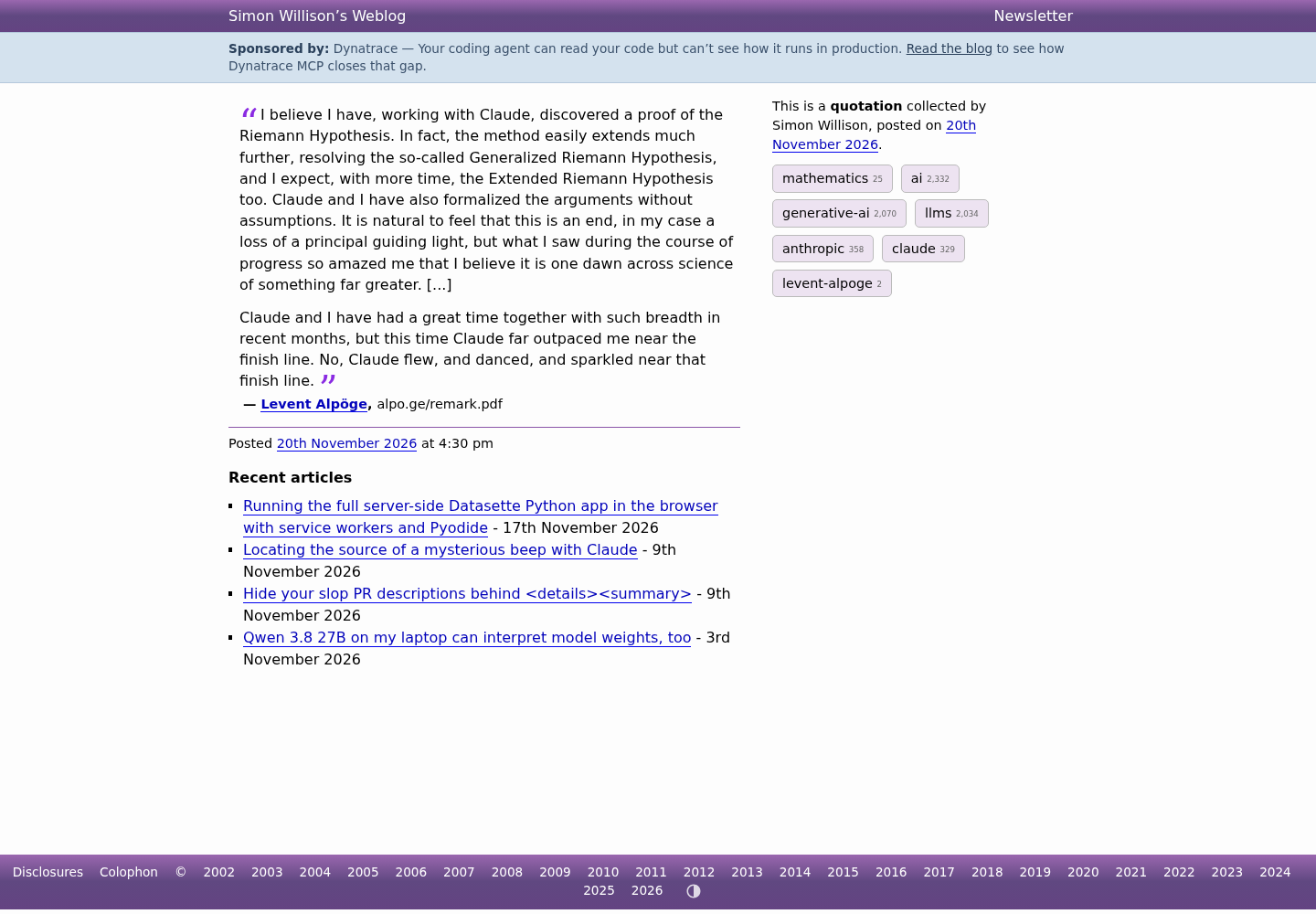
Scientific American says Alpöge posted the argument coded in Lean, which verifies the mathematical correctness of each argument. The magazine says issues can arise in Lean, and that experts can verify whether the hypothesis is properly coded and whether the proof is correct. That encoding check is the concrete task this story gives a coding-agent user.
The Verge reports that independent verification is still outstanding, that Anthropic has not commented, and that Anthropic has not involved itself in the announcement. In the website document, Alpöge says he texted chief executive Dario Amodei late Sunday night. The Verge says the note suggests he waited until after the Thursday IPO, and it states that Anthropic went public on 19 November 2026. The same article records Anthropic’s August position: the company was working on the Riemann hypothesis with Claude and said, “We don’t expect that the techniques Claude used will lead to proving the Riemann hypothesis.”
Each of these facts sits at its own gate.
| Gate | What reporting supports today | What stays open |
|---|---|---|
| Personal claim | Alpöge says he and Claude found a proof of the Riemann hypothesis and its generalized form | Referee agreement with that belief |
| Lean formalization | He says the arguments were formalized without assumptions, and Scientific American says Lean code was posted | Whether the formal statement matches the theorem, and whether a checker accepts the file |
| Institutional acceptance | The statement is public on his website, as the three outlets report | Clay publication rule, two years of scrutiny, and general acceptance |
Hector Pasten, at the Pontifical Catholic University of Chile, told Scientific American that a correct and understood proof would complete “a dictionary between different branches of math where the connections were only partial,” likening it to “a Rosetta Stone.”
What coding-agent users can do with this
The Lean file is the part of this episode a second person can rerun. Scientific American frames the expert job as two questions: whether the hypothesis is coded properly, and whether the proof checks.
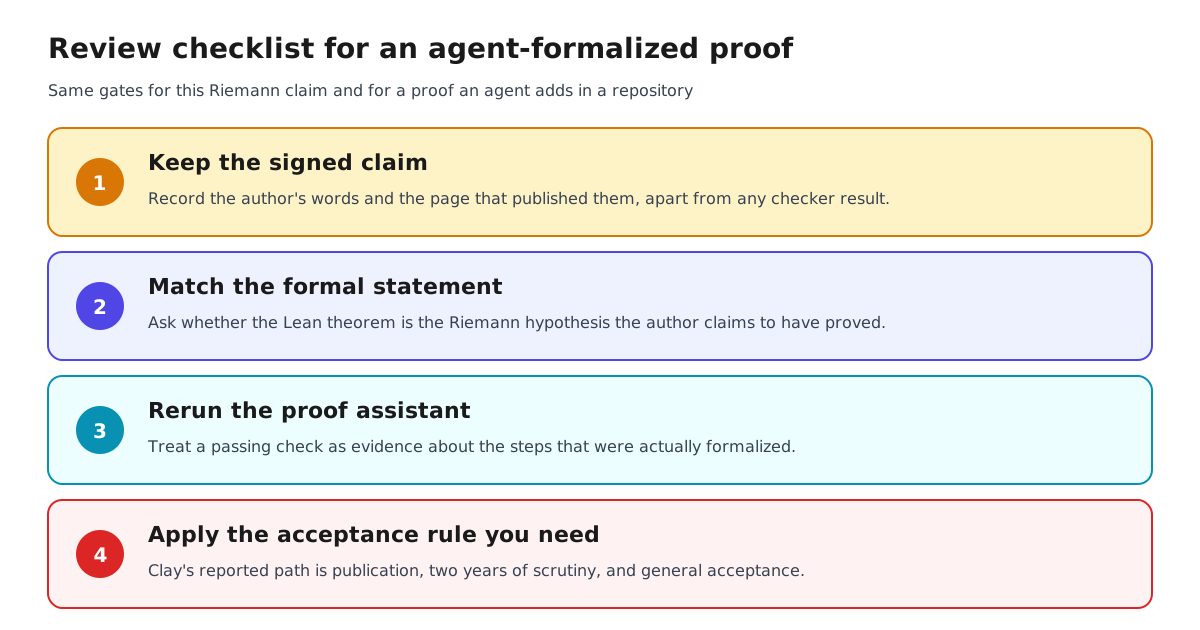
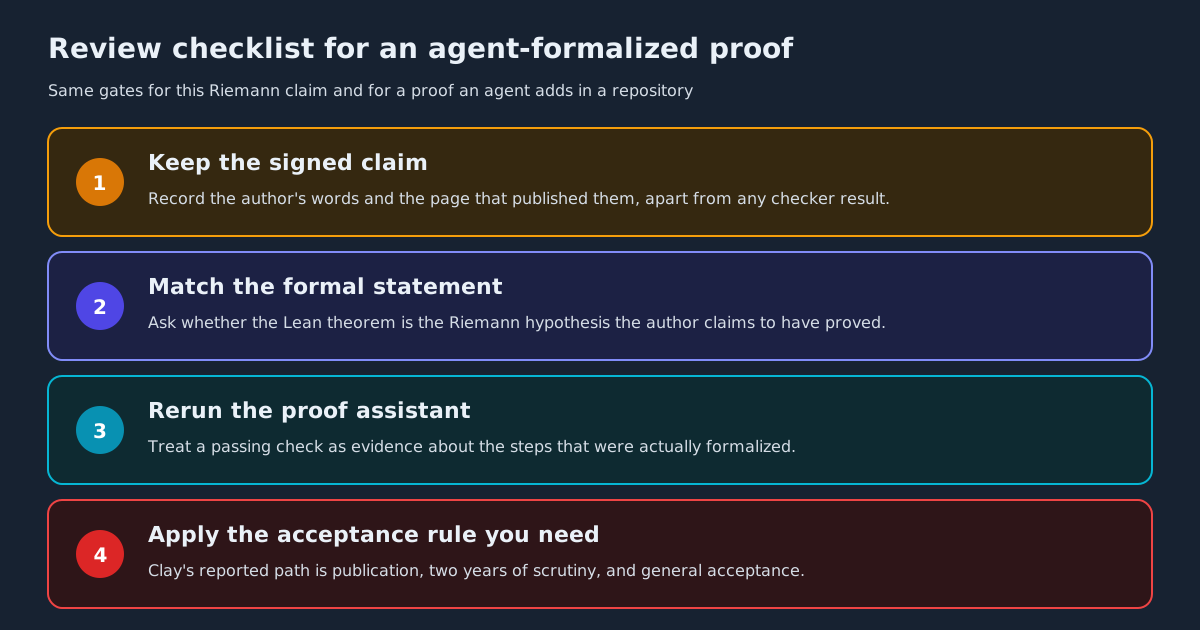
Keep the signed claim and the checked artifact in separate notes. Here the belief is the statement Willison and The Verge trace to Alpöge’s site, and the artifact is the Lean argument Scientific American describes.
Read the formal statement before treating a passing check as success. Scientific American warns that the hypothesis has to be properly coded.
Put Anthropic’s silence and the August forecast in the same note as the claim. The Verge’s account is that the company has not joined this announcement and that August’s public note did not expect a proof from the techniques Claude was then using.
When the result would gate a release, a prize, or a later theorem, follow the slowest acceptance rule the sources actually state. The Verge cites Clay’s rules: the solution must be published, withstand at least two years of scrutiny, and receive general acceptance in the global mathematics community before the prize is considered. Clay has not publicly accepted this solution, and The Verge notes that only the Poincaré conjecture has officially been solved under the prizes.
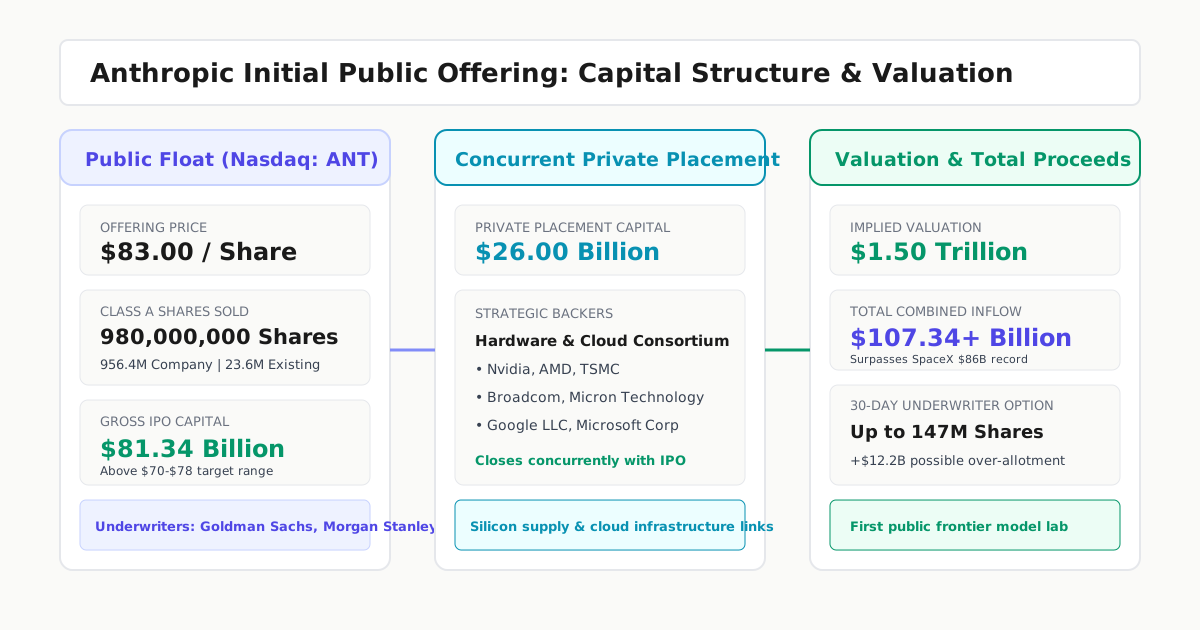
The newsroom guide to catching fabricated citations with Claude Code is the small-repo form of that encoding check. Anthropic’s Nasdaq debut is separate context for the Thursday timing The Verge describes.
A year of claims, one file to read
Scientific American sets the claim against a year of AI systems taking on harder mathematics, including an October OpenAI release the magazine says made rare progress on the primes. Both Scientific American and The Verge recall Alpöge’s July claim of a Claude-assisted solution to the Jacobian conjecture, and both describe the September Navier-Stokes dispute involving OpenAI and NYU mathematician Tristan Buckmaster. The Verge says OpenAI’s Navier-Stokes result is widely treated as credible, still lacks formal recognition, and that OpenAI has denied wrongdoing in how the work was produced.
“It is natural to feel that this is an end, in my case a loss of a principal guiding light,” Alpöge wrote in the statement Scientific American quotes, “but what I saw during the course of progress so amazed me that I believe it is one dawn across science of something far greater.”
Scientific American marks the article as breaking news that will be updated. The status those sources support today is a machine-checkable claim published by its author, with independent verification and institutional acceptance still open.