Off-the-Shelf AI Attack Agent Hit the European Commission's HR and Pay Systems
The European Commission has confirmed an attack on its HR and pay systems by ARTEX, an off-the-shelf autonomous AI penetration-testing agent. Here is what happened and what it means for teams running agents with broad permissions.
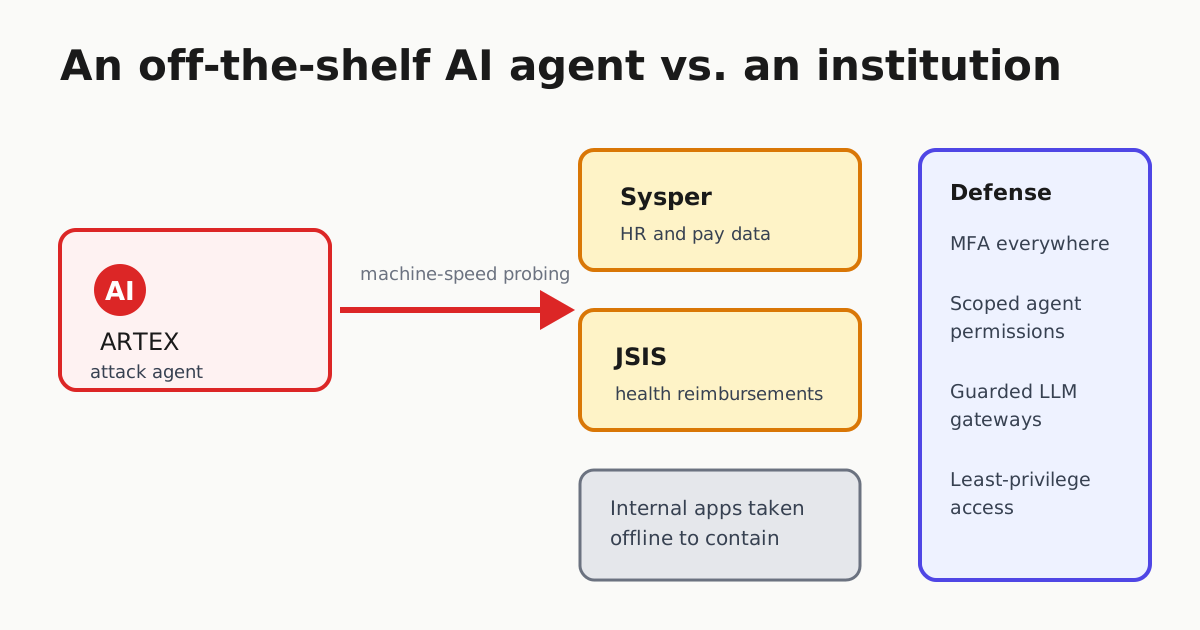
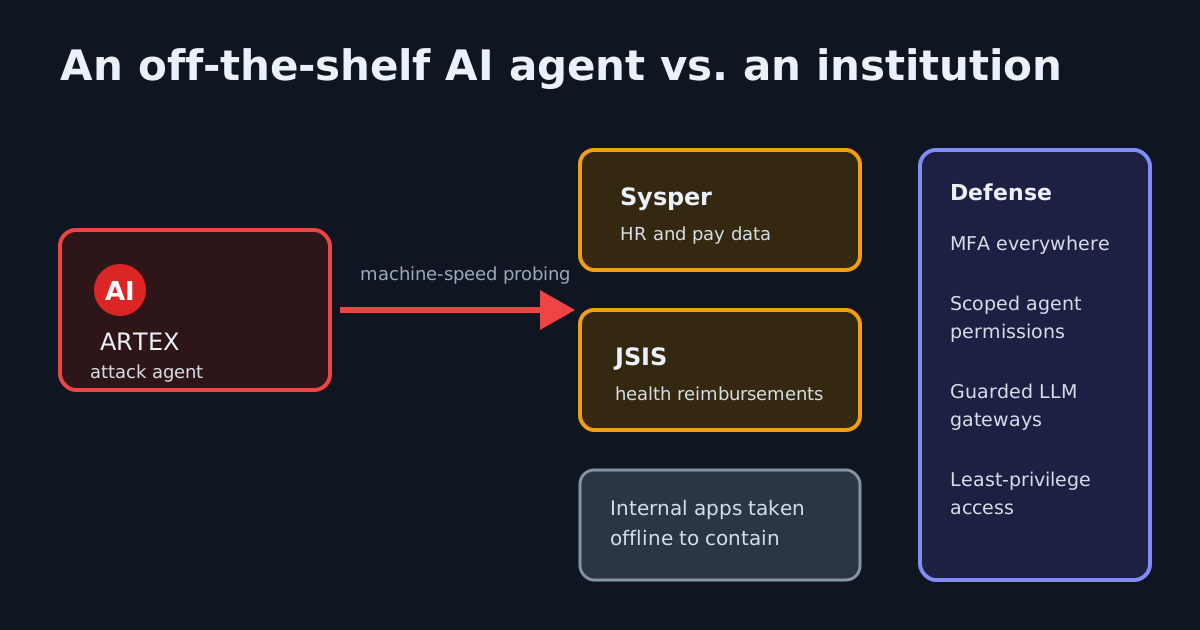
The European Commission has confirmed that an attack which disrupted its internal HR and pay systems for weeks was carried out with ARTEX, a publicly available autonomous AI penetration-testing tool — the first named EU institution to fall to an off-the-shelf agentic hacking agent.
Euronews reported on Nov. 19 that Commission officials lost access to Sysper, the internal platform for salaries, leave requests, timesheets and training sign-ups, for several days. The attack was detected and confirmed on 22 October. The Commission’s digital spokesperson, Thomas Regnier, said the attack used a publicly available AI tool, that no ransomware demand was received, and that the Commission had “not detected any evidence of a data breach affecting Commission staff as a whole.” Several internal apps were preventively taken offline to stop the attack spreading; by Thursday Sysper was back, but the Joint Sickness Insurance Scheme (JSIS) health-reimbursement platform remained unavailable, according to two officials who spoke anonymously. CERT-EU and the European Data Protection Supervisor have been informed.
The open question is data exposure. Sysper and JSIS hold officials’ names, pay grades, home addresses and contact details — raw material for highly targeted phishing against exactly the people who handle EU policy. The Commission’s IT department, DG DIGIT, is still assessing the damage, and no attacker has been identified.
From honeypot telemetry to a named institutional victim
ARTEX is an open source autonomous penetration-testing tool that probes systems for weaknesses automatically. It became a named threat earlier this year: TechCrunch reported that Censys found more than 800 distinct ARTEX deployments exposed to the web without a password, and that Microsoft describes the system as AI agents conducting attacks “from reconnaissance through data exfiltration with little needed human interaction.” Security vendors have linked it to attacks on Korean financial firms in September and on ConnectWise in October, where Microsoft said the attackers moved so fast that defenders had “little time to detect and respond.”
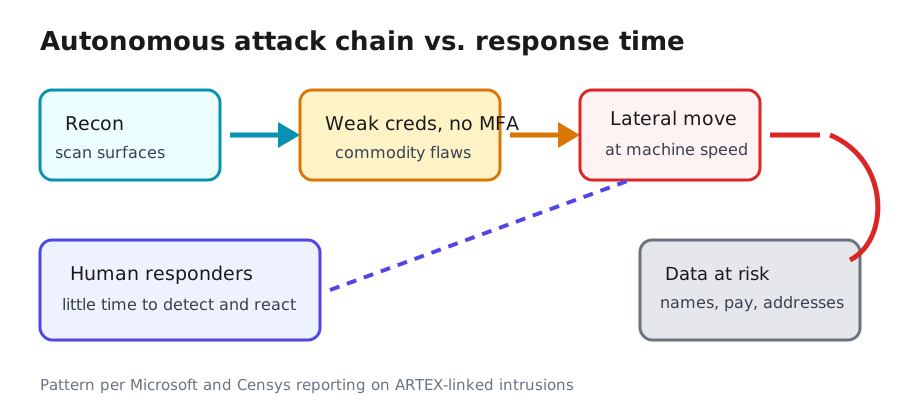
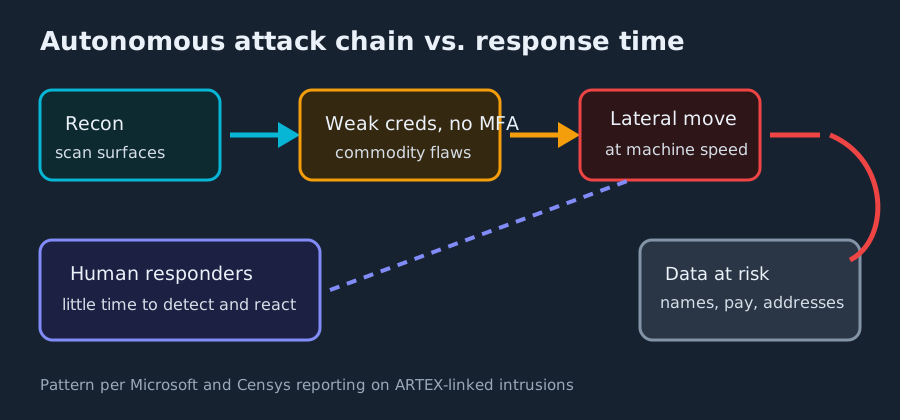
Notably, many ARTEX-linked attacks have not relied on novel exploits. TechCrunch notes they often abused weak or guessed passwords and missing multi-factor authentication — commodity failures that an always-on agent can grind through at machine speed.
Why this matters for anyone operating AI agents
The Commission incident lands amid a wider scramble. Semafor reported Nov. 20 that U.S. officials attribute a string of recent tech outages to companies rushing to patch as AI exposes vulnerabilities in old software, and that Sens. Maria Cantwell and Mike Rounds have urged the director of national intelligence’s AI task force to “launch a national effort to confront a new generation of AI-enabled cyber threats.”
For teams that deploy coding agents and internal AI assistants rather than attack tools, the lesson is about symmetry: the same autonomy that makes your agents productive makes an attacker’s agent relentless. Three concrete takeaways:
- Assume machine-speed probing of your credential surface. Weak passwords, orphaned service accounts and endpoints without MFA are now being tested continuously by autonomous tools, not occasionally by humans. Enforce phishing-resistant MFA and eliminate shared credentials on every internal HR-adjacent system, not just the crown jewels.
- Scope agent permissions before an incident forces you to. The Commission’s containment move — preventively taking down internal apps — is a blunt instrument. Properly sandboxed agents with network egress off by default and least-privilege scopes limit what a compromised or misused agent can reach in the first place.
- Watch your LLM gateways. We’ve previously covered honeypot evidence of ARTEX agents hunting LiteLLM, Dify and One API gateways for LLM keys. Any fleet running self-hosted model infrastructure should treat those endpoints as public attack surface, with authentication, rate limits and egress controls — and review the basics of prompt injection and least privilege for agents.
The Commission says the investigation continues. What is already clear is the pattern: an openly available agent, a large institution’s routine back-office systems, commodity weaknesses, and responders working to catch up. The defenses are equally unglamorous — MFA everywhere, scoped permissions, guarded gateways — and this incident is the argument for doing them now rather than after the incident report.