Cloudflare Zero Wire Turns a Critical CVE Into a Triage Briefing and a Read-Only Agent Check
Cloudflare's Zero Wire turns each critical CVE into a plain-language briefing, evidence links and a read-only agent prompt for exposure checks on Radar.
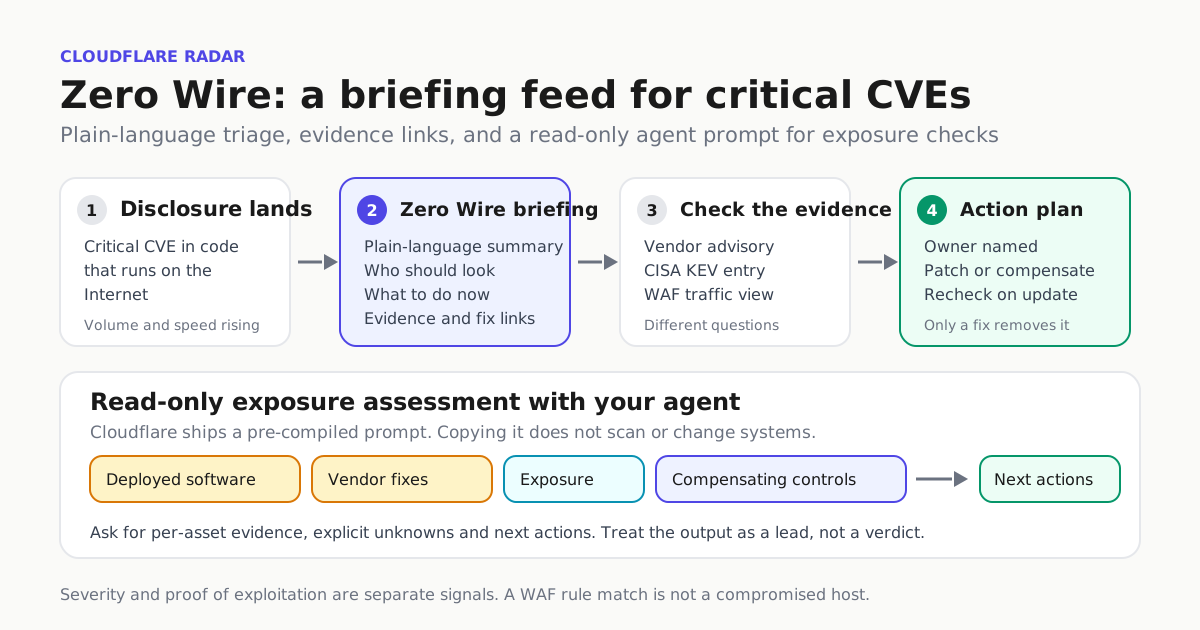
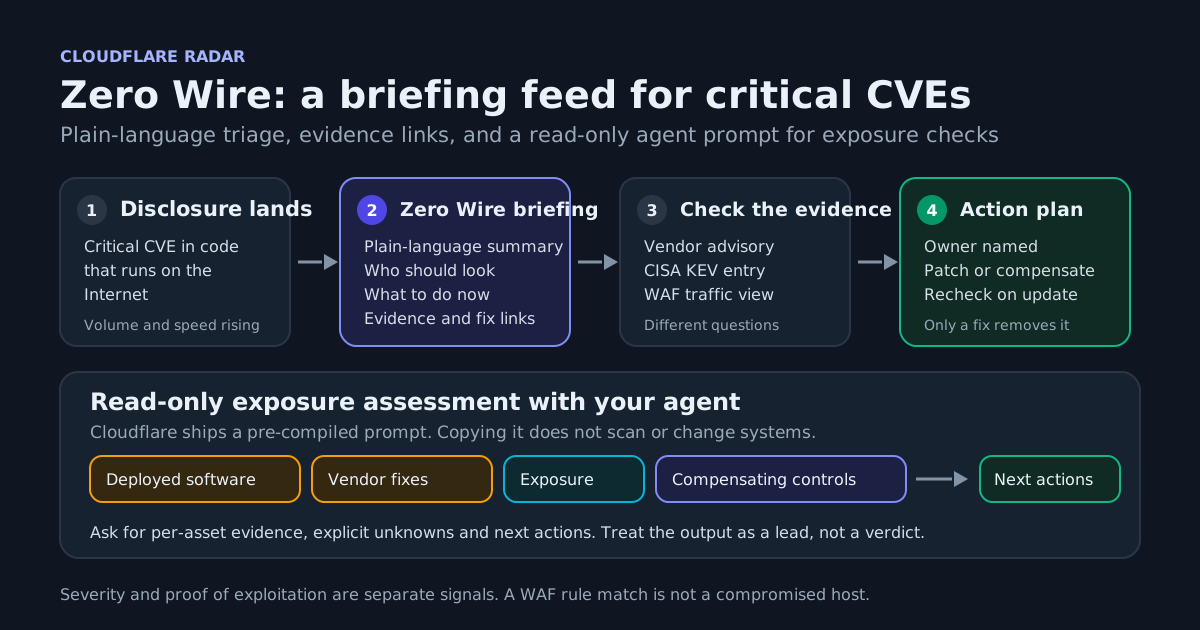
Cloudflare launched Zero Wire on November 3, 2026, and the pitch in the announcement post is triage volume, not another CVE database. Cloudflare’s argument runs through AI: tools that find more flaws faster also push more critical disclosures onto security teams, so the bottleneck moves from finding advisories to answering two questions per advisory — are we affected, and what do we do about it?
Zero Wire is the response: a public vulnerability intelligence feed inside Cloudflare Radar, where each entry is a short briefing rather than a row in a catalog. Cloudflare’s blog index lists it as the newest post on the blog.
What a briefing gives you
According to the post, each briefing carries a plain-language explanation of the vulnerability, who should investigate, recommended actions, and links to the evidence and vendor guidance. Cloudflare calls the format an index card with what you need to know, without the drama, and designs it for two readers: a CISO should read it quickly and ask the right questions; an engineer should follow the same card down to the guidance needed to remediate.
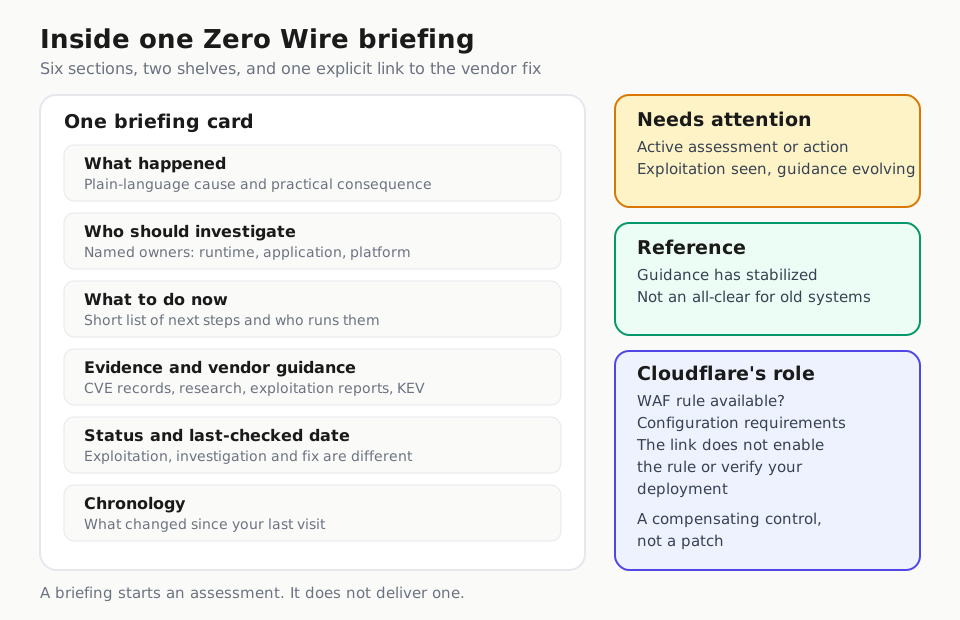
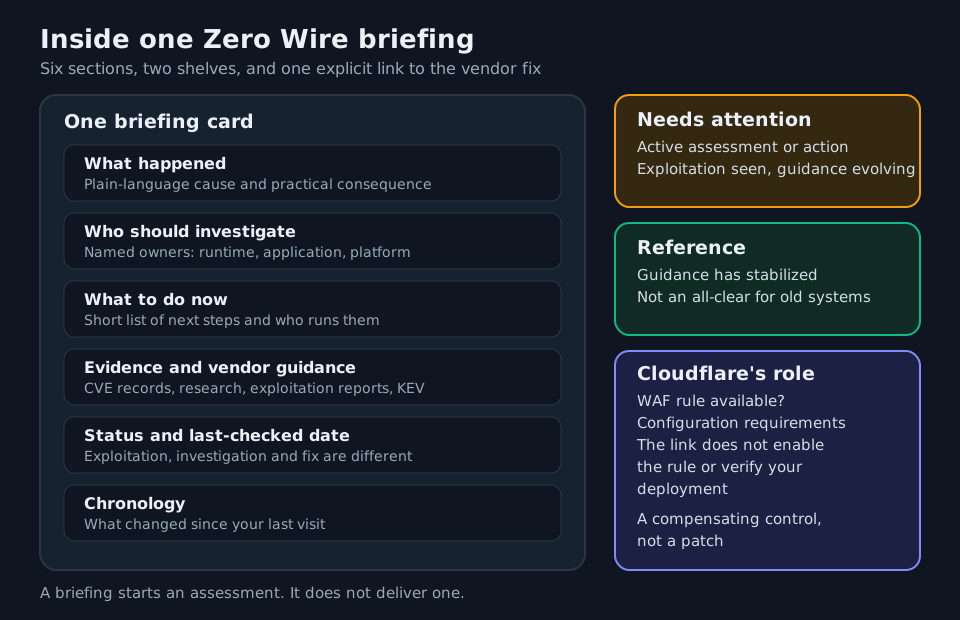
The homepage splits briefings into two shelves. “Needs attention” holds issues requiring active assessment or action, including known exploitation or guidance still developing. “Reference” keeps briefings available once guidance has stabilized. Cloudflare is explicit that moving a card to Reference does not mean every affected system has been patched.
The distinctions matter more than the feed
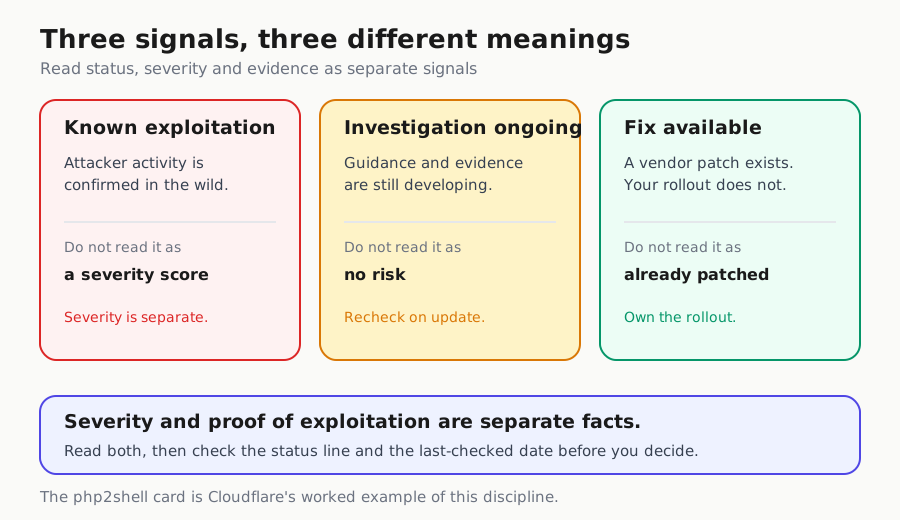
Severity and proof of exploitation are separate facts. Cloudflare says readers need both: a card can be critical with no known exploitation. Where a briefing adds network context, such as the php2shell card’s chart of requests matching Cloudflare WAF managed rules, the post says the chart shows attacker focus, not a count of compromised systems or successful exploits. Observing an attempt does not establish that any particular organization was compromised, and a lack of observed attempts does not establish that exploitation is absent elsewhere.
A mitigation link is a manual step. The Cloudflare section of a briefing reports whether a WAF rule can address a CVE and what configuration it requires, linking to the dashboard. The wording is careful: review your WAF configuration to determine whether you are protected. The link does not enable a rule and does not verify a deployment.
The agent prompt changes the workflow
Cloudflare ships a pre-compiled prompt you can use with your agent to assess the impact on your infrastructure. The post describes it as a request for a read-only assessment of deployed software, relevant vendor fixes, exposure, and compensating controls, returned with per-asset evidence, unknowns, and next actions. Cloudflare states the limit plainly: copying the prompt does not itself scan or change systems.
That shape is worth copying into your own runbooks. An assessment that returns a clean bill of health for your estate without naming what it checked is indistinguishable from a false negative; one that names what it could not determine is a usable work queue. The unknowns are the part operators usually drop.
assessment:
  asset: "host or service"
  deployed_version: "version actually observed"
  affected: "yes | no | unknown"
  vendor_fix_available: "yes | no | unknown"
  internet_exposed: "yes | no | unknown"
  compensating_control: "WAF rule, proxy, or none"
  evidence: "where the version and exposure facts came from"
  unknowns: "what could not be determined, and why"
  next_action: "one concrete step and its owner"
The prompt is only as good as what your agent can read. If your deployment inventory is a wiki page with a stale spreadsheet attached, the assessment inherits that.
Cross-check every briefing against CISA KEV
Zero Wire briefings link to external documents such as CVE records, research, exploitation evidence, and CISA’s Known Exploited Vulnerabilities Catalog. CISA describes that catalog as the authoritative source of vulnerabilities exploited in the wild and says organizations should use it as an input to their vulnerability management prioritization framework.
Recent entries show the clock running. WordPress core remote code execution issue CVE-2026-119977 was added on November 3, 2026 with a due date of November 6. Two PHP runtime issues, CVE-2026-109618 and CVE-2026-109619, were added on October 26 with due dates of October 29, both flagged for forensic triage under CISA directive BOD 26-04. A Linux kernel entry in the same window notes the flaw can be chained with those two PHP CVEs to implant PHP webshells and run commands as root.
| Source | Answers | Does not answer |
|---|---|---|
| Zero Wire briefing | What changed, who owns the fix | Whether your estate is affected |
| CISA KEV entry | Exploited in the wild, due date | Whether you run them |
| Agent read-only check | Your versions and controls | Origin compromise |
Find the layer that owns the fix
Cloudflare’s worked example is the php2shell advisory, which concerns flaws in the PHP runtime. That distinction matters for teams running WordPress or Magento: updating application code or a plugin alone does not repair the runtime underneath. The briefing points at the right system owner and the PHP security guidance for affected versions. Before asking which package to update, ask which layer is broken.
What to do on Monday
- Add the Zero Wire feed to the sources your triage agents read, and treat each card as a trigger for your own read-only assessment, not a verdict.
- Pair every briefing with a KEV lookup. Exploitation in the wild changes both the clock and the response.
- Track what your agent could not determine as a list. Unknown gets dropped between the briefing and the ticket.
- Treat every Cloudflare control link as a manual configuration step. Only the vendor fix removes the flaw.
- Re-read the last-checked date before you re-litigate a decision you already made.
Limits
The premise that AI is changing both the volume and speed of critical vulnerability discovery is Cloudflare’s framing, and the announcement offers no measured counts; nothing here should be read as a statistic. The feed is also days old, so there is no adoption or coverage data to cite.
Zero Wire is not a catalog of every CVE: it complements vendor advisories and databases, concentrates on critical issues in Internet-facing software, and does not replace the advisory that establishes affected versions. The information is useful whether or not you are a Cloudflare customer, and a dedicated Cloudflare protection is not a prerequisite for inclusion. For a related workflow, see LiteLLM MCP on the KEV list and Cloudflare’s GLM-5.3 KV cache exposure, the same class of operator-facing triage problem.
Sources
- Zero Wire announcement — Cloudflare Blog, Nov. 3, 2026
- Cloudflare Blog index — announcement date
- Known Exploited Vulnerabilities Catalog — CISA