Meta Buys Conductor: Cloud Workspaces Go Read-Only Nov. 13 and Shut Down Nov. 20 for Parallel Claude Code and Codex Users
Meta has acquired Conductor, the Mac app for running Claude Code, Codex and Cursor agents in parallel. Conductor Cloud goes read-only Nov. 13 and shuts down Nov. 20. The local app gets new models and critical fixes until early 2027.
Meta has acquired Conductor, the Mac app developers use to run several Claude Code, Codex and Cursor agents side by side. Axios reported the deal as an exclusive on Nov. 4, citing sources familiar with it. Meta confirmed the acquisition to TechCrunch but gave no further details. Financial terms were not disclosed.
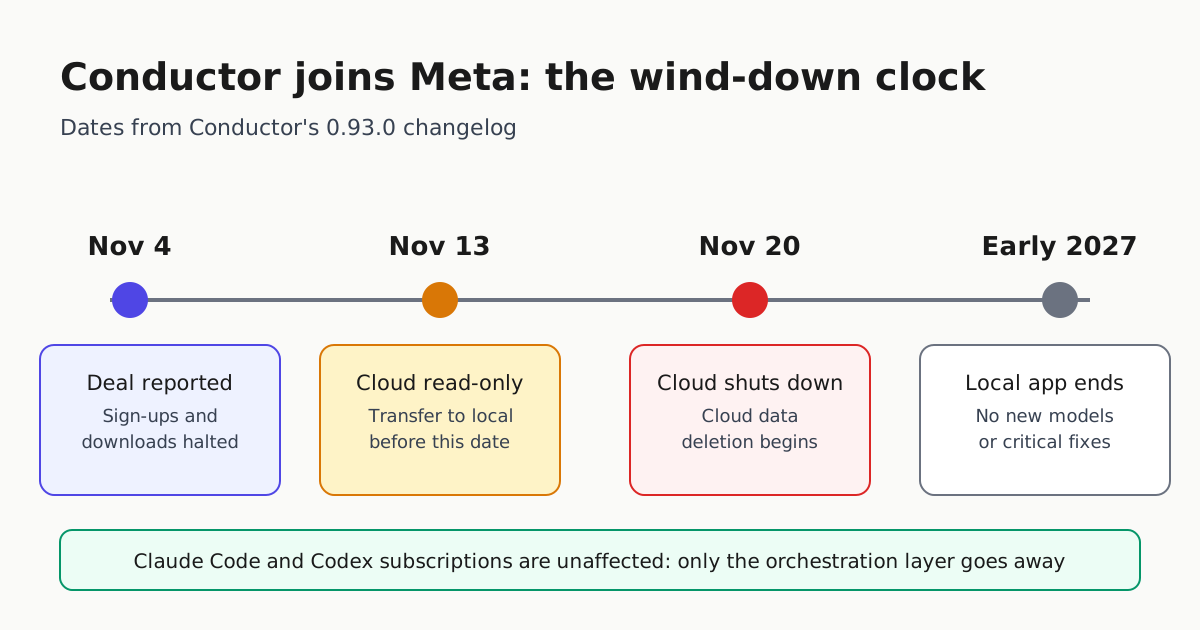
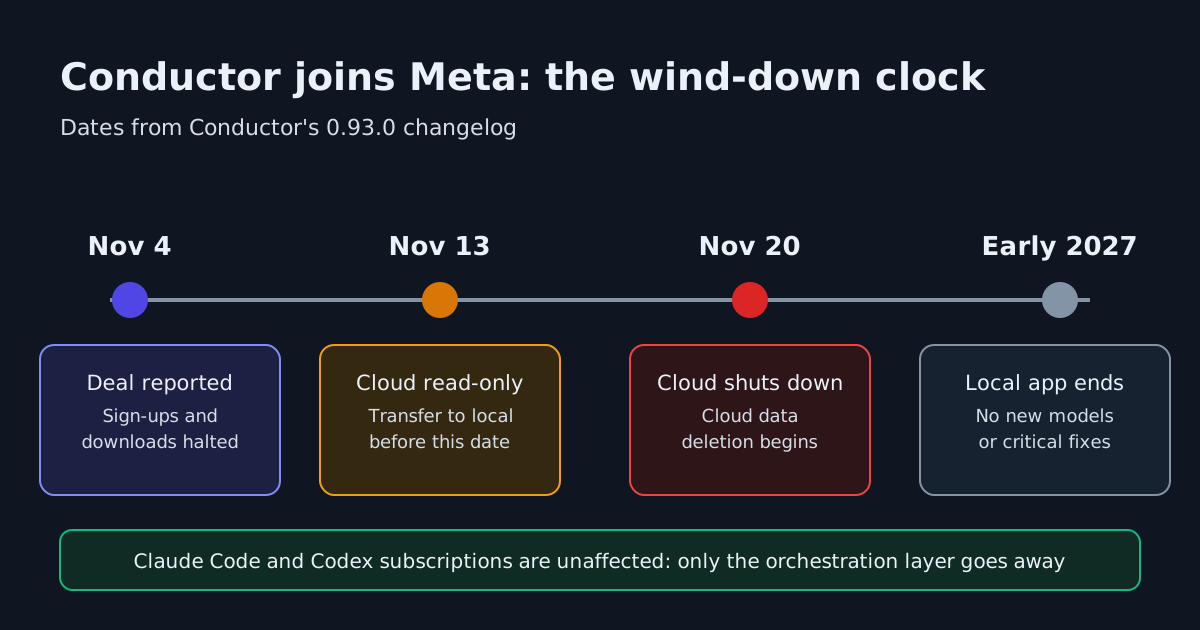
For people who use Conductor, the deal itself matters less than the schedule in the company’s own 0.93.0 changelog entry. Conductor Cloud goes read-only on November 13 and shuts down on November 20. The local Mac app “keeps getting new models and critical bug fixes until early 2027.” Anyone with cloud workspaces has nine days of normal access left.

What Conductor does
Conductor coordinates coding agents. It doesn’t make them. SiliconANGLE describes the setup like this: a developer runs several agents at once, each in an isolated copy of the codebase, then reviews and merges what they produce. Supported agents include Anthropic’s Claude Code, OpenAI’s Codex and Cursor. Users pay for those agents through their own subscriptions and API keys. A hosted version, Conductor Cloud, runs agents in sandboxed virtual machines where they can keep working for hours, and an iPhone app lets users check on them. TechCrunch also notes that the agents come from major labs such as Anthropic and OpenAI, not from Conductor.
Conductor was already in use at Meta before the deal. When the startup announced a $22 million Series A in March, it named Meta, Google and Spotify among companies with dozens of engineers on the product, according to SiliconANGLE. Conductor’s website now claims more than 100,000 users.
The wind-down schedule
| Date | What changes | Source |
|---|---|---|
| Nov. 4 | New sign-ups and downloads halted; Pro subscribers get paid features free | SiliconANGLE |
| Nov. 13 | Conductor Cloud becomes read-only | Conductor changelog |
| Nov. 20 | Conductor Cloud shuts down; the company then starts deleting cloud data | Conductor changelog; TechCrunch |
| Early 2027 | Local app stops getting new models and critical fixes; Conductor deletes the app’s user data | Conductor changelog; SiliconANGLE |
No source gives a specific date for “early 2027.” Treat it as a window you can’t plan around precisely.
What to do before Nov. 13
The changelog lists two exit paths:
- Move a cloud workspace to your Mac. Right-click the workspace and choose Transfer to local. This moves the workspace and its chats.
- Download everything. Go to Settings → Account → Export data.
The changelog doesn’t say whether Transfer to local still works after the cloud goes read-only. The safe deadline is Nov. 13, not Nov. 20. Do any transfers while the service still accepts changes, and keep Nov. 13–20 for checking that exports are complete. According to SiliconANGLE, active subscribers will get refunds. Conductor also says it has never sold user data or trained models on it, and doesn’t plan to.
Your model access is not affected. Conductor runs on each user’s own Claude Code and Codex subscriptions, so those accounts and their usage limits stay as they are. What goes away is the layer on top: the workspace list, chat history, cloud sandboxes and the phone check-in. Work committed and pushed to your Git remote is safe. Uncommitted changes and agent chats that exist only in a cloud workspace are what need transferring.
For now, the local app is still being maintained. Version 0.93.0 added GPT-6.1 Terra to the Codex model picker and fixed the Claude account usage display for newer Claude Code limit data. That buys time to choose a replacement. It doesn’t make Conductor a long-term tool. Parallel-worktree workflows now exist in several other places, including Claude Code Desktop’s parallel sessions and Codex’s managed worktree tools. For the general case, see our notes on who should own a worktree.
Why Meta wants it
Axios frames the deal as part of a race among AI labs to own the tools developers use, with coding as a key route to enterprise spending. Sources told Axios that Conductor’s “rapid pace of product development and focus on developer experiences” is expected to help Meta build its next generation of AI coding products.
The timing is notable. Axios reports that OpenAI said the same day it plans to acquire Pierre Computer, a startup focused on storing and managing AI-generated code (our coverage). OpenAI had already announced plans in June to buy Ona, which runs coding agents in cloud sandboxes. Meta’s own coding push includes the Muse Code agent, launched in August according to TechCrunch (our review), and Muse Spark Open, an open-weights model aimed at coding, released Oct. 15 according to SiliconANGLE.
CEO Charlie Holtz, who co-founded the company (formally Melty Inc.) with CTO Jackson de Campos in 2024, posted that the team has “big, crazy plans for the next interface.” He said customers would get “something new” by early next year, TechCrunch reports. On X, Holtz said he was looking forward to working with Meta chief AI officer Alexandr Wang and Nat Friedman, head of product at Meta Superintelligence Labs.
Announced vs. known
Some of this is confirmed and dated. Some is only promised.
- Confirmed: Meta owns Conductor (Axios report, Meta confirmation to TechCrunch). The cloud read-only and shutdown dates come from Conductor’s own changelog.
- Promised, undated: a new interface “early next year,” and continued local maintenance until early 2027.
- Not disclosed: the price, and whether Conductor’s successor will keep supporting Claude Code, Codex and Cursor or move toward Meta’s Muse models.
That last point matters most for anyone who picked Conductor because it worked with several vendors’ agents. Nothing published so far answers it. Until Meta or the Conductor team does, plan on the assumption that this orchestration layer ends in early 2027. This is the second agent tool to announce a shutdown in a month, after Google’s Jules.