OpenAI to Acquire Pierre, Folding Code Storage and Git Review Tools Into Codex
OpenAI will acquire Pierre Computer, whose Trees and Diffs libraries already power code review in Codex and whose Code Storage service hosts Git-backed history. What is confirmed, what is not, and what folding review and storage into Codex means for teams whose agents now write much of the code.
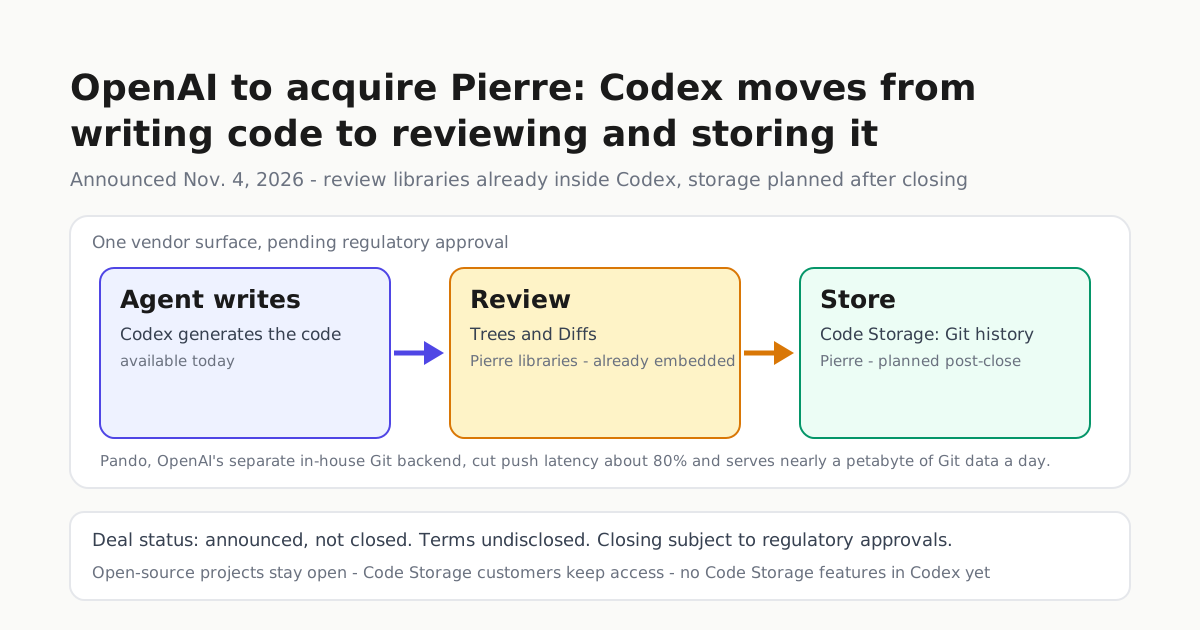
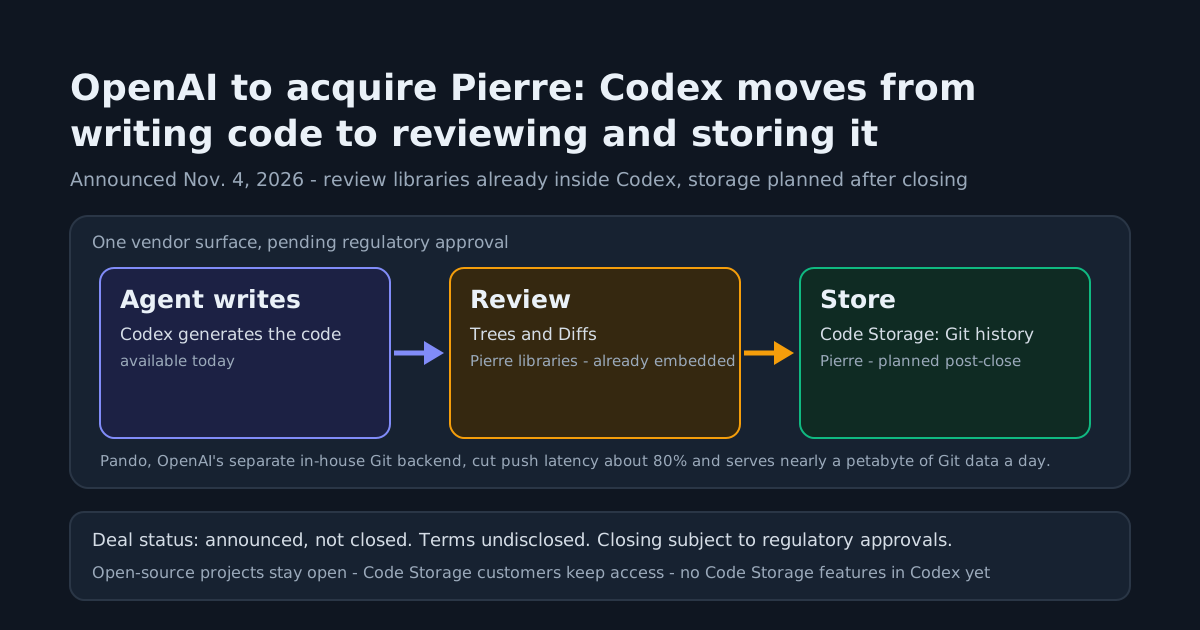
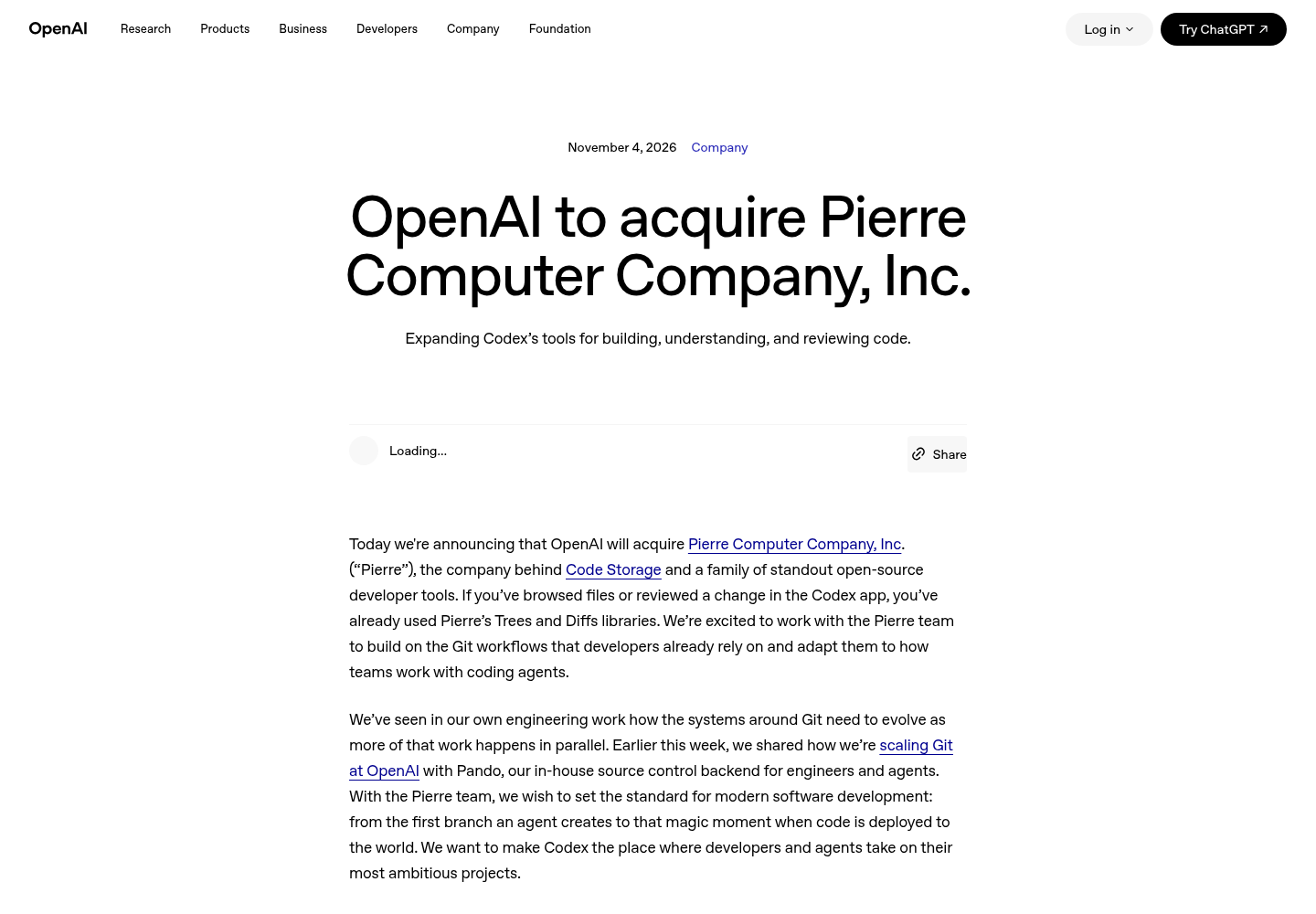
OpenAI announced on November 4, 2026 that it will acquire Pierre Computer Company, Inc., the company behind Code Storage and a family of open-source developer tools. The deal has not closed: OpenAI says closing is subject to customary conditions, including regulatory approvals, and that the two companies remain separate and independent until then.
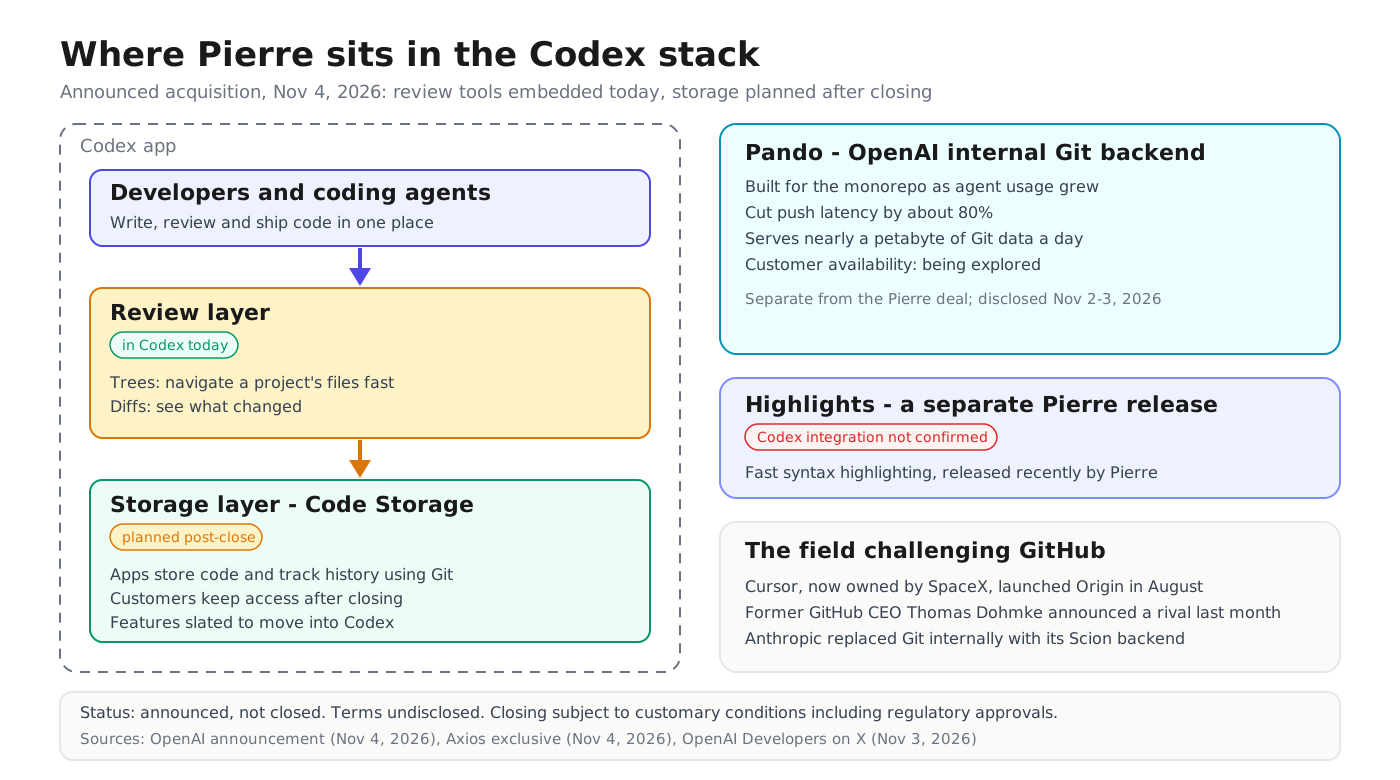
What makes this more than a logo swap is that part of Pierre already ships inside Codex. “If you’ve browsed files or reviewed a change in the Codex app, you’ve already used Pierre’s Trees and Diffs libraries,” OpenAI wrote in its announcement. If the deal closes, OpenAI would own that dependency outright and could extend it further down the stack, from the review pane toward storage: Axios reports OpenAI plans to integrate Code Storage into Codex.
What Pierre actually builds
Pierre is a small team with a large footprint in the two parts of developer tooling agents touch most: navigating files and reading changes. Per OpenAI’s announcement:
- Trees lets developers navigate a project’s files quickly.
- Diffs shows what changed, and its Edit mode lets a reviewer fix a line of code right where they spot the problem.
- Highlights, released recently, is a syntax highlighter fast enough to update as a developer types or an agent streams code.
- Code Storage is a service that lets apps store code and track its history using Git.
| Pierre component | What it does | Status at OpenAI |
|---|---|---|
| Trees | Fast navigation of a project’s files | Already embedded in the Codex app |
| Diffs | Shows what changed | Already embedded in the Codex app |
| Diffs’ Edit mode | Fix a line in place | Pierre tooling; Codex use not confirmed |
| Highlights | Syntax highlighting that tracks streaming code | Recently released by Pierre |
| Code Storage | Git-backed storage API for apps | Continues for customers; features slated for Codex |
The last row is the strategic one. Code Storage is a product surface, not just a library, and OpenAI says customers can keep using it after closing while it works to bring Pierre’s features into Codex.
A direct challenge to GitHub
Axios, which broke the news as an exclusive the same day, frames the deal bluntly: OpenAI is joining a crowd of companies challenging Microsoft’s GitHub as AI agents take on more coding work. GitHub has spent years as the central repository and nerve center of software development, but it has also faced reliability issues and outages as AI coding took off, and critics argue it was built for humans at a moment when much software is written by machines.
The field Axios describes is crowded and recent. Cursor, now owned by Elon Musk’s SpaceX, launched the GitHub rival Origin in August. Former GitHub CEO Thomas Dohmke announced a competing product last month. Anthropic went further internally, replacing Git with its own Scion backend after Claude-driven merges reached 30,000 per day. Microsoft owns nearly a quarter of OpenAI even as the two compete — a tension this deal sharpens, because source control is GitHub’s home turf.
Pando explains the timing
The acquisition lands two days after OpenAI published its engineering post on Pando, its in-house source control backend for engineers and agents. In a November 3 post on X, OpenAI Developers said Pando cut push latency by roughly 80% and now serves nearly a petabyte of Git data a day, so Git capacity can grow alongside agent usage. Axios adds that OpenAI is exploring ways to make Pando available to customers.
The two announcements are separate, and OpenAI has not said Pando will be combined with Pierre’s technology. Read side by side, though, the direction is explicit: OpenAI built Pando because Git had to scale with agent usage in its own monorepo, and it wants Code Storage’s features inside Codex after closing. If both plans proceed, the company that needed Git to scale with agent usage internally would also own the review-layer libraries and the Git-backed storage product. That is a stated ambition, not a shipped architecture. OpenAI’s own framing: the systems around Git “need to evolve as more of that work happens in parallel,” and Codex should span “from the first branch an agent creates to that magic moment when code is deployed to the world.”
What is confirmed, and what is not
- Announced, not closed: the agreement to acquire Pierre, pending regulatory closing; Trees and Diffs already in Codex; Pierre’s open-source projects stay open-source with OpenAI continuing to contribute; Code Storage customers can continue after closing.
- Not disclosed: financial terms. Neither OpenAI’s post nor Axios names a price.
- Not shipped: any Code Storage feature inside Codex. This is an announced deal pending regulatory approval, and OpenAI describes only an ambition to bring Pierre’s functionality into its product.
That gap between announcement and availability matters for planning: nothing here changes what a Codex user can do today.
The operator read
For teams running coding agents, the consolidation raises three questions worth answering before any of it ships.
Review and storage move onto the model vendor’s surface. GitHub’s own Octoverse data shows more than 40% of pull requests now start with a coding agent, and that review is the bottleneck. Whoever owns the review tooling owns the choke point where agent output becomes merged code. Owning the libraries already inside Codex, if the deal closes, would let one vendor increasingly see and shape the whole path from generation to merge.
History portability is the lock-in question. Code Storage stores code and tracks history with Git, which is what keeps it substitutable today. If its features fold into Codex behind proprietary layers, the exit path is what protects you: mirror remotes, scheduled exports, and CI that does not assume any single forge. The same instinct applies to agent-native forges like Entire, which replaces pull requests with agent-scored trails — a novel abstraction is only an improvement if your history leaves with you.
Provenance follows the platform. When the tool that writes code also stores and reviews it, the audit trail of what the agent did and what a human approved ends up on the same vendor’s infrastructure. Teams with separation-of-duties requirements should decide, per repository class, whether that concentration is acceptable and which layers stay vendor-neutral.
What to watch
Three signals will show when this becomes real: a closing date or regulatory clearance, the first Code Storage capability appearing natively in Codex, and any Pando customer availability. Until then, read the deal as a statement about where OpenAI thinks the coding-agent market is heading — toward the infrastructure under the code, not just the model writing it — and keep your Git history somewhere you can move.
Sources
- OpenAI to acquire Pierre Computer Company, Inc. | OpenAI
- Exclusive: OpenAI targets Microsoft's GitHub with deal for startup
- OpenAI Developers on X: "We built Pando, a new Git backend for our monorepo, to handle more pushes and fetches without changing how our engineers and agents use Git. Pando cut push latency by ~80% and now serves nearly a petabyte of Git data a day. We can grow Git capacity alongside agent usage." /