Entire Launches a Git Forge That Replaces Pull Requests With Agent-Scored 'Trails'
Former GitHub CEO Thomas Dohmke's Entire replaces pull requests with agent-scored Trails, claims 89x-faster Git hosting, and adds token-saving agent memory.
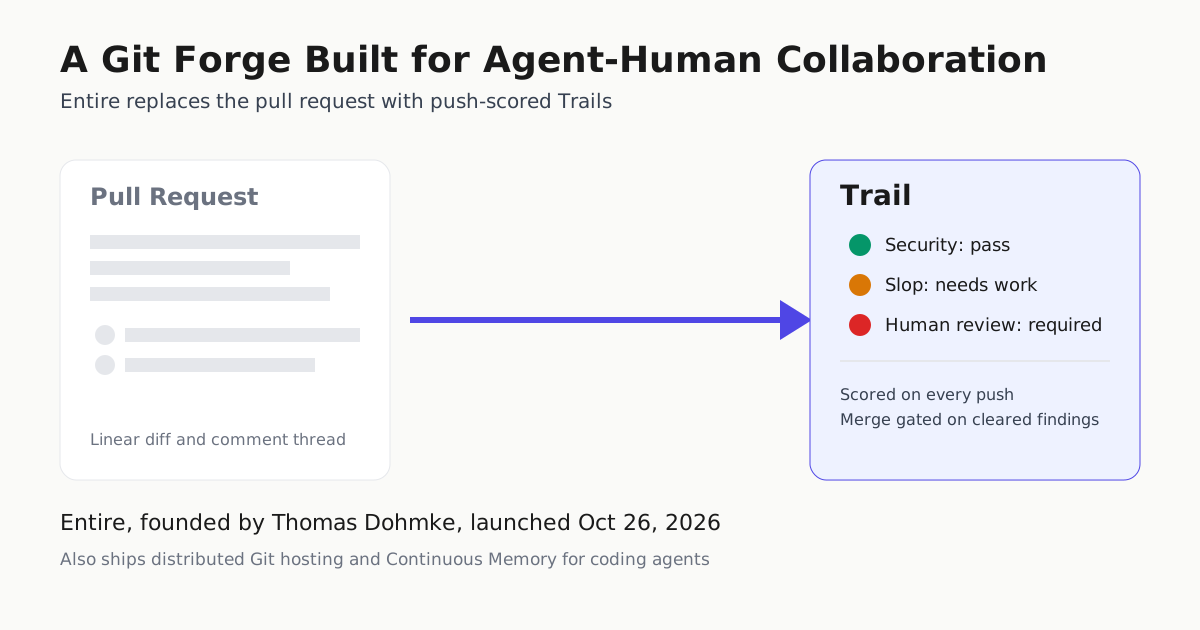
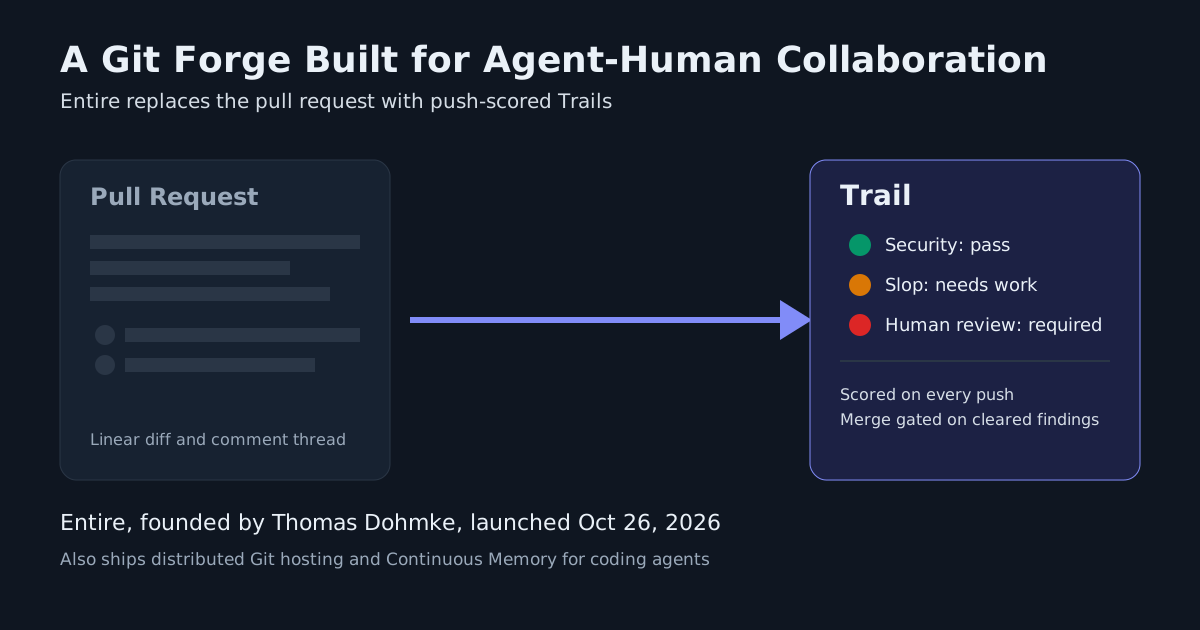
Thomas Dohmke ran GitHub for four years before stepping down in August 2025. On October 26, 2026, his new startup, Entire, launched a Git forge built on a different premise: the pull request, software’s review unit for two decades, doesn’t work when the thing pushing commits is an agent running continuously, not a person pushing a few times a day.
Entire’s answer is a new unit called the Trail, paired with a custom distributed Git-compatible backend and a persistent memory layer for coding agents. Dohmke announced it on X the same day, and the launch was covered independently by Analytics India Magazine and Tech Times.
Trails swap the diff for a scoreboard
A standard pull request has a human read a linear diff, leave comments, and wait on a CI check before merging — an interface built for a world where a person wrote the code, not one where an agent pushes dozens of commits an hour and another agent is the one reading the review thread.
A Trail restructures that flow. Every push triggers review agents that run independently in isolated cloud sandboxes (Daytona and E2B host the sandboxes; Claude Code and Codex power the review agents) and return a score plus a written rationale per eval. Each project ships with pre-defined agents covering code quality, security, and slop that can be enabled per repo; Entire’s own team, for instance, runs Security, Slop, and Human Review Required evals across many of its repositories, and teams can configure their own via the web UI or a JSON config committed to the repo. The dashboard shows the last five runs plus the current one, so a team can see whether scores are stabilizing. That execution model raises the same question operators should ask of any review bot that actually runs pull-request code: where it executes and what it can see matters as much as the score it returns.
| Pull Request | Trail | |
|---|---|---|
| Review trigger | Human opens a PR | Every push |
| What’s shown | Linear diff + comments | Eval scores + open findings |
| Who reads the diff | A human reviewer | Often nobody |
| Merge condition | Approval + passing CI | Gates: scores clear + CI + optional approval |
Findings carry severity levels and stay visible until an agent or developer resolves or dismisses them. “Gates” are configurable per repo to require specific conditions — including human sign-off — before merge. Teams used to treating branch protection rulesets as the backstop against a bad merge are looking at a different control surface here, one worth migrating deliberately rather than copying by default. Dohmke’s framing, from Entire’s launch announcement: developers can “confidently merge without reviewing every line in the diff” once the loop between coding agent and review agents stabilizes.
A new Git backend, and a speed claim to verify yourself
Entire built its own Git-compatible server on a distributed object store and a transactional reference database, rather than hosting on stock Git. The company’s own “forgemark” benchmark reports 418 pushes per second for Entire versus 4.7 for GitHub — marketed as 89x faster, and 6x faster than Cursor’s Origin hosting service.
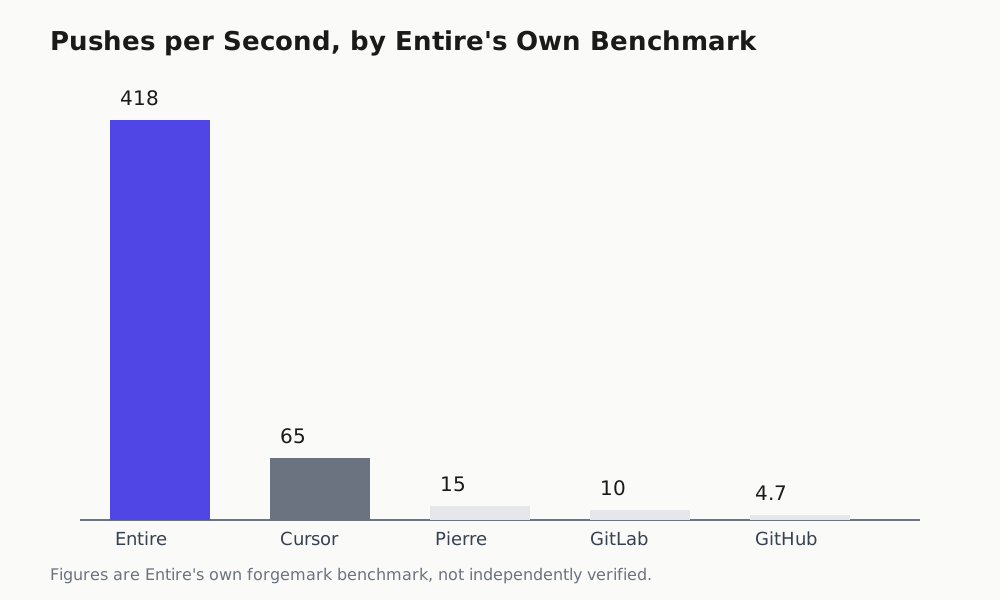
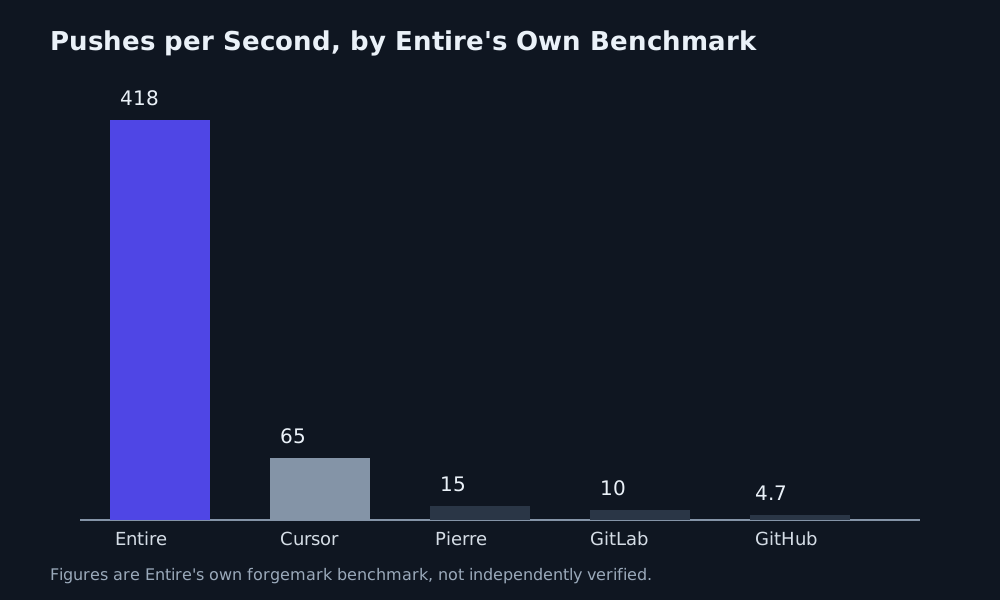
That benchmark is company-published and unverified; treat the multiple as a vendor claim until outside testing replicates it. Hosting is live in the US, EU, India, and Australia, with repositories mirrorable from GitHub so teams can keep GitHub as source of truth while running Trails on top, or fail over to Entire-native branches during a GitHub outage. Running that mirror means every agent clone and fetch path needs its own authentication plan so CI doesn’t stall when one side becomes unreachable.
That positioning isn’t incidental. Per Tech Times’ review of IncidentHub data, GitHub logged 257 incidents, including 48 major outages, in the twelve months ending April 2026, and processed roughly 17 million AI-generated pull requests a month as of March 2026, up from roughly 4 million in September 2025. Entire is betting that volume breaks the PR-and-single-server model before it breaks GitHub’s reliability record.
Continuous Memory: two CLI tools, one token claim
Every new agent session normally starts from zero. Entire’s “Continuous Memory” ships as two open-source, local-first CLI tools. entire-graph parses the repository with tree-sitter — no network or model calls — into a map of definitions, callers, types, routes, and change impact; the company says this cut token consumption up to 71% versus feeding an agent raw source. entire-brain indexes agent session logs recorded in Git history alongside that graph, so a future session can retrieve not just what the code does but why a prior agent changed it. Connected to Entire’s backend, those memories can be shared across a team and surface directly inside a Trail.
Both the token-savings figure and a separate claim of a 94.74% score on the LoCoMo memory benchmark are Entire’s own pre-release numbers, flagged in the underlying coverage as unverified by outside parties.
CI partners and the money behind it
Entire launches with first-party CI integrations from Buildkite and Depot — bk pipeline convert and depot ci migrate import existing GitHub Actions workflows, including secrets and variables, with minimal rewriting. Buildkite CEO Kevin Gounden and Depot co-founder Kyle Galbraith both backed the launch with quotes in Entire’s press release.
Entire disclosed a $60 million seed round in February 2026 at a $300 million valuation, led by Felicis with Madrona, Microsoft’s M12, Basis Set, and others — reported by Analytics India Magazine as the largest seed round in developer-tools history. The company has grown to 50 employees.
What to actually test
For anyone running Claude Code or Codex against a real repo, Entire is worth a pilot, not a migration decision: mirror a non-critical repo, point agents at the Entire CLI, and watch whether eval-gated merging actually reduces human review time or just moves the bottleneck to tuning Gates. The 89x hosting-speed and 71% token-savings numbers are both Entire benchmarks against GitHub and its own prior baseline — run your own push-throughput and token comparisons before building a workflow around either figure.
For teams already weighing what happens to Git-based review at agent scale, this sits alongside Anthropic’s internal move off Git entirely and recent work on risk-routed, critic-style code review — all pointing at the same pressure point: the PR was built for humans reading human-paced diffs, and that assumption is the thing breaking first.
Sources
- The Git Forge for Agent-Human Collaboration · Entire
- Entire Launches an Independent Git Forge for Agent-Human Collaboration
- Thomas Dohmke on X: "Agents reinvented how we produce code. It changed our tools and half of our workflow. It’s time for the other half to catch up. Today, we’re shipping Entire: the Git forge for agent-human collaboration. We’ve built @GoEntire using Entire. Now we want to see what you'll build wi…
- Former GitHub CEO Launches Git Platform Built for AI Agents
- GitHub Had 257 Incidents in 12 Months: Entire Ships Distributed Forge for AI Agents