Harmonic's Aristotle Now Formally Verifies AI-Generated C and Verilog, Not Just Math Proofs
Harmonic says Aristotle now formally verifies AI-generated C and Verilog, proving properties across every input and running checks in CI starting today.
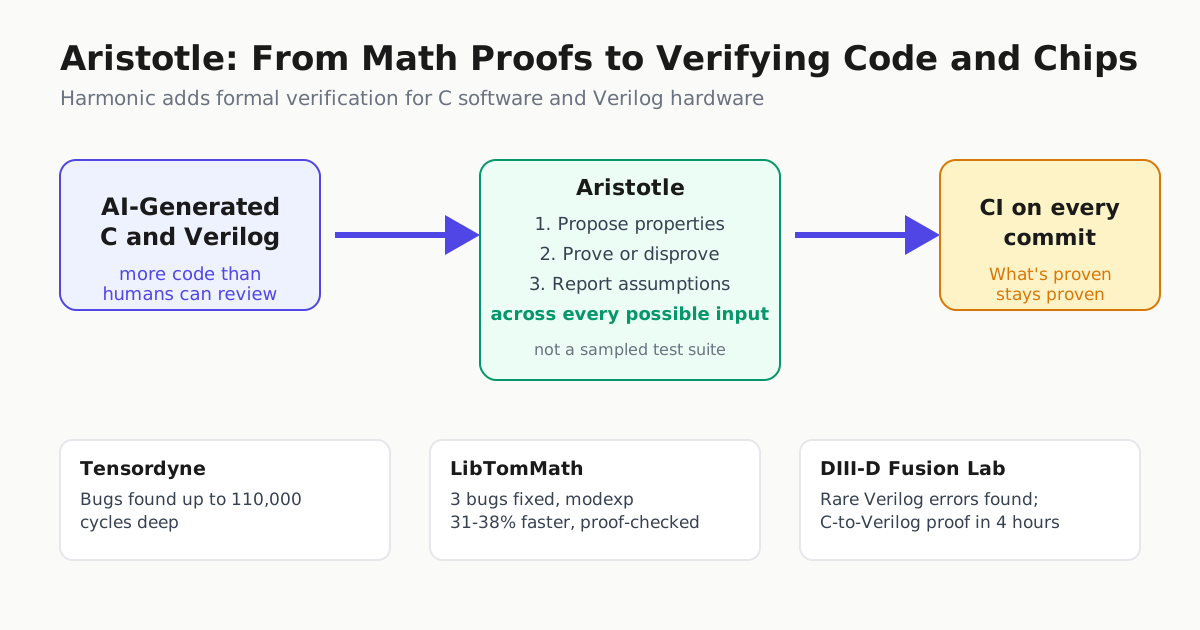
Harmonic, the “mathematical superintelligence” startup co-founded by Robinhood CEO Vlad Tenev, said on October 27, 2026 that its Aristotle model now formally verifies C software and Verilog hardware designs, moving beyond the research-math proofs it built its name on. The expansion targets a specific operational gap: AI agents now write more code than any human team can review line by line, and traditional testing only samples a slice of possible behavior.
What changed
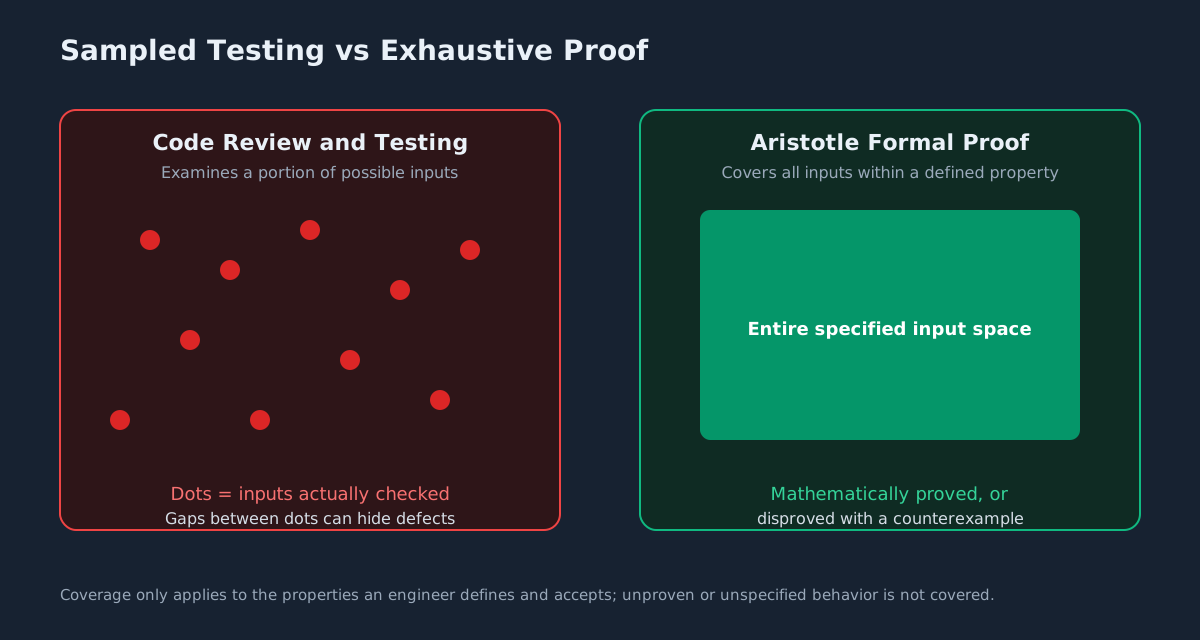
Per Harmonic’s announcement, Aristotle fits into a team’s existing workflow in four steps: it proposes properties from the code it’s given, attempts to mathematically prove or disprove each one across every possible input in the defined system — not a sampled test suite — reports which properties it proved, which it couldn’t, and the assumptions each proof rests on. Engineers review the proposed properties, commit the ones they accept to the repository, and run Aristotle in CI on every subsequent commit, so a property that’s proven stays proven unless the code underneath it changes.
For C, that means checking functional correctness and the absence of certain classes of undefined behavior. For Verilog, it covers control-path properties like liveness and safety alongside data-path math. Harmonic co-founder and CEO Tudor Achim framed the move as extending beyond pure developer workflows, saying mathematically verifying critical systems “provides a new way to identify defects and vulnerabilities before they become costly or catastrophic problems,” according to the same announcement.
Harmonic’s own X post is blunt about the motivation: “AI is writing more code than anyone can review. We’re building the AI that verifies it.” That framing, and the case-study numbers below, are Harmonic’s own — not an independent benchmark.
The evidence Harmonic is pointing to
Harmonic names two production examples in its own post: at chip startup Tensordyne, Aristotle found bugs up to 110,000 cycles deep in a block the team considered hardest to verify. On LibTomMath — the big-number library behind Tcl and Dropbear SSH — it fixed three bugs and made modular exponentiation 31–38% faster in Harmonic’s own benchmarks, with the faster code proved against the same spec as the original.
A third case study comes from outside Harmonic’s own post. According to EconoTimes’ reporting, authors affiliated with General Atomics say Aristotle examined Verilog already in production in a Thomson-scattering diagnostic system at the DIII-D National Fusion Facility and identified multiple rare errors that manual review could have taken days to catch. In a separate exercise, starting from one research paper and a 254-word prompt, Aristotle reconstructed C code for attachment-fraction calculations, generated a Verilog counterpart for FPGA acceleration, and proved the two versions bit-for-bit equivalent on the first attempt — in four hours. Those findings are set to appear in an abstract for the IAEA’s AI for Fusion workshop (Nov. 9–11), with General Atomics’ C. Mitchell Clark listed to present.
What to attribute, and to whom
Superpower Daily’s independent writeup draws the sharpest distinction worth keeping: finding bugs, or reconstructing a working program, is not the same test as reliably verifying that a specified property holds for every input. Its editorial take is explicit that “the announcement offers no independent measurement of how reliably Aristotle does either new kind of check.” Until an outside evaluator publishes numbers, the DIII-D and Tensordyne results should be read as named, attributed case studies — not as a general reliability score for C or Verilog verification.
Reuters-sourced coverage, via KSL, confirms Aristotle shipped today with usage-based pricing and notes that researchers separately using Harmonic’s technology found critical bugs in PHP, prompting a global patching rush — a different application from the C and Verilog verification announced here, but another data point on how Harmonic’s reasoning technology is already being used.
What this means for a coding-agent workflow
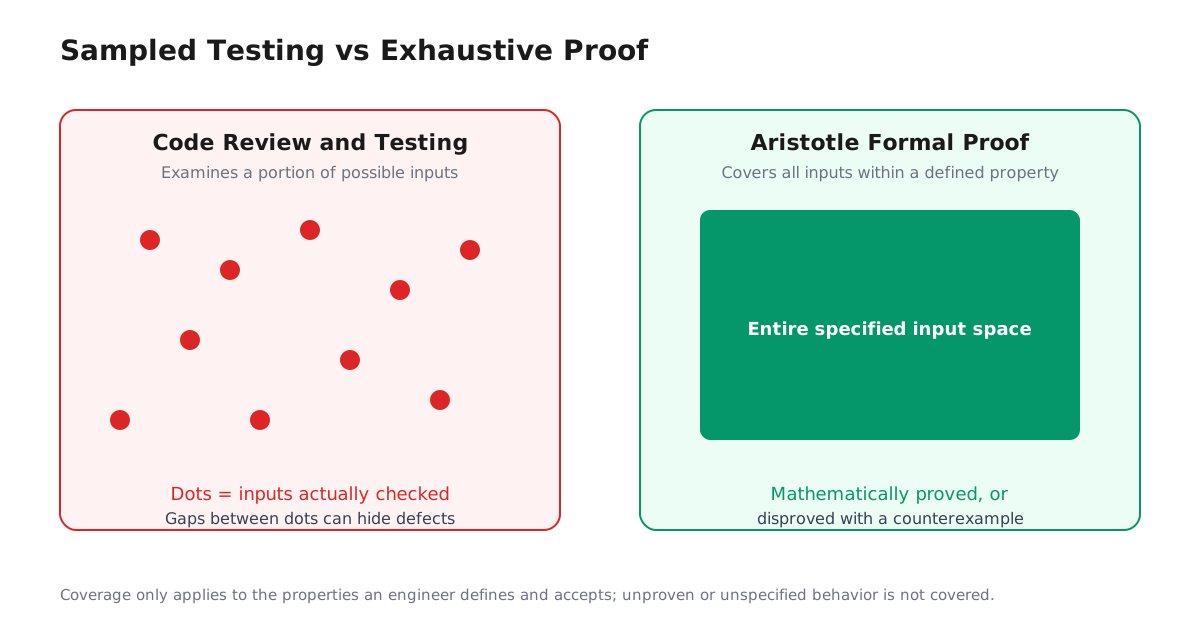
The practical pitch is narrower than “AI checks all your code.” It’s: pick the properties that actually matter — memory safety in a C parser, a safety invariant in a Verilog state machine — let Aristotle try to prove or disprove them, read the assumptions it lists before trusting a “proved” result, and wire the proof into CI so a later commit that breaks the property fails the build instead of shipping. That’s a materially different trust boundary than code review or sampled testing, closer in spirit to the formal-methods approach GitHub Next is exploring for Rust with its Proof-Driven Development Kit built on Verus, and complementary to statistical AI code review tools like the ones Greptile is scaling across GitHub pull requests — proof covers what’s specified exhaustively; review and testing still catch what wasn’t specified.
Aristotle is live today at aristotle.harmonic.fun with self-serve, consumption-based pricing; Harmonic did not disclose a price, and enterprise customers can reach bd@harmonic.fun for volume pricing, dedicated support, or on-prem and private-cloud deployment.
Sources
- Aristotle Expands Into Formal Verification for Software and Hardware, Starting With C and Verilog | Harmonic
- Harmonic on X: "We’re bringing Aristotle to code. AI is writing more code than anyone can review. We're building the AI that verifies it. Starting today with C and Verilog." / X
- Harmonic adds software and chip-design verification to its Aristotle AI model | Superpower Daily
- Robinhood CEO's AI startup Harmonic expands into software, chip design verification | KSL.com
- Harmonic Adds Formal Checks for C Software and Verilog Hardware | EconoTimes