Claude Security Drops the Scan Button: Continuous Monitoring and Automatic Fix Tracking Reach Public Beta
Anthropic's Claude Security now scans repositories continuously, auto-tracks fixes, and ships an API, webhooks and an MCP connector for Claude Enterprise teams.
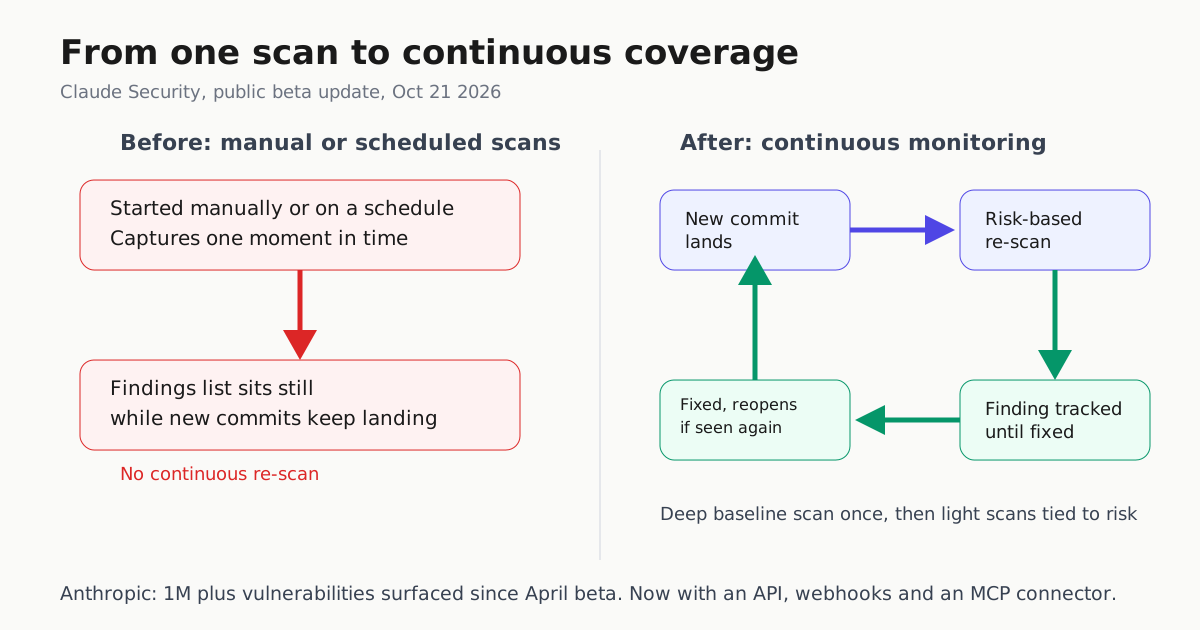
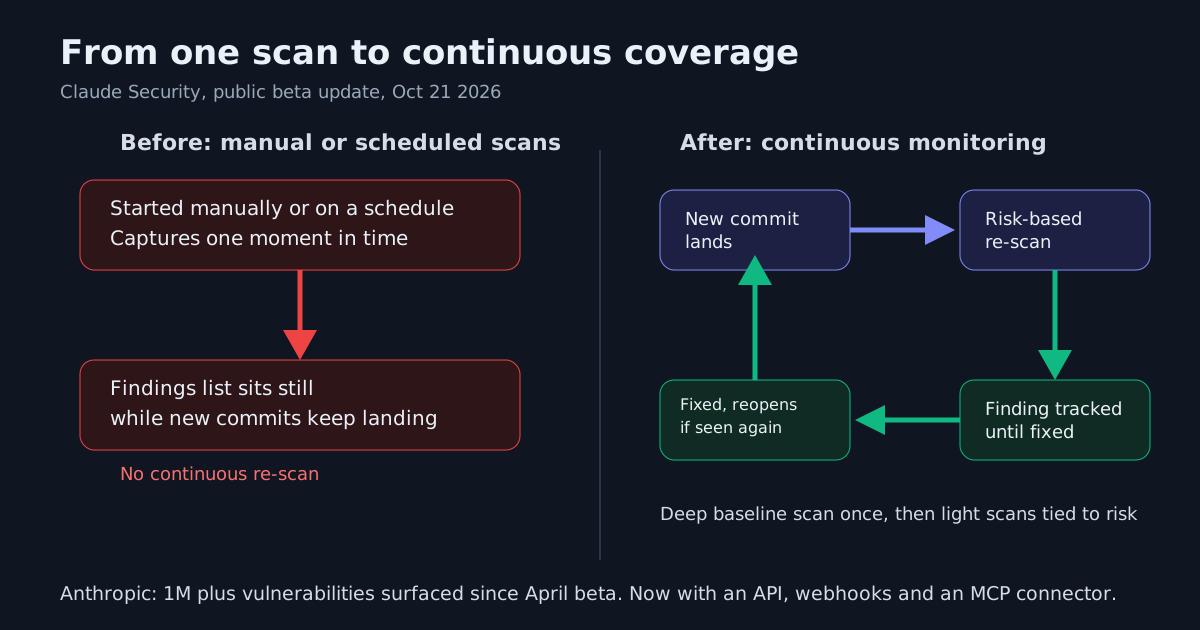
Claude Security has stopped waiting for someone to press scan. Anthropic’s October 21 announcement turns the tool from an on-demand vulnerability scanner into something that stays attached to a codebase: it runs one deep baseline scan, then keeps re-scanning as commits land, tracks which findings get fixed, and reopens them automatically if the same flaw resurfaces. Anthropic’s own account posted the update on X the same afternoon, and the change is in public beta today for Claude Enterprise customers.
TestingCatalog’s same-day coverage of Anthropic’s Claude Security update, confirming the move to continuous scanning and automatic fix tracking.
What actually changed
Until now, Claude Security findings captured a single moment. A team scanned, got a list, and that list went stale the moment anyone merged code. Anthropic’s support documentation spells out the new mechanics: create a project, connect up to eight repositories through the Claude GitHub App (including GitHub Enterprise Server) or an access token for GitLab and other Git providers, then choose a branch and scope. Claude runs the deep baseline scan once, and after that it watches for new commits and scans changes “regularly based upon their risk and complexity” — there’s no fixed schedule to configure, and no one has to remember to re-trigger a scan before a release.
Projects can also hold multiple repositories at once, which matters for the class of bug that lives between services rather than inside one of them — Anthropic’s example is a backend that silently trusts input a client was supposed to validate first. TestingCatalog’s same-day coverage of the launch likewise describes this multi-repository model for catching weaknesses that cross service boundaries.
Fix tracking closes the loop
The part most likely to change how security teams actually use the tool is fix tracking. Claude Security now checks open findings against the code that changed and marks them fixed when a patch ships — regardless of whether the fix happened inside Claude Code or through a completely separate process. If Claude later finds the same issue again, the finding reopens on its own. That removes the manual reconciliation step that made prior AI scanners hard to trust inside CI: someone no longer has to go back and confirm, finding by finding, whether a merged PR actually closed the hole a scan flagged weeks earlier.
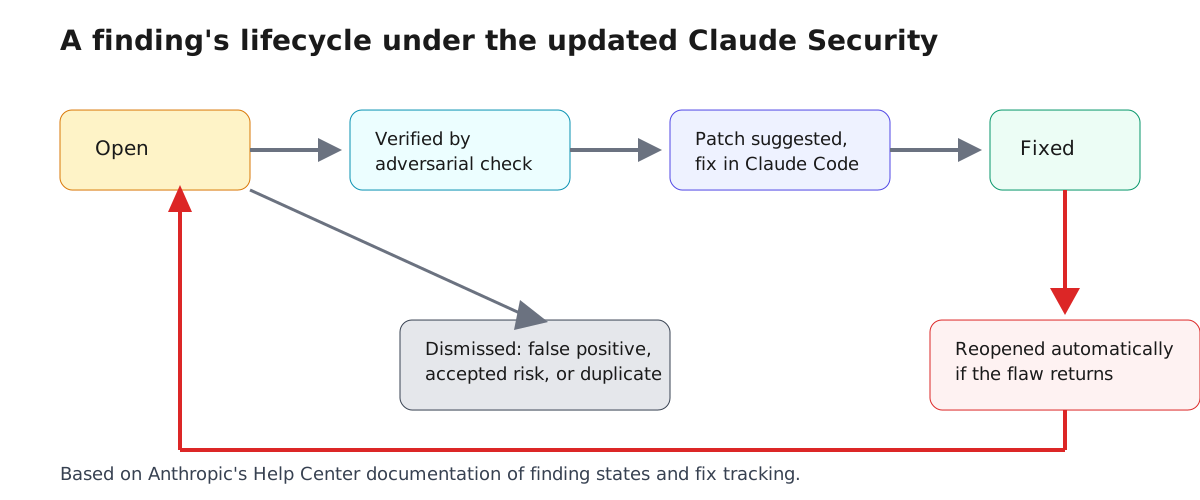
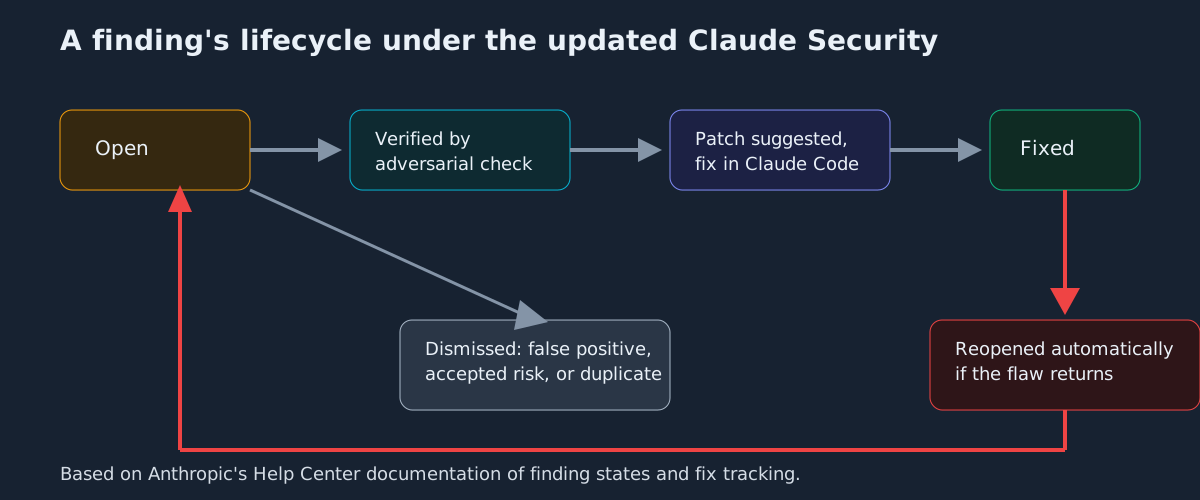
Finding lifecycle under the updated Claude Security, built from Anthropic’s Help Center description of verification, fix tracking and dismissal states.
Team-supplied context now shapes severity
Each project gets an editable knowledge base where a team describes deployment details, applicable security policies, and anything a new security engineer would need to know. Claude Security also auto-generates a threat model from the code itself, which the team can review and correct, and subsequent scans use that model to decide what’s worth flagging and how severely to rate it. Vanta’s Director of Security, Nathan Hunstad, is quoted in Anthropic’s announcement describing exactly that effect: once his team wrote its own risk policy into the threat model — focusing on what external users can actually reach — “the findings matched how we prioritize instead of only a severity score.”
Findings now reach other tools
Claude Security ships a new API that can list and read projects and findings, resolve or reopen findings, and manage projects and their repositories; personal access tokens scope access to whatever the creating user can already see. Webhooks can push new-finding events into Slack, Jira or other systems. And Claude Security is now available as an MCP connector inside Claude.ai and Claude Code, so an engineer can pull up a finding, ask Claude about it, start a fix, and mark it resolved without leaving the session. IonQ’s Joe Coniglio called the API and MCP additions “a game changer” for operationalizing the tool inside a product security team, per the same announcement. New role-based access controls also let admins open the tool to more teams that own code without handing out project-creation rights to everyone.
The numbers and the caveats
Anthropic says organizations have already surfaced more than a million vulnerabilities since Claude Security’s April 2026 public beta launch. Scans run on Claude’s full model family including Claude Mythos, and Anthropic is offering eligible Claude Enterprise organizations up to $25,000 a month in free usage credits for two consecutive months, through December 31, 2026 — a window short enough that orgs signing up after November 1 won’t get the full two months.
The catch list is real: this is Claude Enterprise only, still public beta, scans are explicitly stochastic (the help center FAQ warns two runs of the same code can return different results), and it does not support Zero Data Retention. Existing projects built on the earlier manual-or-scheduled scanning experience keep running as-is and must be manually migrated to get continuous scanning and the new credits — migration does not carry over webhooks, scan history, or scheduled scans, and GitHub Enterprise projects can’t migrate at all. For teams already running Claude Code to generate commits faster than a person can manually re-trigger a scanner, closing that staleness gap is the part worth testing first.
For related ground on keeping AI-touched code and agents from becoming the weak point, see Automater’s guide to securing AI agents and the recent Claude Code Review GA rollout, which covers Anthropic’s separate PR-time review product on the same Enterprise and Team tiers.
Sources
- Claude Security now scans continuously and tracks fixes | Claude by Anthropic
- Claude on X: "Claude Security now keeps up with your code as it changes. Connect your repositories once. Claude runs a deep first scan, then re-scans as changes land, so findings stay close to the current state of your code. In public beta on Claude Enterprise." / X
- Claude Security | Claude by Anthropic
- Use Claude Security | Claude Help Center
- Claude Security gets continuous scans and fix tracking