Consensus Ships Its Full Research Agent as an API and MCP Server, Putting Citation-Backed Science Inside Any Agent
Consensus now exposes its complete research agent through its API and an MCP server, so Claude, ChatGPT, Cursor or a custom agent can run citation-backed scientific search as one tool call. What each plan's quota buys and how to verify answers.
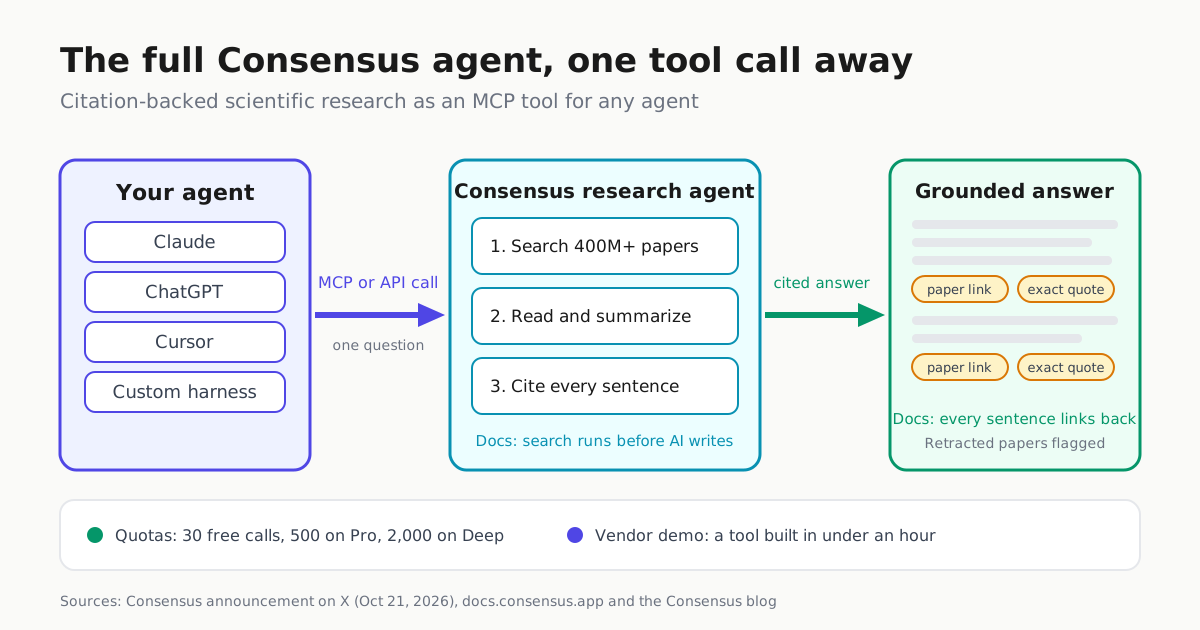
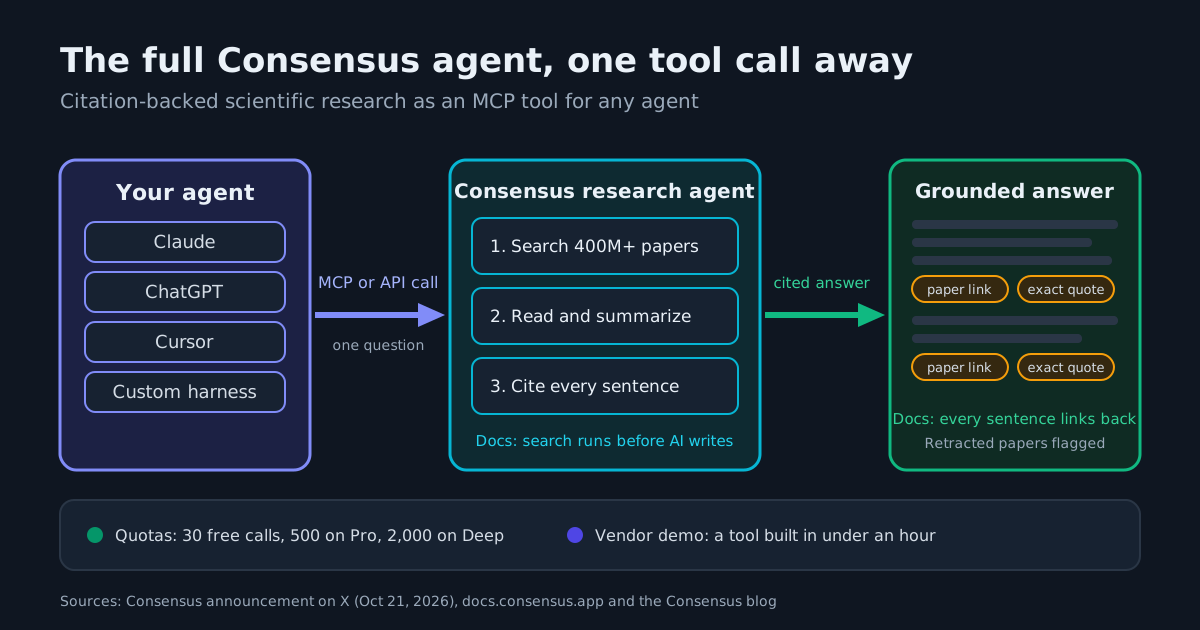
Consensus — which brands itself on X as “The AI operating system for academic research” — announced on Oct 21, 2026 that its full research agent is now available through its API and a Model Context Protocol (MCP) server. For agent builders, the change is concrete: any MCP-capable client — Claude, ChatGPT, Cursor or a harness you operate — can delegate an entire research task to an agent that searches, reads and answers with, per Consensus’s docs, a citation on every sentence. The company frames this as “full” agent access, implying earlier programmatic hooks were narrower, although the captured materials do not document the previous API surface.
What shipped, and why “full” matters
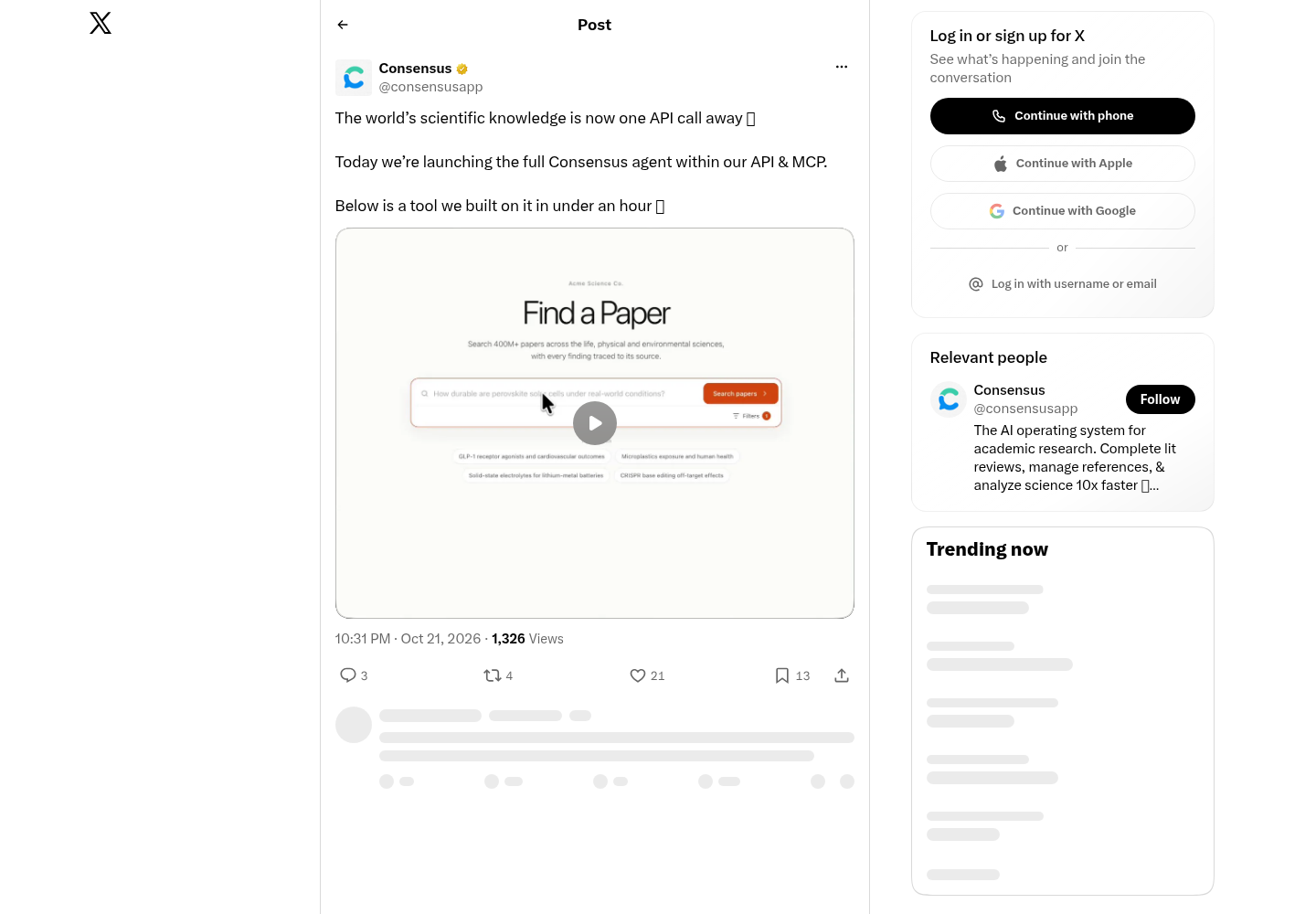
“Today we’re launching the full Consensus agent within our API & MCP,” the company posted on X at 10:31 PM on Oct 21, 2026, framing the release as putting the world’s scientific knowledge one API call away. The post embeds a video of a tool the team says it built on the new interface in under an hour. That is a vendor demo, so treat the one-hour claim as marketing — but the direction is unambiguous: Consensus is selling its agent as a tool other agents call.
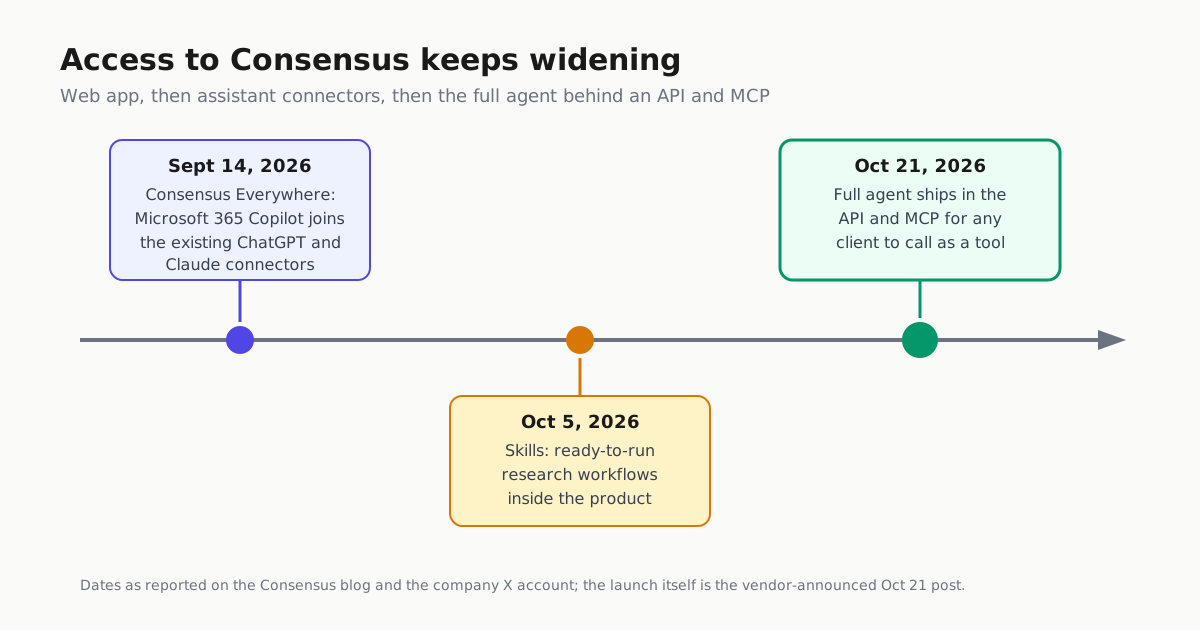
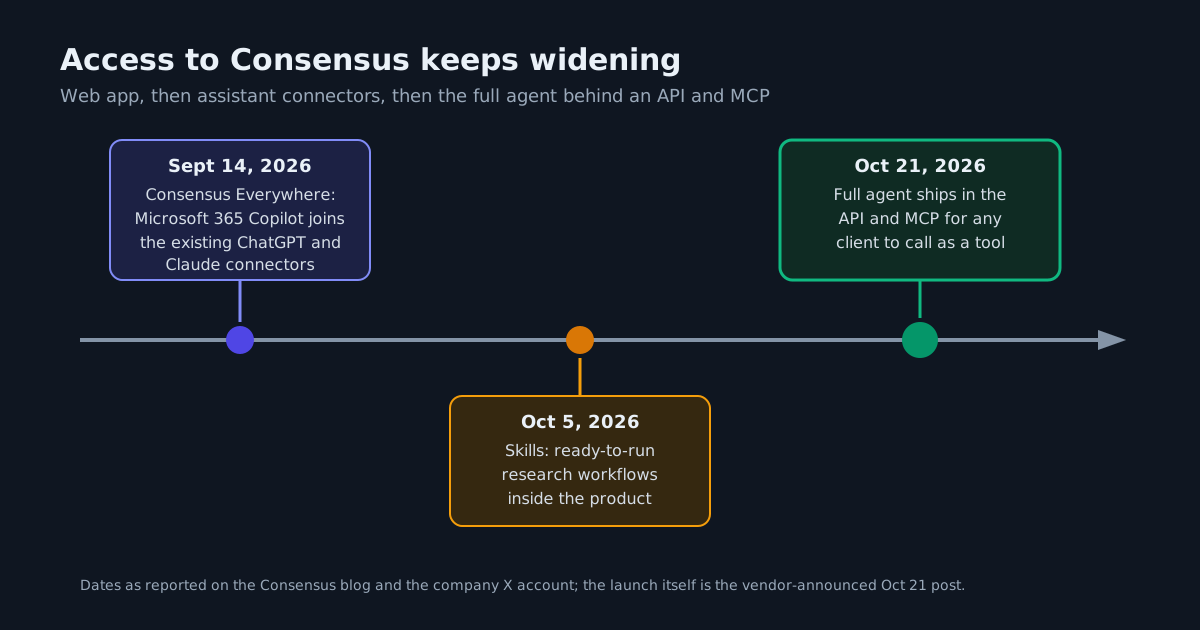
The word to notice is “full.” Consensus already ran inside ChatGPT and Claude before its Sept 14 “Consensus Everywhere” update added Microsoft 365 Copilot, and on Oct 5 it shipped Skills, ready-to-run research workflows. This launch puts the complete multi-step research agent — not just paper search — behind programmable interfaces, extending the pattern we covered when Workday took its MCP server GA: a vertical app exposing its live expertise as a tool for other agents.
Consensus’s docs describe the product as search-first, and the company presents the same design for its agent surfaces; the API and MCP response format was not verified for this article. What docs.consensus.app states:
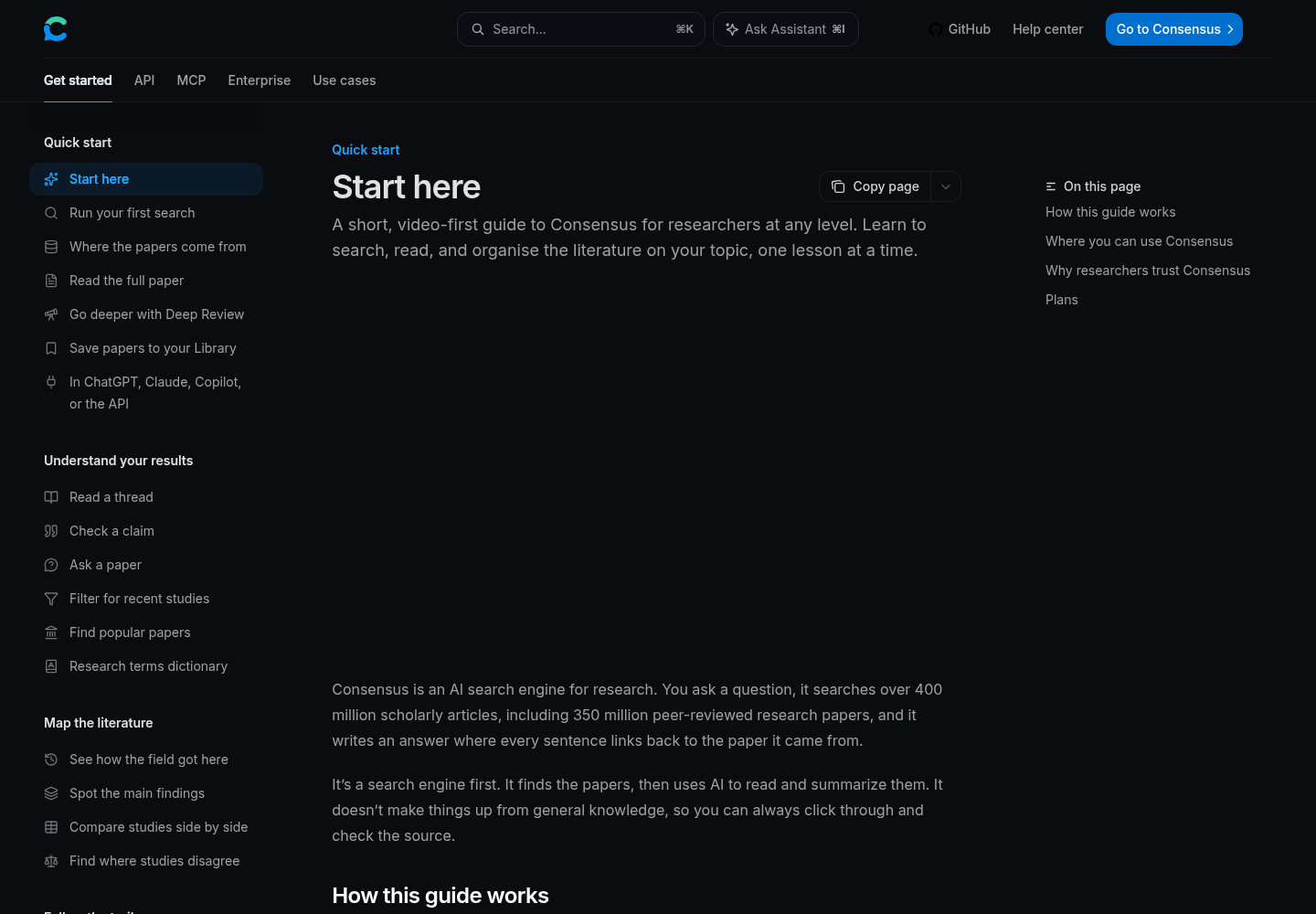
- It searches more than 400 million scholarly articles, including 350 million peer-reviewed papers, before the model writes anything.
- In the web app, every sentence of an answer links back to the paper it came from, and hovering a citation shows the exact supporting quote — a UI affordance; what an MCP or API tool call returns to your agent is whatever the server serializes.
- Retracted papers are flagged and never used in answers.
- Consensus says your searches and uploads are not used as training data.
What the quotas buy
API and MCP usage is metered per plan, and the metered column is small next to unlimited paper search:
| Plan | Price | API and MCP calls per month | Deep Reviews per month |
|---|---|---|---|
| Free | $0 | 30 | 3 |
| Pro | $20/mo or $144/yr | 500 | 15 |
| Deep | $65/mo or $540/yr | 2,000 | 200 |
| Teams | Not listed | 500 per user | 50 per user |
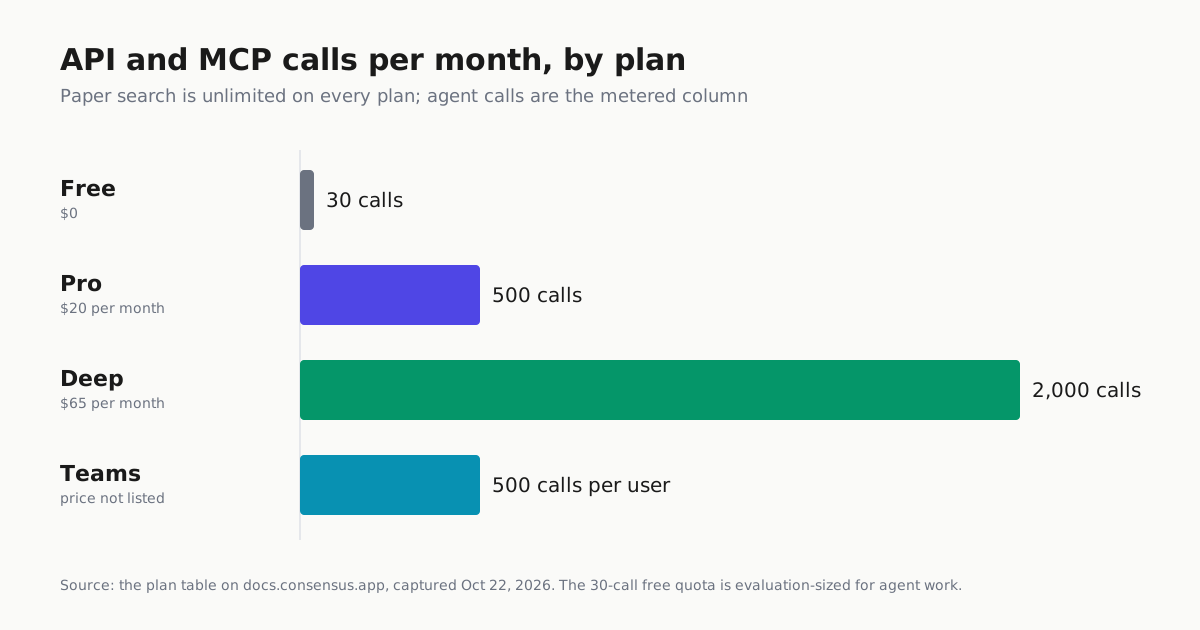
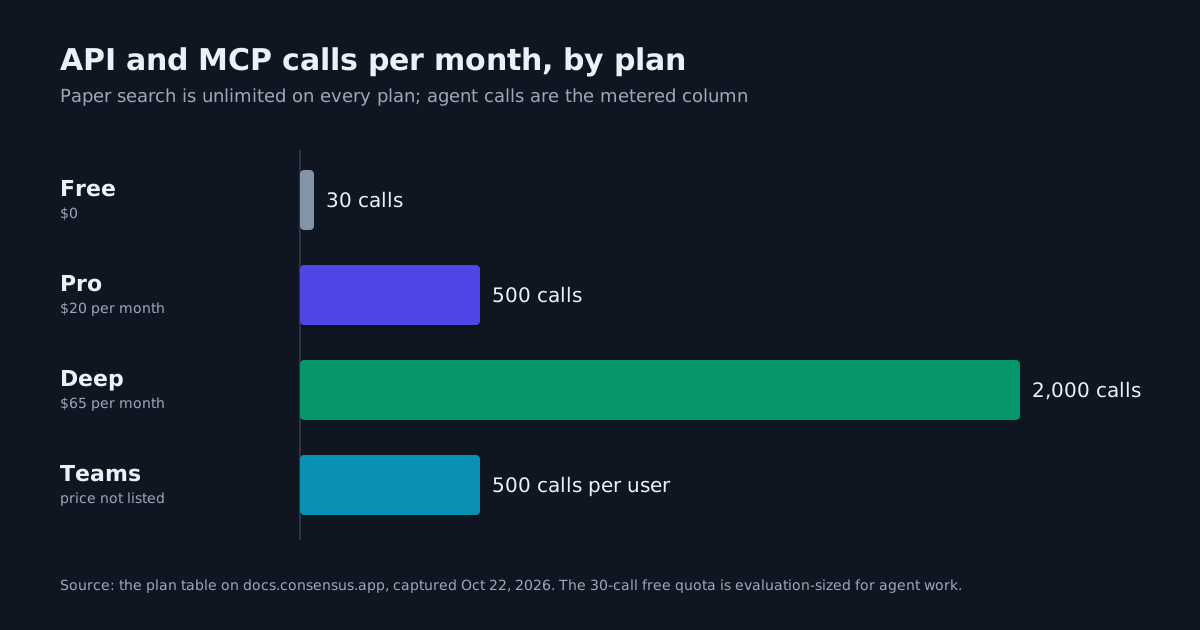
Read those numbers before you architect anything. Thirty free calls per month is evaluation-sized — enough to bake off Consensus against whatever research path your agents use today, not enough to run a production agent. The Pro tier’s 500 calls works out to roughly 16 agent-initiated research tasks per day spread evenly, but only if one task consumes one call; the captured docs do not say whether a multi-step agent run is billed as a single call or several, and that ambiguity is the first thing to measure.
Wiring it in
The docs describe connecting in one click from ChatGPT, Claude or Copilot, or building on the API, and the docs site keeps dedicated API and MCP tabs beyond the start page captured here. Those captured pages do not publish the MCP endpoint, transport or authentication scheme, so do not copy a guessed command: hosted MCP servers commonly authenticate with OAuth flows rather than a static bearer key, and a fabricated header line will fail or, worse, misauthenticate silently. Follow the MCP tab of docs.consensus.app for the current transport, endpoint and sign-in steps, and confirm the server lists its tools before wiring it into a pipeline.
Our Claude Code MCP setup guide covers scopes and connection-failure triage, and MCP Explained covers the protocol itself.
What it unlocks, and what to verify
The practical win is literature-grounded answers inside workflows that already run on agents:
- A research subagent that returns claims with paper-level citations your main agent can quote, instead of a general model inventing plausible-looking sources.
- A citation-checking pass over drafts or literature-review sections, where each claim is verified against what Consensus actually found.
- Domain-grounded retrieval for scientific or regulated work where a general web-search API — even a strong one like Exa 3.0 — is not aimed at the peer-reviewed corpus.
Hold the launch to the same discipline as any vendor-hosted tool. “One API call away” and the under-an-hour build are Consensus’s own claims; Consensus has not cited an independent benchmark of answer quality, and we have not seen one. Citations reduce hallucination but do not eliminate summarization errors, so spot-check answers against the quoted passages — the same fetch-before-you-drive posture we recommend for research jobs generally. And because the server is vendor-hosted, treat its output as untrusted input to your agent: cap its quota, log its calls and pin what your workflow expects, per our MCP hardening guide.
Bottom line: a citation-backed scientific research agent is now a tool your agents can call, and the free tier is enough to evaluate it this week. Measure how calls are counted against the quota, spot-check citations before trusting summaries, and budget for the 500-call Pro tier before anything reaches production.
Sources
- Consensus on X: "The world’s scientific knowledge is now one API call away 🌎 Today we’re launching the full Consensus agent within our API & MCP. Below is a tool we built on it in under an hour 👇" / X
- Consensus (@consensusapp) / X
- Start here - Consensus
- Product updates, company news, science content, and more.