Databricks AI Runtime Goes GA With Serverless NVIDIA GPUs for Training and Fine-Tuning Open Models
Databricks AI Runtime is GA: managed NVIDIA GPUs meet governed Lakehouse data, with NeMo, NGC containers and Nemotron cookbooks for enterprise fine-tuning.
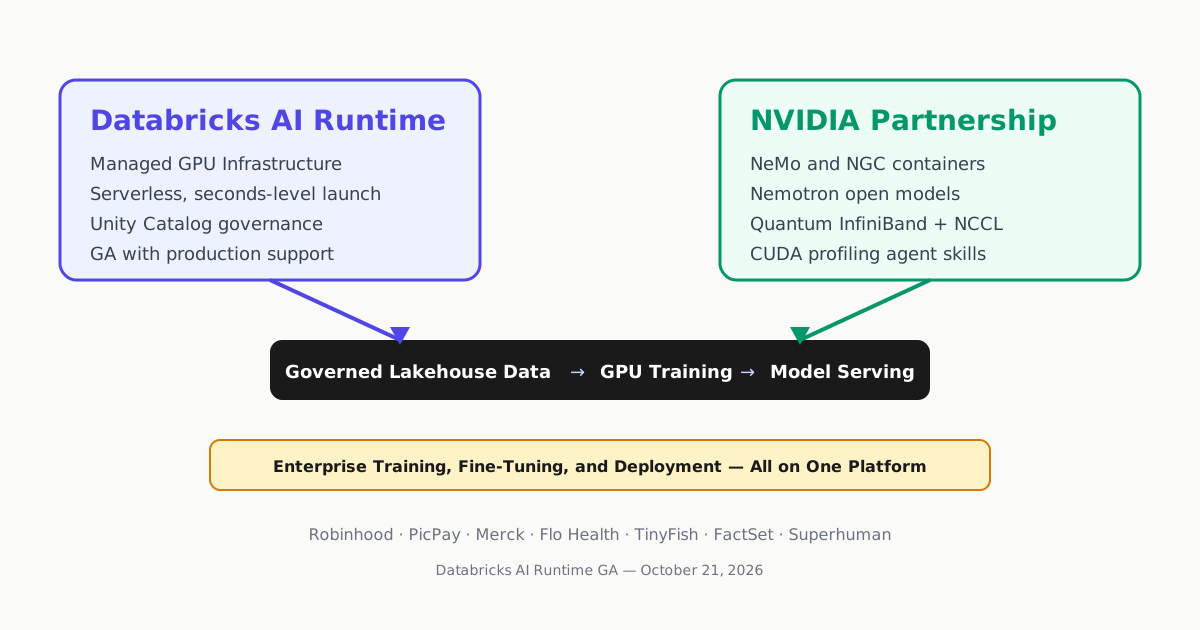
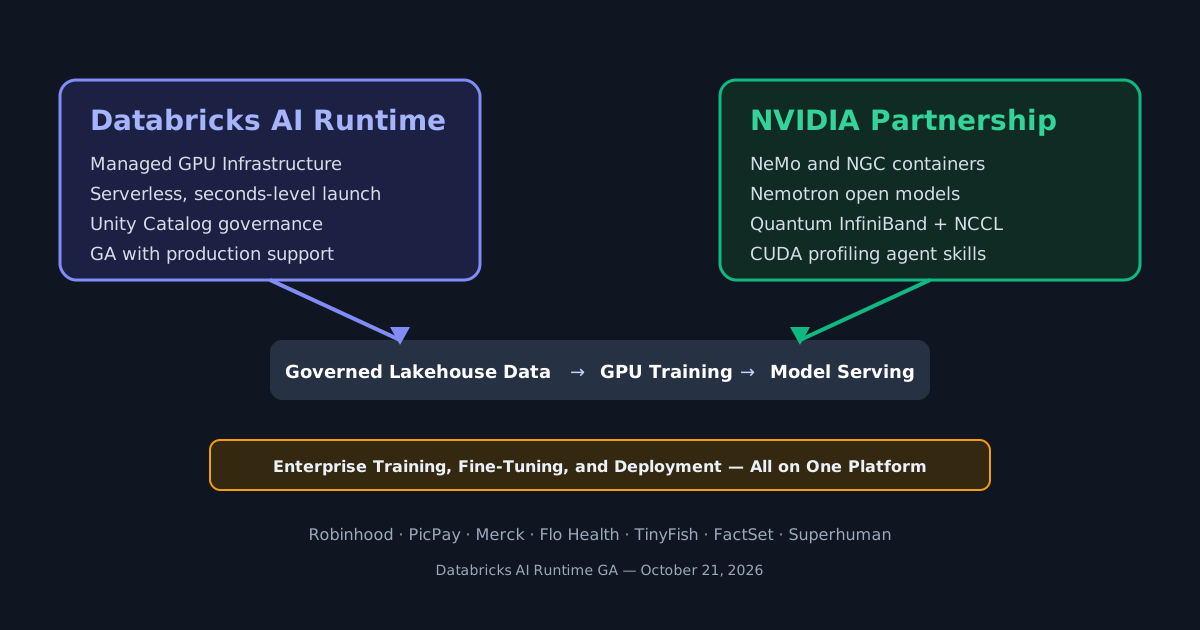
Databricks took AI Runtime to general availability on October 21, giving enterprise teams a fully managed GPU environment for training, fine-tuning, and serving models directly on governed Lakehouse data. Both the GA announcement and the companion NVIDIA partnership post appeared on the Databricks blog the same day. At GTC Berlin, Databricks and NVIDIA expanded their collaboration, bringing NeMo, NGC containers, and Nemotron cookbooks to serverless GPU workloads inside the platform. Together, the two announcements address the split-brain problem that has dogged enterprise AI teams: training data lives in the Lakehouse under Unity Catalog governance, while GPU compute has historically required a separate stack with its own capacity planning, network configuration, and — critically — its own access controls.
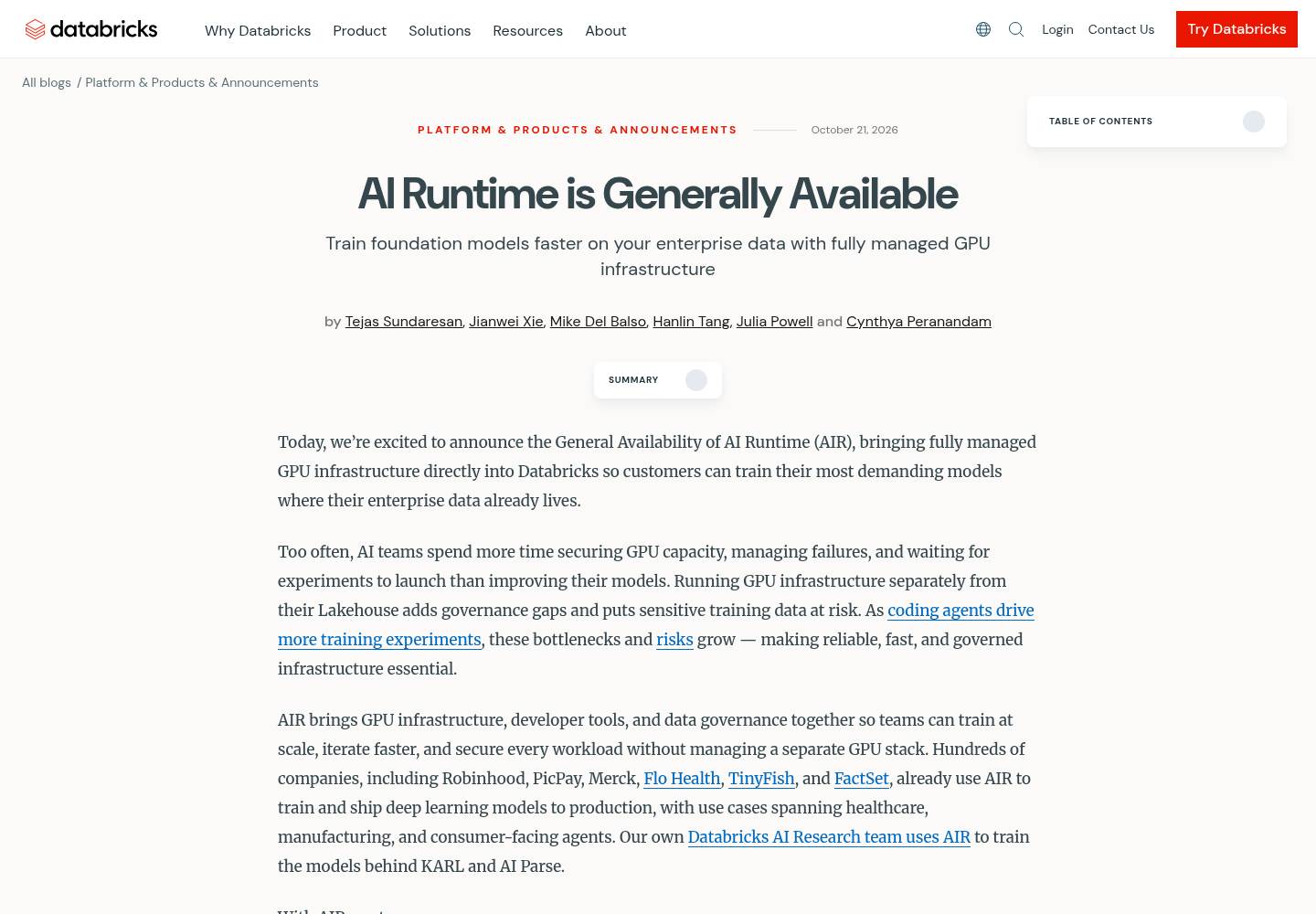
With AI Runtime (AIR), GPU workloads now inherit the same Unity Catalog permissions that govern the rest of the Databricks platform. Read and write access to training data, model checkpoints, and logs all flow through consistent policies. The serverless infrastructure provides VM-level workload isolation, PrivateLink support, and serverless egress controls — protections Databricks positions as stronger than conventional GPU isolation mechanisms that expose the host kernel. Usage and costs appear in Databricks billing system tables alongside other workloads, giving teams workload-level visibility into where the GPU budget goes.
The performance story matters for teams iterating on models. Databricks claims seconds-level launch latency even for large RDMA-enabled clusters with dozens of GPUs, achieved through warm serverless GPU pools and lazy image loading that starts workloads immediately while continuing to pull container image data in the background. Superhuman reported cutting its large-scale training time from roughly seven days on a single-node A100 setup to 48 hours on multi-node H100 GPUs — a 3.5x speedup. FactSet said the platform reduced time to set up, train, and deploy a custom model from days to hours.
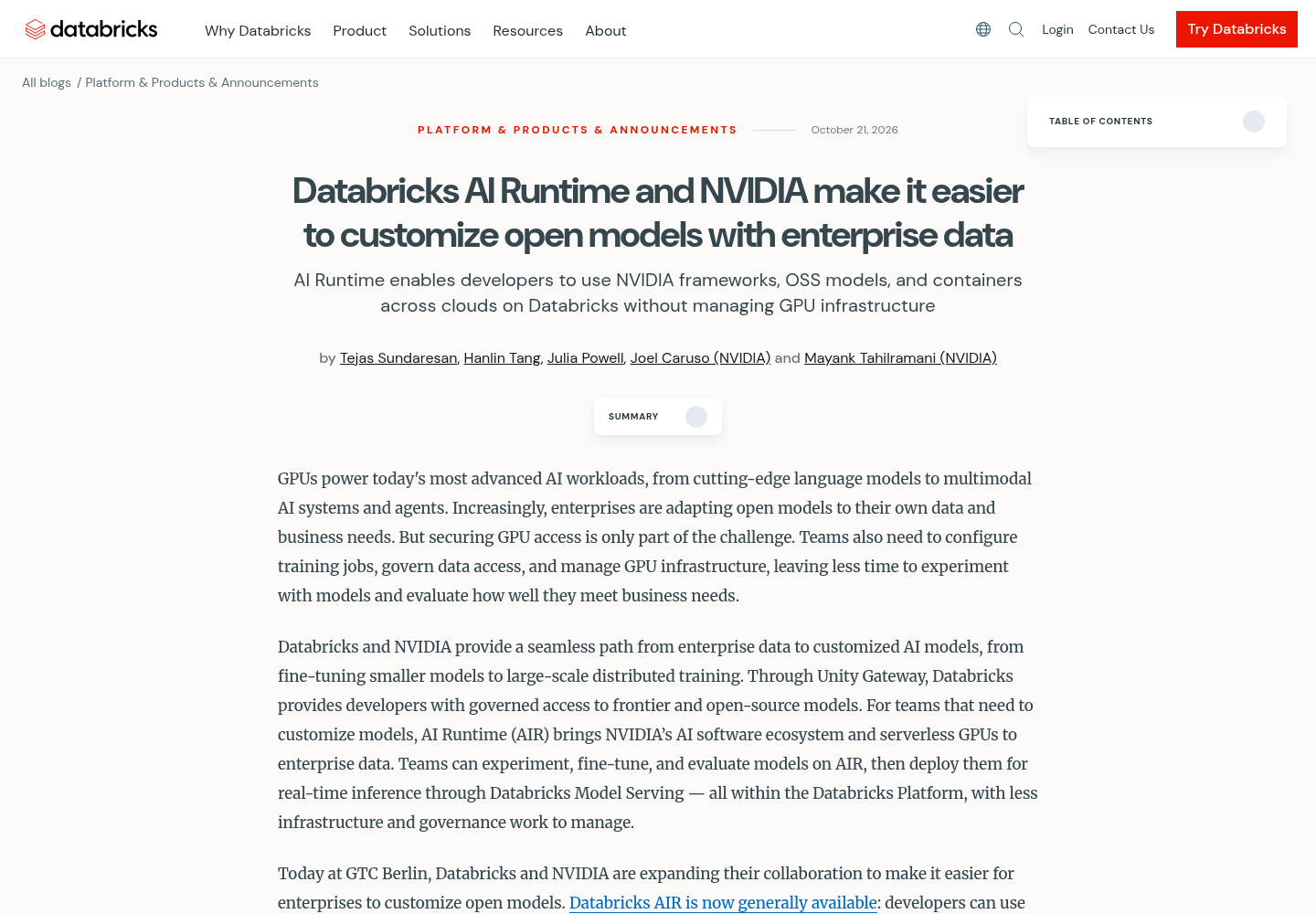
The NVIDIA integration adds a specific on-ramp for teams working with open models. Developers can pull GPU-optimized containers from the NVIDIA NGC Catalog into the Databricks Artifact Registry and use NVIDIA NeMo and NeMo Automodel for fine-tuning workflows. Nemotron 3.5 Lightning and Super VL are available on Databricks from day one, and new Nemotron cookbooks provide pre-built paths for model customization. NVIDIA Quantum InfiniBand provides high-bandwidth, low-latency networking with RDMA, while NCCL handles communication between GPUs — all managed by Databricks.
Genie Code, Databricks’ embedded debugging agent, now ships with NVIDIA-specific agent skills that apply expertise on CUDA, cuDNN, NCCL, and profiling tools when investigating training errors or performance bottlenecks. Teams can describe the modifications they want in a notebook, request guidance on setting up a fine-tuning job, and get help resolving errors as they happen — then inspect the generated code and confirm it is correct before launching the GPU run. MLflow tracks experiments and GPU utilization, helping teams compare both model results and compute performance in one place.
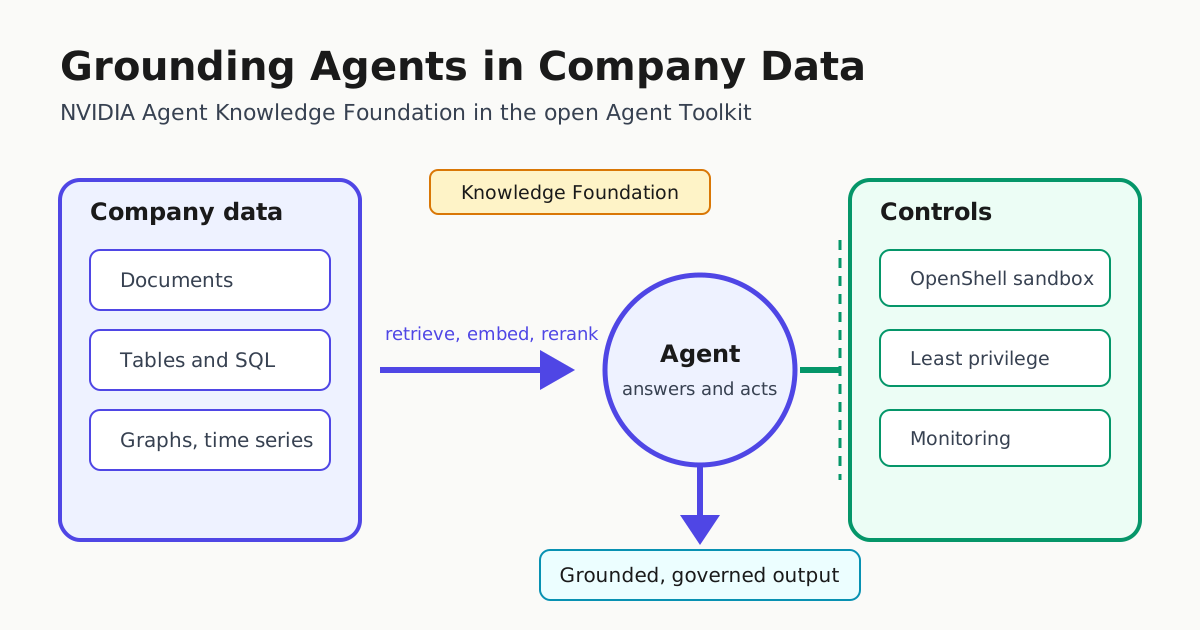
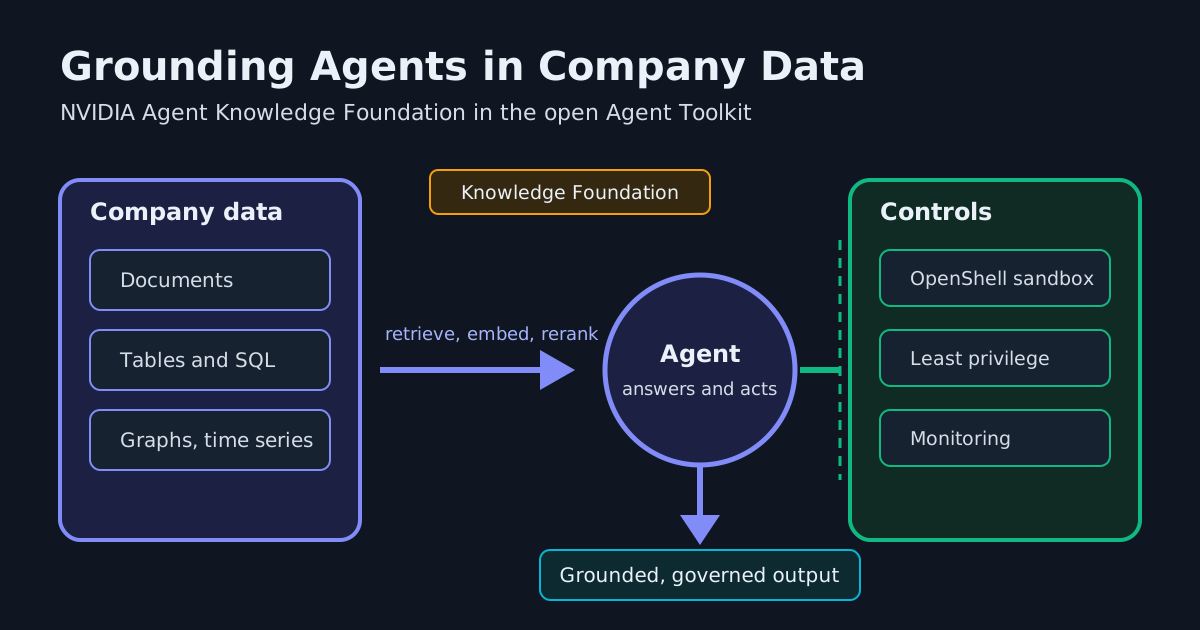
AIR supports customization beyond large language models. Databricks highlighted a validated fine-tuning workflow for NVIDIA Kumo Anomaly, an open research model for time-series anomaly detection, paired with the Genie Ontology to connect unusual patterns in time-series data with business meaning. This points toward the agent use case: models that can detect anomalies and contextualize them within enterprise workflows — part of what NVIDIA calls its Agent Knowledge Foundation vision.
Hundreds of companies are already using AIR, according to Databricks, including Robinhood, PicPay, Merck, Flo Health, TinyFish, and FactSet. Use cases span healthcare, manufacturing, and consumer-facing agents. Databricks’ own AI Research team uses AIR to train the models behind KARL and AI Parse. For teams already running agent workloads on Databricks, AIR fills a specific gap: managed infrastructure for the model customization step that sits between raw foundation models and deployed agents grounded in enterprise data. After fine-tuning, teams can deploy customized models through Databricks Model Serving for real-time inference, completing the loop from governed data through GPU-accelerated training to production serving without leaving the platform.
AIR arrives as Databricks builds out its enterprise agent platform with capabilities like Lakebase branching databases for agentic SDLC workflows. The GPU training layer was the missing piece: now teams can govern the data, branch the database, train the model, and serve the agent all within one security perimeter. For enterprise teams evaluating whether to build or buy GPU infrastructure for model customization, the GA milestone means AIR is now a fully supported production service inside the Databricks platform — giving teams a governed, serverless GPU path for model customization without leaving the Lakehouse.