
Replit's CEO Says It Dropped Anthropic. An Insider and Replit's Own Blog Say Otherwise.
Amjad Masad told TechCrunch Disrupt that Replit no longer works with Anthropic, citing cost and performance. A source says the partnership stands, and Replit's own September engineering post shows Claude still in production — a live case study in multi-model routing economics.
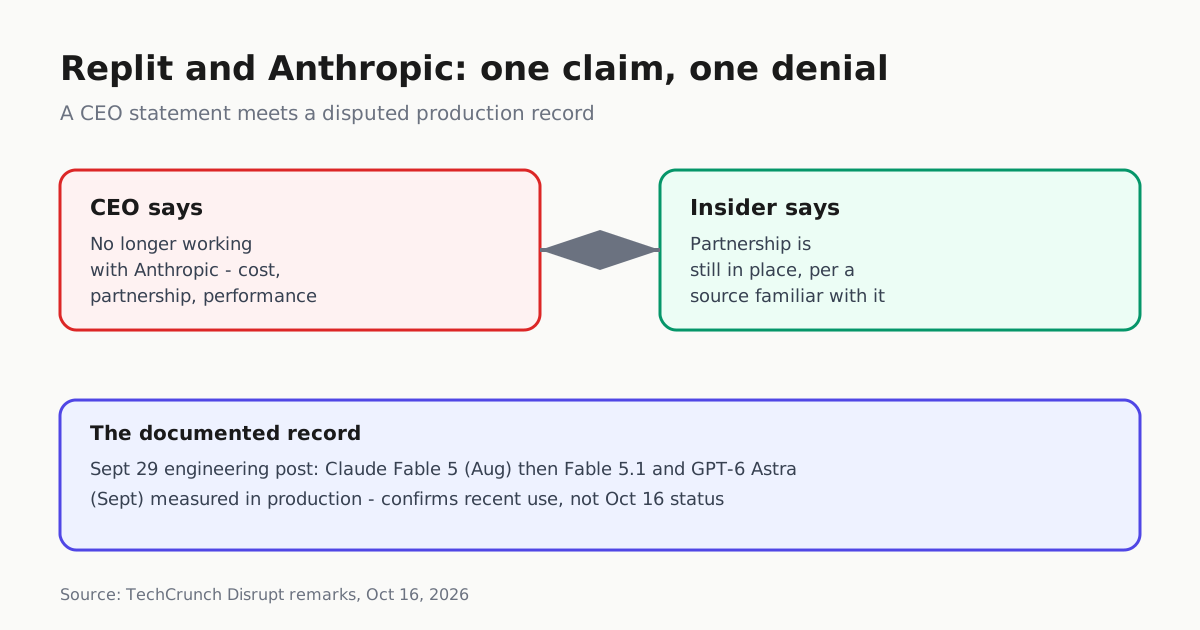
Replit co-founder and CEO Amjad Masad said on stage at TechCrunch Disrupt on October 16 that Replit “no longer works with Anthropic,” pointing to cost, partnership quality, and model performance as the reasons. “I think ChatGPT is better now,” Masad said, adding that Replit’s internal and public benchmarks show OpenAI’s Sol and Astra models “consistently” outperforming on vibe-coded app generation from scratch (TechCrunch).
That statement did not go unchallenged. TechCrunch reported that a person familiar with the Replit-Anthropic relationship, who asked not to be named, said the partnership was “still in place.” The outlet also noted evidence on Replit’s own website, blog, and social accounts that the company was using Anthropic models as recently as a few weeks ago — including a late-September engineering post citing Claude Fable 5 and Fable 5.1 running inside Replit Agent’s production environment, and a Replit product employee posting on X about using Anthropic’s Opus 5.5 around the same time.
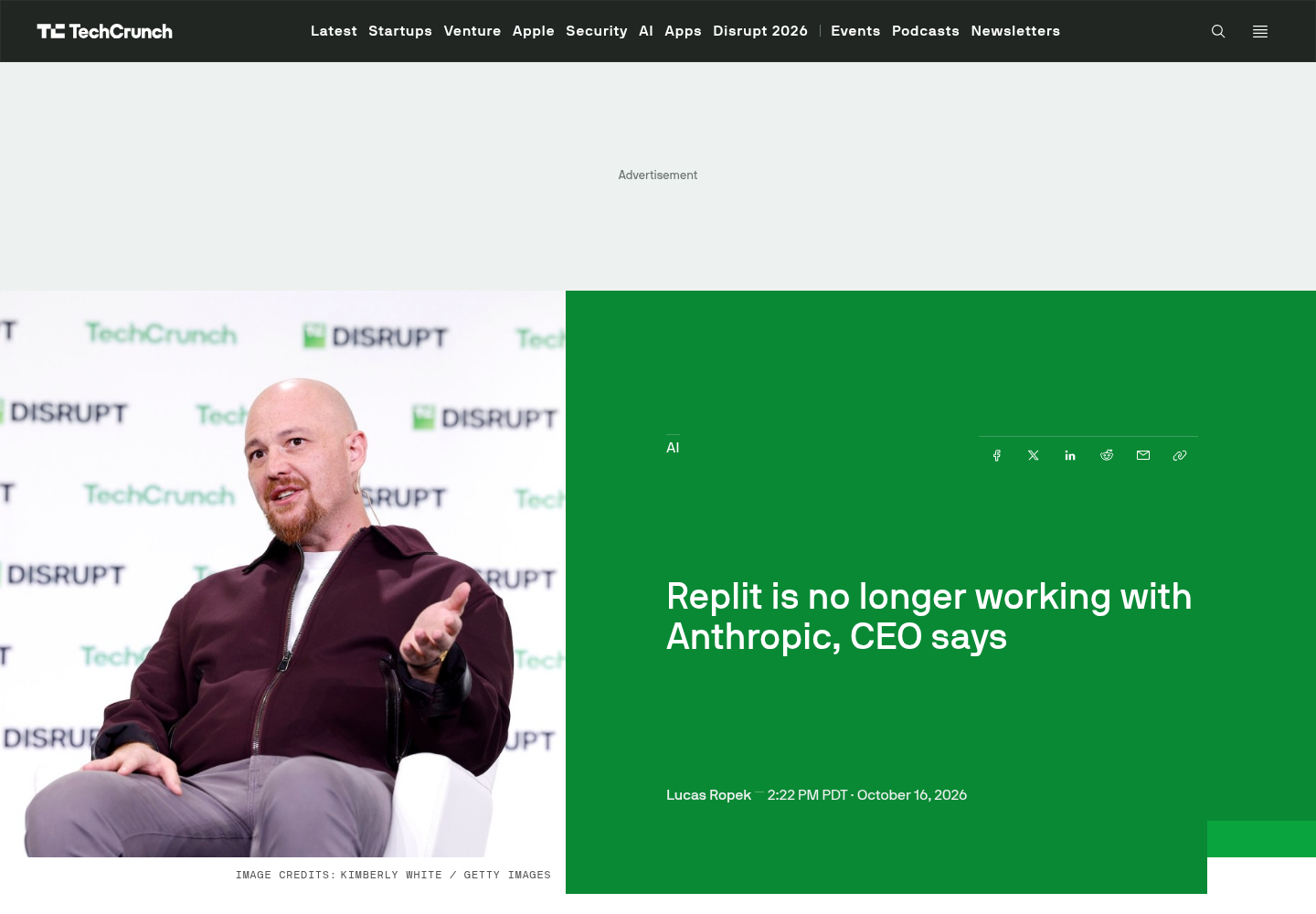
Here is TechCrunch’s report as published, showing the claim and the disputed framing side by side:
What Replit’s own data actually shows
The clearest documentary evidence sits in Replit’s September 29 engineering post, “Free the models: Harness design at the frontier,” which Superpower Daily summarized in detail. The post compared one week of production traffic per model: Claude Fable 5 in August, then Fable 5.1 and OpenAI’s GPT-6 Astra in September. That establishes Claude was in production as of last month — it does not establish whether Anthropic access continued through Masad’s October 16 remarks. Techmeme’s aggregation of the story captured the same tension in its headline: Masad’s claim, set directly against the insider’s denial.
Replit reached back out for clarification after Masad’s comments; TechCrunch said it would update the story if the company responds.
The more useful story: task-based model routing
Setting aside who is right about the relationship’s current status, the September post describes a strategy that matters more to anyone running AI coding agents: Replit doesn’t pick one model and stick with it. Its stated goal is matching each job to the model that is cheapest at acceptable quality, not routing every task — code generation, UI layout, writing slides, drafting email — through a single “best” model.
| Task type | Replit’s stated approach |
|---|---|
| Vibe-coded app generation from scratch | Benchmarked against Sol and Astra, which Masad says “consistently” perform better |
| General coding/agent harness work | Claude Fable 5 and 5.1 measured in production as recently as September |
| Non-coding tasks (UI, slides, email) | Explicitly treated as separate routing decisions, not tied to the coding-model choice |
The diagram below maps that same router logic from Replit’s own post: one dispatcher, four task categories, each pointed at whichever model currently wins Replit’s internal cost-and-quality bar — a bar that, this week, is itself in dispute.
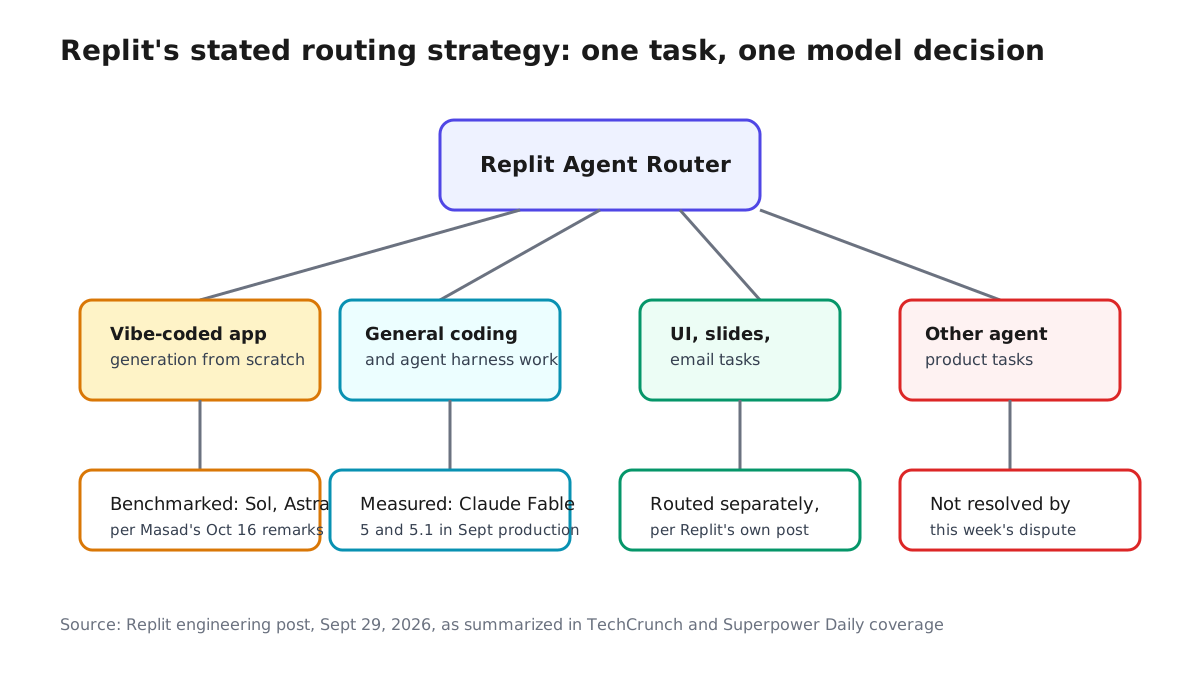
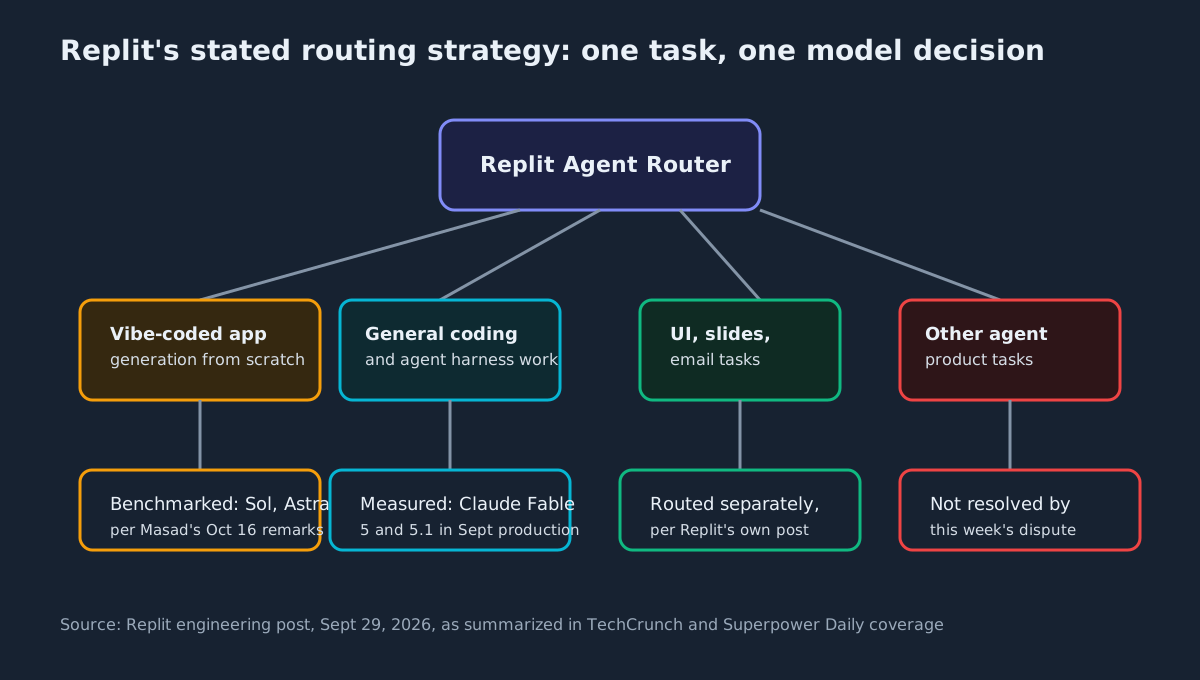
That’s the part worth taking from this story even if the Anthropic relationship questions stay unresolved: a platform running at Replit’s scale treats model choice as a per-task, re-evaluated decision driven by its own benchmark data, not a single vendor commitment. Replit announced its OpenAI partnership in August, and Masad’s framing — OpenAI as the better partner “for now” — was explicitly provisional, not permanent.
What this means for teams running multi-model fleets
For anyone operating a fleet of coding agents across providers, three things are worth doing regardless of how the Replit-Anthropic dispute resolves:
- Treat vendor cost/performance claims as marketing until you can reproduce them. Masad cited both an internal and a public benchmark; neither is visible to outsiders in this story, and Replit’s own numbers conflict with its stated current relationship.
- Log which model actually served each request, not which model your dashboard says is default. Replit’s dispute exists largely because outside observers can only infer production model usage from scattered blog posts and social media, not a live ledger.
- Re-run cost/performance comparisons per task type, not once for your whole pipeline. Replit’s own post argues coding, UI generation, and writing tasks shouldn’t share a model decision — the same logic that should guide any team routing between Claude, GPT, and open-weight models.
For more on building and auditing model-routing policy instead of trusting a single vendor’s cost claims, see Automater’s guides on reconciling vendor lane claims against your own meter data, comparing hosted routers against your own cascade, and pricing cost per completed task instead of per-token list price.
Sources
- Replit is no longer working with Anthropic, CEO says | TechCrunch
- Techmeme: CEO Amjad Masad says Replit is no longer working with Anthropic, citing cost and saying “ChatGPT is better now”; source: the partnership is still in place (TechCrunch)
- Replit CEO says Anthropic relationship has ended, but that claim is disputed | Superpower Daily