Anthropic Extends Its GSA OneGov Deal to Every Level of U.S. Government at 40% Off
Anthropic's expanded GSA OneGov deal gives federal, state, local, tribal and territorial governments 40% off Claude with no minimum spend, landing the week of its S-1 filing.
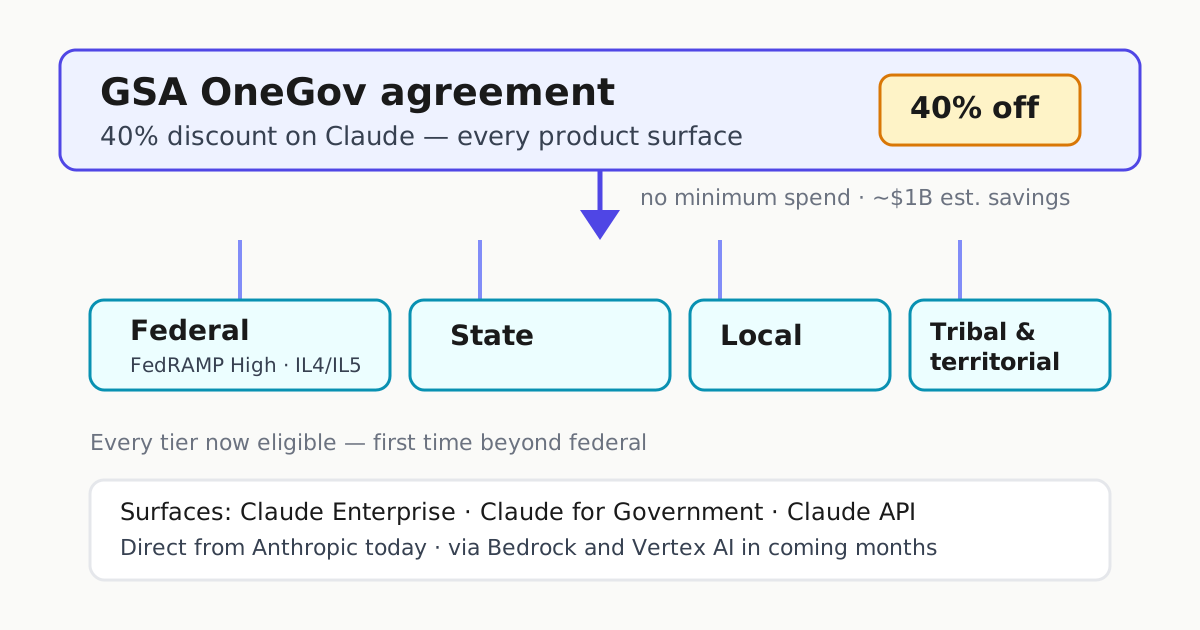
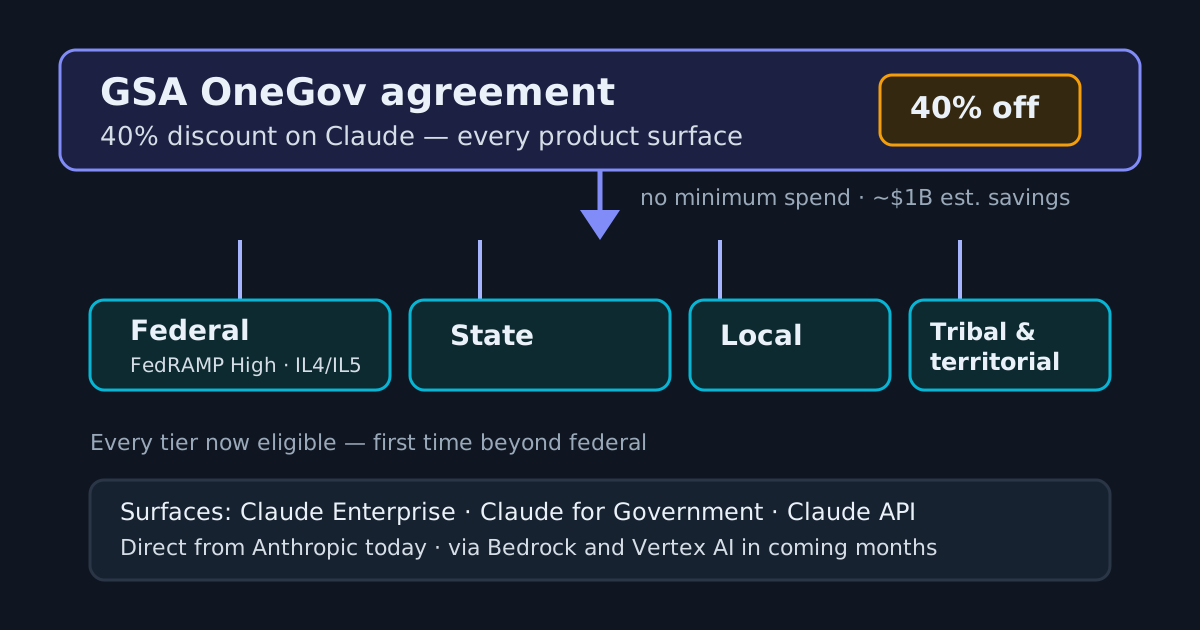
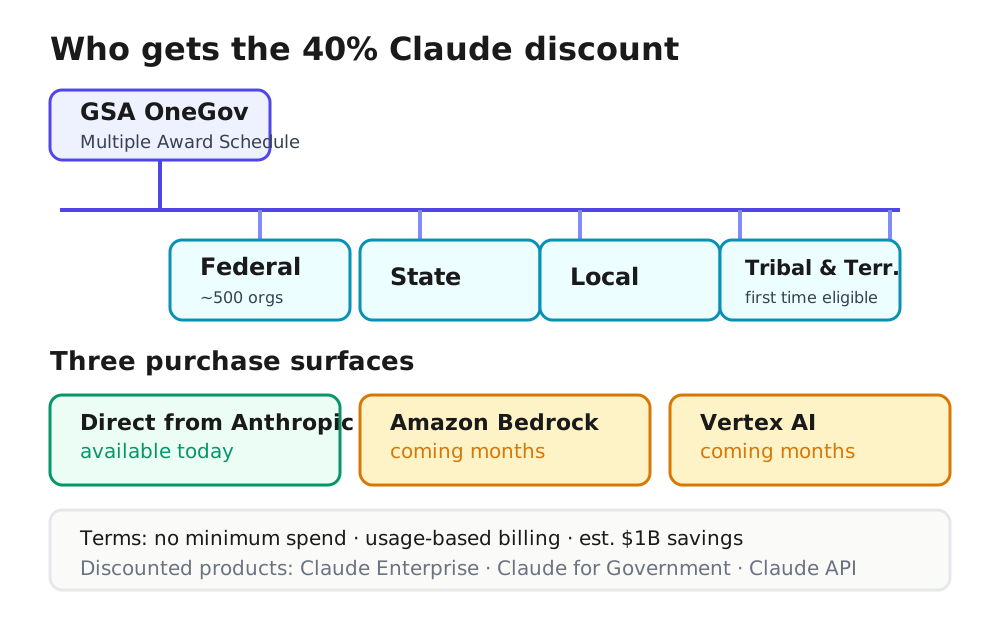
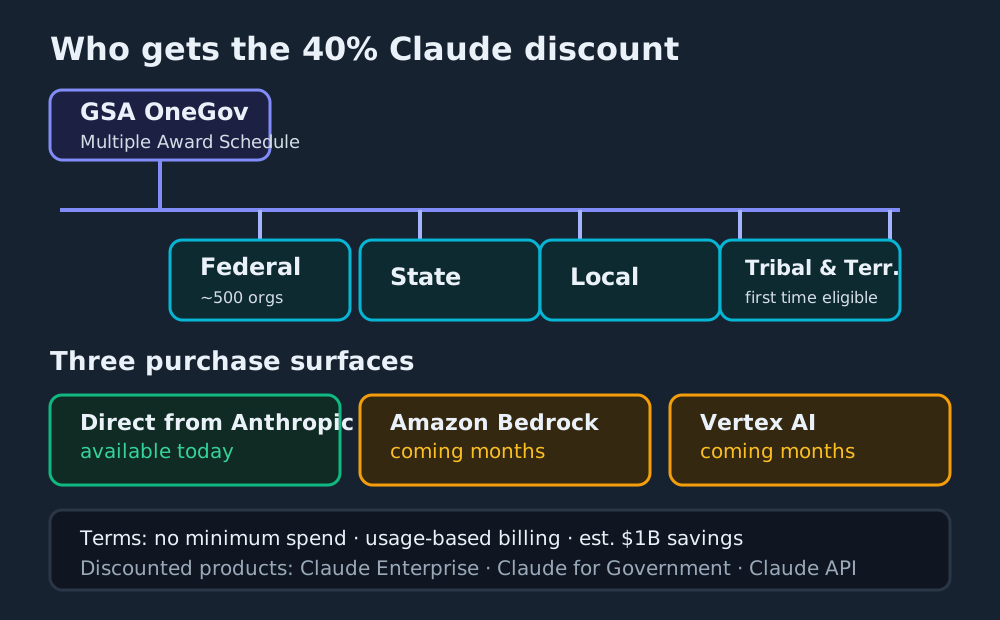
Anthropic has expanded its OneGov agreement with the U.S. General Services Administration (GSA) into the broadest public-sector pricing deal it has yet offered: a 40% discount on Claude Enterprise, Claude for Government and the Claude API, extended for the first time to state, local, tribal and territorial governments as well as federal agencies. The company announced the expansion on Oct 27, estimating the discounts will save governments roughly $1 billion, with no minimum spend commitment — agencies pay only for the usage they consume.
What the deal actually changes
The practical news is scope, not existence. A OneGov discount for federal buyers already existed; the new agreement extends it across every level of U.S. government and — for the first time — across every product surface. That includes direct purchases from Anthropic today, and purchases through cloud providers in the coming months. Agencies can already buy at the discount through GSA’s Multiple Award Schedule.
The economics matter for a buyer segment defined by tight budgets and long procurement cycles. A 40% cut on the API, the enterprise seat product and the government platform — with no minimum commitment — lowers the barrier for pilots that previously required a large upfront investment. That is a deliberate land-grab move: volume without lock-in, priced to make Claude the default experiment in agencies that must justify every line item. It also signals where enterprise AI purchasing is heading generally — what IT is actually buying increasingly includes negotiated vendor rates rather than list price.
Anthropic says roughly 500 U.S. federal, state and local government organizations now use Claude. Weekly Claude for Government active users are up about eightfold since February, and usage across federal civilian agencies has grown about 20-fold in a year. Those are company-reported figures, but the direction is unambiguous: public-sector adoption was already compounding before the discount widened.
Where agencies can actually run it
The deal lands on top of a compliance stack Anthropic has spent the year assembling. Claude for Government — which delivers Claude’s coding and agentic capabilities at near-feature parity with commercial offerings — reached general availability on September 30 at FedRAMP High. Agencies building their own tools can use Claude through Amazon Bedrock (FedRAMP High, with select models authorized for DoD IL4 and IL5 in AWS GovCloud) or Google Cloud’s Vertex AI (FedRAMP High). Claude Enterprise is in process for FedRAMP Moderate through the FedRAMP 20x program.
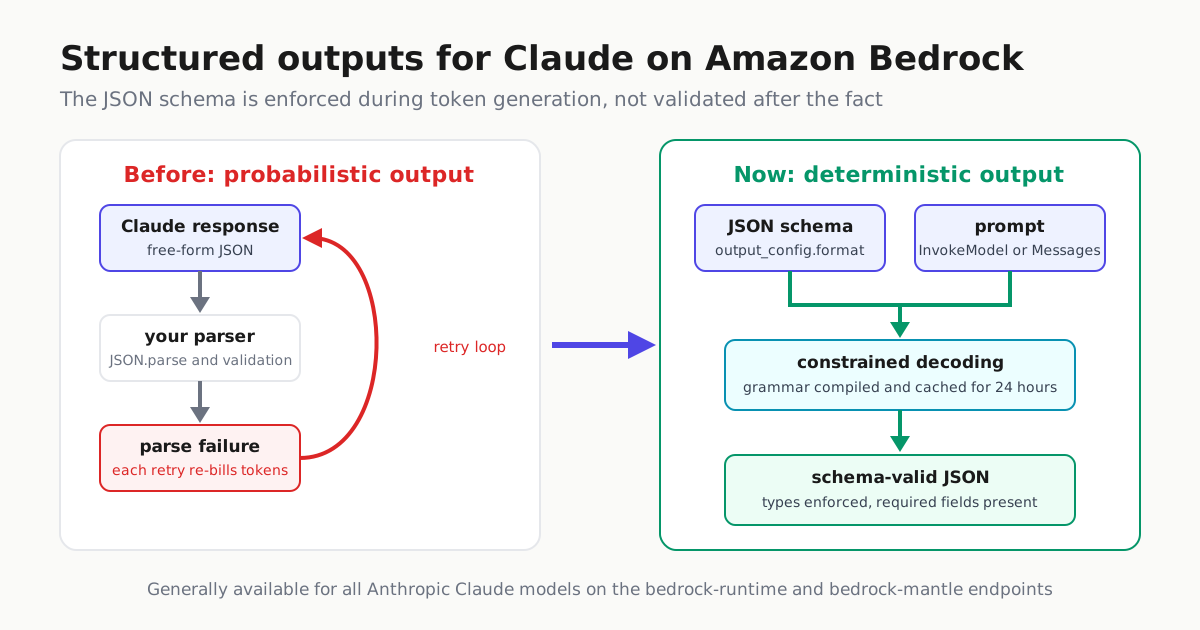
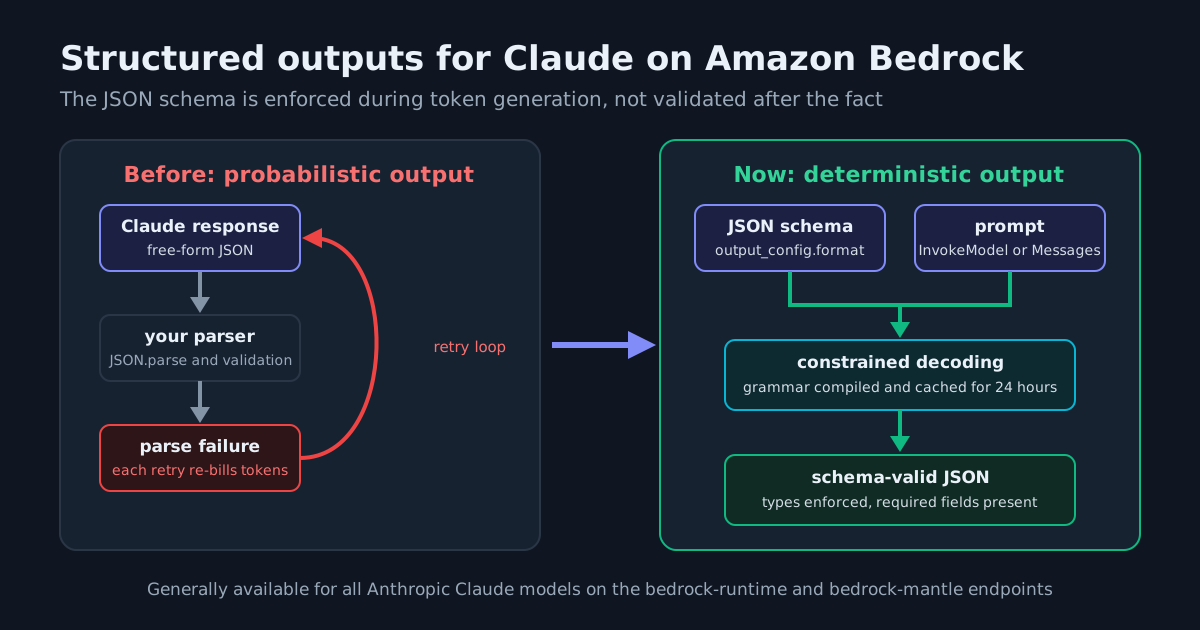
That positions Claude for what Anthropic calls agencies’ “most sensitive unclassified work” — a meaningful distinction for operators: this is not classified-workload authorization, and teams scoping deployments should read the IL4/IL5 boundaries on Bedrock carefully rather than assuming uniform coverage across surfaces. Agencies already wiring Claude into their own tooling on AWS have adjacent building blocks, like the structured-outputs support Bedrock shipped for Claude, to combine with the discount.
Anthropic also lists the workloads it says agencies are already running: backlogs, records and forms processing, and legacy-code modernization. The named examples skew toward code — Utah gave Claude Code to 34 developers across 10 state agencies, where 80% had a working environment within 30 minutes and 71% reported saving 20+ hours in a four-week pilot; a state IT developer moved nearly 900 API methods to a new framework in two days against a one-month estimate. As with all vendor case studies, these are selected successes rather than an audit — but they show where the vendor expects the volume, and where the discounted tokens will actually flow.
The timing is not a coincidence
The expansion lands the same week Anthropic filed its S-1 with the SEC for a proposed Nasdaq listing under the ticker ANT. The IPO backstory, as TechCrunch reports from the S-1, is dominated not by venture investors but by strategic ones: Amazon holds $6.2 billion in convertible notes that its own filings valued at $97.9 billion as of June 30, invested roughly $18 billion in total, and Anthropic has committed to spend at least $110 billion on AWS over the next decade. Google, holding an estimated mid-single-digit stake after dilution, has secured at least $114 billion in cloud commitments through 2033. It is part of a broader financing race — OpenAI has been racing to raise at a $1.4 trillion-plus valuation ahead of Anthropic’s mid-November listing.
That financial structure explains the GSA deal’s shape. A company carrying over $80 billion in losses against rising revenue, heading into a trillion-scale-market-cap IPO, needs a growth story with durable enterprise legs — and government is one of the largest, stickiest buyer segments available. Discounting 40% to win it now trades margin for installed base ahead of the listing. And because much of that usage will run through Bedrock and Vertex AI, the cloud commitments that fund Anthropic’s investors are fed by the same contract.
What it means for operators
For teams at any level of U.S. government, three things are concretely new: eligibility (SLTT governments, not just federal), surface coverage (API, Enterprise, Government, direct and via cloud marketplaces), and terms (no minimum spend). The discount is available today through GSA’s Multiple Award Schedule; the cloud-provider path arrives “in the coming months,” so agencies buying through Bedrock or Vertex should confirm the discount applies before assuming it does.
For everyone else, the deal is a signal about where enterprise LLM pricing is heading in 2026: large buyer segments are being won with preferential rates rather than product differentiation alone, and the labs that can afford to discount — because cloud giants underwrite their compute — will keep squeezing the ones that can’t. If your organization negotiates AI contracts, the existence of a published 40% public-sector rate is a data point worth bringing to your own vendor conversation.