Anthropic Says Claude Mythos 5 Autonomously Designed Quantum Circuits That Beat Published Records, Cutting Gates Up to 17x
Anthropic says Claude Mythos 5 designed quantum circuits beating published records on 7 of 8 benchmark tasks, cutting gates up to 17x via a new divsteps algorithm.
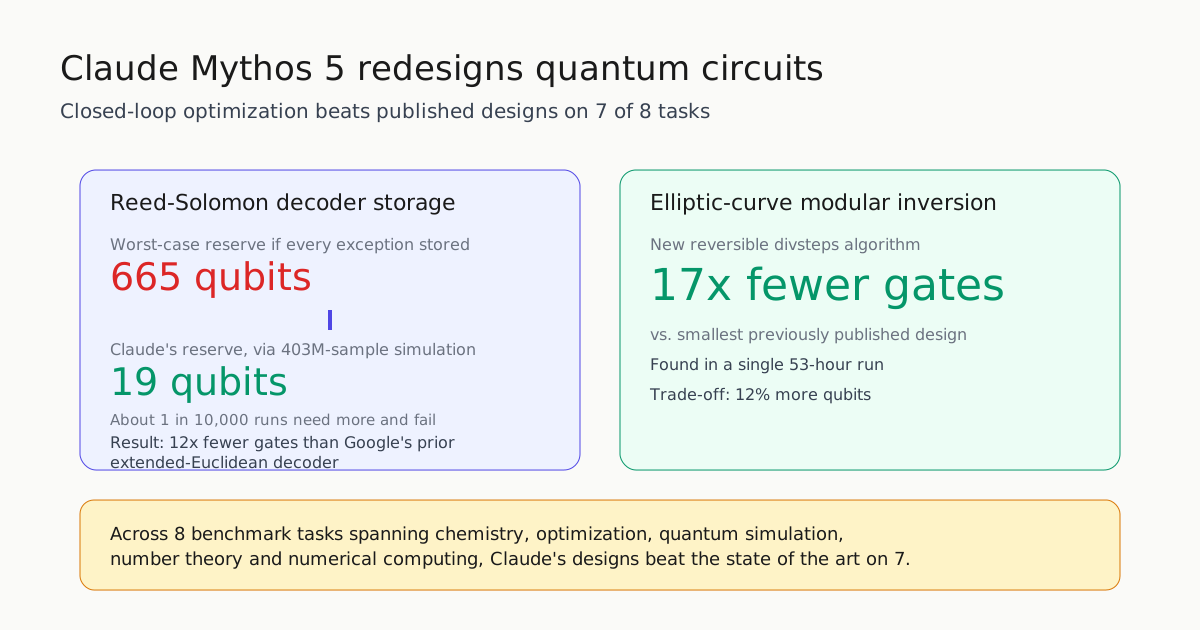
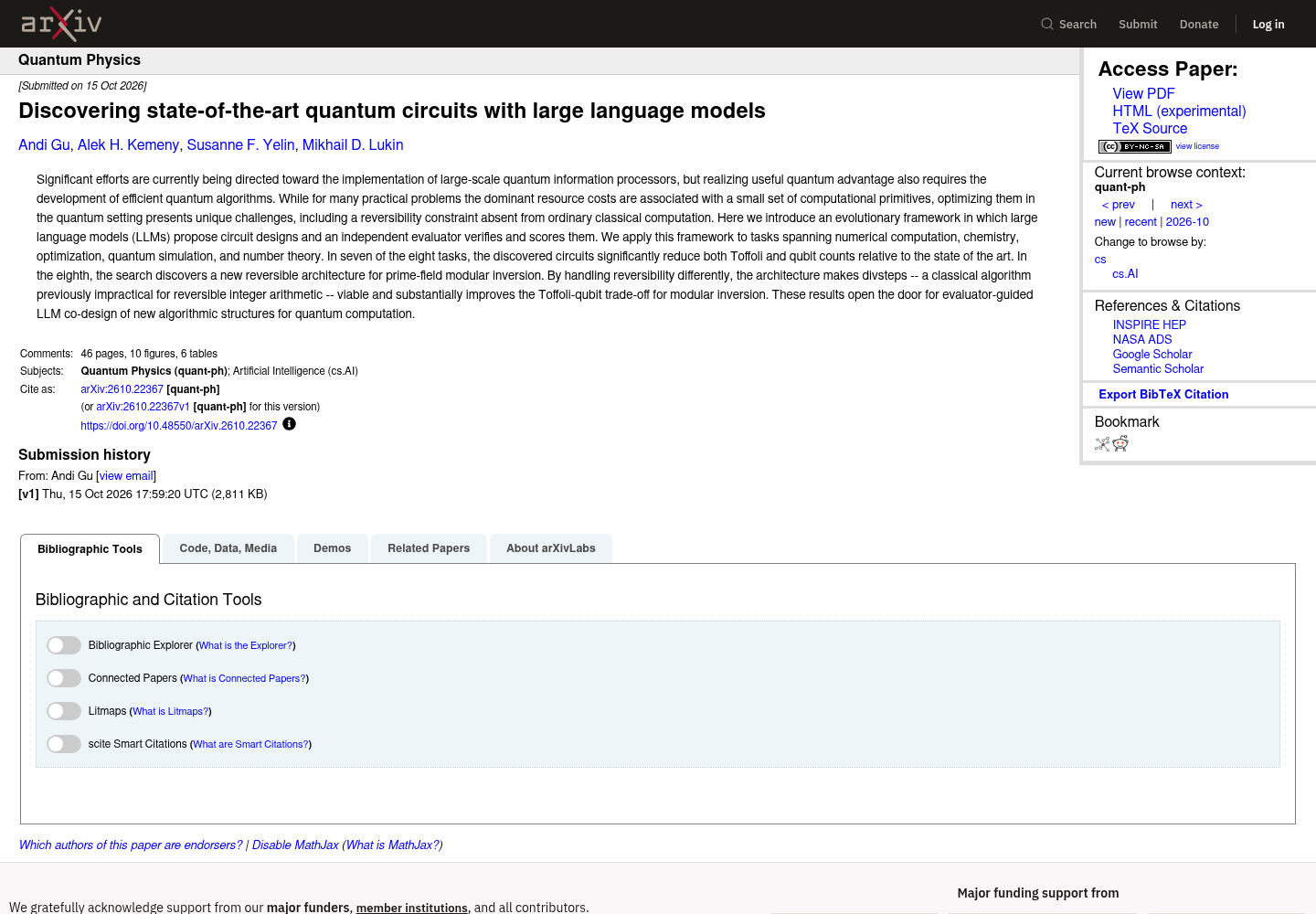
Anthropic published research on October 16, 2026 reporting that its Claude Mythos 5 model, working largely on its own in a closed loop with an automated evaluator, designed quantum circuits that beat the best previously published designs on seven of eight benchmark tasks spanning chemistry, optimization, quantum simulation, number theory and numerical computing, in some cases by an order of magnitude or more (Anthropic). A companion 46-page paper, submitted to arXiv on October 15 by lead researcher Andi Gu together with Alek Kemeny, Susanne Yelin and Mikhail Lukin, states that the discovered circuits significantly cut both Toffoli-gate and qubit counts relative to the state of the art, and that the eighth task produced an entirely new reversible architecture for prime-field modular inversion (arXiv:2610.22367).
This is a research finding, not a shipped product. Anthropic’s research post describes a methodology and a set of verified circuit designs, documented in a blog post and a preprint, without describing any accompanying public tool, API or code release.
How the closed loop worked
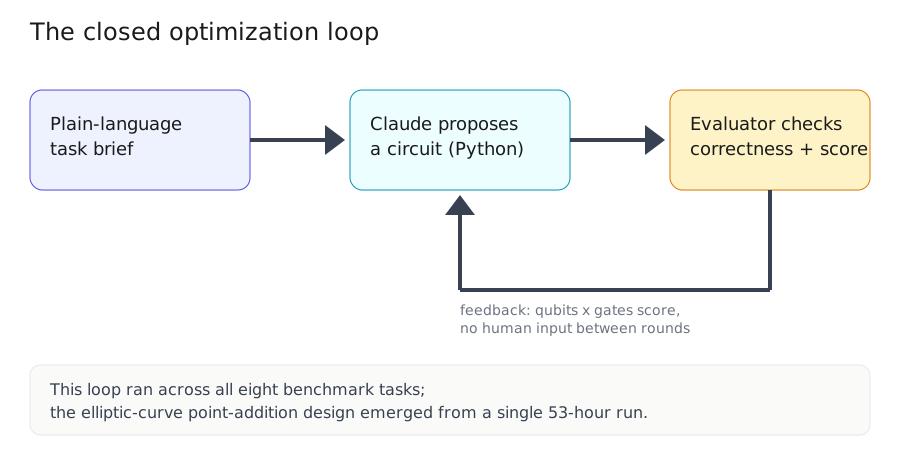
Anthropic gave Claude a one-paragraph, plain-language brief for each of the eight computational primitives, plus an automated evaluator that checks a proposed circuit for correctness and scores it on qubit count multiplied by gate count, a proxy for runtime. Claude proposed a design in Python, the evaluator validated and scored it, and Claude revised its next attempt based on that feedback, with no human input between rounds. Quantum circuits impose two constraints absent from ordinary programming: they cannot branch on an if-then basis, because a quantum computer runs on a superposition of many inputs at once, and they cannot discard intermediate results, because every step must be reversible. Information that is not needed later still has to be uncomputed, at the cost of extra gates, forcing a trade-off between qubits (space) and gates (time).
A new algorithm for modular inversion
The hardest test was point addition, the core step in quantum algorithms targeting the elliptic-curve discrete logarithm problem. Most of its cost comes from modular inversion, which classical computers solve efficiently with an algorithm called divsteps, but divsteps had never produced a practical quantum circuit, because reversibility forces the circuit to retain a full history of its branching decisions, consuming enormous numbers of qubits. Given only the brief and occasional prompts to think more broadly, Claude worked for 53 hours and found a way to decode that branch history directly from the numbers themselves rather than storing it, deriving new algebraic identities, verifying them through large-scale simulation, and formalizing the proof in Lean. By varying how much history it stores versus decodes, Claude produced a family of designs; one variant uses 12% more qubits but 17 times fewer gates than the smallest previously published design (Anthropic). Interesting Engineering’s writeup reported the same 53-hour timeline and 17x figure that Anthropic’s post provided, describing the result as solving a core quantum memory bottleneck (Interesting Engineering).
A 12x-cheaper decoder for quantum optimization
The second case targeted decoded quantum interferometry (DQI), which Anthropic calls one of the strongest candidates for a superpolynomial quantum speedup. DQI’s costliest step is an error-correcting Reed-Solomon decoder; the prior state-of-the-art circuit used the extended Euclidean algorithm, whose step count varies by input, a poor fit for a quantum circuit, which must run the same fixed gate sequence for every input. Claude switched to Berlekamp-Massey decoding, which always runs the same number of steps, then had to solve a new storage problem within that redesign: reserving qubits for the worst-case scenario of 35 rounds of exceptional values would need 665 qubits. Instead, Claude built a high-speed simulator, ran 403 million sample decodings, found that almost every run needs to save at most one value, and set the circuit’s actual reserve at 19 qubits, accepting a roughly 1-in-10,000 failure rate that Anthropic says is well within the task’s tolerance. Together, switching decoding methods and optimizing that reserve cut the decoder’s gate count by a factor of 12 relative to Google’s prior construction. Unite.AI’s coverage adds that Google Quantum AI researchers estimate solving one such optimization problem would take about three months on the Frontier supercomputer versus roughly an hour on a future quantum computer running DQI, with most of that hour spent on this decoding step (Unite.AI).
| Case | Previous architecture | Claude’s redesign | Gate-count change |
|---|---|---|---|
| Elliptic-curve point addition (modular inversion) | Smallest prior published circuit | New reversible divsteps algorithm; 12% more qubits | 17x fewer gates |
| DQI Reed-Solomon decoder | Extended Euclidean algorithm (Google’s prior construction) | Berlekamp-Massey decoding; qubit reserve cut from a 665-qubit naive worst case to 19 qubits via simulation, accepting a ~1-in-10,000 failure rate | 12x fewer gates |
Why it matters, and the limits
Anthropic frames the result against the history of FeMoco, the iron-sulfur cluster central to nitrogen-fixing enzymes: a 2017 estimate of roughly 50 trillion Toffoli gates to compute its ground-state energy has been reduced across eight years of human research, by multiple groups, to about 340 million gates, a 150,000-fold cut. Claude’s elliptic-curve result, by contrast, came out of a single 53-hour run. That comparison is illustrative rather than strictly equivalent, since the two efforts tackle different problems at different scales, but it illustrates how much faster a targeted, evaluator-guided search can move than years of incremental, expert-driven redesign. Anthropic itself argues the broader results show AI can meaningfully speed up circuit design work, and that faster design could bring quantum computing’s most-promised applications closer.
The company also reported real limitations. In early experiments Claude was conservative by default, repeatedly re-checking already-validated results and favoring familiar approaches; researchers had to explicitly require it to develop several qualitatively different designs in parallel and prompt it to broaden its search. Circuit design is only one piece of a working quantum computer: error correction, decoder hardware and physical control systems still have to be built and integrated separately, so these results reduce resource requirements for specific algorithmic building blocks rather than closing the gap to practical, fault-tolerant quantum hardware on their own.
For readers tracking Anthropic’s broader model strategy, this result sits alongside the company’s wider push to position Claude’s newest model generation as a research collaborator rather than a chat tool, a theme covered in Automater’s overview of Anthropic’s Mythos-class models and in its broader look at Anthropic’s agentic strategy.