
Accenture Caps Centrally Funded Claude at $29 per Month for Affected Enterprise Users, Pushing Overage to Project Budgets
An internal Accenture memo reported by 404 Media centrally funds only $29 per person per month toward Claude for affected Enterprise users, pushing overage to project WBS codes. What it reveals about enterprise Claude Code economics, and how to build per-seat budgets and chargeback before your own squeeze.
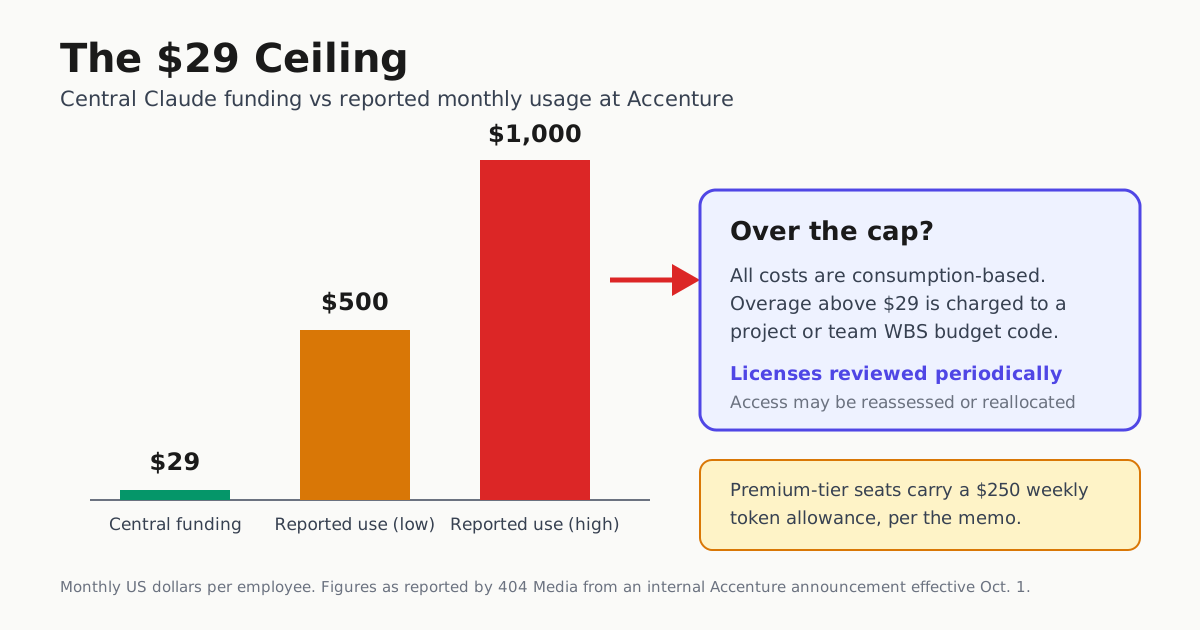
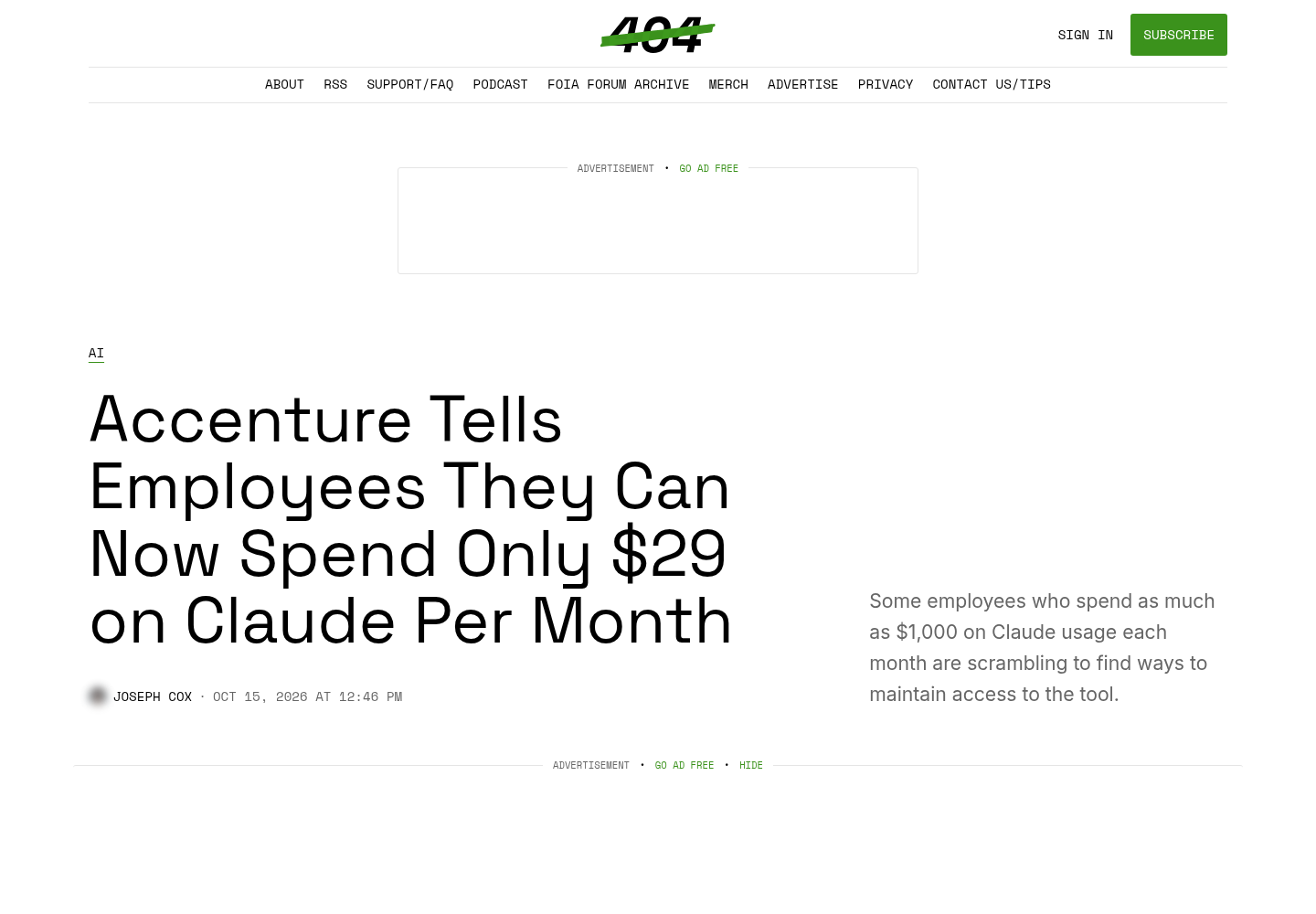
Accenture has told many of its employees — the population covered by a new change to how Claude Enterprise costs are funded — that it will centrally fund only $29 per person per month toward Claude usage, per an internal announcement obtained and reported by 404 Media on Oct 15. Effective Oct 1, affected workers must charge consumption above that allowance to a specific project or team budget code, and employees who had been burning $500 to $1,000 a month are scrambling to keep access. The change is not a company-wide flat rule: 404 Media describes Premium arrangements with $250 of weekly token usage that leave some users differently situated.
The memo, titled “Claude Enterprise Users: Important Updates to Licensing and Usage Costs,” is a sharp public look at what happens when an enterprise AI rollout meets a real token bill. For anyone running coding agents at organization scale, it reads as both a template and a warning.
What the memo says
According to 404 Media’s reporting on the announcement and on internal employee messages:
- $29 per person per month, centrally funded, for those covered. That is the entire central allowance for employees subject to the change.
- All costs are consumption-based. Overage must find a Work Breakdown Structure (WBS) code — Accenture’s handle for a project or team budget — to fund the rest.
- Tiers matter. Premium plans come with $250 of weekly token usage, but many employees are not on that plan; one message reported usage above $500 for months and a Premium upgrade “blocked on the support page.”
- Real work drives the burn. Another employee wrote they use Claude Code “extensively” to build and test an AI accelerator for multiple clients, at around $500 to $1,000 per month.
- Access is not guaranteed. “License allocations are reviewed periodically and access may be reassessed based on business priorities, role requirements, usage patterns, and evolving workforce needs,” the announcement reads. A third message showed one employee’s access revoked altogether.
- The company’s line. A spokesperson said Accenture’s approach is “to provide the right tool for the right work” and that it continues to invest in AI capabilities, skills and enablement.
Why $29 disappears fast
Anthropic’s public pricing shows the consumption billing arrangements like Accenture’s sit on. Claude Enterprise costs $20 per seat per month, billed annually with a 20-seat minimum, plus usage at API rates, and Enterprise admins can set user- and organizational-level spend limits. A $29 centrally funded allowance resembles such a spend limit written into internal policy. Neither 404 Media nor Anthropic discloses Accenture’s contract rates, models or billing route, so what follows compares public list prices to the reported allowance, not to Accenture’s bill.
At Anthropic’s list prices, $29 buys about 14.5M Sonnet 5.5 input tokens, 2.9M Sonnet 5.5 output tokens or 1.45M Opus 5.5 output tokens.
That arithmetic is ours, before batch discounts or prompt caching. Each figure isolates one charge direction, so these are scale references, not complete-session estimates. As a hypothetical, not a measured workload: an agent emitting a couple of million output tokens refactoring a codebase would land near the Opus 5.5 figure and exhaust a month of central funding in one session. Claude Code runs across terminal, IDE, desktop and web surfaces on a Claude subscription or Console account, and Anthropic’s pricing FAQ notes terminal work shares one usage pool with the plan, with pay-as-you-go API credits for heavy coding. Which route produced Accenture’s reported $500-to-$1,000 months is not established; what is established is that consumption at those magnitudes dwarfs a $29 allowance.
The chargeback flow, and what to take from it
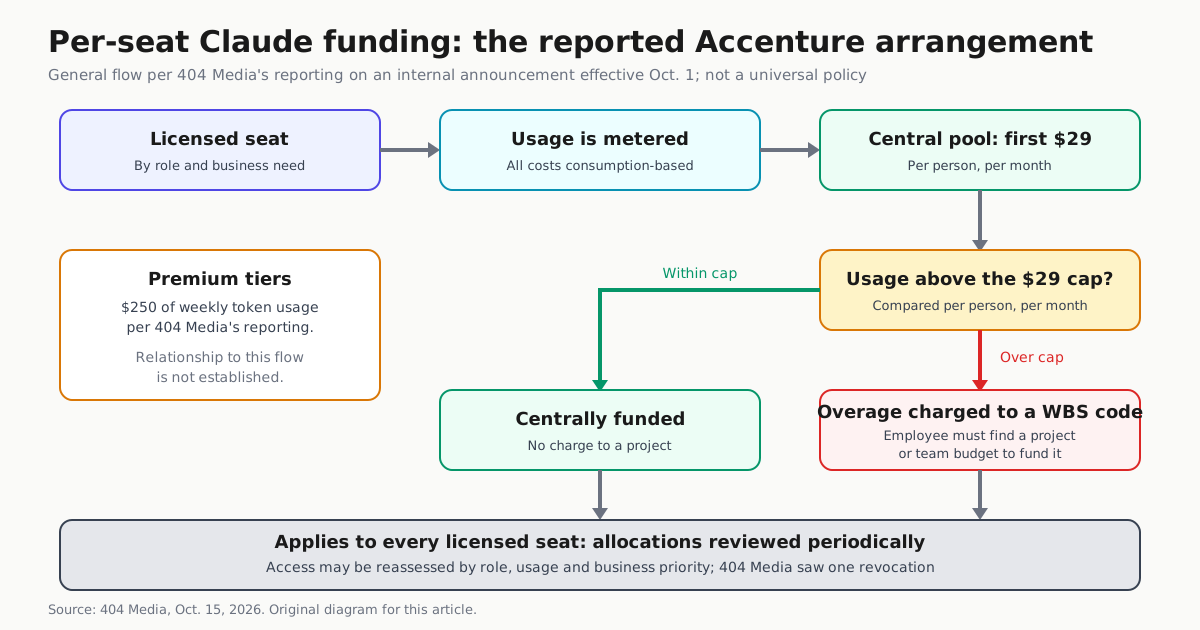
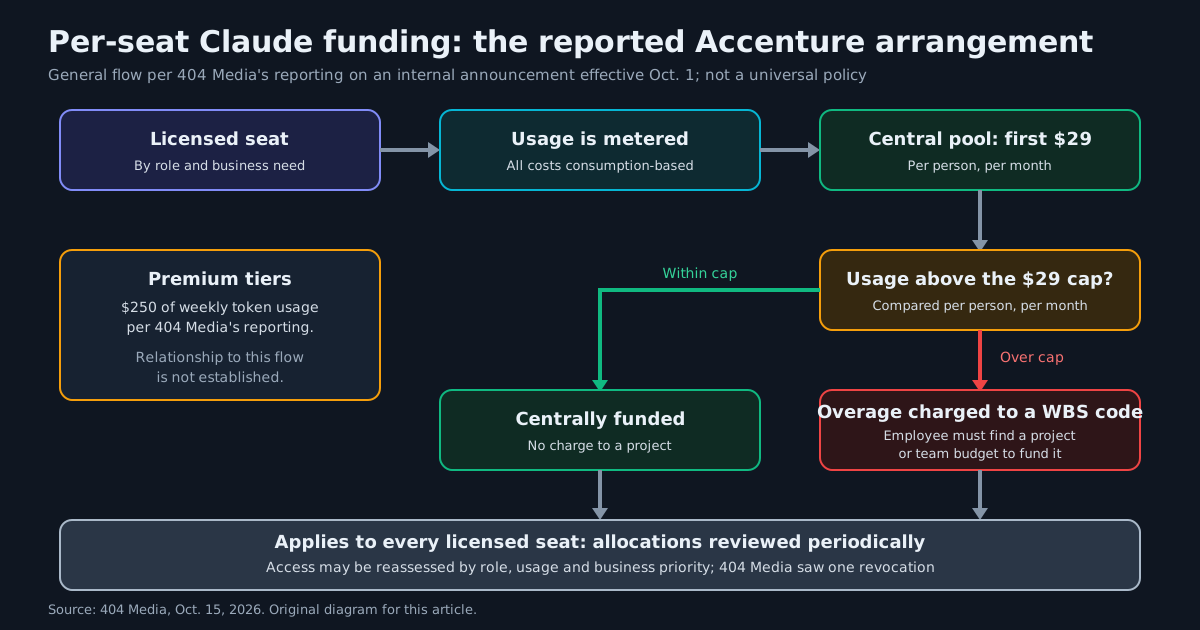
For agent-fleet operators, the reported model is a worked example of per-seat AI budgeting:
- Cap the central pool per seat. A predictable line item, not an open tab.
- Meter everything as consumption. No flat-rate illusion at the finance layer.
- Charge overage to the work that benefits. WBS-style codes turn token spend into a project cost with an owner.
- Re-review entitlements periodically. Licenses follow role, business need and usage patterns, not tenure.
Levers that shrink the bill before a hard cap:
- Route by model. Commodity work goes to Haiku 5.5, from $0.10 input and $0.50 output per MTok; reserve Opus 5.5 and Fable 5.1 for tasks that pay for themselves.
- Batch and cache. Anthropic lists batch at a 50 percent saving and Sonnet 5.5 prompt-cache reads at $0.10 per MTok against $2 for fresh input.
- Reconcile before you charge back. Match client estimates, gateway meters and provider invoices before overage lands on a team’s code; our gateway chargeback reconciliation guide walks through the three-way match.
The flat-rate era keeps wobbling
Accenture’s cap mirrors what we have tracked across tools in The Subscription Squeeze: metering creeping into arrangements that used to be flat-rate. It also validates the operating-bill-versus-token-bill framing — the seat price is small; consumption scales. 404 Media flags the irony: a firm that encouraged clients to invest heavily in AI now rations it internally.
Caveats
This is a single-outlet exclusive. 404 Media saw the announcement and internal messages; Accenture has not published the memo, and every memo detail here is as they reported it, including which populations the cap covers. Anthropic’s pricing page confirms Enterprise spend controls and current API rates but says nothing about Accenture’s contract, and the $250 weekly Premium allowance appears only in 404 Media’s account. The token figures and session example are our illustrative arithmetic on list prices, not measurements of Accenture workloads.