Factory Acquires HumanLayer and Will Open-Source It: What Current Users Should Do During the Transition
HumanLayer is joining Factory. The hosted platform stays up for a transition period, and users can export, move to Factory, or self-host the open-source code. Here is what is confirmed, what is only reported, and what to do first.
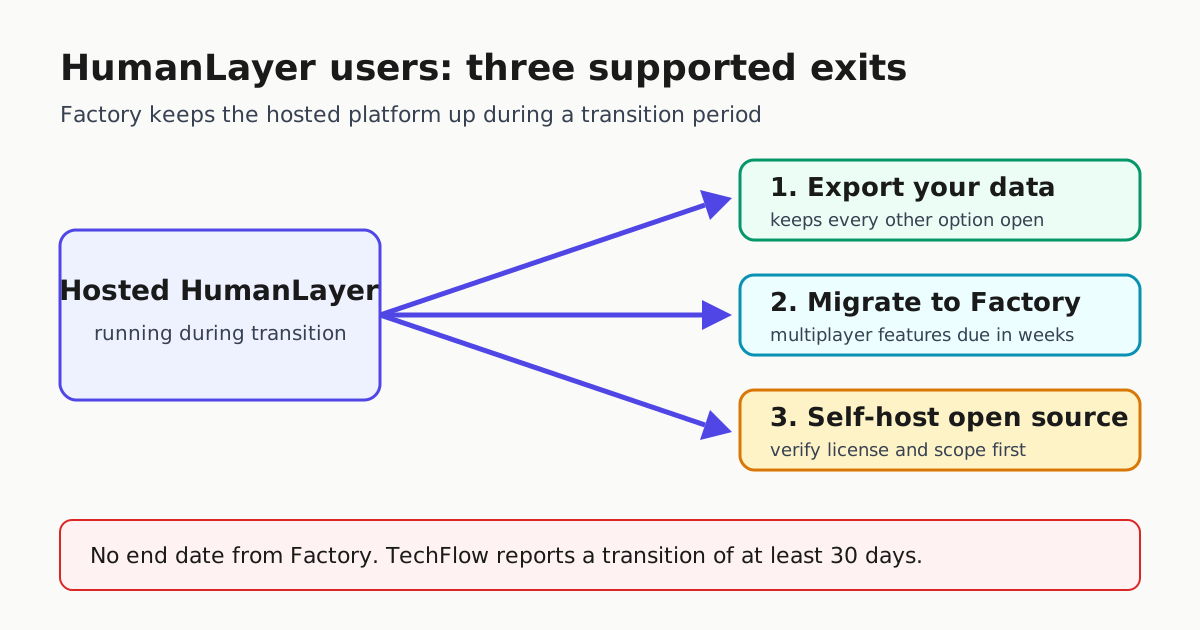
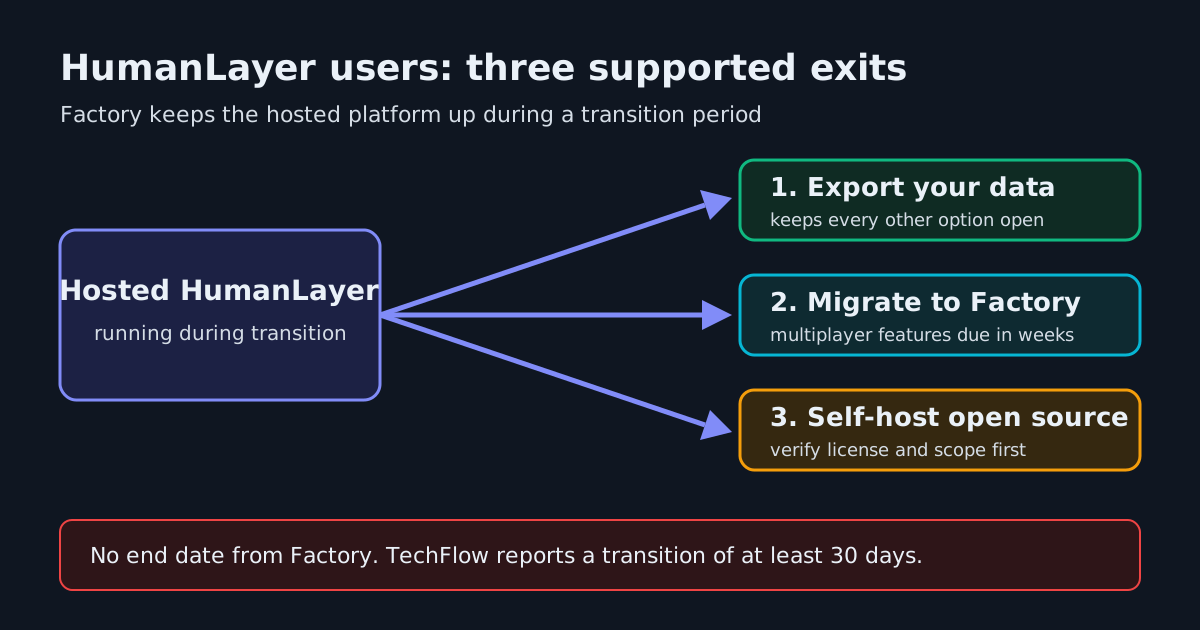
Factory said on November 4, 2026 that HumanLayer is joining Factory. Co-founders Dex Horthy and Kyle Mistele are moving over, and Factory says it will open-source HumanLayer and invite all HumanLayer users to its own platform. For teams that run coding-agent workstreams on HumanLayer’s hosted service, this is not a shutdown notice, at least not yet. It does start a migration decision, and the official announcement does not say when that decision has to be made.
What Factory actually committed to
Factory’s post makes four concrete commitments:
- The hosted platform keeps running for now. “The current HumanLayer platform will remain up and running during a transition period.”
- Three supported exits. Factory says it will help users with “any or all of: exporting their data, migrating to Factory, or self-hosting the HumanLayer open source.”
- Open source. Factory says “we will be open sourcing HumanLayer.”
- Feature transfer into Factory. “In the next few weeks,” Factory says, the HumanLayer team will bring multiplayer tasks and workstreams, plus in-app collaboration on agent-written plans, product specs and design docs.
Factory says HumanLayer has “hundreds of daily active users.” It also credits the founders with the Research/Plan/Implement framework, which Factory calls one of the first viral “skill packs”, published in August 2025.
The open-source part started before the deal. HumanLayer’s blog index lists an October 23, 2026 post titled “Open sourcing HumanLayer” with the summary “HumanLayer core is now open source. Hosted HumanLayer is unchanged for now.” The same index lists the founders’ own November 4 post, “HumanLayer is joining Factory.” Neither page explains how the core that is already open relates to the release Factory now promises, or how much of the hosted product will end up in it. Neither source we checked names the license either, so check the repository’s scope and license before you plan a self-hosted deployment.
What is reported but not on Factory’s page
Two details that matter to paying users show up only in secondary coverage. TechFlow, citing HumanLayer’s announcement, reports that the transition period will last at least 30 days. It also reports that HumanLayer will refund past monthly fees to paying users. TechFlow adds real-time session diff streams to the list of features going to Factory. Factory’s own page states neither the 30-day figure nor the refund. Treat both as reported until HumanLayer confirms them to you directly.
RuntimeWire describes HumanLayer, based on Factory’s X thread, as “a multiplayer coding agent IDE and cloud for running agents locally or in the background.” It frames the deal as Factory buying team coordination for coding agents.
| Item | Factory’s page | Secondary reports |
|---|---|---|
| Hosted platform stays up | Yes, “during a transition period” | At least 30 days (TechFlow) |
| End date | Not given | Not given |
| Export, migrate, self-host | All three supported | Same |
| Refunds | Not mentioned | Past monthly fees refunded (TechFlow) |
| Open-source license | Not stated | Not stated |
| Features moving to Factory | Multiplayer tasks, collaboration on plans, specs and design docs | Adds live session diff streams (TechFlow) |
How this differs from the Conductor deal
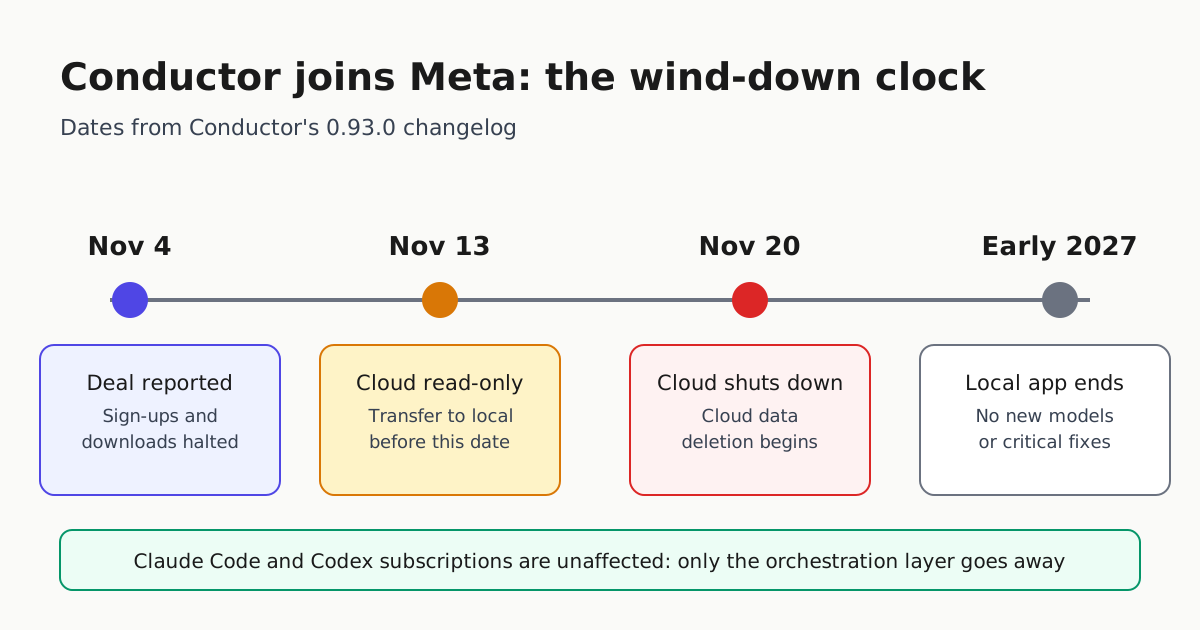
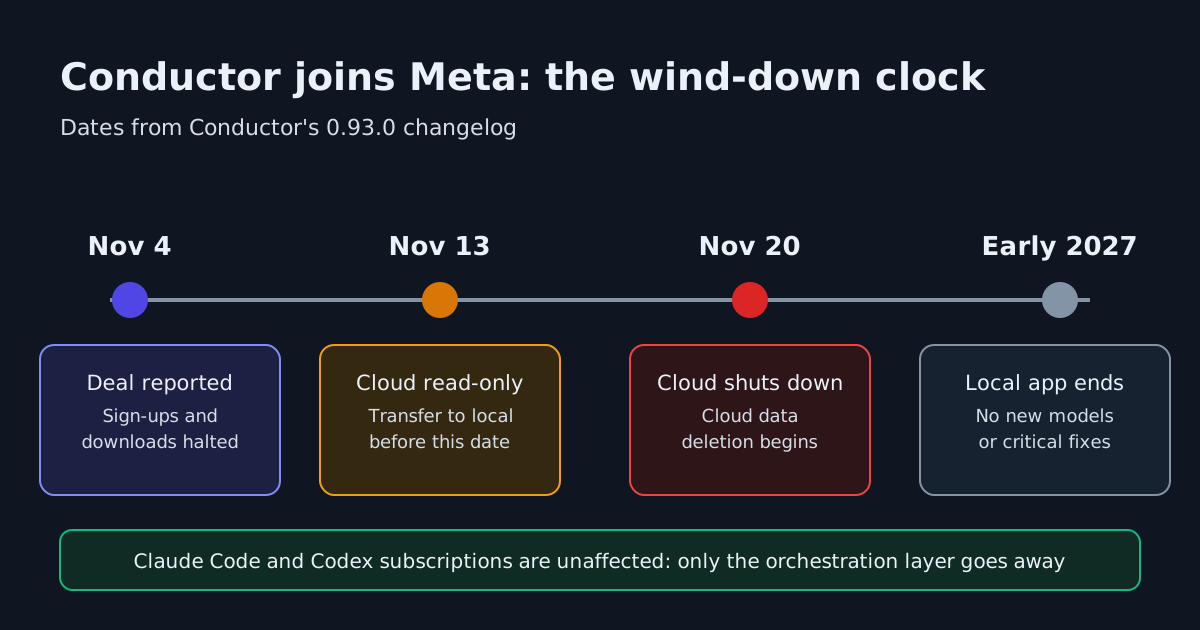
Same week, similar shape: a big buyer takes in a small multi-agent coding tool. The user impact is very different. When Meta bought Conductor, users got fixed read-only and shutdown dates. HumanLayer users get an open-source fallback and no published end date. That is better for anyone willing to run the code themselves. It is riskier for anyone who waits for a deadline before acting. In practice, the minimum is the 30 days TechFlow reported.
What to do this week
- Export first, then decide. Exporting is one of the three supported paths, and it keeps your other options open. Pull whatever your team stores only in the hosted service, such as workstream history and agent-written plans or specs, while the platform is still up. Our guide to exporting vendor-hosted agent evidence covers what to capture and how to check that the export is complete.
- Get the dates and billing terms in writing. Ask HumanLayer to confirm the transition length and the refund TechFlow reported. Find out whether billing stops now or at cutover.
- Choose by how much control you need. If your team relies on running agents inside your own infrastructure, self-hosting the open-source code keeps that model. Check the license and the scope of the release first. Some parts may stay hosted-only. If your team wants to keep multiplayer collaboration, Factory’s Droid platform is where the HumanLayer team says those features are going, but Factory says they are still weeks out. Put a dated check on your calendar and don’t migrate before they ship.
- Keep the workflow apart from the vendor. Research/Plan/Implement is a method, not a hosted feature; Factory credits the founders with publishing it as a skill pack in August 2025. If your RPI prompts, skills and CLAUDE.md or AGENTS.md conventions live in your repositories, they move with you whichever path you pick. If they live only in hosted HumanLayer, copy them into version control first.
- Run one migration rehearsal. Take one real workstream and run it end to end on your chosen target, whether that is self-hosted or Factory, while the hosted service still works as a fallback.
Why it matters beyond HumanLayer
Acquisitions keep folding small coding-agent tools into larger platforms. Conductor went to Meta, and OpenAI is buying Pierre for Codex. Each deal raises the same question for users: if this vendor disappears, can we still run our agent workflow? HumanLayer users have a better answer than most, because the code is being opened up. That answer only holds if you test it before the transition period ends.