Google Is Shutting Down Jules: Finish Sessions by Nov. 11, Export Your Data Before Dec. 31
Google is retiring Jules, its asynchronous GitHub coding agent. Here are the dates, what the official export saves, which automations will stop and what Google has not said about Antigravity.
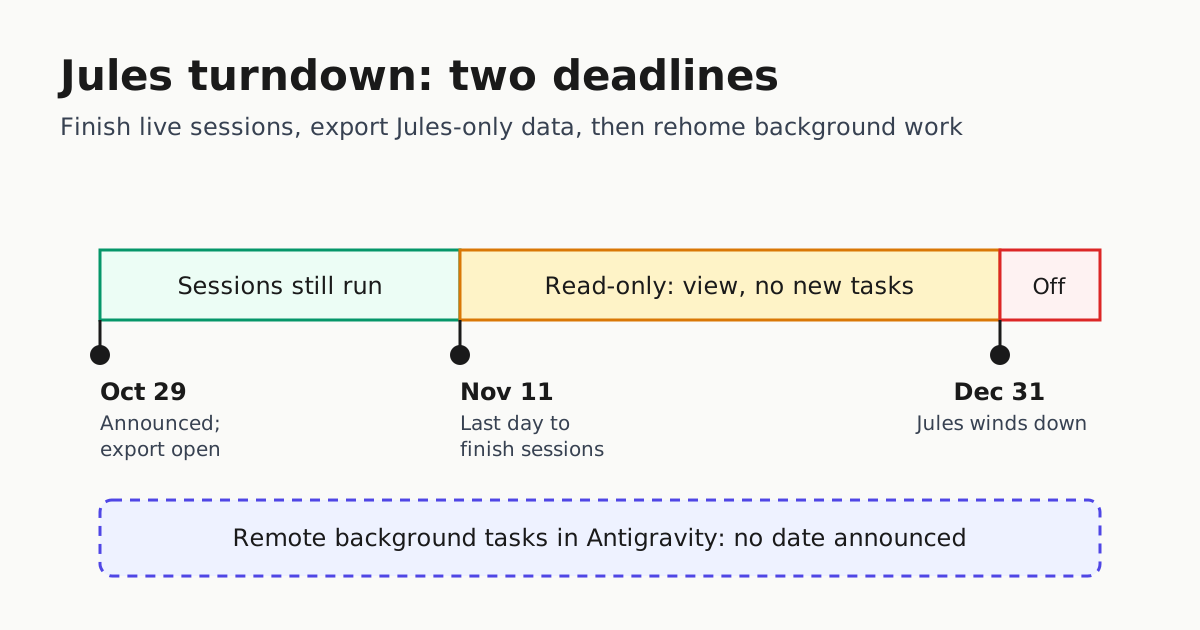
Google is retiring Jules, the asynchronous coding agent that took a prompt or a labeled GitHub issue, worked in a cloud VM and returned a pull request. On Oct. 29 the official Jules account on X said Jules “will be winding down” while Google brings its learnings into Antigravity. The account said the goal is “autonomous remote background task execution and an agent-first development environment.”
The operative details are in Google’s Jules changelog, which describes the shutdown as part of the company’s work “to unify our agentic coding efforts.” If your team gives Jules backlog work, the time left to act is short.
The dates
| Date | What Google says happens |
|---|---|
| Now to Nov. 11, 2026 | You can keep finishing up sessions. Export is available now. |
| After Nov. 11, 2026 | Jules becomes read-only until the end of the year. |
| Dec. 31, 2026 | Jules winds down. |
| No date given | Jules-style remote background execution in Antigravity. |
Google gives no time of day for either cutoff. Treat Nov. 10 as your real deadline for live work, and don’t leave the export until December.
What survives and what you have to export
The changelog draws a clear line. “Your code, branches, and pull requests already live in GitHub, so they stay where they are.” Everything else that lives inside Jules has to be exported. That covers account settings, environment variables, scheduled tasks, connected repositories, memories, setup scripts and every session, including its prompt, plan, full activity log and code patches.
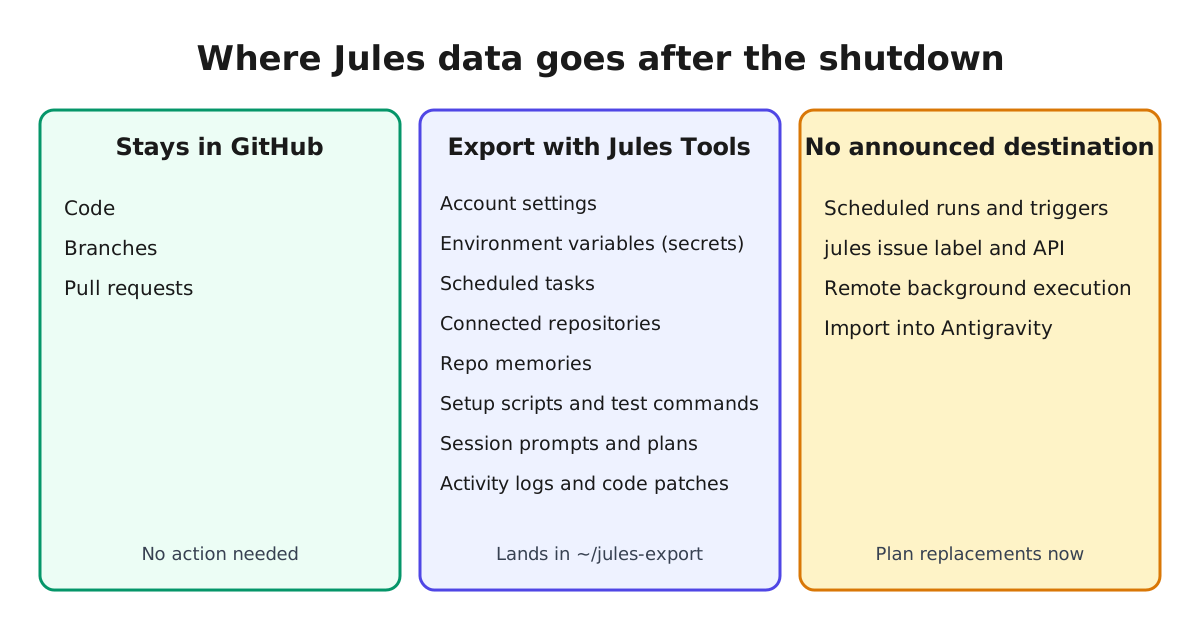
The export does not move anything into Antigravity. Times of AI notes that Google has not confirmed whether users can transfer session histories, memories or scheduled tasks directly. The changelog only describes saving them to a local folder.
How to run the export
Google’s process uses the Jules Tools CLI:
npm install -g @google/jules
jules login
Next, Google says to open a CLI coding agent from your home directory and paste the export prompt from the changelog. Its example agent is Claude Code. Chrome Geek pointed out that it is notable for Google’s own guide to name Anthropic’s tool. The prompt tells the agent to check your setup, run a Python export script and report what it saved. Results go to ~/jules-export, with one folder per repository and one folder per session. Each session folder holds a readable summary.md, the activity log and the diffs.
Google’s own prompt lists several caveats you should know before running it:
- It reads your Jules credential. The script pulls the CLI’s access token from the macOS Keychain, the Linux secret store or
~/.jules/cache/oauth_creds.json. Read the script before you paste it into an agent session. The prompt tells the agent not to print the token or the values inenv-variables.json. - It relies on undocumented endpoints. Settings, environment variables, repos and memories come from an internal
$rpcendpoint. Sessions come from REST endpoints underaida.googleapis.com. Google warns that if these start returning 404 or 400 errors, the agent should report the failure instead of guessing at a fix. Export early, while these endpoints still answer. - The token is short-lived. It expires about an hour after login. If every call returns a 401, sign in again.
- Connect GitHub first. Otherwise the export won’t include repository data.
- The export holds secrets.
env-variables.jsoncontains your environment variable values in plain form. Keep the folder private and out of your repositories.
If your evidence or audit policy needs agent session history, store this export as the record. Our guide to exporting vendor-hosted agent evidence before access changes applies directly here.
Find the automations that will stop
Jules was built to run without supervision, so some of its work runs on triggers nobody checks anymore. The changelog documents several ways to start Jules work:
- Scheduled tasks for recurring jobs such as weekly dependency checks or nightly lint fixes
- The
juleslabel on GitHub issues - The Jules REST API (
jules.googleapis.com/v1alpha/sessions), which Google pitched for Slack, Linear, Jira and CI/CD integrations - Suggested Tasks, CI Fixer and the Render integration, which pushed fixes to Jules-created PRs
- PR comment responses, where Jules pushed commits in reply to review comments
Google has not given a separate end date for each of these. Still, a read-only service does not accept new tasks, so plan as if every trigger stops working after Nov. 11. Find any scripts or bots that call the API and remove them or add a fallback, so they don’t fail without anyone noticing. Copy your scheduled-task definitions out of the export, because those are the jobs you will have to rebuild somewhere else.
Where the background work goes
Google names Antigravity as the destination but gives no date for Jules-style remote background execution there. Our guide to Antigravity after Gemini CLI covers Google’s earlier consolidation in the same direction. Crypto Briefing adds a cost detail: Jules’ free tier allowed 15 tasks a day with three running at once, and nothing equivalent has been announced. That figure comes from Crypto Briefing, not from Google’s notice.
If you need unattended issue-to-PR work in the meantime, you have to choose a replacement now. Options include scheduled and cloud runs in Claude Code, Cursor’s cloud agents or GitHub Copilot’s cloud agent. Pick based on how your repos, secrets and review gates are set up, not on what feels most like Jules. Your exported setup.sh and test-command.txt files help here, since they record the environment Jules actually needed. The broader lesson is the same one in our harness die-off analysis: keep the prompts, setup scripts and gates under your own control so a vendor shutdown costs you a migration, not your workflow.
This week’s checklist
- List every repo connected to Jules (
jules remote list --repo). - Finish or publish any in-flight sessions as branches or PRs before Nov. 11.
- Connect GitHub, run the export and confirm the session and patch counts it prints.
- Move
env-variables.jsonto a secrets store, then delete the plaintext copy. - Turn off API callers, label automations and scheduled tasks, or point them at a replacement.
- Assign someone to watch Antigravity for a background-task date. Until Google gives one, don’t plan around it.
Sources
- Jules on X: "When we launched Jules, it was an experiment to learn how asynchronous coding agents can help developers ship faster. Seeing what you built taught us so much about where agentic development is headed, directly shaping several products across @Google. We’re working on bringing our lear…
- Changelog | Jules
- Google winds down Jules AI agent, folds its learnings into Antigravity
- Google to Shut Down Jules AI Coding Agent in December 2026
- Jules Ends Dec 31 as Antigravity Adds a Plugin Marketplace - Chrome Geek