
Google Opens SynthID Detector to Everyone, Adding Verification for OpenAI, Nvidia and Kakao AI Media
Google is rolling its SynthID Detector out globally so anyone can check images, video and audio for AI watermarks from Google, OpenAI, Nvidia and Kakao — with real limits on what it can and can't catch.
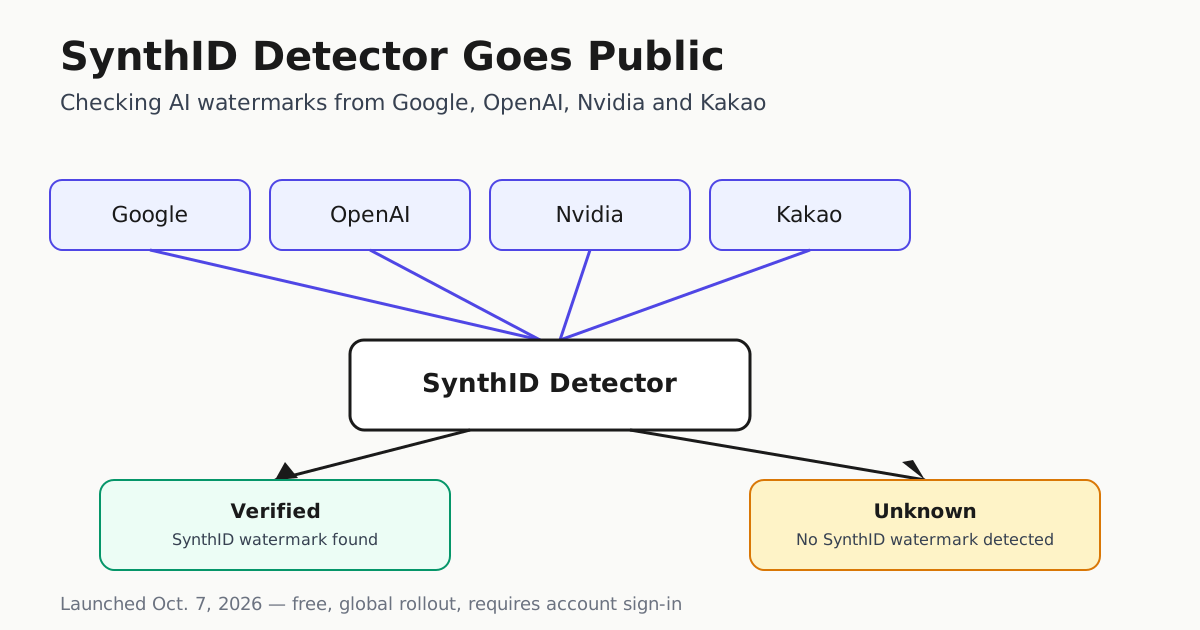
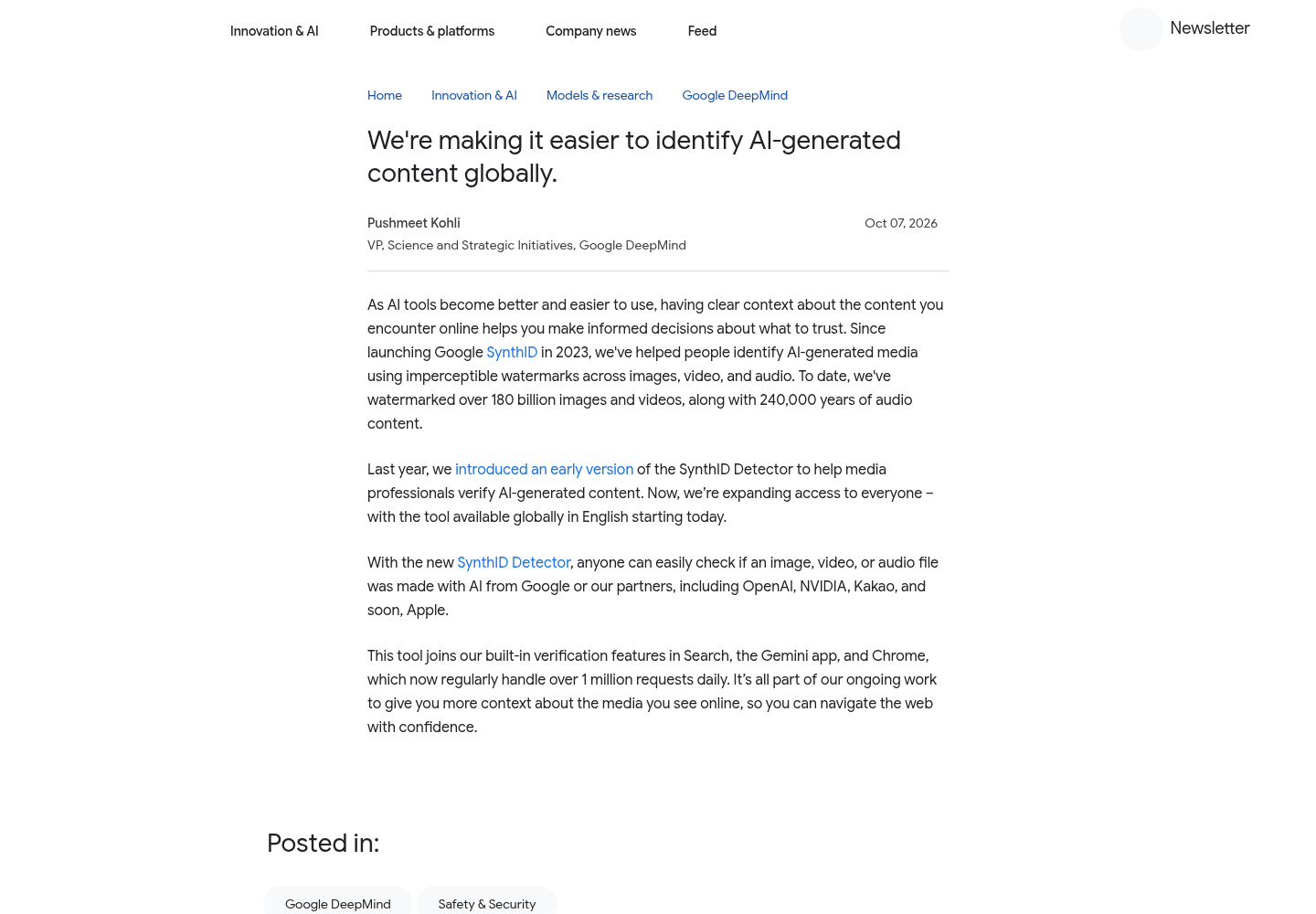
Google DeepMind said on Oct. 7, 2026 that it is opening its SynthID Detector to the general public worldwide in English, ending a year-long restriction that limited the tool to journalists and other media professionals. The announcement, posted by Google DeepMind VP of Science and Strategic Initiatives Pushmeet Kohli, frames the move as part of Google’s effort to give people “clear context about the content you encounter online” as AI generation tools get easier to use (Google DeepMind blog).
From single-vendor tool to cross-industry checker
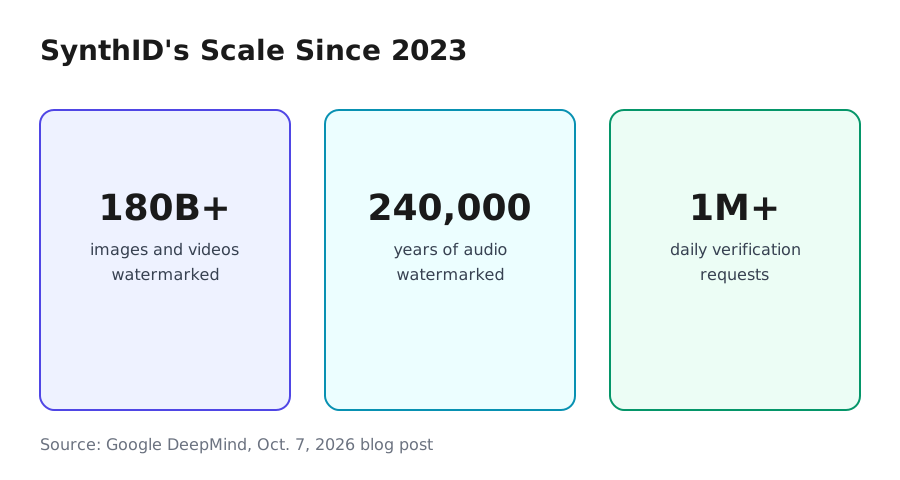
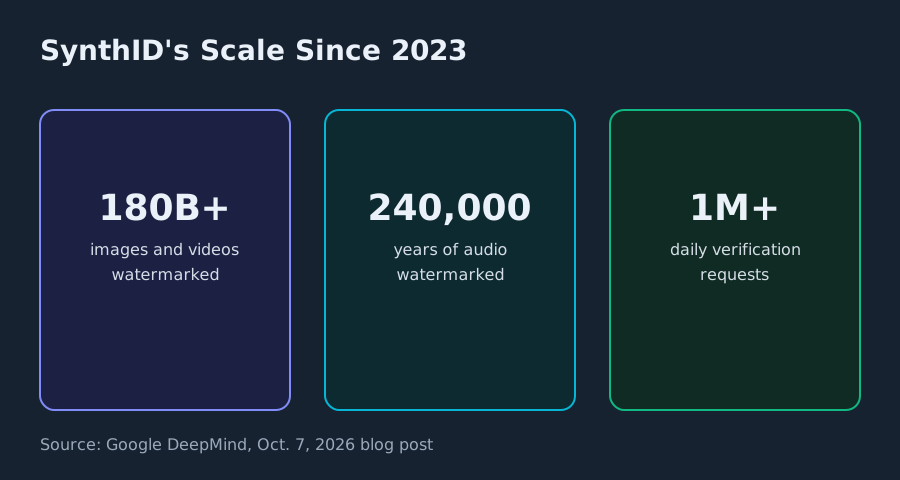
SynthID is the imperceptible watermark Google has embedded in AI-generated images, video and audio since 2023. According to Kohli’s post, Google has now watermarked more than 180 billion images and videos and roughly 240,000 years’ worth of audio content. Verification was previously confined to a limited rollout for media professionals; starting today, anyone can use the detector.
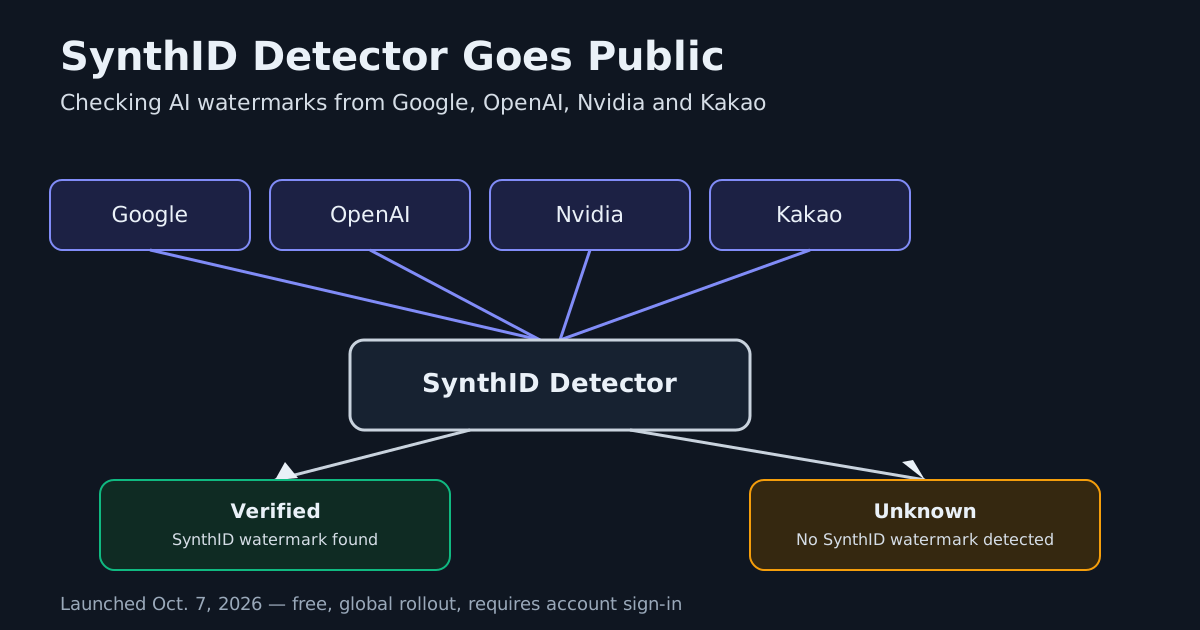
The bigger change is what the detector can check. It now verifies SynthID watermarks not just from Google’s own models but from outside labs too — OpenAI, Nvidia and Kakao — with Apple support described as coming “soon.” That turns SynthID Detector from a Google-only feature into what may be one of the first shared, cross-vendor verification layers for AI-generated media, built around a single watermarking standard rather than one company’s output.
Google also noted that SynthID checks already run inside Search, the Gemini app and Chrome, and that those built-in features now handle more than 1 million verification requests per day — a scale figure that signals how much quiet, automatic checking already happens before anyone opens a dedicated detector tool.
Access isn’t frictionless, however. As SiliconANGLE reported, the web-based detector requires users to sign in with a Google, OpenAI or Apple account before uploading a file (SiliconANGLE). MacRumors confirmed the same sign-in requirement and the partner list, adding that Apple’s support is planned for later this year rather than available now — an announcement-versus-availability distinction worth keeping straight (MacRumors).
What the tool can’t do
Both outlets flagged the same structural limitation: SynthID Detector only finds SynthID watermarks. It has no way to flag AI content generated by models that don’t embed that specific watermark. SiliconANGLE pointed out that Anthropic’s Claude, xAI’s Grok and the large population of open-weight Chinese models carry no SynthID tag at all, meaning the detector will simply miss anything they produce. Meta has its own separate watermarking system for content made with its Muse Image model, and MacRumors noted the detector cannot tell whether a file was generated entirely by AI or merely edited with AI tools — it can only confirm a watermark’s presence, not explain how the content was altered.
Google appears to acknowledge the gap. SiliconANGLE quoted language from the SynthID Detector’s own site stating the company is “continuously working on extending our partnerships” and that “building industry-wide standards takes time, and different content types (image, audio, video) have different technical requirements.” Google describes its goal as a “layered ecosystem where watermarking, metadata standards, and verification tools work together across the industry” — language that reads as an admission that no universal AI-detection standard exists yet, and that SynthID is a bid to become the de facto one rather than a finished solution.
Why it matters beyond the tool itself
The practical significance here is that this is live, shipped access rather than a roadmap promise: the detector is available today, not pending a future release. For newsroom and policy readers, the more consequential detail may be the standard-setting angle — Google now has OpenAI, Nvidia and Kakao using a shared watermark format it controls and verifies, with Apple expected to join. That positions SynthID as infrastructure other companies plug into rather than a one-off feature, at a moment when regulators are increasingly asking platforms to disclose synthetic content. Automater’s prior coverage of the EU AI Act’s Article 50 disclosure rules is directly relevant context for builders tracking how provenance tools like this intersect with legal obligations (EU AI Act Article 50 Is Live).
The caveats matter just as much as the capability. A detector that only catches one company’s watermark format, requires an account to use, and can’t distinguish full generation from editing is a meaningful step toward provenance tooling — not a general-purpose AI detector. Readers evaluating claims about “AI detection” tools should treat SynthID Detector’s scope narrowly: it verifies a specific watermark from a growing but still partial list of partners, nothing more.