Schools that fully block Google student AI also lose Search
On 3 November 2026 TechCrunch and Ars Technica reported a later K-12 rollout: student AI stays off unless administrators enable Gemini, a notebook tool, Gemini in Classroom, and Search. A full block removes student Search. Techmeme relays an early-2027 Times timing; the three clocks differ.
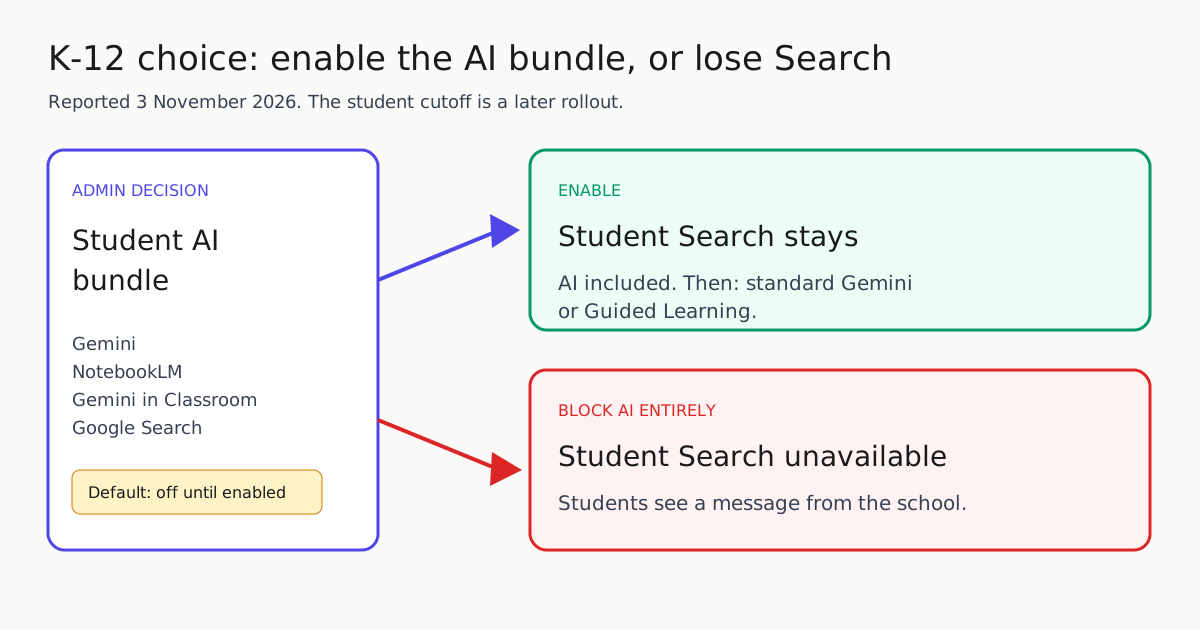
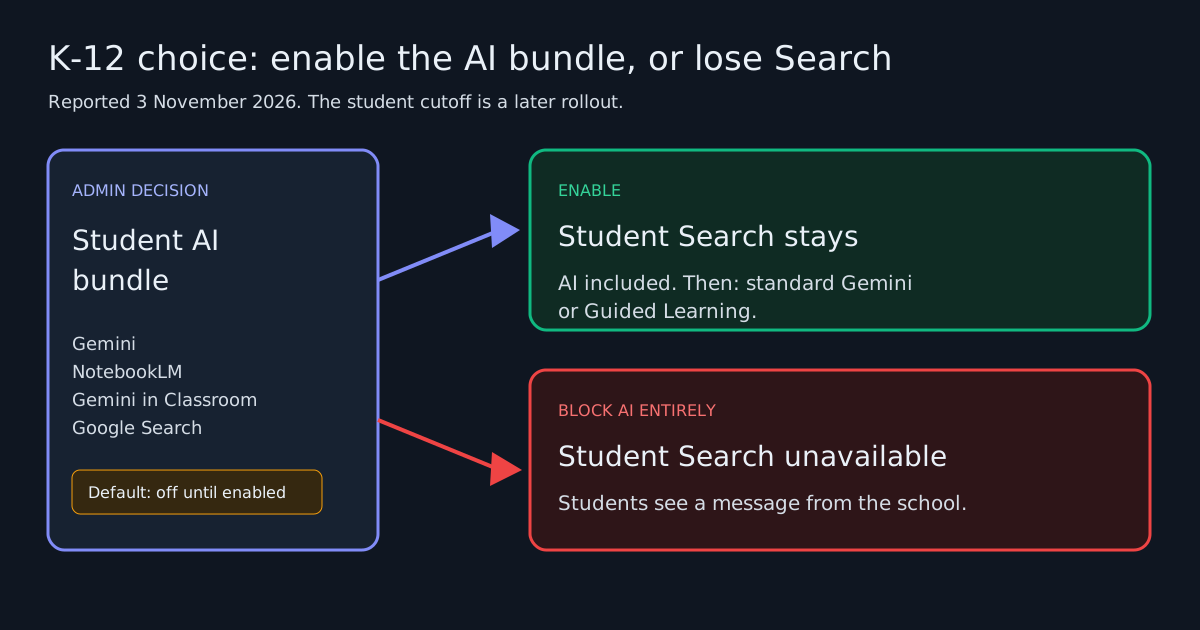
Google told schools, through reporting published on 3 November 2026, that a full block on K-12 student AI also removes student Search. The restriction takes effect at a later rollout. TechCrunch, Ars Technica, and a Techmeme relay of the New York Times give different clocks for that moment.
TechCrunch reporter Aisha Malik wrote that Google announced on Tuesday it will disable AI tools for K-12 students next year unless administrators turn them on. She reported consultations with schools, teachers, researchers, and policymakers, and a revised approach across Gemini, NotebookLM, Gemini in Classroom, and Google Search. Restrict AI altogether, she wrote, and students lose access to Google Search, because AI features are integrated into the engine.
Ars Technica reporter Ryan Whitwam wrote that schools using Google’s education products will be opted out by default, with administrators enabling AI when the changes roll out in the coming months. His product list is Gemini, Gemini Notebook, Gemini in Classroom, and Google Search. He put the bundle in one line: “There’s no picking and choosing—you either allow all the AI or none of it.” Blocking AI means giving up search. He also wrote that Google could offer a school search product without AI tools and is instead creating two AI versions of search.
Techmeme, timestamped 3 November 2026 at 1:40 PM, headlined a New York Times report: Google plans to make restriction easier in early 2027, and schools that block AI entirely lose student Search. This revision’s early-2027 timing comes through that Techmeme relay. The phrase “early 2027” is absent from the TechCrunch and Ars articles.
Two clocks, not one
The announcement date is the firmer fact. TechCrunch’s URL uses 2026/11/03 and the story says Tuesday. Techmeme’s stamp is 3 November 2026, 1:40 PM. A November 4 Boston line on the TechCrunch page is an event advertisement. The article dateline stays 3 November.
The rollout date is a range of phrases. Malik quotes Chris Phillips, Google’s vice president for education, from a blog post: the company will share “more specifics with schools in the coming months ahead of the changes rolling out.” Whitwam puts the default opt-out in those coming months. Techmeme’s Times headline says early 2027. Each of those phrases stays with the outlet that printed it. Student Search, on all three accounts, changes when the rollout reaches student accounts.
Phillips’s reason for coupling Search to the block is quoted by both TechCrunch and Ars from The New York Times: “Search and AI are deeply integrated.” Students at a school that restricts AI altogether “will not have access to search, and they’ll see a message from their school that indicates it’s not available.” TechCrunch also carries his goal line, to “provide school leaders the control and confidence to use AI products in classrooms as they see fit.” The blog and the Times story sit outside this evidence set.
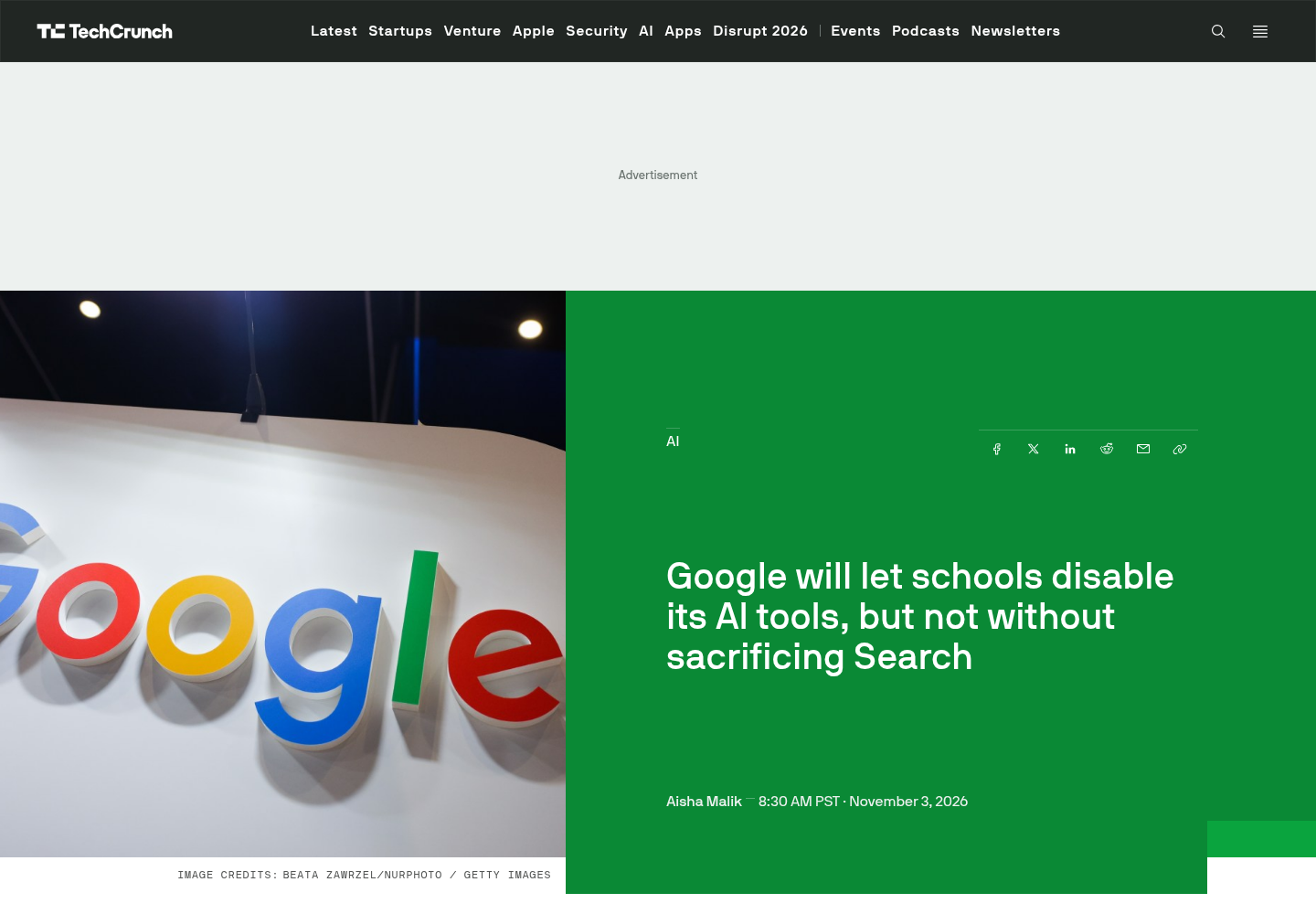
The capture shows Malik’s TechCrunch article page, the publisher story of the K-12 plan.
What each choice does
Enable the bundle and student Search stays, AI included. Whitwam writes that an enabled school then gets two Search AI options, standard Gemini-based AI and Guided Learning. Guided Learning also sits in Classroom. He describes it as tutoring that should withhold a finished answer, and he records Google’s note that generative products can make “mistakes.”
Malik treats Guided Learning’s school launch as news beside the restriction. The tool was unveiled earlier this year. She calls it a sort of AI tutor aimed at understanding rather than a direct answer, against worry that chatbots complete the assignment. She places the tutor with the announcement and the cutoff later.
Block the bundle and student Search is withdrawn. Students get the school message Phillips described. The fetched articles describe that full block, and Ars describes the bundle as all or nothing. The admin wording in the articles is “restrict AI altogether,” “block AI entirely,” and Ars’s single bundle.
NotebookLM is Malik’s name. Gemini Notebook is Whitwam’s. The documents leave open whether those labels are one product.
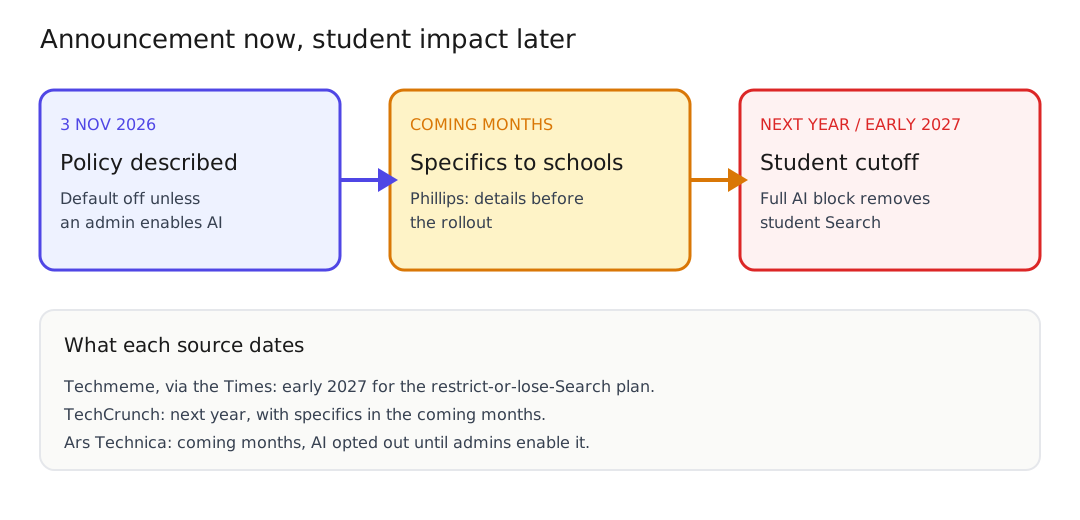
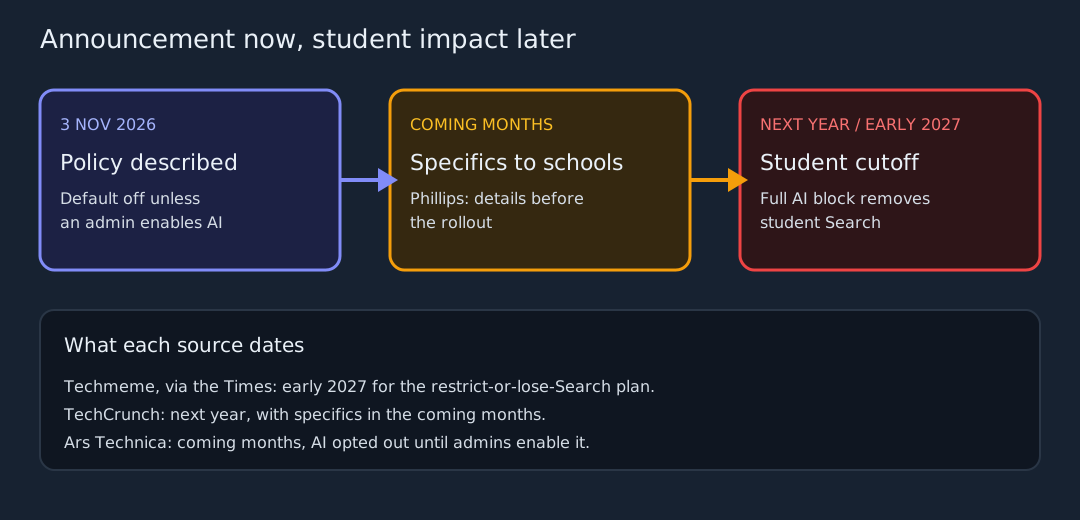
The diagram keeps the clocks apart. Column one is the 3 November description of default-off. Column two is Phillips’s coming-months specifics, via TechCrunch. Column three is the student cutoff, labeled with Techmeme’s early 2027, TechCrunch’s next year, and Ars’s coming months side by side.
Why it matters to K-12 accounts
Administrators of Google education products are the people who choose. Students on those accounts, including classrooms built on Chromebooks, are the people who lose or keep Search. Malik writes that teachers may reject AI Overviews as the way students finish research and may still want Search for sources and materials. On these reports the two wishes travel as one setting. Whitwam’s context is Google’s consumer stance: Search is AI search, most searches show an AI Overview, and the product nudges people toward AI Mode.
He names DuckDuckGo, which can turn AI features off, as a possible exit for schools that reject the bargain. That alternative is his. The fetched pages supply a consequence inside Google’s suite: keep student Search and accept the AI bundle, including the Guided Learning option Ars describes, or refuse the bundle and replace student Search with a school message.
For the mechanics of answer-generating software, separate from this account switch, see how AI agents actually work. The K-12 control reported here is coarser: the student Google bundle is on, or Search leaves with it.
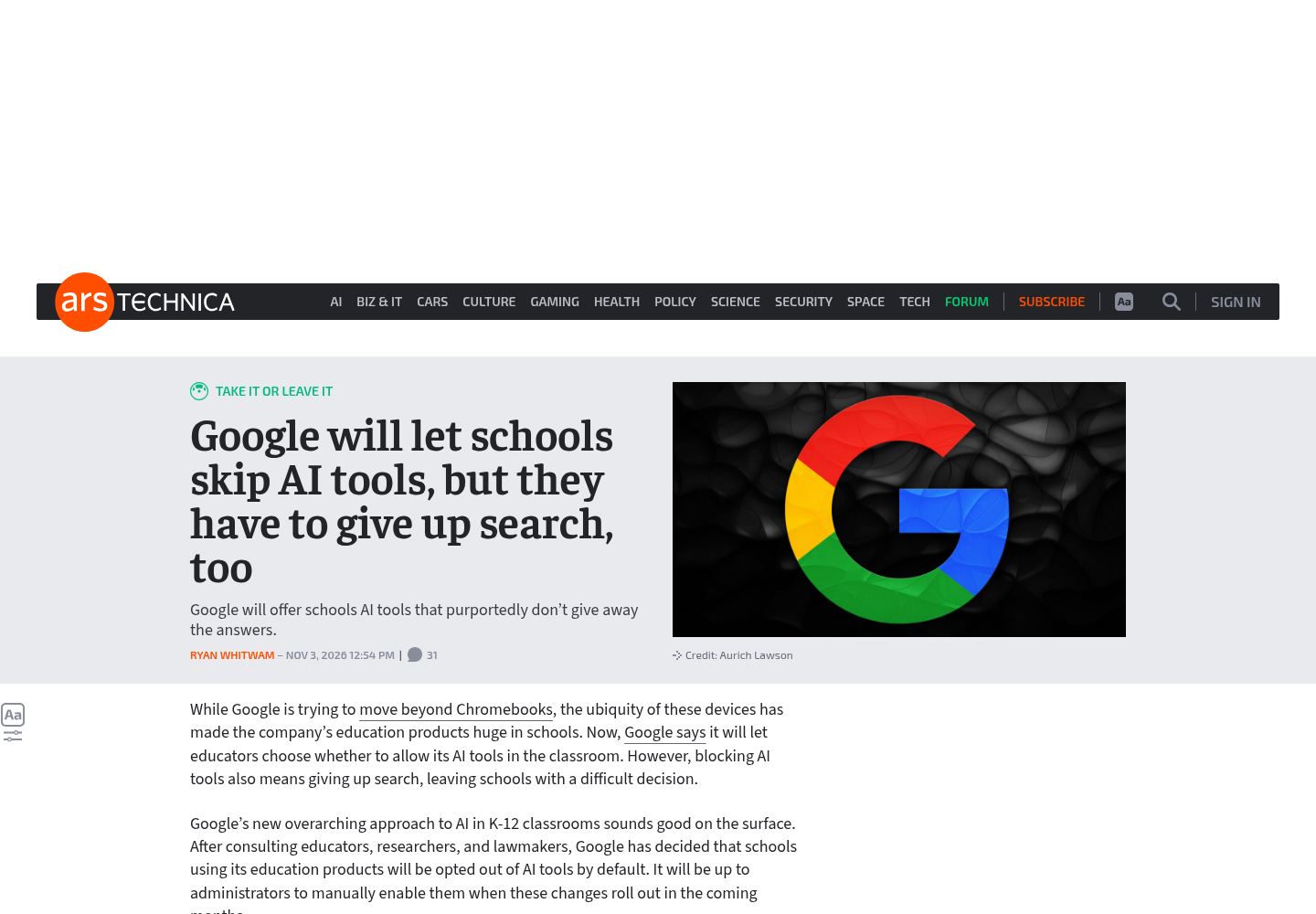
The Ars capture shows Whitwam’s article page.
What remains unsettled
The shape of the choice is what these pages support. At rollout, the tools default off. Enable them, and Search remains with AI, including Guided Learning. Block them entirely, and student Search is unavailable behind a school message. Specifics are promised before that rollout. Cutoff language stays plural: “coming months” from Ars and from Phillips via TechCrunch, “next year” from TechCrunch, and “early 2027” from Techmeme citing the Times.
A later primary document could still fix the clock and the notebook name. Availability remains the rollout. The 3 November record is the announcement of the bind.
Sources
Sources
- Google will let schools disable its AI tools, but not without sacrificing Search | TechCrunch
- Google will let schools skip AI tools, but they have to give up search, too - Ars Technica
- Techmeme: Google plans to make it easier to restrict its AI tools for students in early 2027, but says schools that block AI entirely will lose student access to Search (New York Times)