DR Pixel: Deep Research That Skips OCR and Reads Page Images Directly
Researchers with Berkeley NLP and collaborators released DR Pixel, an open-source deep-research agent that retrieves and reasons over rendered page images across a 1.06M-page corpus, and report it beats OCR-based baselines with fewer tool calls. Benchmark, code, data and a trained model are public.
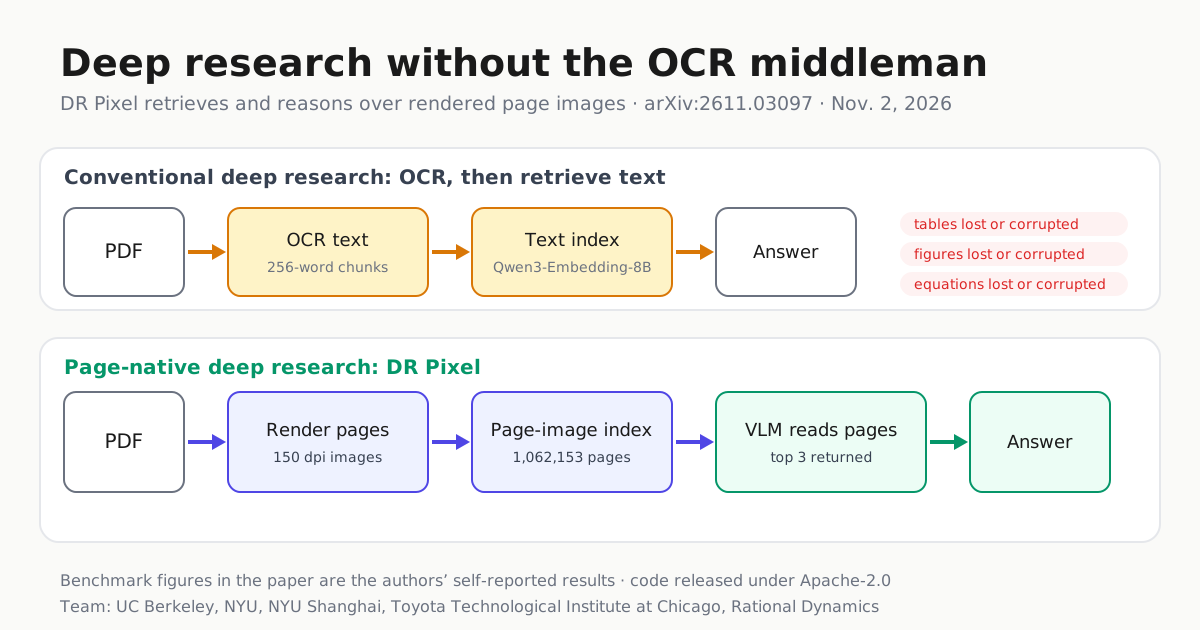
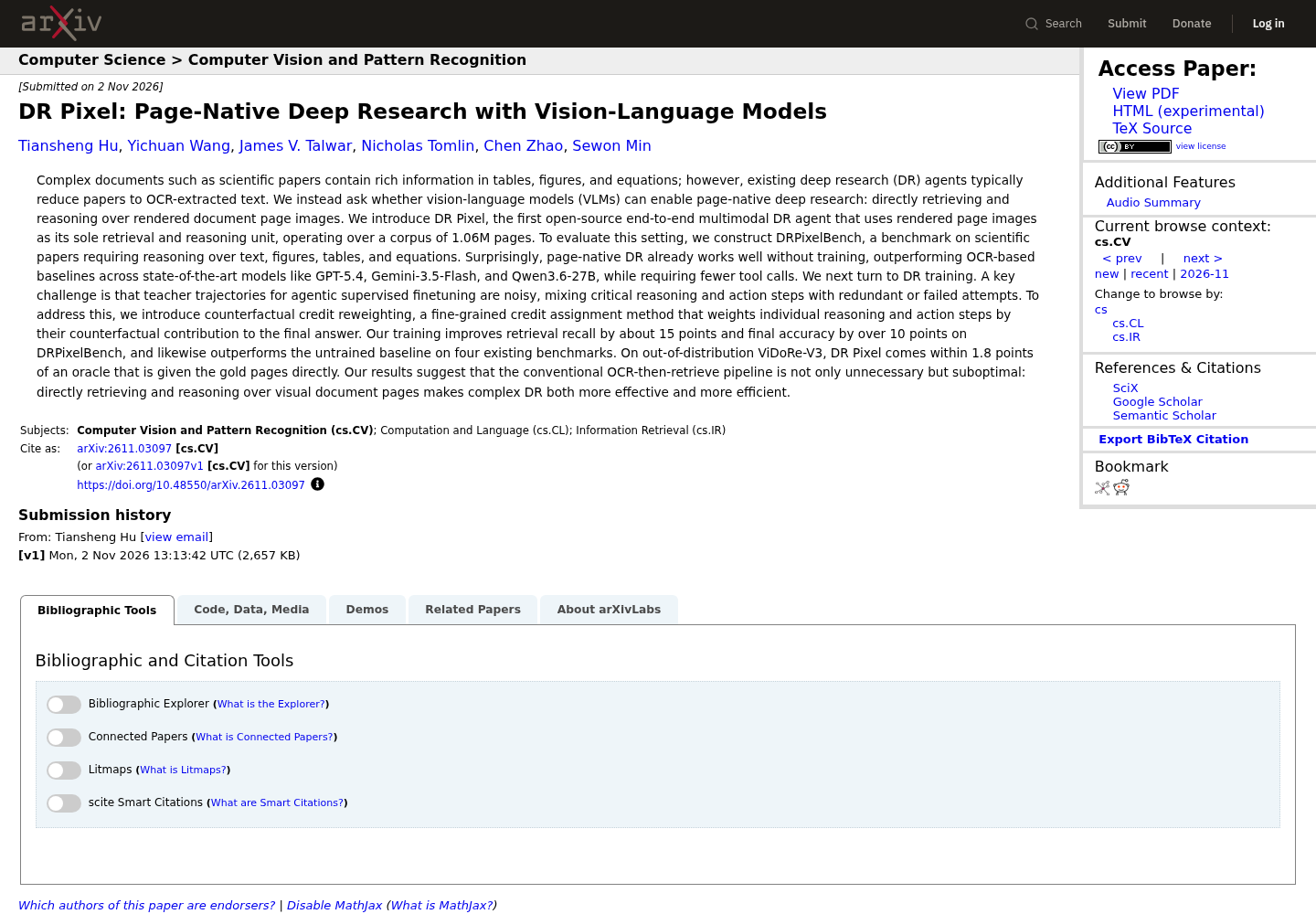
Deep research agents usually meet a paper only after something has flattened it into text. On Nov. 2, 2026, a team spanning UC Berkeley’s NLP group, NYU, NYU Shanghai, Toyota Technological Institute at Chicago and Rational Dynamics published DR Pixel on arXiv and shipped the whole artifact stack with it: the paper, a benchmark, an evaluation harness, Apache-2.0 training code, and a trained open-weight model. The paper describes DR Pixel as the first open-source, end-to-end multimodal deep research agent that uses rendered page images as its sole retrieval and reasoning unit, over a corpus of 1.06 million pages. The Hugging Face daily papers listing shows it published Nov. 2 under the Berkeley-NLP banner, submitted by lead author Tiansheng Hu on Nov. 3.
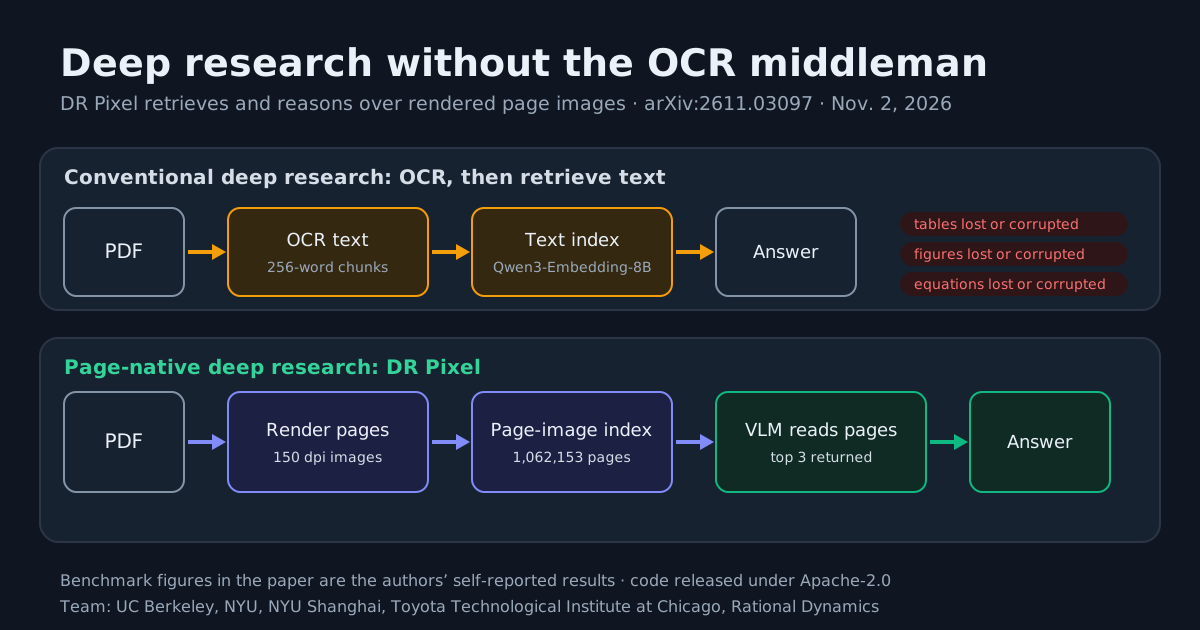
The argument targets a pipeline most teams run without thinking: ingest a document, OCR or parse it to text, chunk, embed, retrieve. Scientific papers concentrate exactly the content that conversion damages — tables, figures, equations. DR Pixel instead renders every page as an image, embeds those page images, and has a vision-language model read what it retrieves.
What page-native changes in the loop
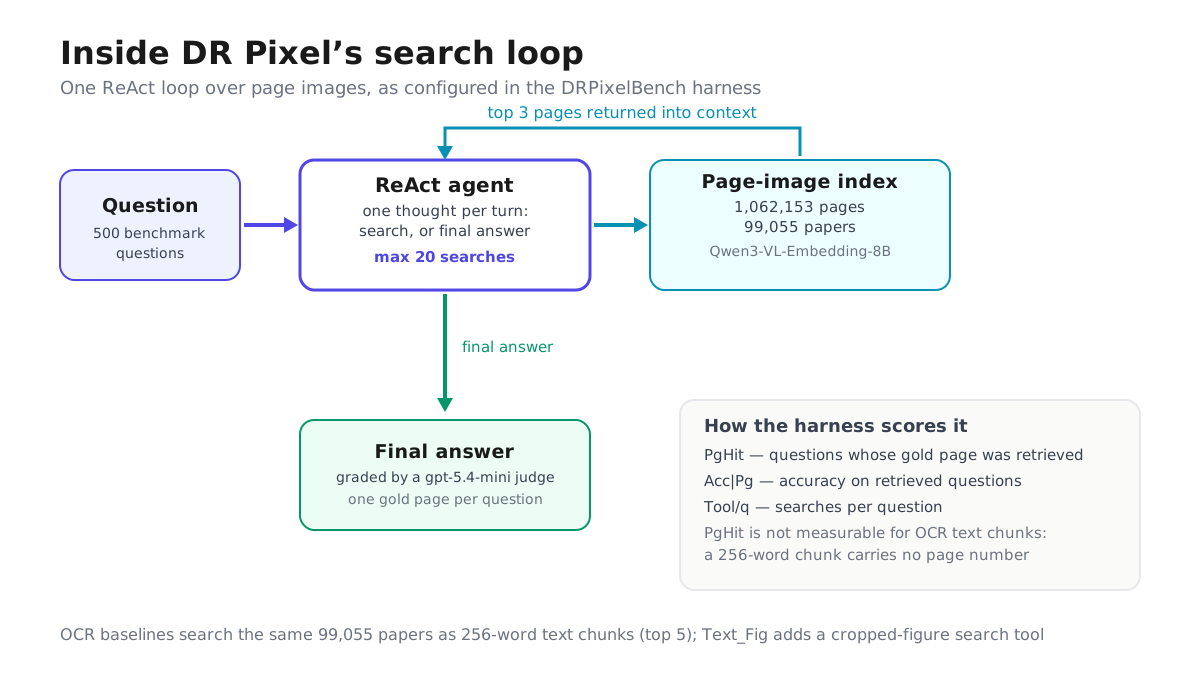
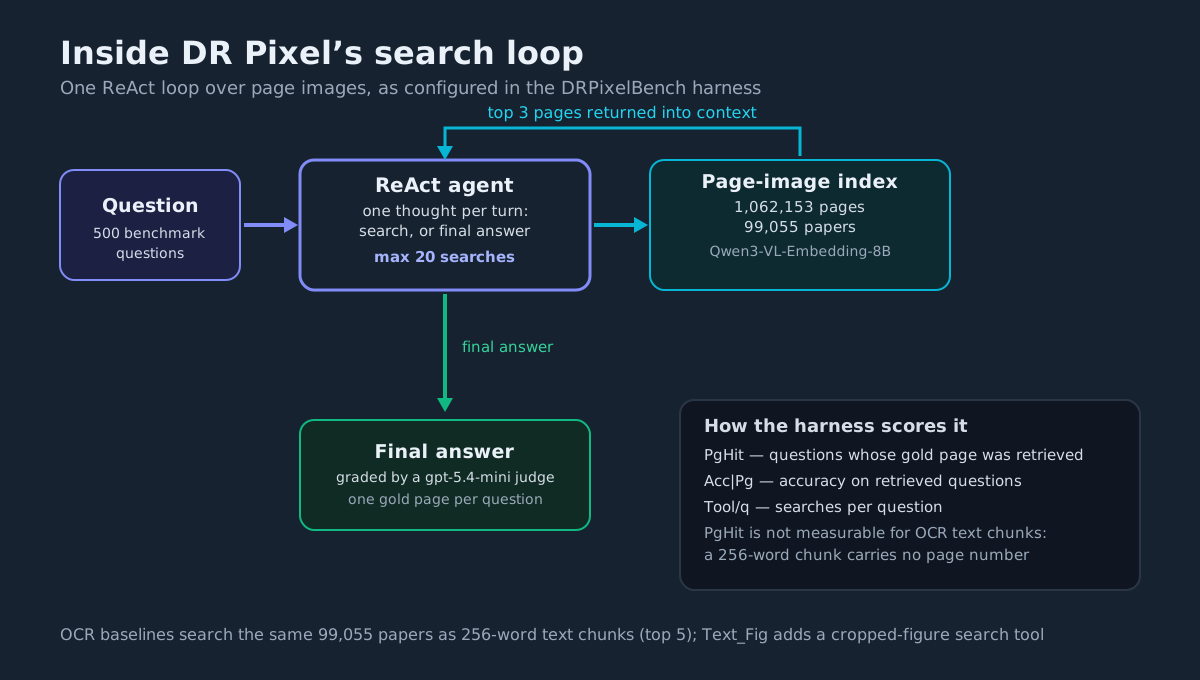
The agent still runs a standard ReAct loop: one thought per turn, then a search or a final answer, with at most 20 searches per question. What changes is what the search tool hands back. Per the repository README, DR Pixel searches 1,062,153 page images rendered at 150 dpi and embedded with Qwen3-VL-Embedding-8B, and gets the top three pages back into context.
| Config | What the agent searches | Needs vision | Gets back |
|---|---|---|---|
| Page (DR Pixel) | Whole-page images | Yes | Top 3 pages |
| Text (OCR baseline) | 256-word OCR chunks, embedded with Qwen3-Embedding-8B | No | Top 5 chunks |
| Text_Fig | Text chunks plus a cropped-figure search tool | Yes | Top 5 chunks plus figures |
All three configurations search the same papers; only the retrieval unit differs.
What the benchmark shows
DRPixelBench holds 500 questions over those 1,062,153 pages from 99,055 scientific papers, each grounded in exactly one gold page and requiring reasoning over text, figures, tables or equations. The headline findings — self-reported, and worth reading that way:
- Untrained page-native deep research already works. It outperforms the OCR-based baselines across GPT-5.4, Gemini-3.5-Flash and Qwen3.6-27B while needing fewer tool calls.
- After training, DR Pixel lands within 1.8 points of an oracle handed the gold pages directly on out-of-distribution ViDoRe-V3.
The harness conventions matter when reading those numbers. PgHit is the share of questions whose gold page was retrieved, and the README notes it is not measurable for the Text baseline, because a 256-word OCR chunk carries no page number. Acc|Pg scores accuracy only on retrieved questions; Tool/q counts searches per question.
The training recipe: stop imitating wasted searches
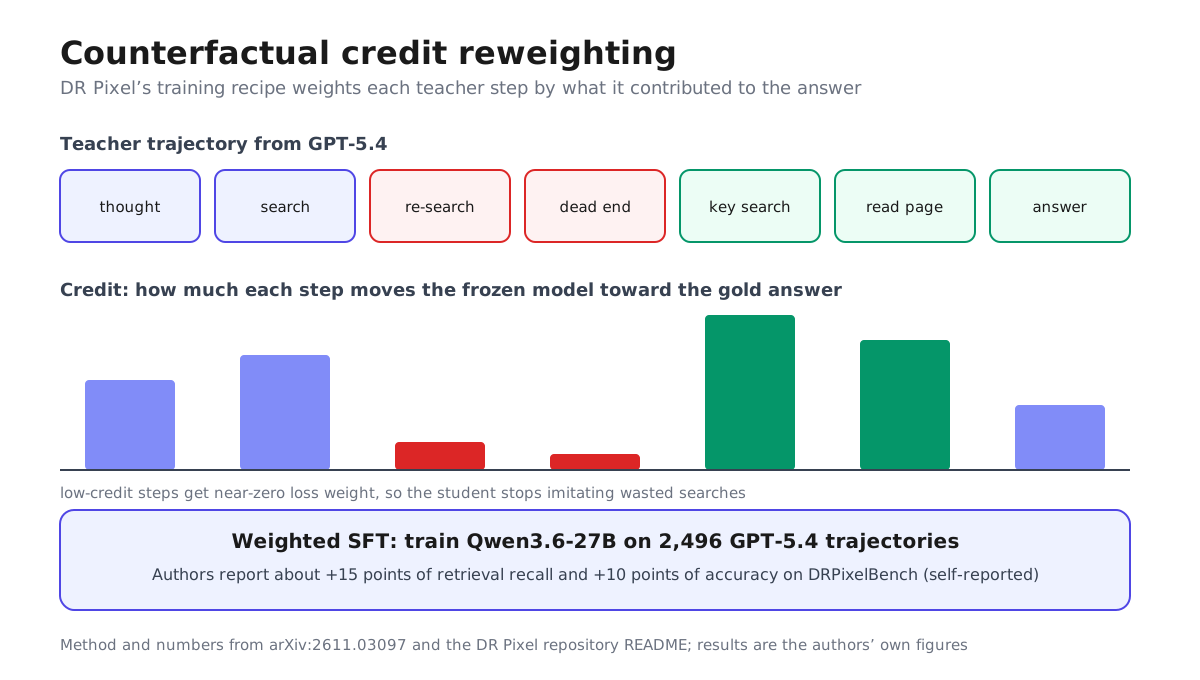
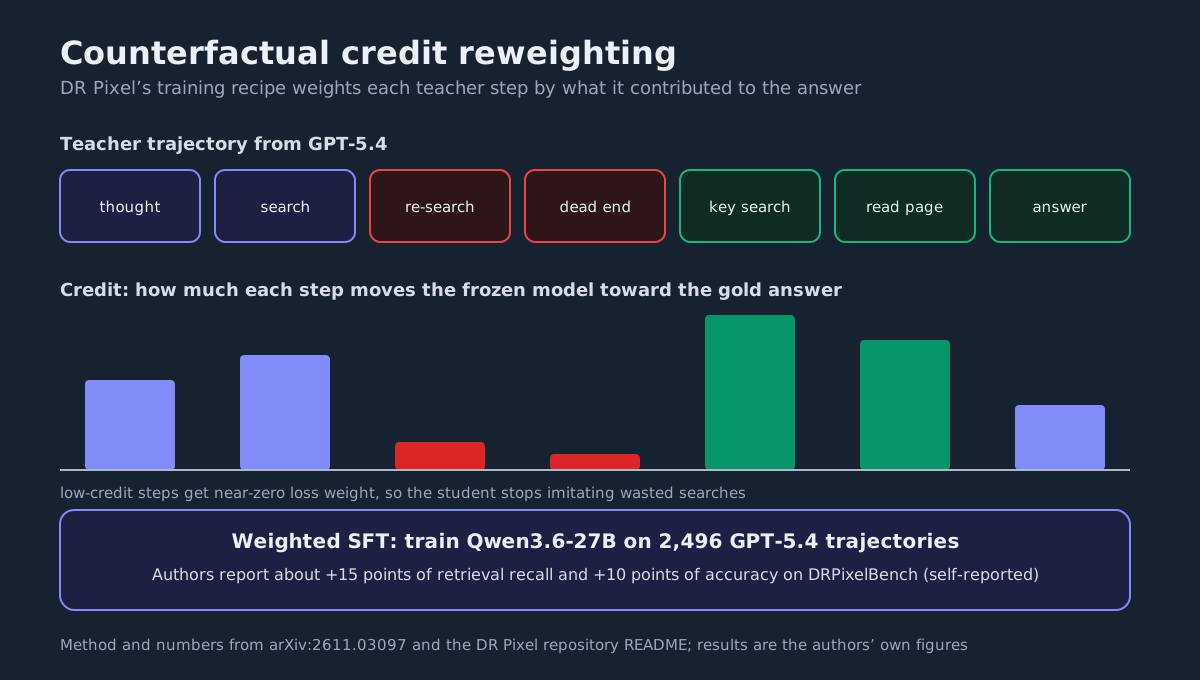
The training contribution may travel further than the retrieval result. Teacher trajectories for agentic supervised finetuning are noisy — they mix critical steps with redundant or failed attempts — and standard SFT imitates every one, so the student “learns to search too much,” as the README puts it.
Counterfactual credit reweighting scores each reasoning and search step by how much it changes the frozen base model’s likelihood of the gold answer, turns those scores into per-step loss weights, and trains with ordinary SFT. Concretely, the team fine-tuned Qwen3.6-27B on 2,496 GPT-5.4 trajectories and released the result as HughieHu/DR-Pixel-Trained with the per-step weights. The authors report about 15 points of retrieval-recall gain and more than 10 points of final accuracy on DRPixelBench, plus wins over the untrained baseline on four existing benchmarks.
Running it yourself
The harness is built to be pointed at any OpenAI-compatible endpoint, hosted or local: install with pip install -e '.[client]' inside eval/, run python -m drbench.doctor for a roughly 20-second check of the model, search endpoint and image input, then python -m drbench.eval --config Page runs and grades all 500 questions, judged by gpt-5.4-mini. Other APIs need one subclass overriding complete(). The data ships too: all 1,062,153 page images (473 GB), the OCR text, and embedding indices of 8.7 GB and 36 GB in the HughieHu/drpixel-bench dataset.
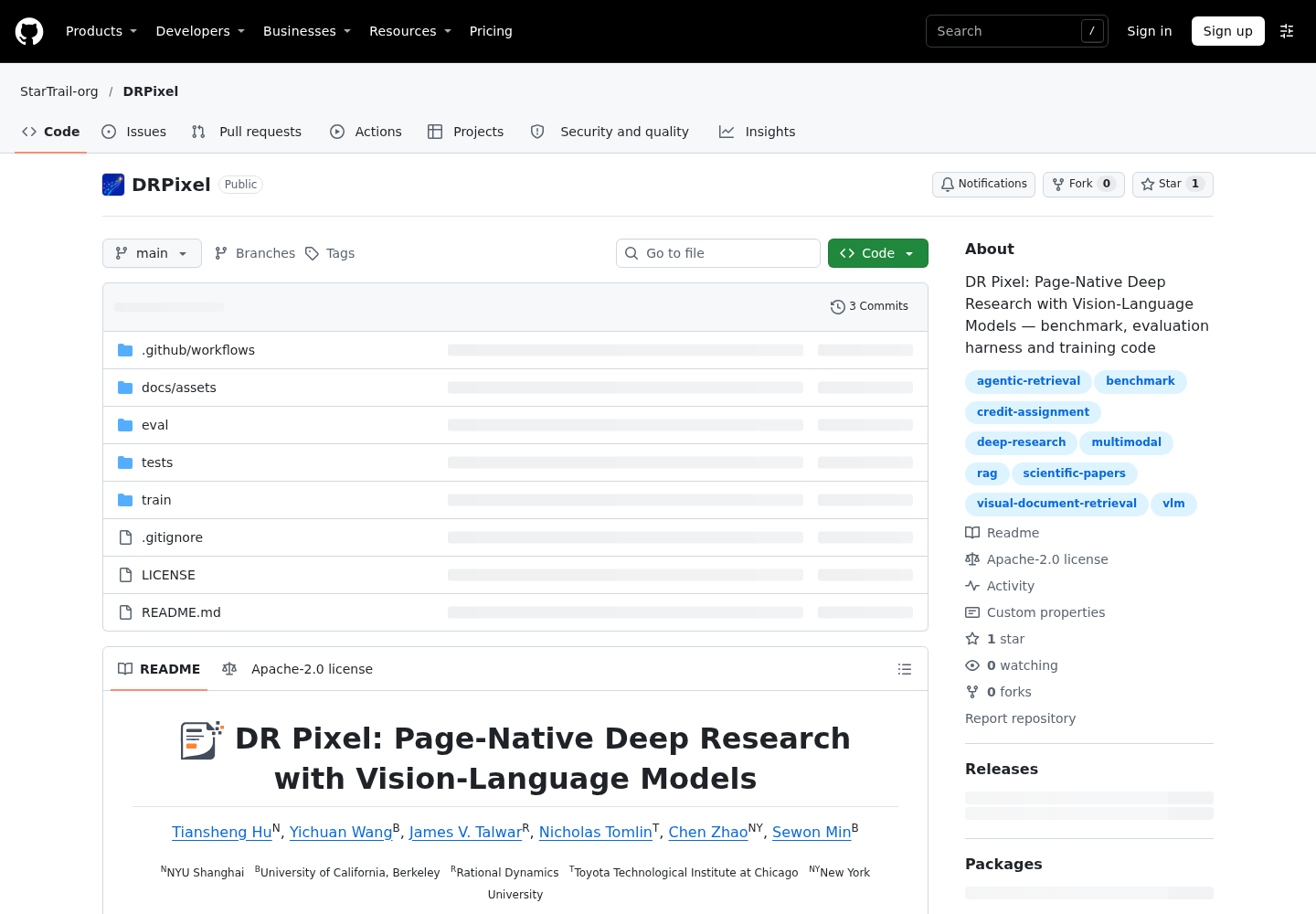
Caveats worth holding onto. The repository is days old — three commits and a single star at capture time — so treat every number as the authors’ own report, not an independent replication. The corpus mixes arXiv and open-access proceedings with papers from AirQA, IRPapers and M3SciQA; those 13,946 benchmark papers keep their original licenses, PDFs are not redistributed, and only 76.3% of the corpus carries an arXiv ID.
Why it matters for agent builders
If your agents work over visually dense corpora — papers, invoices, schematics, scanned contracts — the OCR stage you treated as plumbing may be where accuracy dies. This is a runnable argument that the page image itself can be the better index. Whether that holds on your documents is a bake-off question, the same discipline as our Docling vs MarkItDown intake test: run both lanes on your own files and grade the answers.
Two adjacent threads make the timing interesting. We have argued agents should fetch real pages rather than driving a browser; DR Pixel pushes that instinct into document retrieval, where the faithful rendering beats the lossy transcription. And separate work just showed discrete visual tokens matching continuous ones on multimodal understanding — the field is converging on pixels as a format to work in, not one to survive.
The numbers are self-reported and the project is young. But with the harness, corpus and training recipe all public, the claim that OCR-then-retrieve is “not only unnecessary but suboptimal” is now something you can test on your own corpus this week.
Sources
- [2611.03097] DR Pixel: Page-Native Deep Research with Vision-Language Models
- Paper page - DR Pixel: Page-Native Deep Research with Vision-Language Models
- GitHub - StarTrail-org/DRPixel: DR Pixel: Page-Native Deep Research with Vision-Language Models — benchmark, evaluation harness and training code · GitHub