NVIDIA Nemotron 3.5 Super VL Brings Open Multimodal Reasoning to Specialized Agents
NVIDIA's open 120B Nemotron 3.5 Super VL unifies text and vision for specialized agents, with NeMo tuning, NIM serving and SageMaker day-zero deploy options.
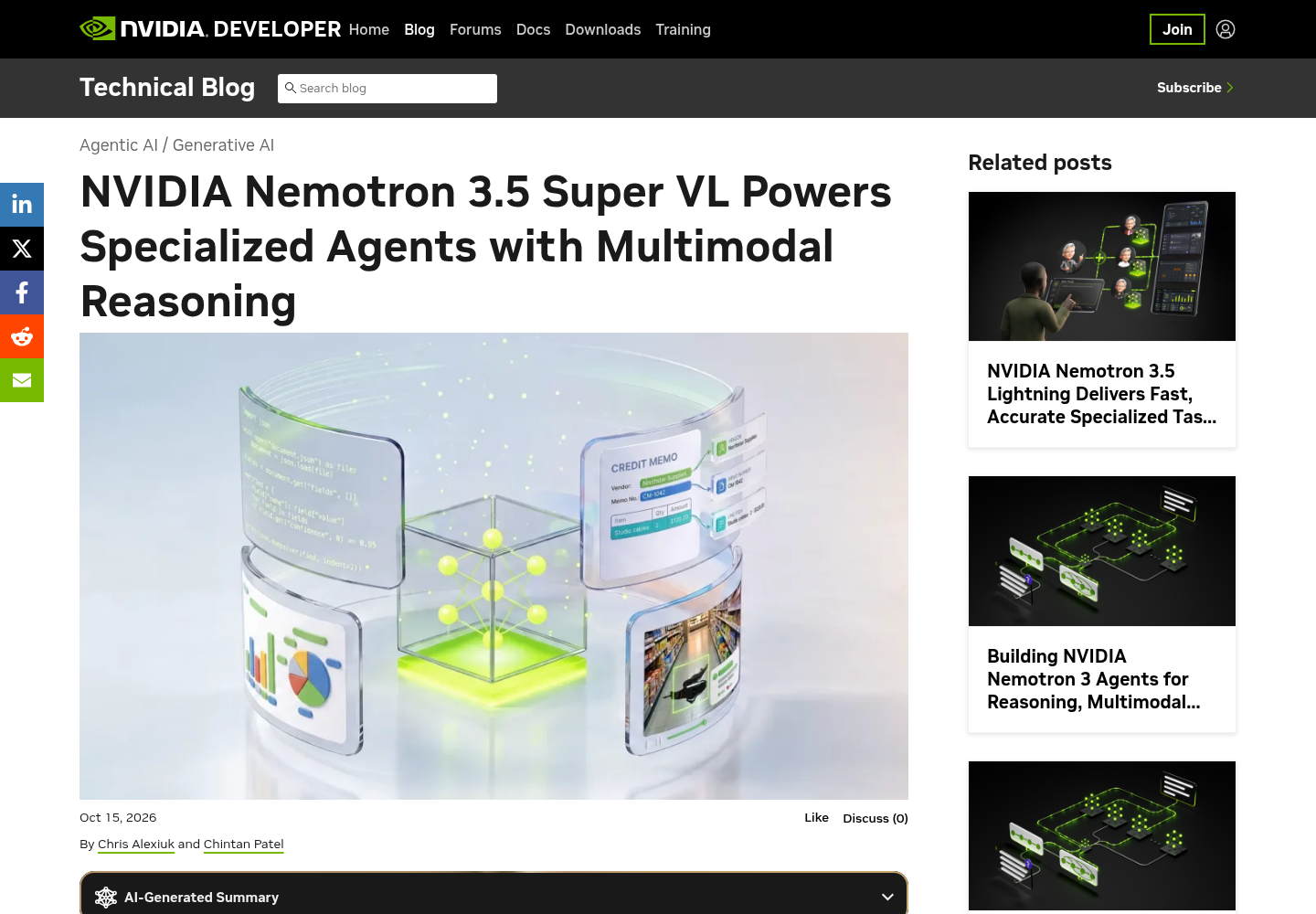
NVIDIA just gave coding-agent builders an open alternative to stitching separate text and vision models together.
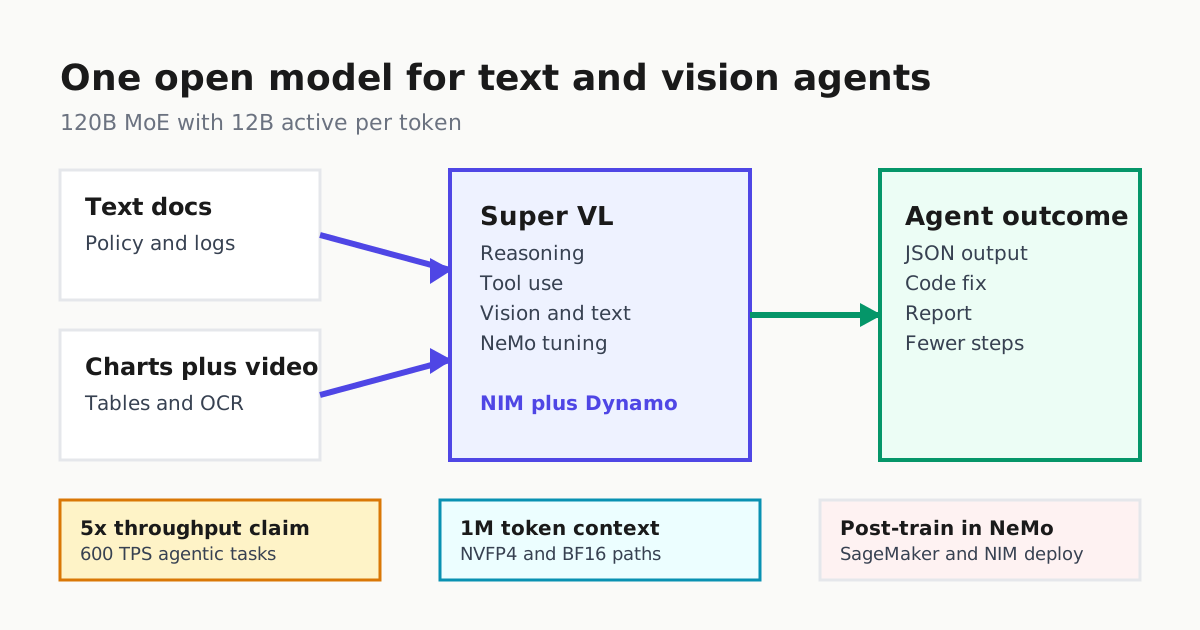
Nemotron 3.5 Super VL is a 120B-parameter mixture-of-experts model that activates 12B parameters per token. It combines reasoning, instruction following and tool use with text, image, document and video understanding in one checkpoint, aimed at long-running specialized agents that read documents, check sources, follow policy and call tools.
The pitch is consolidation: one post-trainable model for multistep work, instead of routing context between a chat model and a separate vision-language model.
What shipped
NVIDIA published the technical breakdown in its developer blog, announced the family expansion in its company blog, and AWS added a managed path via SageMaker JumpStart.
The release includes base, post-trained and NVFP4-quantized checkpoints, training recipes, open datasets and reinforcement-learning environments. Weights are on Hugging Face and ModelScope, hosted inference on OpenRouter, and production serving as NVIDIA NIM.
Super VL and Bolt 74B-A9B are available now. Bolt E4B is forthcoming Oct. 23, after this article, and is not yet available:
| Model | Role | Target |
|---|---|---|
| Lightning | High-volume text | Throughput pipelines |
| Super VL | Specialized multimodal agents | Cloud, data center, DGX Spark, RTX |
| Ultra | Complex planning | Large enterprise servers |
| Bolt 74B-A9B 24GB | Local agents, 2-bit native | RTX and DGX Spark |
| Bolt E4B 4GB, forthcoming Oct. 23 | Conversational and embedded | GeForce RTX, Jetson, Spark |
For agent teams the comparison is Super VL versus closed vision-plus-text stacks and versus running two open models side by side.
Why one model matters for agents
Document, research and security agents constantly cross modalities. A support agent checks a policy PDF. A research agent links a chart on page 4 to a table on page 19. A coding agent reads a failure screenshot, checks docs and proposes a patch.
Super VL targets that mix: charts, tables, OCR, multipage documents and video, trained with a two-stage fine-tuning pipeline that combines visual evidence with reasoning, chat, safety, long-context data and agent trajectories. NVIDIA cites 80.8% on CharXiv chart reasoning, rising to 84% with Python interpretation, versus 63% for Nemotron 3 Nano Omni, plus strong OCRBench v2 placement.
For coding work, NVIDIA says added training on agent actions, repos and software tasks lifted SWE-bench and Terminal-Bench over Nemotron 3 Super. Evaluations span Hermes, LangChain, OpenClaw, OpenCode, Pi, Codex and Claude harnesses.
| Evaluation | Ultra | Super VL |
|---|---|---|
| Hermes Bench | 56.33% | 63.44% |
| LangChain behavioral | 84.3% | 87.05% |
On efficiency, NVIDIA claims over 600 tokens per second on Artificial Analysis Intelligence Index agentic tasks on Baseten, up to 5x higher throughput on a single GPU than peers in its class, and 4x faster task completion from throughput plus token efficiency.
Treat those as vendor-reported harness numbers to verify on your own trajectory. The durable ideas are architectural: prefix caching that preserves attention and Mamba states, multi-token prediction with a boosting phase, NVFP4 quantization with quantization-aware distillation, and LiLiCorr speculative decoding claimed at up to 2.3x faster generation on DGX Spark.
Post-train it for tools and policy
The day-zero value is customization. NVIDIA frames Super VL as a foundation to adapt to domain terms, tool interfaces, procedures and policies with NVIDIA NeMo.
The stack is NeMo AutoModel for supervised fine-tuning and LoRA, NeMo RL and NeMo Gym for agentic reinforcement learning, NeMo Data Designer for chart question answering and long-document data, open Hugging Face sets for tool use, finance reasoning, chat, long context, fairness and 40 vision-language tasks, plus a GitHub usage cookbook.
As a conceptual pattern, one multimodal agent call can replace a chain: give the model a screenshot, log text and relevant policy pages, ask it to extract chart values, link the table and emit structured JSON using tools such as a code interpreter and document search, then compare accuracy, tool calls and steps to done against your current pipeline on a held-out eval set.
Early examples follow the same pattern: Scale AI for Skydance vendor credit processing targeting 40x lower cost and 5x lower latency, Ramp for receipt images to structured JSON expecting 50% higher throughput and 10x lower latency, and AI21 and Alice for threat intel reporting 41% higher accuracy. Also cited are AfterQuery for Hebbia credit analysis, Mercor on APEX-SWE coding, Atlassian for Jira and Confluence search, CrowdStrike for blue teaming, Perplexity for search, and Salesforce for government workflows.
If you run a two-model document pipeline today, try replacing extraction plus summarization with one Super VL call that reads the chart, links the table and returns JSON. Keep your eval set and compare accuracy, tool calls and steps to completion.
How to deploy it
You have three practical paths. First, workstation: run on DGX Spark, DGX Station and RTX PRO and RTX systems where data must stay local. EXO Labs placed Super VL on the Pareto frontier for accuracy versus completion time on DGX Spark. Bolt 74B-A9B is the lighter local option with llama.cpp, Ollama, LM Studio, Unsloth and vLLM support.
Second, data center: NIM packages optimized engines, validated configs and standard APIs, refreshed every two weeks. Dynamo adds KV-cache-aware routing and disaggregated serving. NVIDIA claims 8x more users at 50 tokens per second on 16 B200 GPUs with 85% lower first-token latency.
Third, AWS managed: SageMaker JumpStart offers NVFP4 on G7 instances with RTX PRO 4500 Blackwell GPUs, and BF16 weights on ml.p5en.48xlarge for fine-tuning, reinforcement learning and distillation. AWS notes 1M-token context, hybrid mixture-of-experts with 12B active plus vision encoder, built-in multi-token prediction, per-request reasoning control, JSON output and tool calling in ten languages.
Treat JumpStart, NIM and Dynamo as separate deployment options for their own environments. Check the checkpoint format and serving requirements for each path before planning a move between managed tuning and dense multi-user serving. For background on models that can hold a tool loop, see open-weight models that can actually drive a harness.
What to try first
Replace a vision-plus-text chain with one agent that extracts, reasons and emits JSON, and count tool calls saved. Give a coding agent screenshots plus logs and ask for test, diagnosis and fix in one turn. As an editorial experiment, try a small LoRA on your own tickets, receipts or reports and expand only if evals improve, before committing to full fine-tuning or reinforcement learning. Benchmark time to correct completion with prefix caching on, then add speculative decoding.
Super VL will not replace a planner for the hardest orchestration or a tiny model for cheap chat. Its niche is the middle tier that does enterprise work: visual, multistep, tool-calling agents you can own and run where your data must stay.
Sources
- NVIDIA Nemotron 3.5 Super VL Powers Specialized Agents with Multimodal Reasoning | NVIDIA Technical Blog
- Open From Data Center to Desktop: NVIDIA Expands Nemotron Family With Highest Efficiency Super VL and Bolt Models | NVIDIA Blog
- Nemotron 3.5 Super VL model now available on Amazon SageMaker JumpStart - AWS