Modal Adopts NVIDIA's Arm-Based Vera CPUs After Its Own Benchmarks Showed Up to 2x Sandbox Throughput
Modal's own benchmark says NVIDIA's Arm-based Vera CPU keeps its pace as agent sandboxes pile up, while x86 and Graviton rivals plateau. Modal's fleet begins its Arm turn.
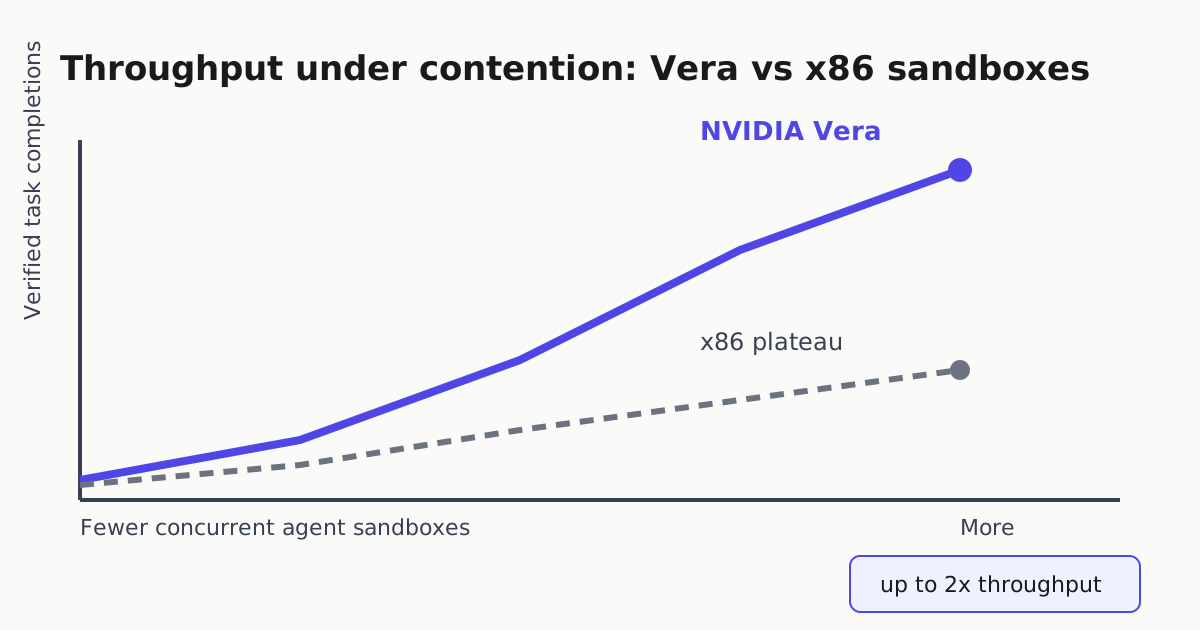
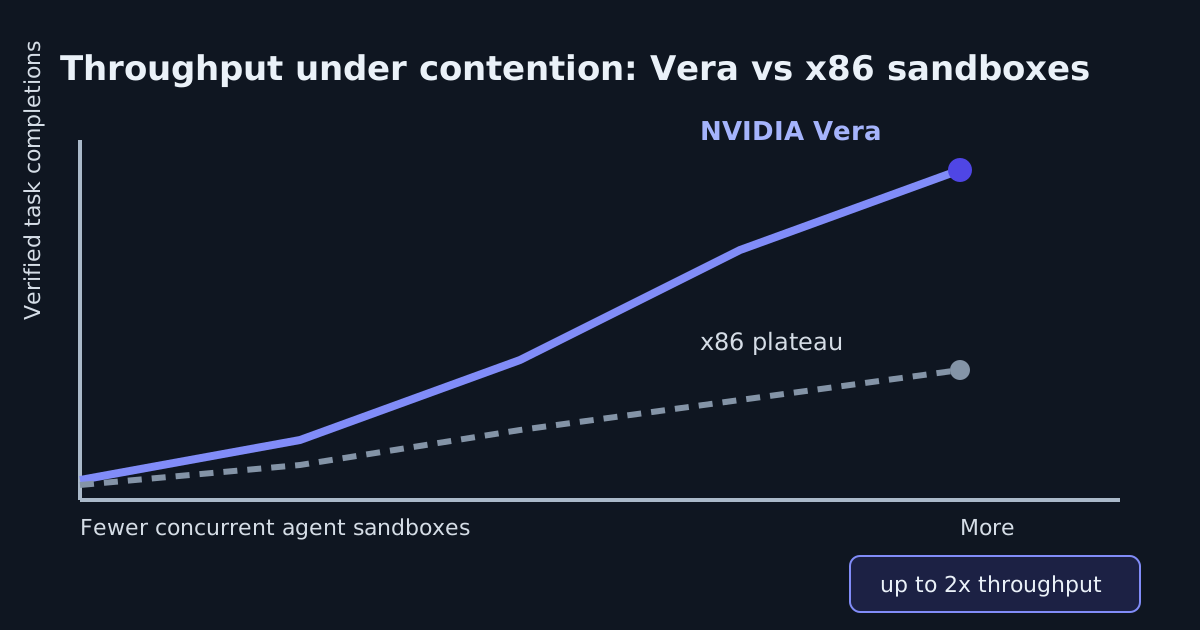
Modal, the serverless compute platform that hosts sandboxed execution for background coding agents and reinforcement-learning rollouts, says it will roll out support for NVIDIA’s Arm-compatible Vera CPU to power Modal Sandboxes — its first Arm machine in a fleet that has been exclusively x86 until now.
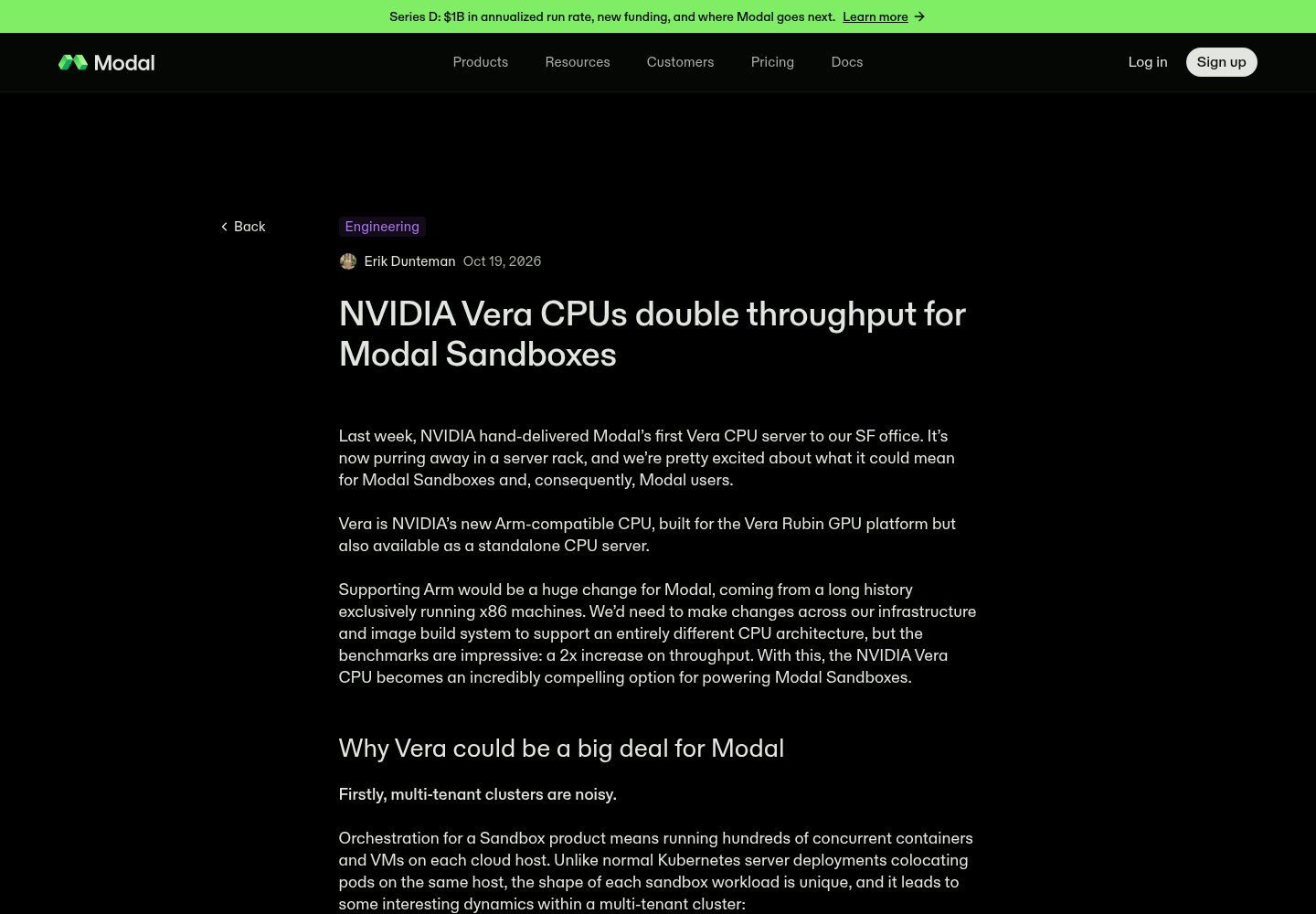
The announcement, in an engineering blog post by Erik Dunteman dated October 19, 2026, follows hands-on benchmarking on a Vera server NVIDIA hand-delivered to Modal’s San Francisco office. Modal reports up to double the task throughput on Vera versus an equivalent x86 machine under concurrent load. Reuters picked up the story the same day, noting Modal until now relied entirely on Intel and AMD processors. The announcement comes amid a broader NVIDIA push into agentic-AI infrastructure documented on the NVIDIA Technical Blog, while Modal’s own blog banner still leads with its $1B-run-rate Series D news.
Why CPU throughput now matters for agents
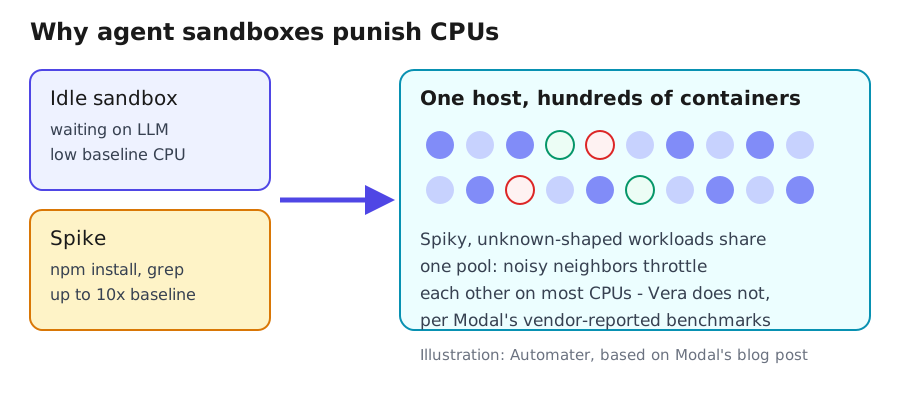
Modal’s core argument is that agent sandboxes invert the usual multi-tenant profile. Each sandbox spends much of its life idle, waiting on an LLM, then spikes hard — an npm install or an expensive grep can surge CPU usage 10x above baseline. Hundreds of these heterogeneous workloads share one host, so noisy-neighbor contention is the norm, not the exception. Modal lets users reserve for P50 usage and burst above it, which saves money but increases exposure to exactly that contention.
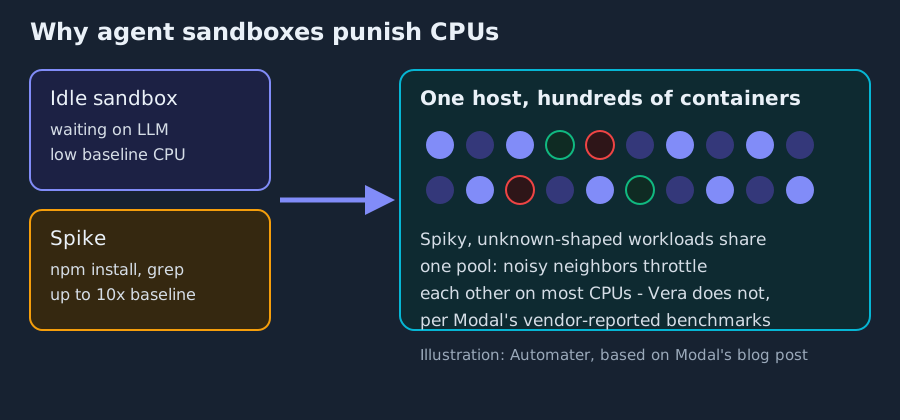
That makes concurrent throughput — not single-task latency — the metric that decides how many sandboxes a host can absorb without user-visible slowdowns. For background agents, faster task completion means faster answers and lower CPU-time cost of goods sold. For RL rollouts, CPU time saved is GPU time saved, because most training loops are synchronous: an entire fanout must finish before the accelerator moves on. The same logic underpins our guide to reading agent benchmarks in 2026: the workload shape you measure has to match the one agents actually impose.
Agentless Agent Bench
To test Vera, Modal built a new benchmark, Agentless Agent Bench: 50 Terminal-Bench oracle solutions and verifiers with all network calls stripped out and containers prewarmed, isolating the CPU-side work agents actually do — compilation, grepping, git operations, device emulation.
On a quiet host run serially, Vera’s straightline latency advantage over AMD Zen 5, Intel Granite Rapids (GNR), and AWS Graviton was modest and inconsistent — Modal’s author admits to skepticism on first seeing it. The picture changed under contention, where the benchmark packs 50, 100, and 150 concurrent containers onto the machine and counts verified task completions per 60 seconds.
Selected 50-container results (verified completions per 60 s, vendor-reported):
| Logical CPUs | NVIDIA Vera | Intel GNR (bare) | AMD Zen 5 | Graviton 5 (vm) |
|---|---|---|---|---|
| 16 | 1,586 | 997 | 1,099 | 817 |
| 32 | 2,752 | 1,777 | 1,508 | 1,805 |
| 79 | 4,238 | 2,383 | 1,572 | 3,468 |
| 155 | 4,169 | 2,544 | 1,482 | — |
At 150 containers the gap widens further: Vera reaches roughly 6,500 completions per 60 seconds at 155 logical CPUs, while Zen 5 flatlines under 1,000 and Intel GNR tops out around 4,600.
The killer feature is contention
Modal attributes the result to Vera’s memory bandwidth: it packs more container workloads per core without throttling, and — counterintuitively — does not slow down as jobs accumulate. The alternatives hit early throughput plateaus as CPU counts climb; Vera keeps improving, which Modal reads as headroom beyond the single benchmark node it had.
These are vendor-adjacent benchmarks — run by Modal on hardware NVIDIA supplied, with the Vera team reportedly unsurprised by the results — not independent evaluation. And the announcement is a plan to roll out support, not shipped availability: Modal says it still needs to rework its infrastructure and image build system for an entirely different CPU architecture, and will work with NVIDIA and cloud providers to scale the fleet.
Still, the signal for operators is concrete. If agents are making CPU efficiency a first-order driver of agent speed and cost per task — the same economics we walk through in cost per completed task versus token price — then the host CPU under your sandbox runtime becomes a real line in agent economics, not a commodity afterthought. Modal’s story until now has been scale and funding, as in its $1B ARR and $750M Series D round; this is the first evidence of the company changing the silicon under its sandbox product.
For platform teams running their own agent fleets, the takeaway is the benchmark design more than the chip: measure concurrent, spiky, heterogeneous container workloads under contention, not straightline latency on a quiet host. That is the regime agents actually impose, and it is where Modal says Vera separates from the x86 field by up to 2x.