NVIDIA RTX Spark Ships: One Machine to Code, Test and Deploy Local AI Agents
NVIDIA RTX Spark laptops shipped October 16 from six vendors starting at $2,599, pairing a Grace CPU with a Blackwell GPU and up to 128GB of unified memory. Here is what developers can run on one machine, what Junie Local delivers at 55 tokens per second, and where a week of Verge testing tempers the pitch.
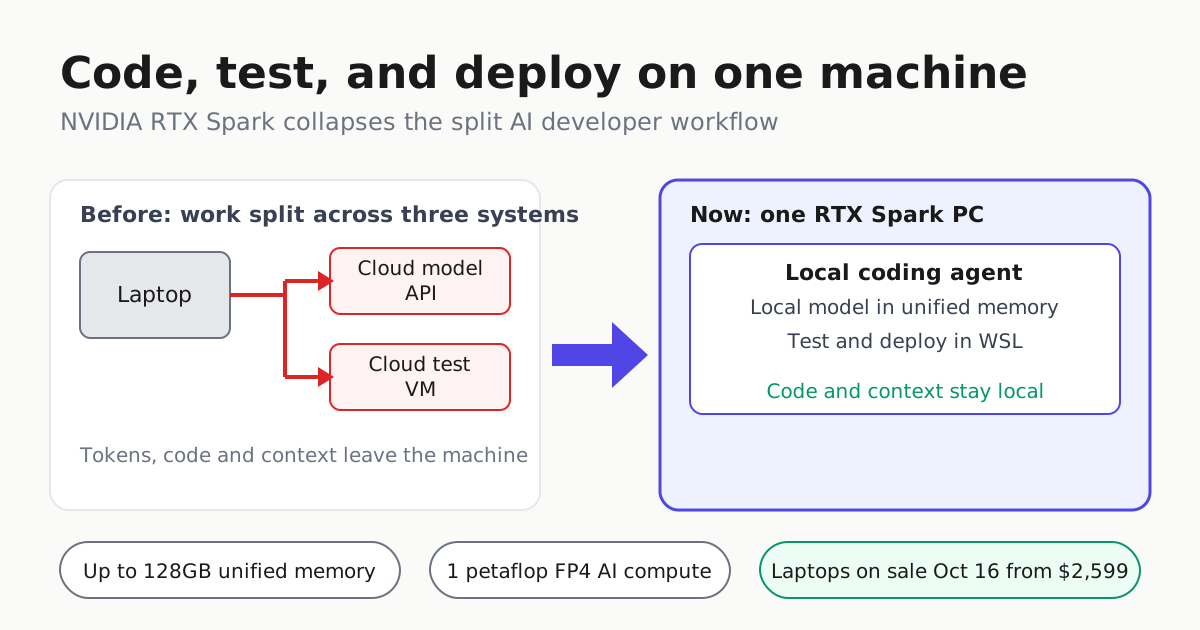
NVIDIA’s first RTX Spark PCs went on sale October 16, and the pitch to developers is unusually blunt: AI coding split the workflow across a laptop, a cloud model API and a cloud test VM, and it does not have to stay that way. The NVIDIA developer blog published at launch frames the new machines as the fix — one Windows PC where the coding agent, the model it calls and the environment you deploy to all live in the same box.
The official announcement puts RTX Spark laptops on sale from ASUS, Dell, HP, Lenovo, Microsoft and MSI, starting at $2,599. All of them run the same recipe: a single superchip pairing an NVIDIA Grace CPU with a Blackwell RTX GPU (MediaTek collaborated on the CPU design), up to 128GB of unified memory and up to 1 petaflop of FP4 AI compute. Compact desktops follow in November, positioned for agents that run around the clock. NVIDIA also marked the day with launch events worldwide in cities including San Francisco, Berlin, Taipei and Seoul.
What changes in the workflow
The concrete claim is workflow collapse. Developers can work in the new Windows Developer Config — built with Microsoft, it installs top development frameworks, mutes notifications and enhances the terminal — or in Windows Subsystem for Linux, where the environment and dependencies match what you deploy to the cloud, so code stops migrating between OSes. Because the machine carries an NVIDIA GPU, NVIDIA argues the deploy target scales to an installed base of 150 million RTX PCs plus virtually every cloud running its GPUs. The unified memory is also enough to run coding models such as Qwen 3.8 Flash Next locally, cutting cloud agent token consumption.
The performance story is that development became GPU-bound: inference to drive agents, fine-tuning for customization, and still some compilation. Against Intel’s Panther Lake 12Xe, NVIDIA reports 4.6x performance on coding agents, 2.7x on fine-tuning and 1.8x on code compilation. The methodology footnote matters — Intel Core Ultra X9 388H normalized to 1.0, using AA-AgentPerf-local with Qwen3.8-27B, Unsloth LoRA with Llama-3.1-8B and Linux kernel compilation via the Phoronix Test Suite.
The stack that makes it usable
The Windows-on-Arm toolchain is the quieter unlock. With Microsoft, NVIDIA shipped the first PyTorch-CUDA build for the platform, the first Python release that is native by default with Python 3.15, over 2,000 ready-to-use Conda packages, and Arm-compatible versions of more than 97 percent of the top 15,000 Python packages. Data-science tooling that assumed x86 is the usual blocker for Arm Windows; these releases close most of that gap.
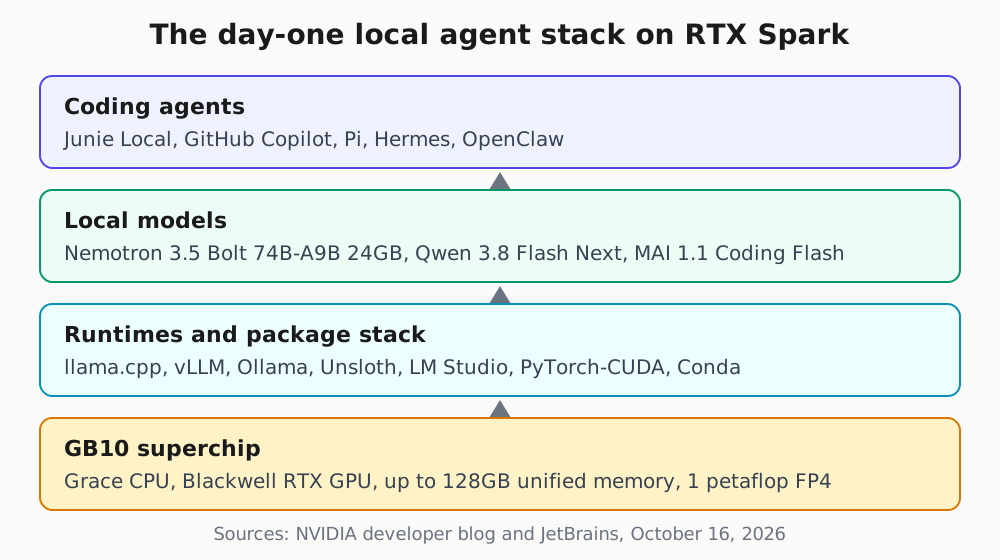
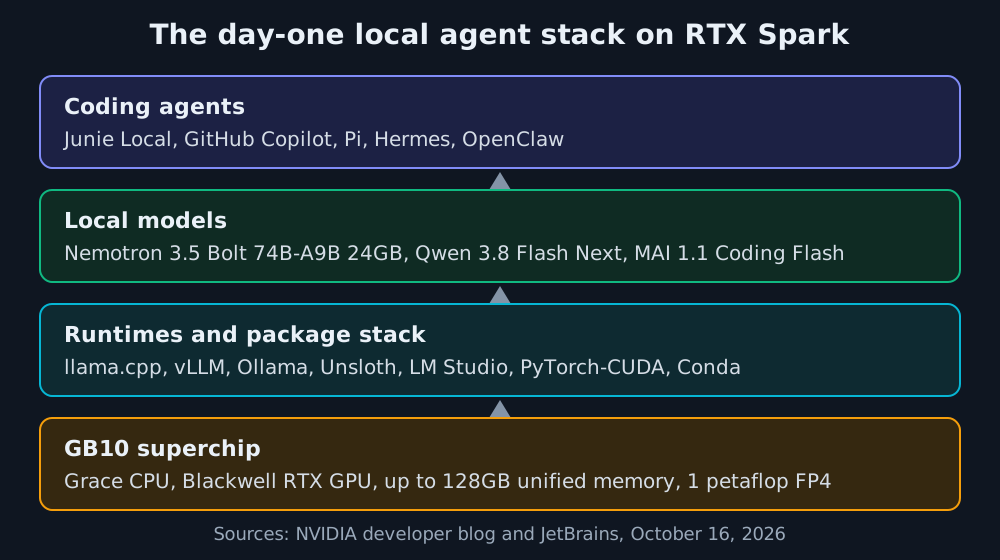
Day-one agent support covers GitHub Copilot, Pi, Hermes and OpenClaw. Copilot now reaches local AI through Windows ML with llama.cpp as a backend, the HydraFusion prompt router also handles local models, and Microsoft’s MAI 1.1 Coding Flash runs on the machine. Hybrid routers send prompts to local models when they are good enough and escalate to the cloud only when needed, which is where token savings actually come from. Sandboxing arrives through NVIDIA OpenShell and Microsoft Execution Containers, and NVIDIA PAIR lets one RTX Spark serve inference to other Windows, Linux and macOS computers on a home network.
The model side gained a purpose-built option: Nemotron 3.5 Bolt 74B-A9B 24GB, a 74-billion-parameter mixture-of-experts model with 9 billion active parameters, packed into 24GB using 2-bit quantization-aware training. It runs through llama.cpp, vLLM, Ollama, Unsloth and LM Studio, and it is fully open source including training data, weights and recipes. Decision models, which pick an agent’s next action without a long reasoning loop — up to 200x faster by NVIDIA’s claim — are now supported in llama.cpp and Unsloth.
Junie Local on day one
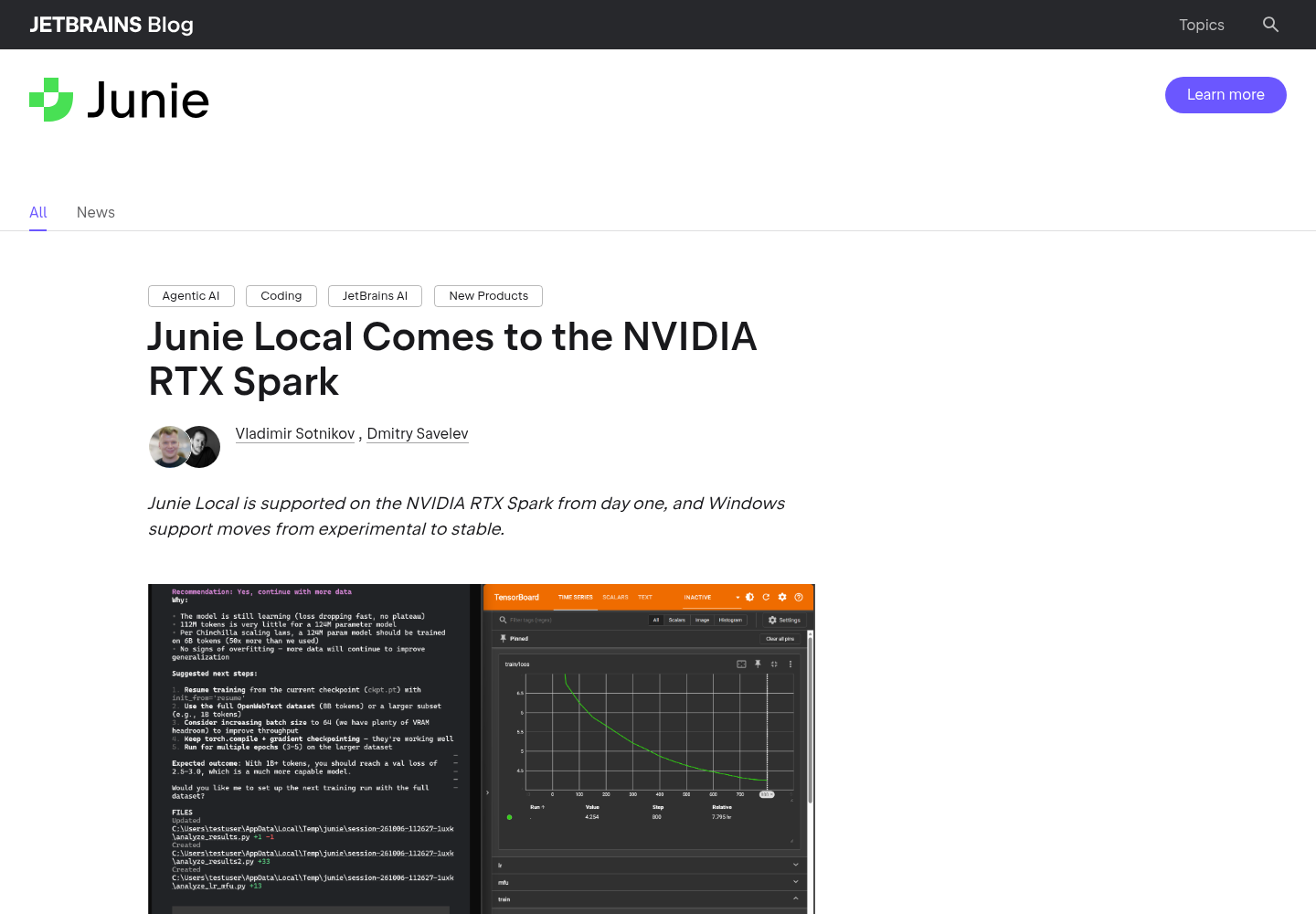
JetBrains shipped native Junie Local support at launch and moved Windows support from experimental to stable. Install Junie, run /local, and you have a coding agent that reads code, edits files and runs tests with the model and code staying on the machine — no token charges and no quotas. On RTX Spark, JetBrains measured up to 55 tokens per second as its initial performance baseline. Junie Local sizes its context window to the GPU memory available, uses FP8 computation on Blackwell Tensor Cores and applies speculative decoding. The same release covers x64 Windows PCs with RTX cards holding at least 24GB of VRAM; you need NVIDIA driver 581 or newer and about 20GB of disk. It is free, with no registration, subscription or credits.
powershell -NoProfile -ExecutionPolicy Bypass -Command "[Environment]::SetEnvironmentVariable('JUNIE_LOCAL_MODEL', '1', 'Process'); iex (irm 'https://junie.jetbrains.com/install.ps1')"
The week-long reality check
The Verge spent a week with five of the laptops and published collective impressions. The tested machines share the N1X chip with 20 CPU cores and 6,144 CUDA cores, and they are expensive:
| Laptop (as tested) | Unified memory | Price as tested |
|---|---|---|
| ASUS ProArt P16 | 128GB | $6,999.99 |
| Microsoft Surface Laptop Ultra | 128GB | $5,899.99 |
| HP OmniBook Ultra | 32GB | $3,199.99 |
Local AI still feels like a beta aimed at developers, in their telling. A Hermes agent running Qwen3.8-27B took 10 minutes and 10 percent of a 99.9 watt-hour battery to build a daily news briefing that cloud Claude Opus 5.5 produced in half the time with more detail and better sourcing. A 36-minute image-editing job burned 30 percent of a Lenovo Yoga 9n battery and cropped the images wrong on the first pass. Battery life for ordinary work landed around five to six hours. Apple’s M-series CPUs still lead comfortably on single-core, and a 12-core M6 Mac Mini matches the 20-core N1X in multicore. Gaming works but leans on DLSS: Cyberpunk 2077 averaged 66fps at medium settings with DLSS Performance.
None of that kills the category; it prices the entry ticket. The cases that hold up today are the ones NVIDIA built for — code that cannot leave the machine, overnight agent runs that would otherwise burn cloud tokens, and hybrid routing that escalates only when a local model is not good enough.
Related reading: our Junie Local launch coverage, the 2026 local AI workstation decision guide, hybrid laptop-and-cloud agent fleets and Nemotron 3.5 Super VL for specialized agents.
Sources
- Code, Test, and Deploy on One Machine with NVIDIA RTX Spark | NVIDIA Technical Blog
- Celebrate the Launch of NVIDIA RTX Spark | NVIDIA Blog
- A week with RTX Spark: everything we’ve learned using Nvidia’s new laptops | The Verge
- Junie Local on NVIDIA RTX Spark: Free Local AI Coding
- NVIDIA RTX Spark PCs Available Today — A New Beginning for Windows PCs | NVIDIA Newsroom