Junie Local Arrives on NVIDIA RTX Spark as Windows Support Goes Stable
JetBrains brings its free local coding agent Junie Local to NVIDIA RTX Spark laptops on launch day, with up to 55 tokens/sec, FP8 and speculative decoding, plus stable Windows support for 24GB RTX cards.
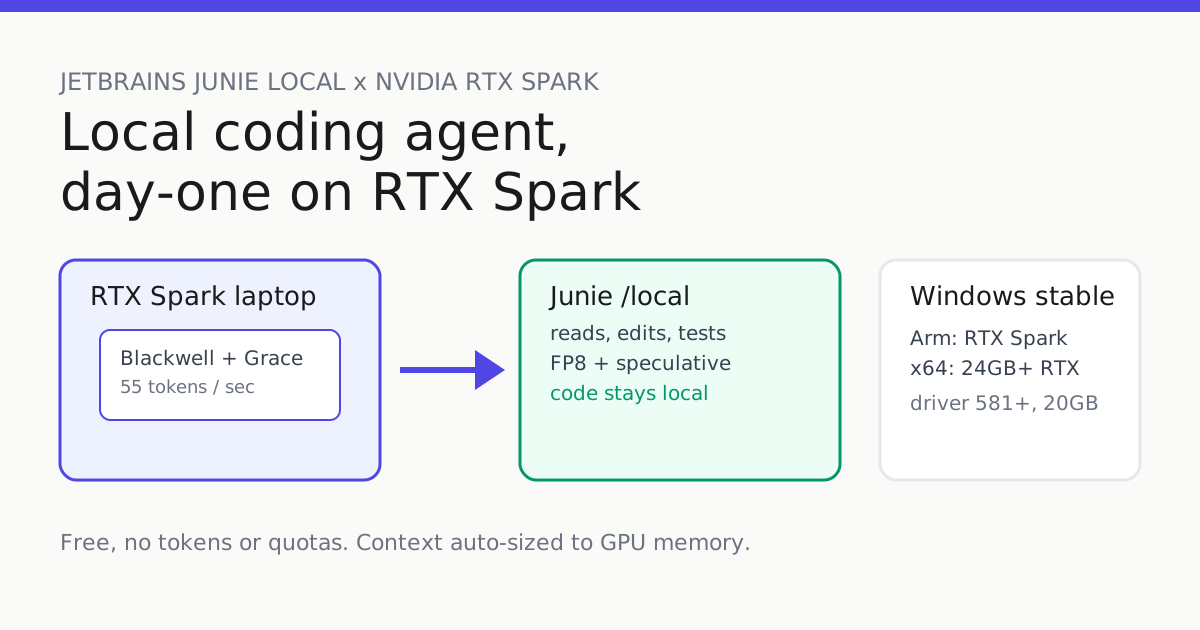
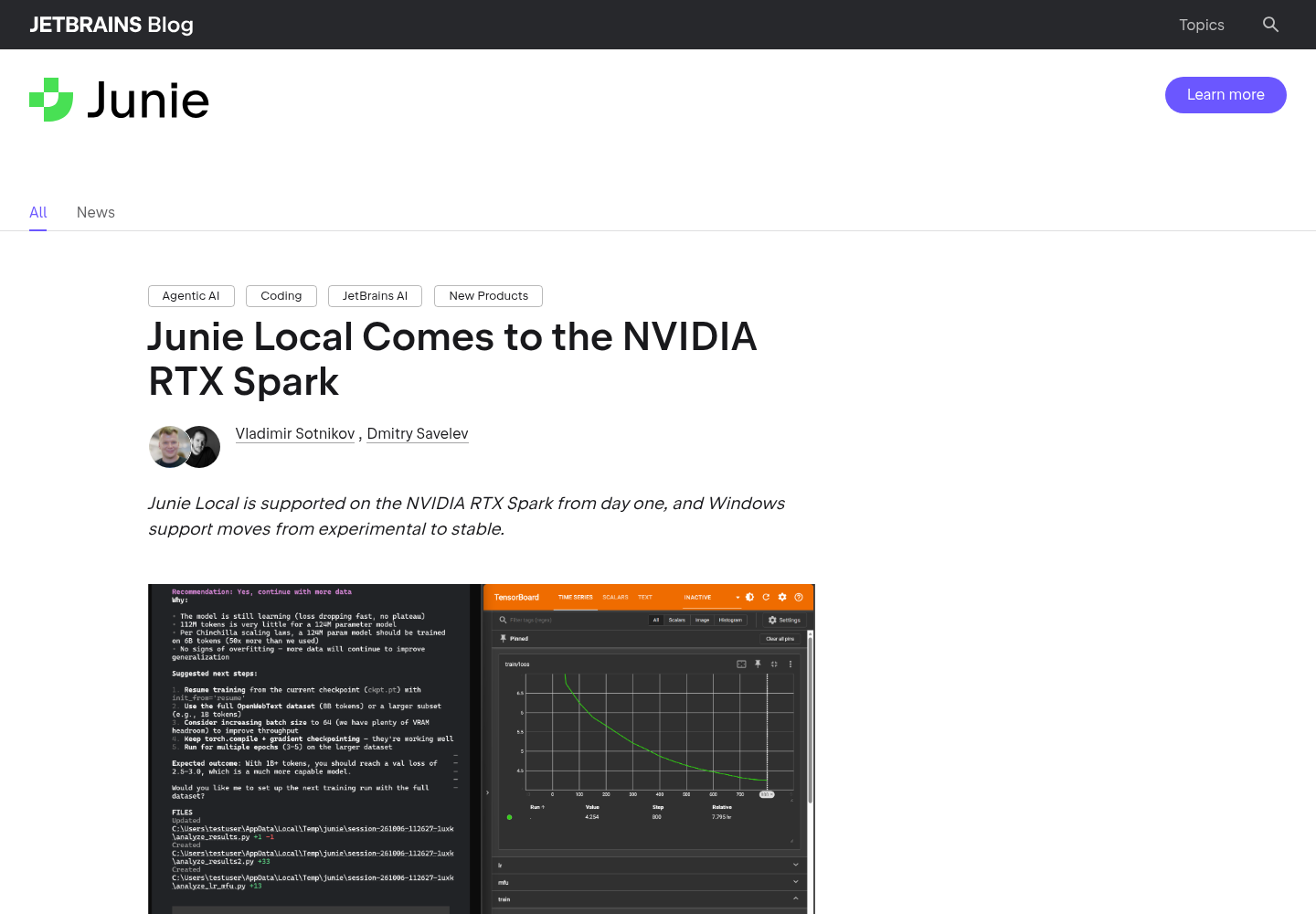
JetBrains is bringing local AI coding to NVIDIA’s new laptop platform on day one. Junie Local comes to the NVIDIA RTX Spark, running as a full on-device coding agent on RTX Spark machines, while Windows support for existing RTX cards moves from experimental to stable.
The timing is tied directly to hardware availability. NVIDIA is celebrating the RTX Spark launch on Oct. 16 with events worldwide, positioning the machine as one PC built for creators, gamers and AI agents. JetBrains says it had early access to RTX Spark hardware to get Junie Local ready for launch.
What Junie Local does on RTX Spark
Junie Local is JetBrains’ free local coding agent. Install Junie and run /local, and according to JetBrains it reads code, edits files and runs tests without sending code off the machine, with no token charges or quotas.
That privacy and cost pitch matters because RTX Spark laptops are explicitly sold as local-AI machines. NVIDIA describes RTX Spark as pairing a Blackwell RTX GPU with a Grace CPU to run larger local models in slim laptops and compact desktops. JetBrains says Junie Local runs alongside LLM training on the same RTX Spark laptop, framing it as part of everyday workflows rather than a separate workstation job.
The launch-day support is notable. Local tooling often lags new chips by weeks while vendors add drivers, quantization formats and installers. Here JetBrains claims native support on Windows on Arm from day one, thanks to joint work with NVIDIA.
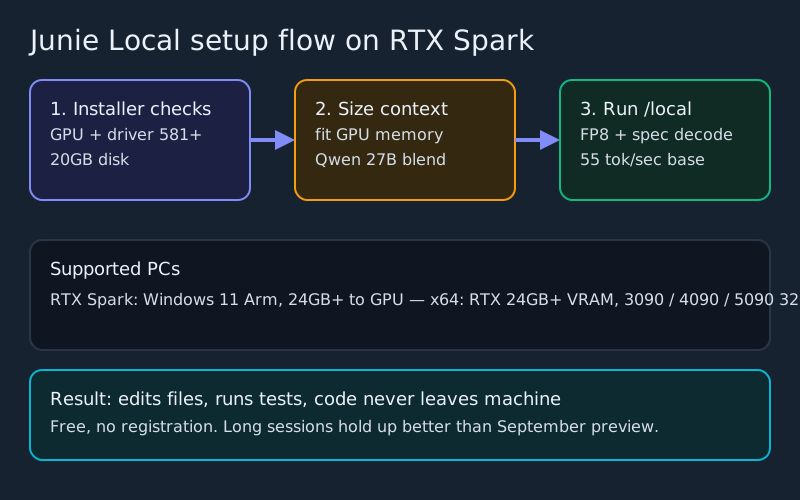
Up to 55 tokens per second, with context sized to your GPU
For RTX Spark, JetBrains discloses an initial performance baseline of up to 55 tokens per second in its testing, with further inference optimizations in development.
Two technical adaptations sit behind that number:
- Context sized to available GPU memory. Junie Local automatically sizes the context window to fit the memory available to the GPU in your configuration. More memory means more code, tool outputs and conversation history retained in the running context.
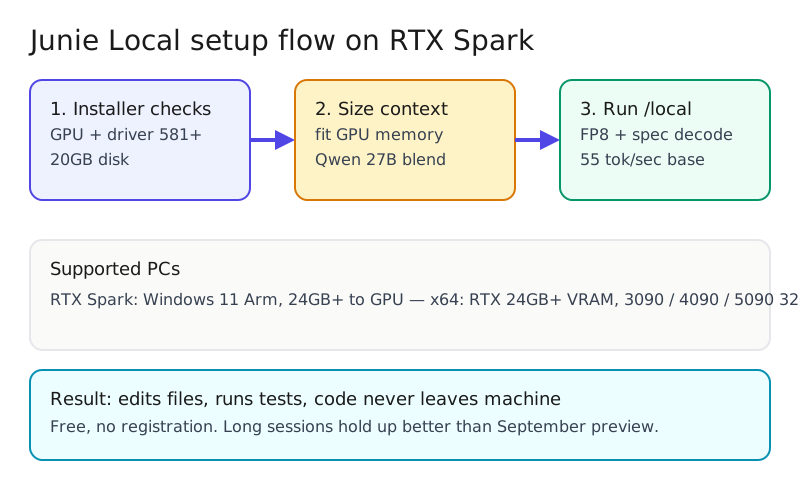
- Blackwell-optimized inference. For inference, JetBrains says Junie Local uses Blackwell Tensor Cores for efficient FP8 computation, plus speculative decoding that drafts several tokens ahead and verifies them together.
JetBrains says it is exploring more efficient model formats and improved speculative decoding to make better use of the GPU’s compute capacity, with benchmarks to follow. In other words, treat 55 tokens/sec as a starting point, not a ceiling — and wait for independent measurements before buying hardware for speed alone.
Windows moves from experimental to stable
The bigger practical change for most developers is Windows stabilization.
When Junie Local launched in August, it required an M5 Mac with 64 GB of memory. In September, JetBrains shipped experimental Windows support for NVIDIA RTX cards with 24 GB of VRAM. Now that support is stable.
JetBrains says Junie Local is now ready for everyday use on:
- NVIDIA RTX Spark PCs, running natively on Windows on Arm
- Windows PCs with NVIDIA RTX graphics and at least 24 GB of VRAM, running x64 Windows
On supported x64 hardware that means Ampere or newer 24 GB cards, such as RTX 3090, 4090 or 32 GB 5090. You also need NVIDIA driver 581 or newer and about 20 GB of free disk space for the model.
What changed since the September preview, according to JetBrains:
- Simple setup that recognizes the PC, checks GPU and driver, and installs an optimized inference engine, model and Junie integration
- Automatic context sizing for the detected GPU memory
- Choice of Qwen3.6-27B or Qwen3.8-3.6-27B-blend, a merged model JetBrains says retains much of Qwen3.8’s coding ability with Qwen3.6’s shorter reasoning
- More reliable engine start, stop and updates for long coding sessions
| PC | What you need |
|---|---|
| NVIDIA RTX Spark | Windows 11 on Arm, at least 24 GB memory available to GPU |
| Windows PC with NVIDIA RTX | Windows 11 on x64, RTX GPU with at least 24 GB VRAM |
| Both | Driver 581+, ~20 GB free disk |
To try it, JetBrains documents a PowerShell installer:
powershell -NoProfile -ExecutionPolicy Bypass -Command "[Environment]::SetEnvironmentVariable('JUNIE_LOCAL_MODEL', '1', 'Process'); iex (irm 'https://junie.jetbrains.com/install.ps1')"
Then start Junie, run /model, pick a model, and Junie downloads what it needs and switches the session to local.
Why this launch matters — and its limits
Independent early testing suggests why a tuned local coding agent matters on this hardware, but also why expectations should stay grounded. In a week of testing five RTX Spark laptops, The Verge found the N1X chip competitive on GPU but behind Apple M-series on CPU, with prices from $2,599 to $6,999, 5-6 hour real-world battery life, and local AI that felt developer-grade rather than mainstream-ready.
Reviewers described local agents flashing command prompts, fans spinning for basic queries, and a 27B model taking 10 minutes and 10% of a 99.9 Wh battery for a news briefing that cloud Claude did faster. One image-editing task burned 30% of a battery in 36 minutes. That is exactly the gap Junie Local is trying to close: a packaged installer, right-sized context, FP8 and speculative decoding, and a merged model tuned for shorter reasoning.
Whether it succeeds will depend on sustained throughput, memory efficiency and task completion — not just tokens per second. JetBrains explicitly frames next work as improving coding performance while reducing time and memory per task, plus support for additional models.
For teams weighing local vs cloud agents, the significance is optionality. A free, no-registration local agent that runs on a launch-day AI laptop and on widely owned 24 GB RTX desktops gives developers a private alternative for sensitive code, offline work, or overnight runs, without abandoning cloud models for harder tasks. See our guide to the local AI workstation tradeoffs in 2026 for how DGX Spark, Ryzen AI Max and Mac options compare.
Junie Local is free with no subscription or credits, according to JetBrains. The open question is how it holds up in long sessions on 24 GB configurations versus 64-128 GB Spark machines — and JetBrains is asking users to report what worked, what didn’t, and what to build next.