Deepgram Acquires Daily: The Open-Source Layer Under Voice Agents Changes Hands
Deepgram is buying Daily, the team behind Pipecat, the open-source framework many real-time voice agents import. What changes for the teams that ship them.
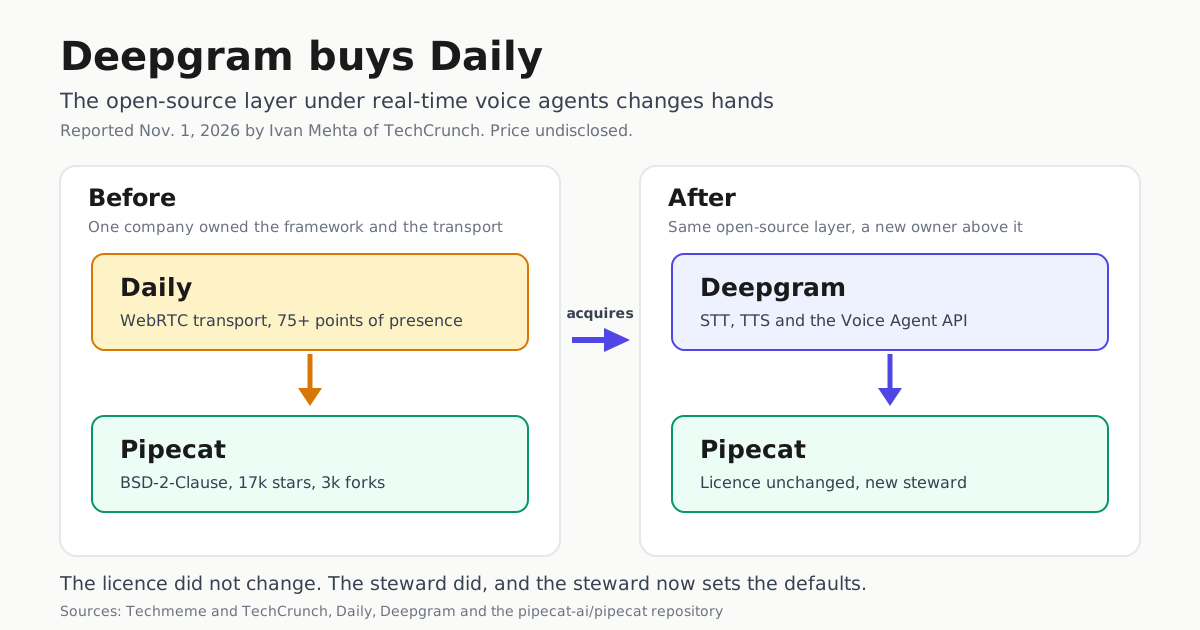
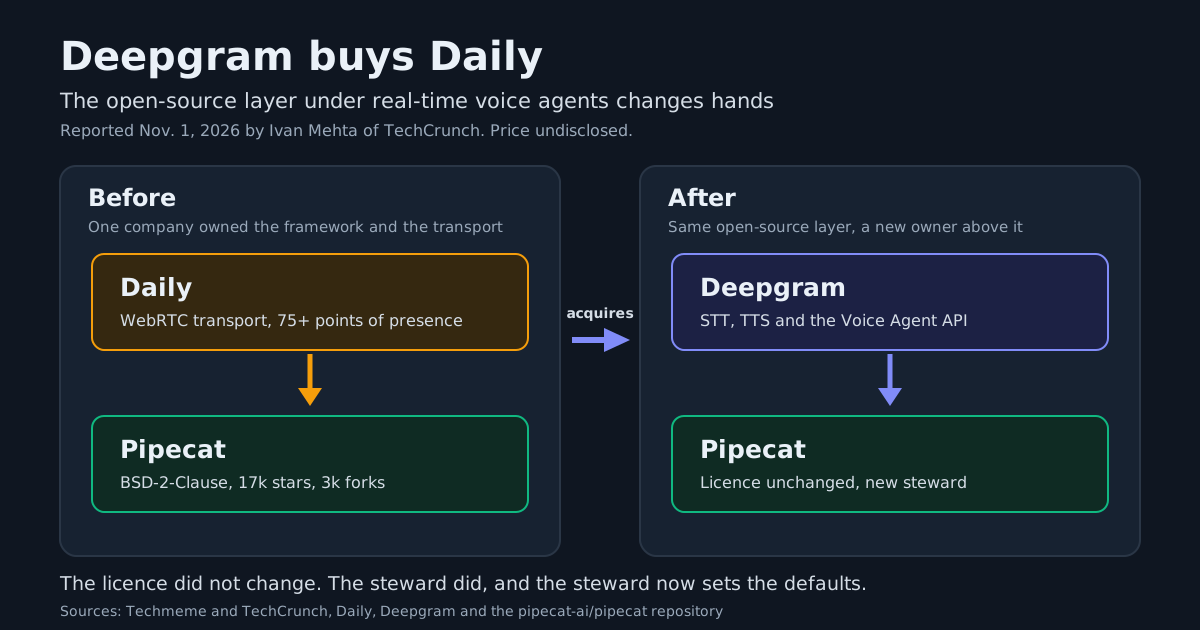
Deepgram has agreed to acquire Daily, the company that maintains Pipecat, the open-source Python framework many real-time voice-agent projects import. TechCrunch’s Ivan Mehta reported the deal on Nov. 1, 2026, and Techmeme carried it on the same day’s front page: the price is undisclosed, and Daily had raised $62 million or more. Daily’s homepage now carries the same news.

Techmeme’s Nov. 1, 2026, 3:09 AM ET snapshot. The visible top of the page carries the Binance and FBI lead items; the acquisition item appears further down the front page, below this fold: “Enterprise voice AI tools provider Deepgram acquires Daily, which has raised $62M+ and develops open-source voice AI framework Pipecat, for an undisclosed sum” (Ivan Mehta/TechCrunch). Source: Techmeme.
The shape of the deal
The transaction is simple in structure and open in terms. Deepgram buys Daily. Daily brings two assets: a commercial WebRTC transport business, and the stewardship of Pipecat, which Daily calls a vendor-neutral, 100% open source orchestration framework for realtime voice and multimodal agents.
One commitment travels with the announcement. Mehta reports that Deepgram said it aims to keep Pipecat open source. The TechCrunch report’s framing is consolidation: the voice AI sector is hot and top players are trying to consolidate their position as more business models come to the fore through partnerships and acquisitions. Deepgram’s own homepage carries a banner announcing that Daily and Pipecat are joining Deepgram, so the acquirer’s site confirms the deal independently of the scoop. Missing from the announcement are the details operators would most want: price, close date, and any governance commitment beyond that intention.
Why the framework matters more than the transport
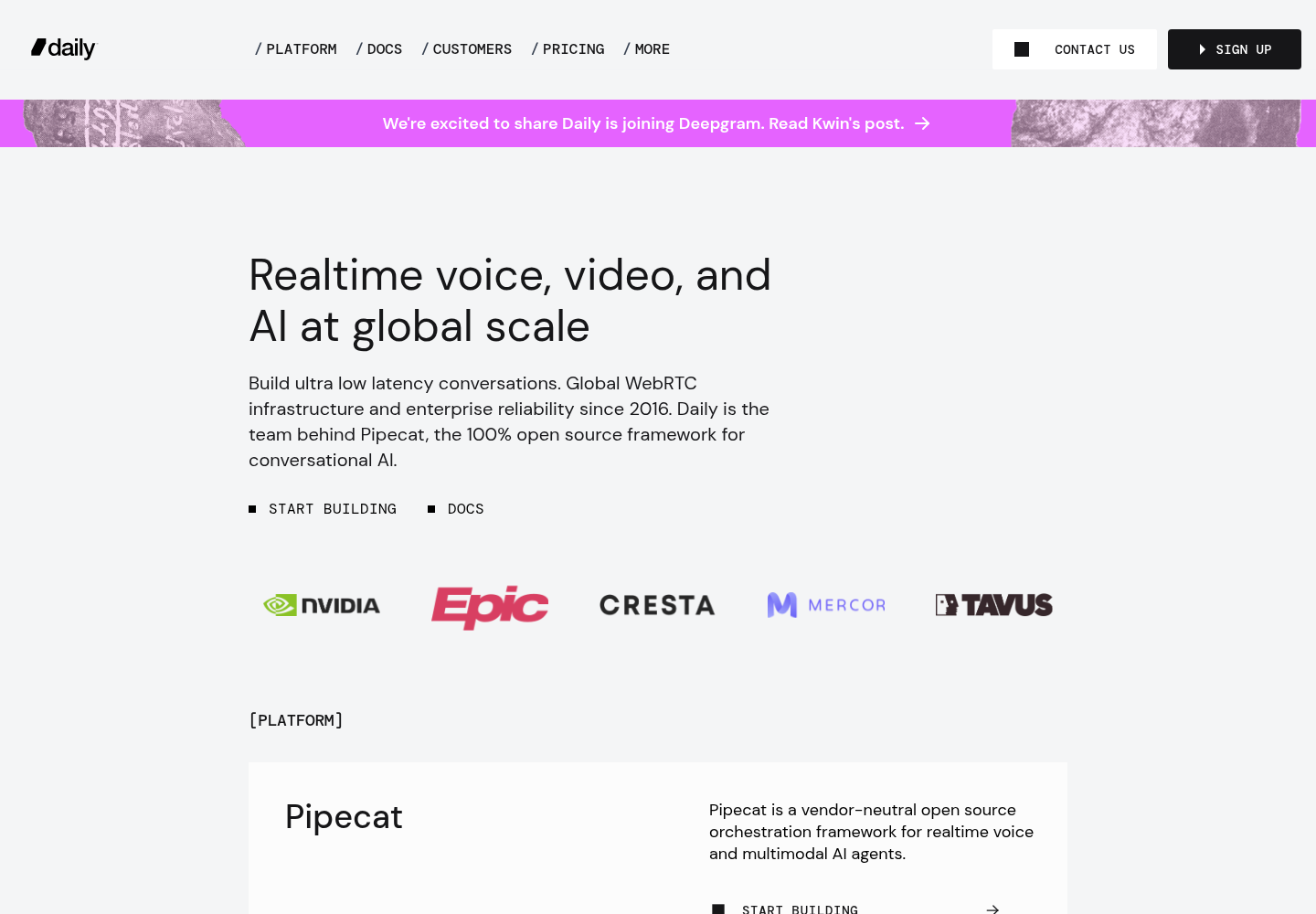
Daily’s homepage, Nov. 1, 2026: the banner announcing that Daily is joining Deepgram sits above the Pipecat and Daily Infrastructure sections. Source: Daily.
Pipecat sits between an application and every model, carrier and telephony provider underneath it. The pipecat-ai/pipecat repository describes it as an open-source Python framework for building real-time voice and multimodal conversational agents, from a single agent to multi-agent systems where specialists hand off, fan out in parallel, or run as sidecars over a shared bus. It carries a BSD-2-Clause licence, 17.0k stars, 3.0k forks and 14,737 commits, plus a CLI, Pipecat Flows and the Whisker debugger.
The CLI scaffolds a project in one command:
uv tool install "pipecat-ai[cli]"
pipecat init
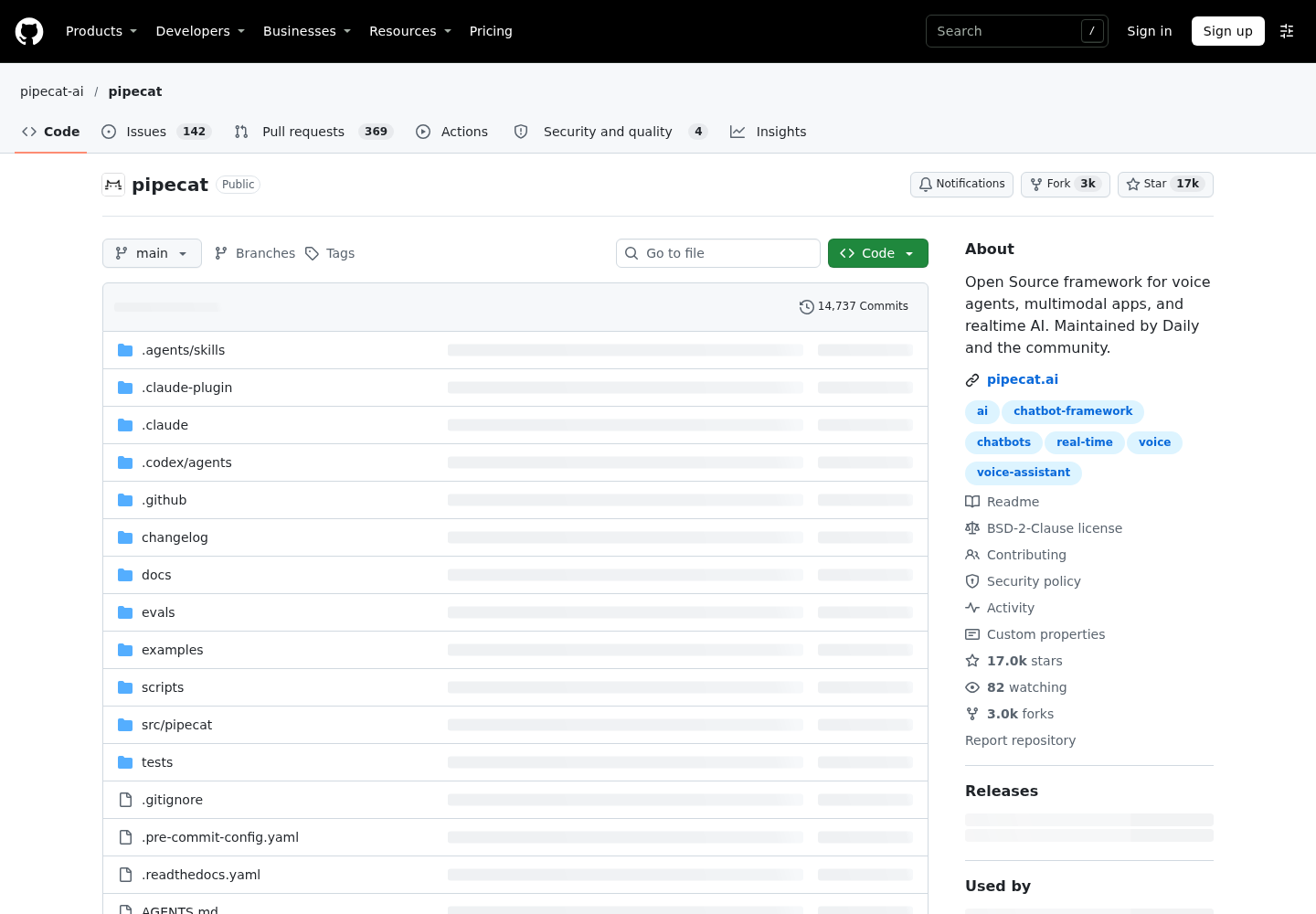
The pipecat-ai/pipecat repository as of Nov. 1, 2026: BSD-2-Clause license, 17.0k stars, 3.0k forks, 14,737 commits, and the README’s provider lists. Source: GitHub.
That breadth is why this is more than an infrastructure tuck-in. Pipecat is not the product; it is where developers choose which product to buy.
Where the acquisition lands in the stack
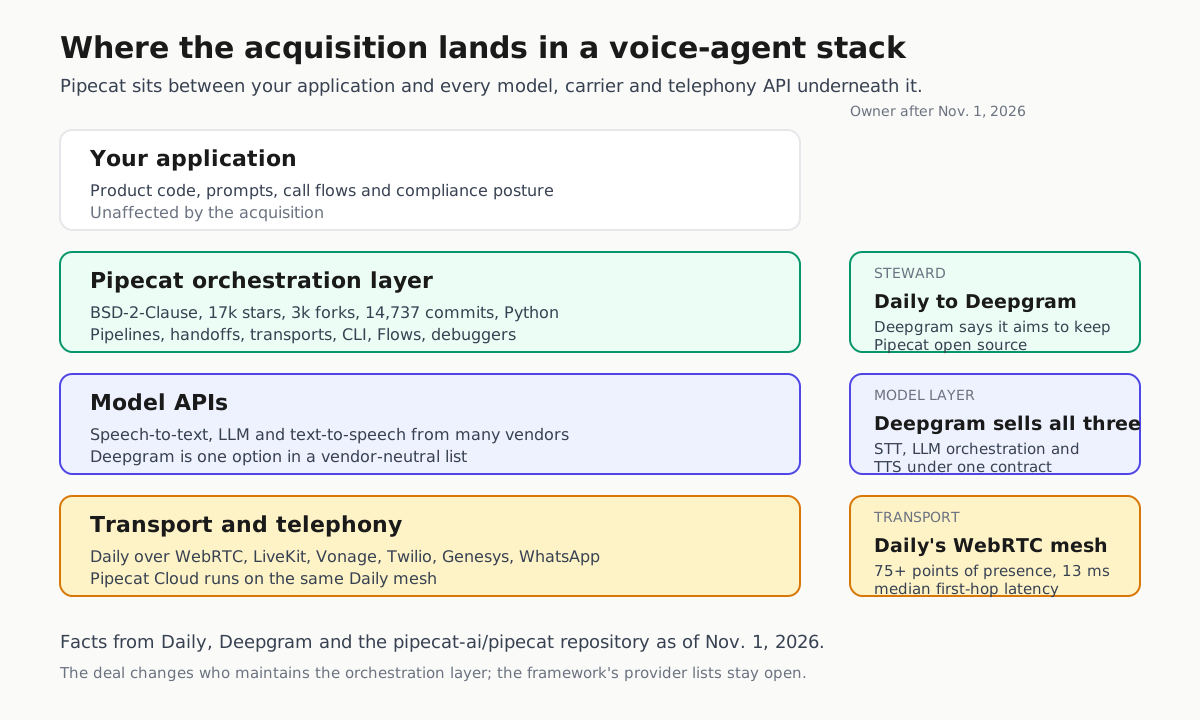
Diagram: a voice-agent stack and who owns each layer after the acquisition. Sources: Daily, Deepgram and the pipecat-ai/pipecat repository.
Deepgram’s homepage sells that whole stack in one platform: audio input, speech-to-text, LLM orchestration, business logic and text-to-speech. It reports 650K+ developers building with it, 5,000+ organizations powered and 99.99% enterprise-grade reliability. Vapi’s founder and CTO Nikhil Gupta says having STT and TTS under one roof eliminates the integration gaps and latency issues of piecing together separate tools.
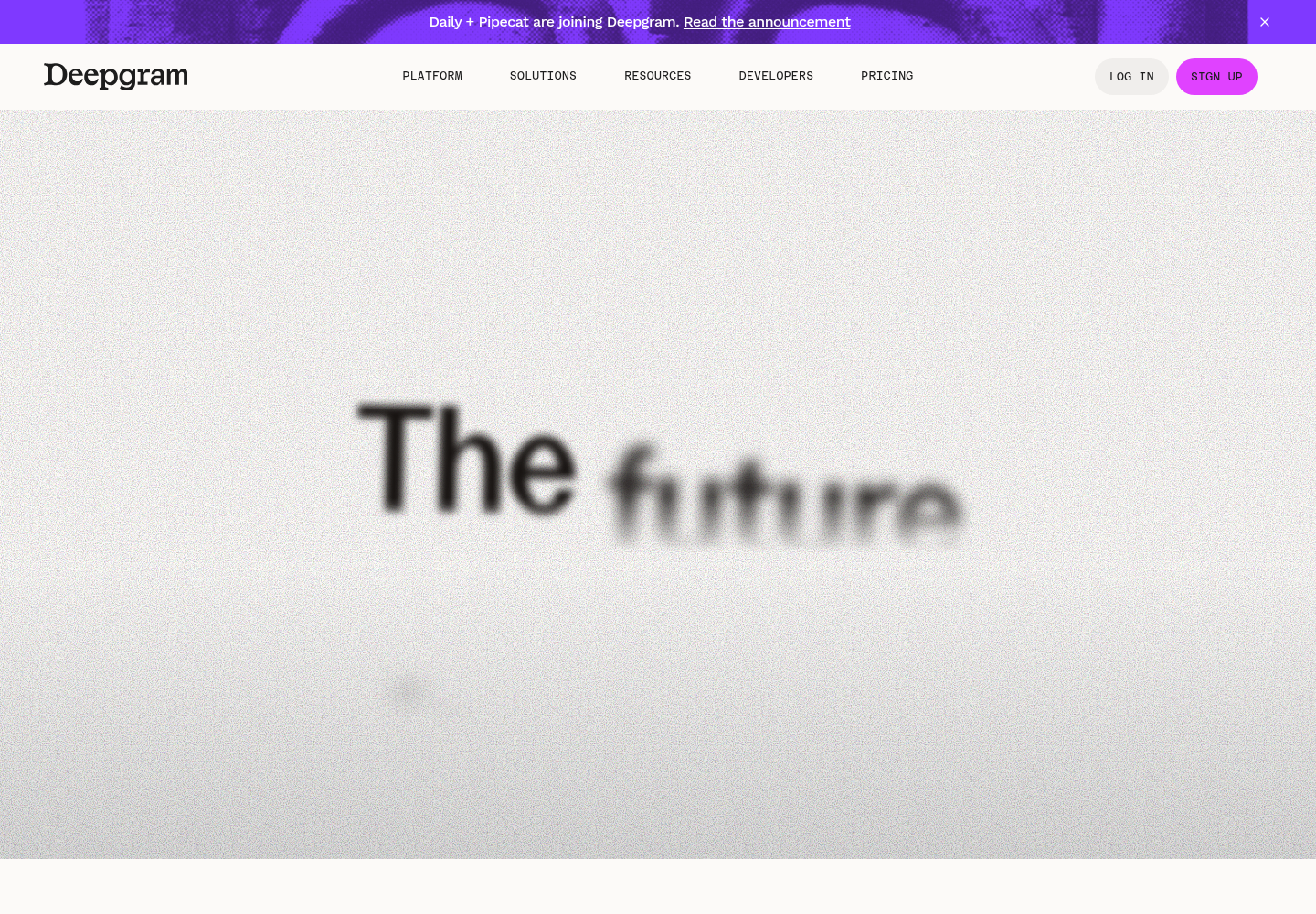
Deepgram’s homepage, Nov. 1, 2026: the visible top of the page leads with the banner announcing that Daily and Pipecat are joining Deepgram. The voice-AI-stack graphic and the developer counters sit further down the page, below this fold. Source: Deepgram.
Daily adds the transport underneath: 75+ global points of presence, 13 ms median first-hop latency, 99.99% service uptime, SOC 2, GDPR and HIPAA posture, and a W3C WebRTC Working Group seat. For an enterprise buyer, one company now spans the orchestration layer, the speech models and the carrier-grade transport.
What the deal does not change
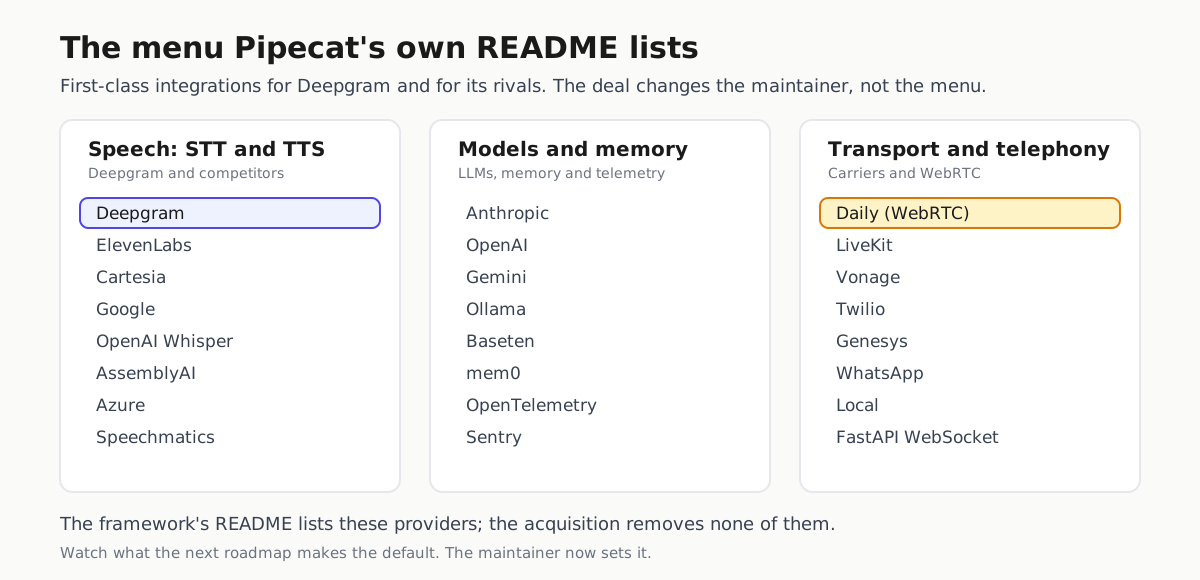
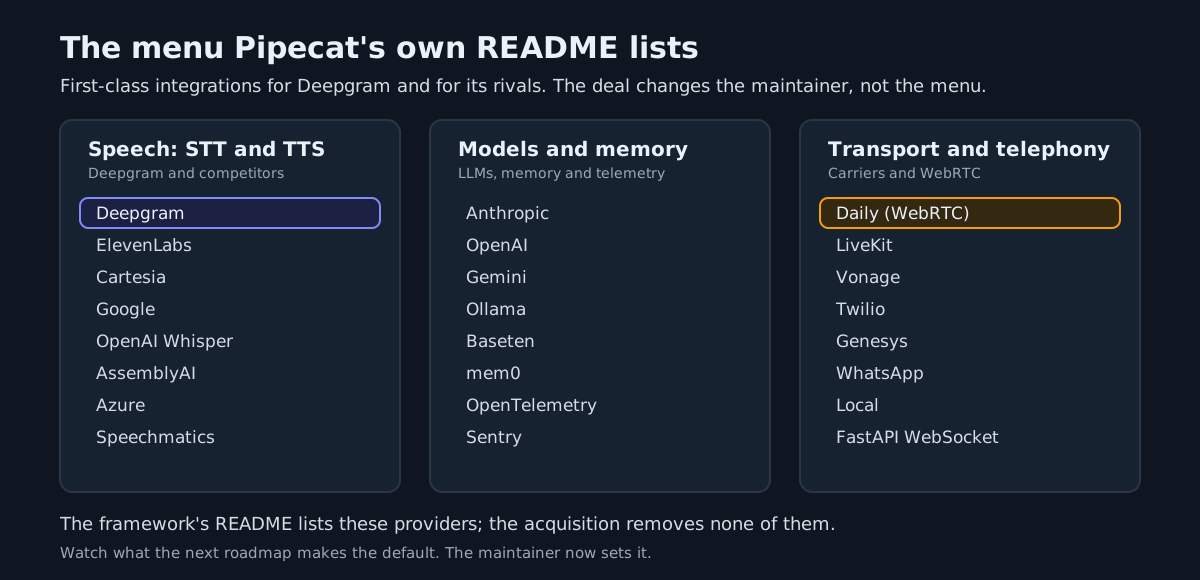
Diagram: the provider families Pipecat’s README lists for speech, models and transport. The acquisition changes the maintainer, not the menu. Source: the pipecat-ai/pipecat repository.
Nothing in Pipecat’s documented design forces a Deepgram stack. The licence is BSD-2-Clause, permissive enough to fork, vendor and redistribute. The README’s provider lists keep Deepgram’s competitors as first-class options, with ElevenLabs and Cartesia beside Deepgram for speech, LiveKit and Vonage’s WebRTC transport beside Daily’s, and Twilio and Genesys still listed as serializers. Pipecat Cloud is one deployment path, not a required one.
The governance risk is not low. The repository’s tagline still reads “Maintained by Daily and the community.” Deepgram now maintains a project with a direct commercial interest in steering framework defaults toward its own speech API and transport. The pattern is not hypothetical: Deno’s move into Cloudflare came with a one-year end to runtime support and a six-month deployment shutdown.
What to verify
| Check | Where to look | Why it matters |
|---|---|---|
| Licence | The LICENSE file | BSD-2-Clause today; confirm no relicensing |
| Governance | README and governance files | The tagline now means Deepgram |
| Defaults | Docs, quickstart and CLI defaults | Daily’s WebRTC mesh is the path of least resistance |
| Provider neutrality | Integration lists and example apps | Confirm rivals stay first-class |
The competitive frame
Deepgram is not buying a neutral framework in a quiet market. Mistral’s Voxtral 3 packages voice-agent tooling with tool calling and EU hosting, while ElevenLabs’ Eleven Realtime adds a second OpenAI-compatible realtime endpoint. Deepgram’s answer is to own the layer between those models. Mistral’s purchase of New Material is the same pattern on the design side: buy the tooling around the model.
Bottom line
This is not a new capability and not a lock-in switch. It is a change of steward for one of the most widely used open-source voice-agent frameworks, and the terms to watch are licence, governance, default transport and provider list. Teams shipping voice agents on Pipecat do not need to change code this week. They do need to read the governance files before the next roadmap cycle decides the framework’s defaults.
Sources
- Techmeme: Enterprise voice AI tools provider Deepgram acquires Daily, which has raised $62M+ and develops open-source voice AI framework Pipecat, for an undisclosed sum (Ivan Mehta/TechCrunch)
- Realtime voice, video, and AI for developers - Daily
- Enterprise voice AI: STT, TTS & agent APIs | Deepgram
- GitHub - pipecat-ai/pipecat: Open Source framework for voice agents, multimodal apps, and realtime AI. Maintained by Daily and the community. · GitHub