Qwen Code v0.26.5 Ends the Unattended Fix Loop: Three Pushes, Then a Human, and a Verify Step That Says Inconclusive
Qwen Code v0.26.5 ends the unattended PR fix loop: three counted pushes, then a human handoff visible in /autofix-pr status, a PR comment naming the blocker, and a verify-pr publisher that marks a round inconclusive instead of publishing a result it cannot back.
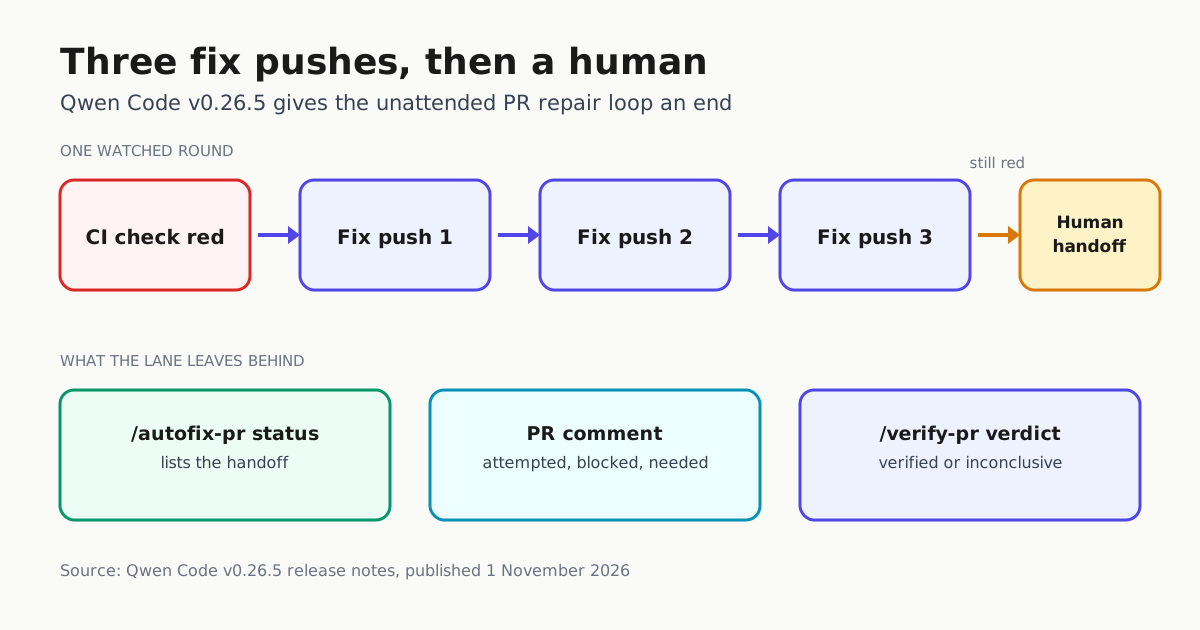
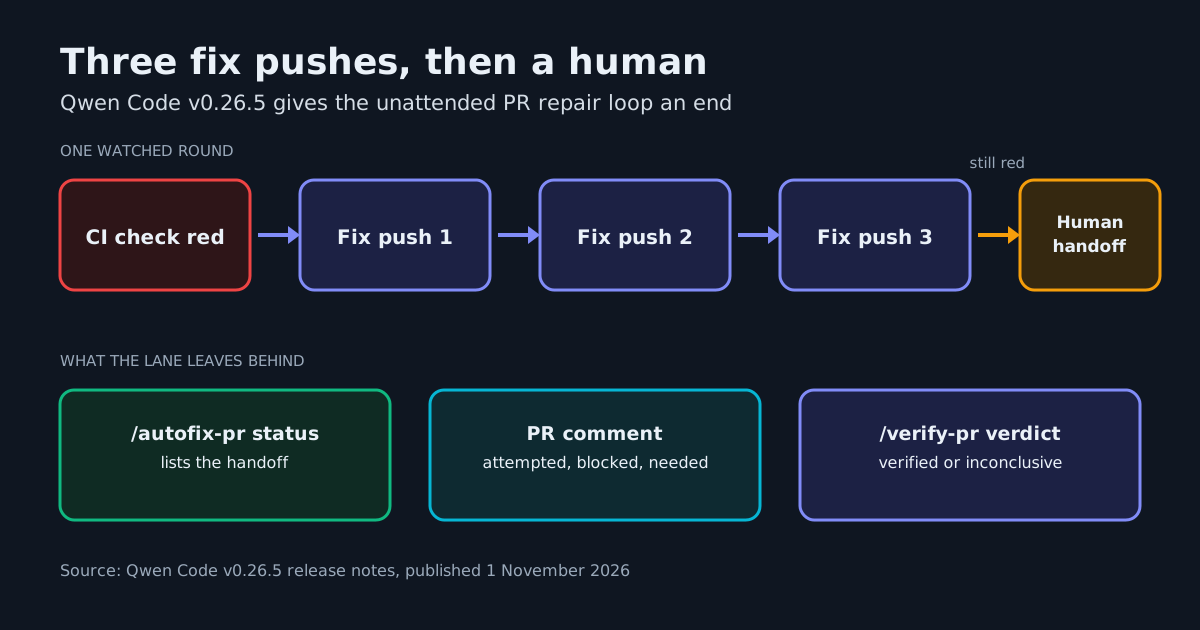
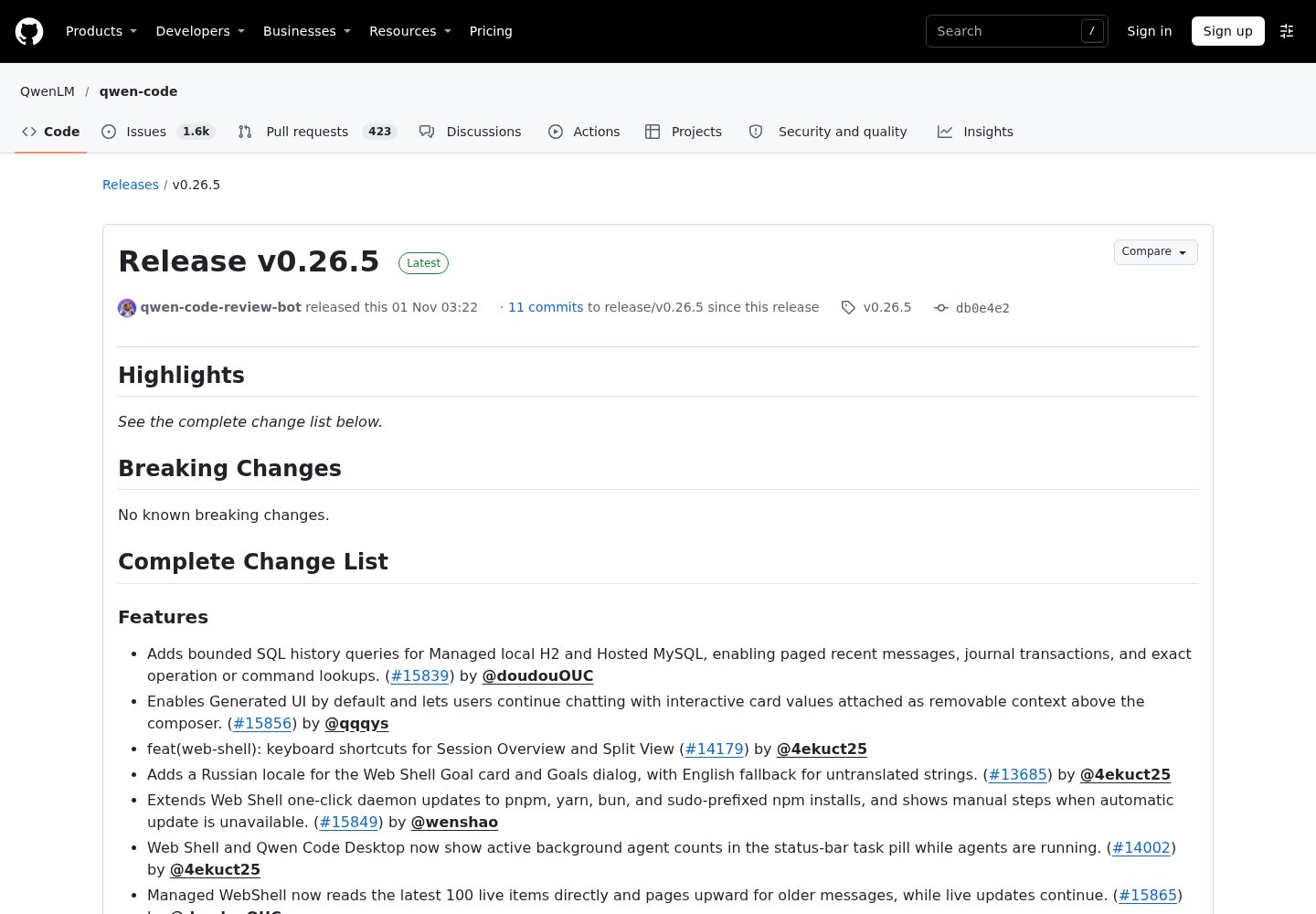
Qwen Code v0.26.5 was published on GitHub at 03:22 UTC on 1 November 2026, and the Desktop build followed at 03:59 from the same commit (db0e4e2). Most of the change list is plumbing: bounded SQL history queries for Managed, a Russian locale for the Web Shell goal card, keyboard shortcuts for split view, CI runner routing. One cluster is not plumbing. This release gives the unattended pull-request repair loop an actual end, and it makes the verifier say when it could not confirm a result.
That is the same feature line we covered when unattended autofix-pr arrived in v0.26.2, and it sits on top of the round budget that v0.26.4 already added to bound autofix takeover in CI. What changes in v0.26.5 is termination: what happens on the third failed push, and whether a published verdict has to survive a check the publisher actually ran.
Three pushes, then a person
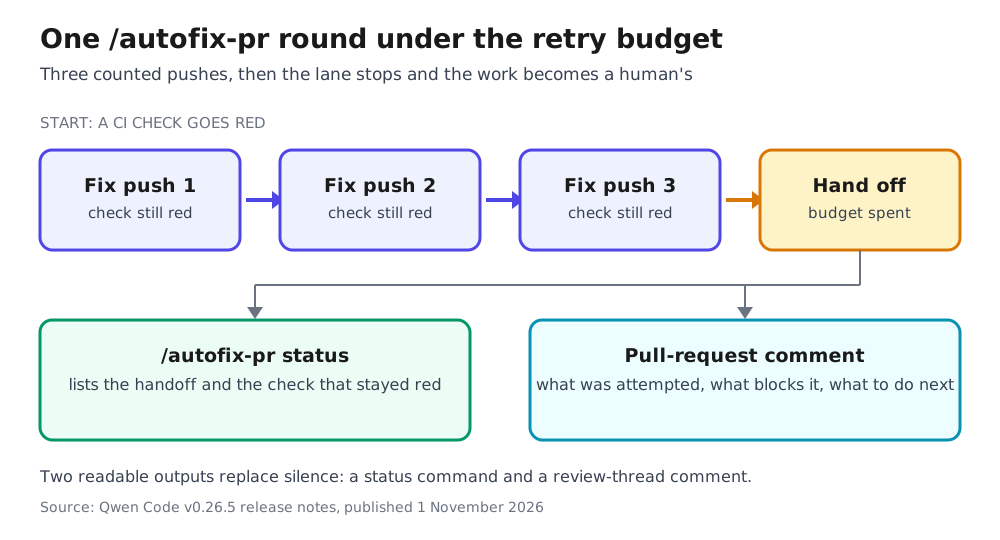
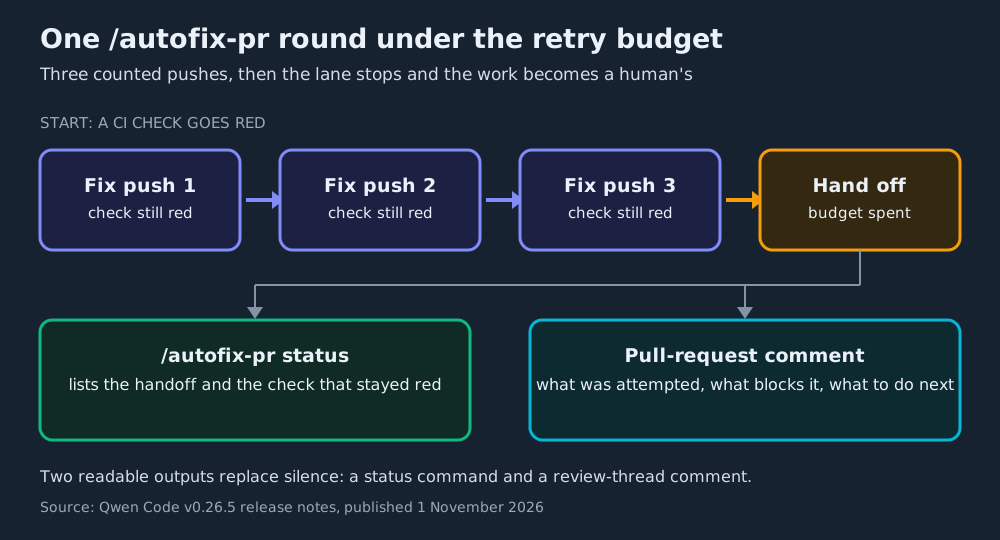
/autofix-pr watches a pull request and pushes fixes when checks go red. In v0.26.5 the skill gains a retry budget: a check still failing after three fix pushes is handed to a human and shown in /autofix-pr status, instead of being repaired a fourth time. The upstream release notes say exactly that, and the Desktop changelog renders it plainly: leave a check for a person once three fix pushes left it red (#15985). The capture below shows the top of that page.
The handoff leaves a trail
A handoff is only useful if it is visible. v0.26.5 also makes autofix-pr post a pull-request comment when a round is blocked, stating what was attempted, what blocks it, and what human action is needed (#15978). The Desktop changelog calls the same item report a blocked round and state the merge boundary.
The practical effect: nothing happened stops being a valid reading of an unattended lane. A stalled repair used to look like a quiet PR or an expensive loop. Now there is a command output and a review-thread comment naming the next human move, which is what the playbooks for CI fix loops and overnight merge gates have been missing.
PR watch stops fixing the wrong thing
PR watch now merges a stale base before attempting fixes, when CI failures may be caused by the branch being behind (#15922). A branch that is merely behind its base can fail checks for reasons that have nothing to do with the patch, and an eager repair agent will rewrite working code to chase them.
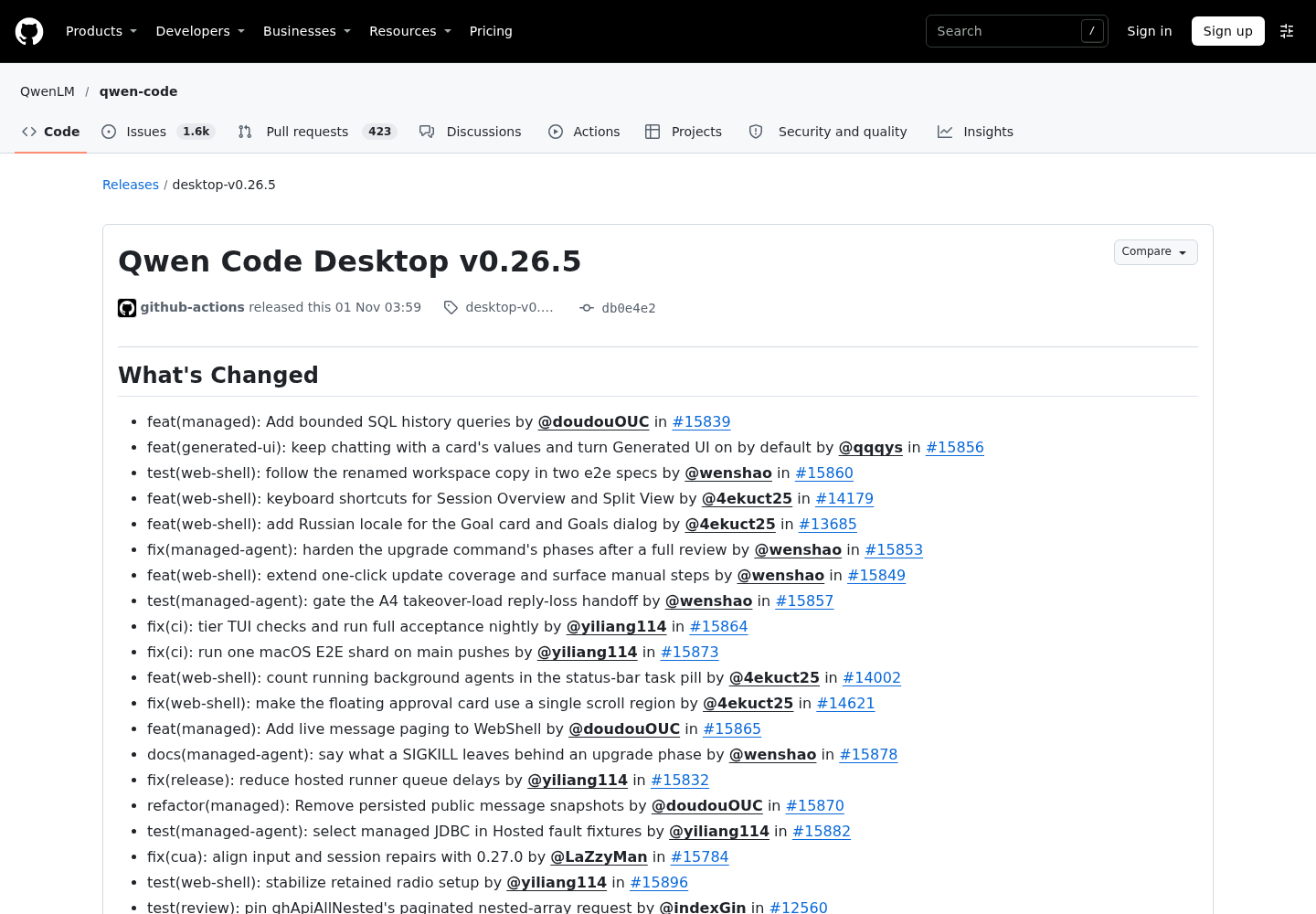
The same release adds --in-place to the PR-watch skill, which co-drives in your checkout, pushes the branch and replies on the PR (#15929), and the documentation now proposes scheduled /autofix-pr --in-place rounds that report findings and require explicit approval before editing (#15960). The capture below is the top of the Desktop changelog for the same version.
The verify step can say inconclusive
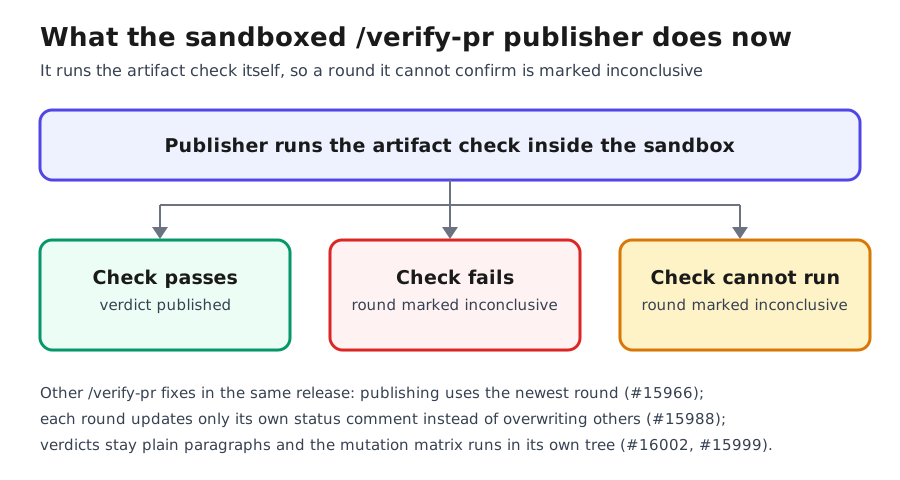
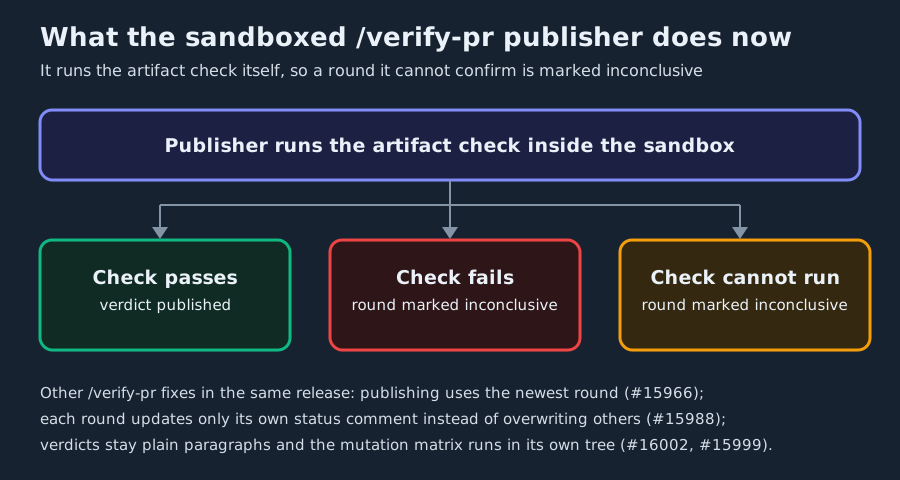
The most consequential line in the release, for anyone who trusts a green verification badge: the sandboxed /verify-pr publisher now runs the artifact check itself and marks the round inconclusive if the check fails or cannot run (#15938). A round the publisher cannot confirm is now a named third outcome rather than a result it cannot back.
Around it, the same release makes the verdict auditable rather than merely present:
- publishing uses the newest round (#15966);
- each round updates only its own status comment instead of overwriting others (#15988);
- deep-verification verdicts stay plain paragraphs, and the published comment is checked against the intended body (#16002);
- the PR badge binds when a flag is glued to the PR number, for example 15979–publish (#15989);
- the mutation matrix runs in its own tree, never on live measured cells (#15999);
- the local flow reuses your working tree only on a clean checkout of the PR head (#15913).
The bundled code-review skill gets the same treatment: it re-anchors after head drift, runs actionlint checks, accounts for blockers, and refuses retries (#16001). A reviewer that re-anchors before it judges and stops at a blocker is a reviewer you can leave running.
What changed, in one table
| Change | What it stops | Where to look |
|---|---|---|
| Retry budget on /autofix-pr (#15985) | A fourth push on a red check | /autofix-pr status |
| Blocked-round comment (#15978) | Silent stalls | The PR review thread |
| Stale-base merge before fixing (#15922) | Repairing the wrong thing | PR watch |
| Publisher runs the artifact check (#15938) | A green nobody verified | The verify round comment |
Also in the box
- Generated UI is on by default, and you can keep chatting with a card’s values, which stay attached as removable context above the composer (#15856).
- An experimental one-command Helm deployment for Managed Agent, with Hosted Harness, MySQL, local execution and an authenticated gateway (#15492).
- A batch request and SDK method that fetch live-session snapshots for up to 20 selected workspaces in one call (#12513).
- The MCP client and core move to 2.4.0, dropping the pre-bundled fast-uri 3.1.0 for better dependency auditability (#15925), and the CLI can update to an exact version without npm discovery (#11486).
What to do on Monday morning
- Update the CLI and Desktop to 0.26.5 and pin the version on lanes that must not drift. The official install path prefers a standalone archive and falls back to npm on Node.js 22 or later, and the CLI now supports exact-version updates without npm discovery (#11486).
- If you run autofix-pr unattended, treat
/autofix-pr statusas the source of truth for a handoff and read the PR comment before concluding the lane is dead or the fix is impossible. - Budget for a handoff, not infinite retries. Three pushes is now the ceiling, so a lane that needs more is a lane that needs a human or a better base.
- If your process depends on verification comments, treat inconclusive as a third state: not a pass, not a failure, and not a reason to assume the artifact was checked.
Everything above comes from the vendor’s published notes for Qwen Code v0.26.5, Qwen Code Desktop v0.26.5 and the release index, plus the project’s own documentation. The semantics described are the vendor’s claims, read from the published release pages rather than demonstrated in a running lane.