OpenAI's Teen Safety Overhaul: Live Limits, Auto-Ended Chats and a Safety Report Due in 2027
OpenAI's new teen safety rules, auto-ended violence chats and a safety report due in 2027: what is live, what is rolling out, what is only promised.
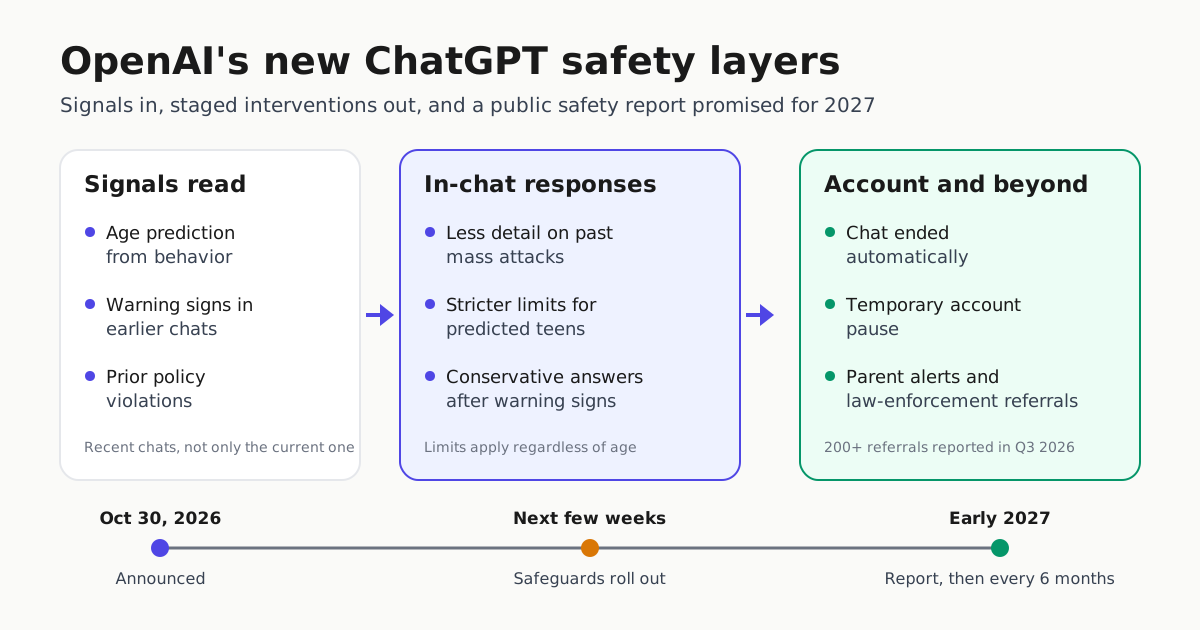
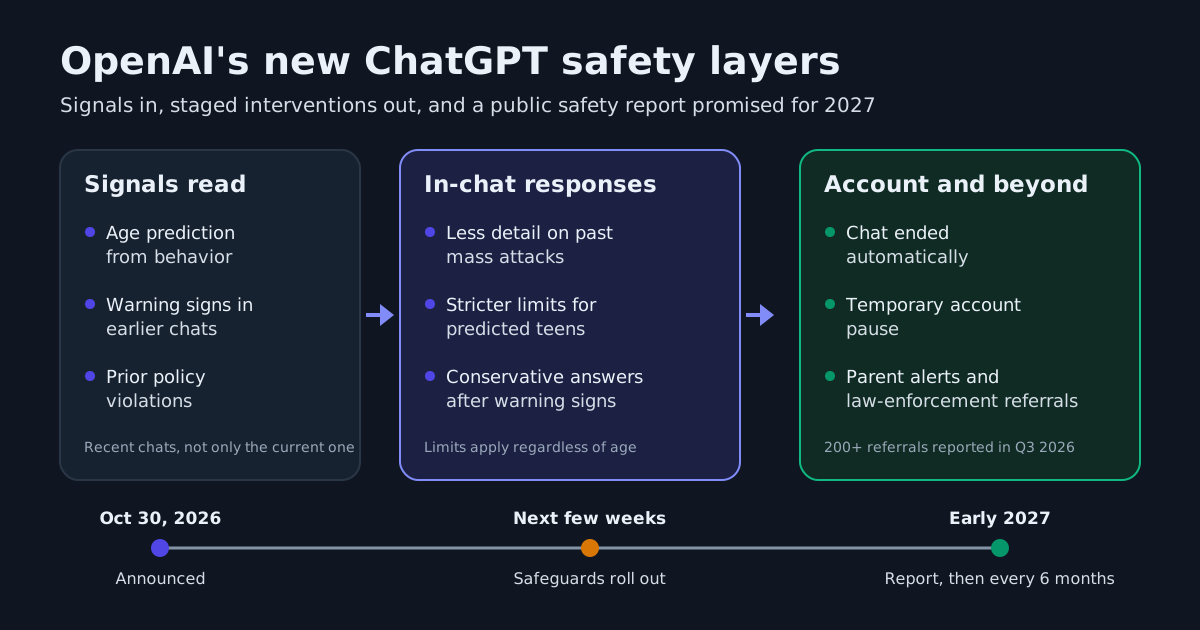
OpenAI’s October 30, 2026 post carries two announcements under one headline: a new Community Safeguards Report and tighter restrictions around firearms content for minors. They are not equally ready. Some described behavior is live, some is scheduled to roll out “in the next few weeks,” and the flagship report does not exist yet — its first edition is promised for early 2027, covering the second half of 2026, with updates every six months after that.
That split is the story. Platform safety teams, schools, parents and builders of minor-facing products need to know which sentences describe shipped behavior, which describe staged behavior, and which are dated commitments.
What OpenAI says is already in effect
The broadest change applies to every user: ChatGPT will now answer questions about past mass attacks with less detail — the weapons and equipment used, how they were obtained, and comparisons on the scale of harm that could amplify an attacker’s notoriety — even when that information is available elsewhere on the open web. OpenAI says the limits hold regardless of the user’s age or reason for asking.
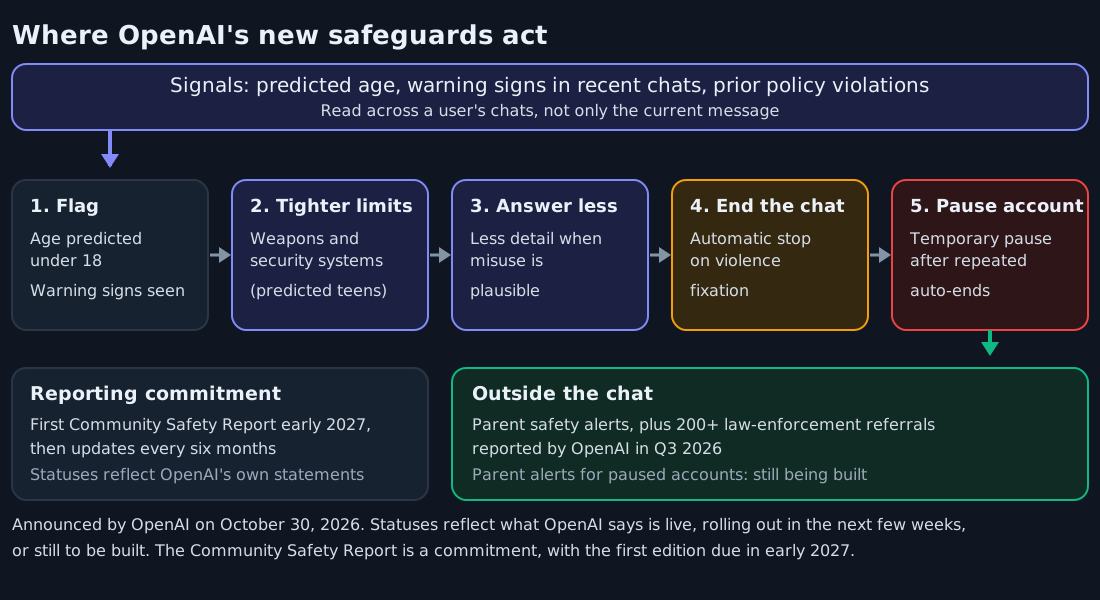
For teens, the change is about plausibility rather than intent. OpenAI says it is extending existing policy to restrict practical information about weapons and security systems that could be misused to facilitate violence, even when a question appears harmless.
Underneath both sits age prediction, which OpenAI says it strengthened to “continually assess new signals as people use ChatGPT” and move teens into the under-18 experience when appropriate. Adults placed there by mistake can confirm adulthood through Persona, OpenAI’s age verification partner, which removes the extra teen protections.
One parental control already ships: since July, safety alerts have fired when a teen’s account has been deactivated for violating violence policies.
What is rolling out in the next few weeks
The post’s closing line says the safeguards detailed in it “will begin rolling out in the next few weeks.” Three changes sit in that bucket.
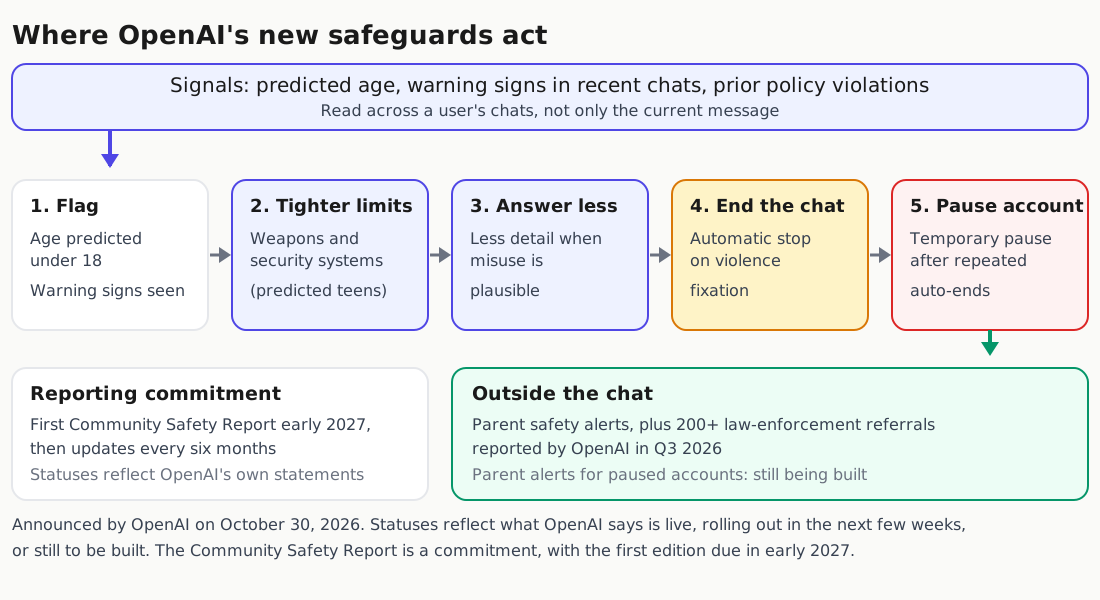
First, conservative answers. When recent chats show warning signs of possible violence, ChatGPT will respond more carefully and share less information that could be misused, extending the May work on short factual summaries of earlier warning signs.
Second, automatic chat termination. When a conversation shows signs that someone is “fixating on violence or the idea of seriously harming another person,” ChatGPT “will be able to automatically end the chat to interrupt that pattern in the moment.” If it ends multiple chats for that reason, OpenAI may temporarily pause the account. The trigger threshold is not published.
Third, parental notification for a pause. OpenAI says it “is working to introduce” alerts when a teen’s account is paused for repeatedly discussing violence, so this sits behind the other two changes.
The commitment and the number
The Community Safety Report is the part with a date attached and the part with nothing to read yet. OpenAI says it will explain how its systems are trained to detect, investigate and respond to community safety issues, will include anonymized examples of how violence-related harm manifests, and will carry relevant data.
The other number is the most consequential and the least verifiable: OpenAI says it made more than 200 law enforcement referrals in Q3 2026 and that they are “making a positive difference in disrupting violent plots.” There is no denominator, no definition of a referral, and no outcome data.
| What OpenAI states | Status | Consequence |
|---|---|---|
| Less detail on past attacks | Live | Historical refusals |
| Stricter teen weapons limits | Live | Plausibility, not intent |
| Conservative answers after warning signs | Rolling out | Less detail mid-chat |
| Auto-end on fixation chat | Rolling out | Session ends with no human |
| Parent alert on pause | Still being built | Cannot be relied on yet |
| First safety report | Early 2027 | A dated artifact |
Operator impact
For teams building teen-facing or educational products, the refusal surface expands on plausibility. Study guides, security coursework, hardware forums and crisis-content products that used to retrieve practical detail may now be refused. Test for it in your own evals.
For support and trust teams, a session’s terminal state is no longer always “the model answered.” A chat can end on its own, and an account can be paused for repeated automatic interventions rather than an explicit violation, so support flows need a second branch. For parents, the alerts are the only observable surface: deactivation alerts exist, pause alerts do not yet.
Hold it to account
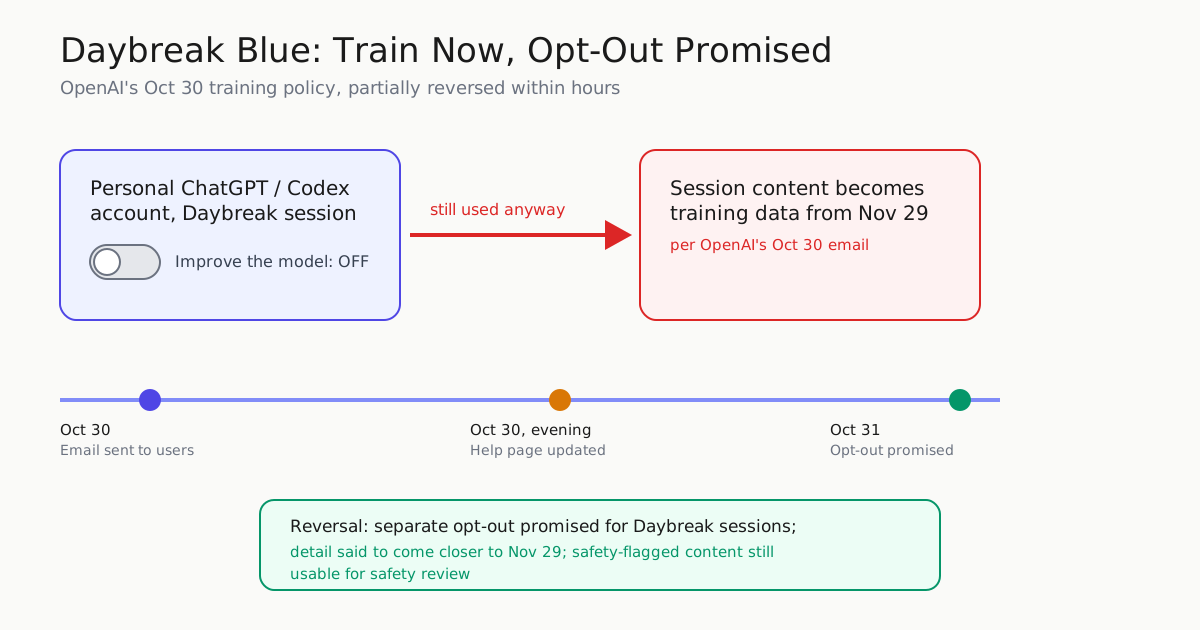
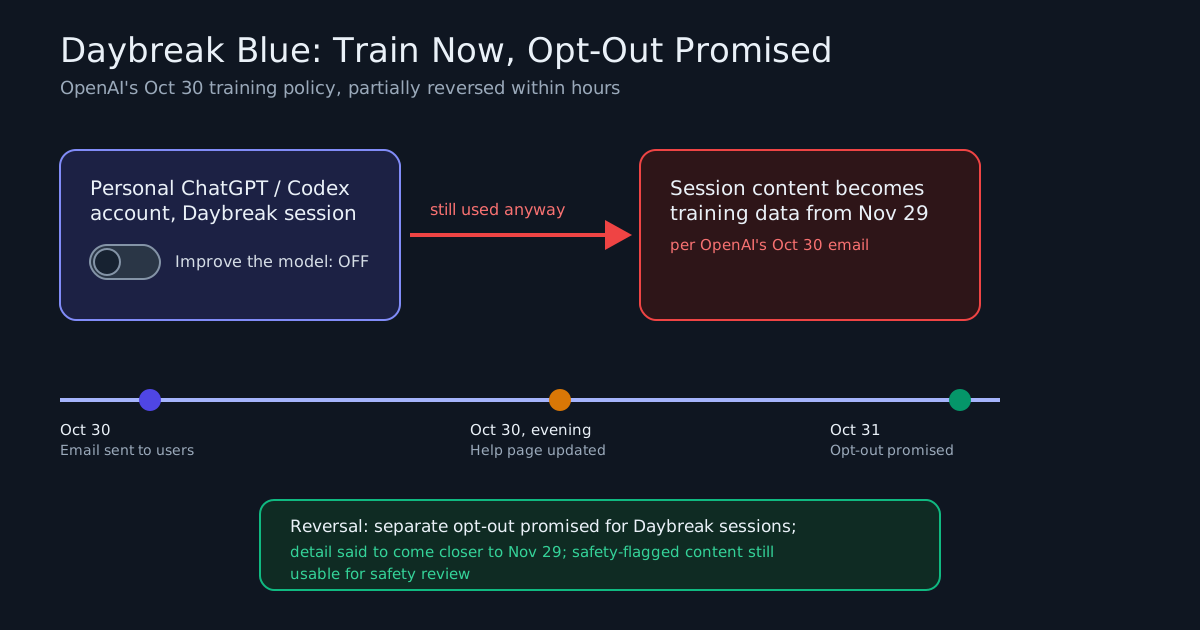
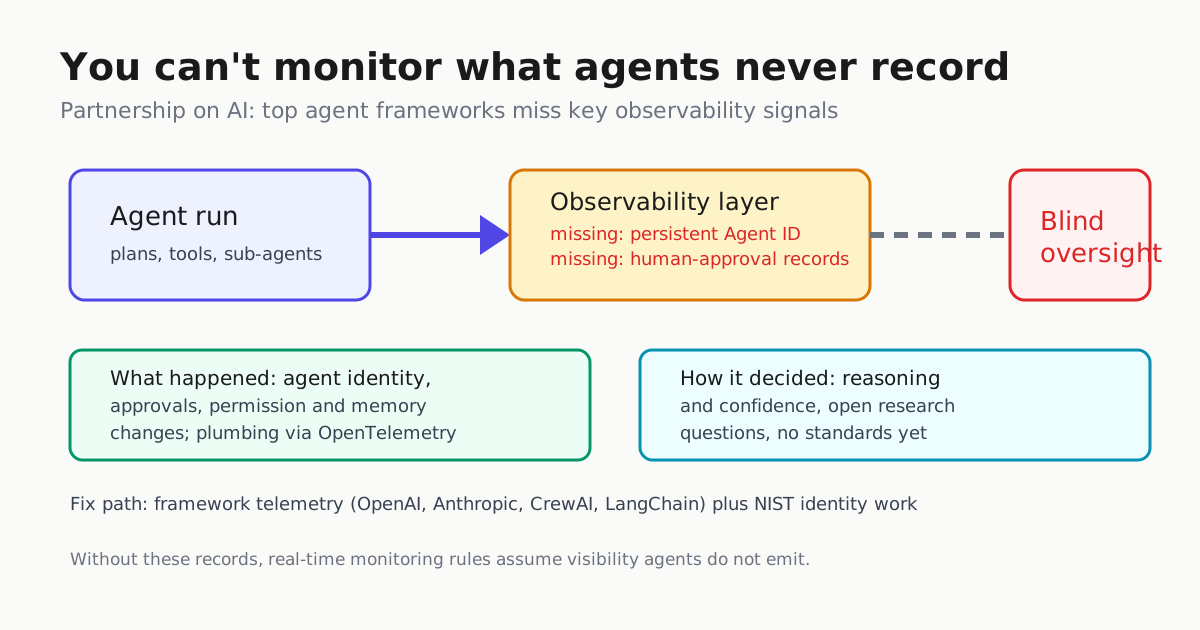
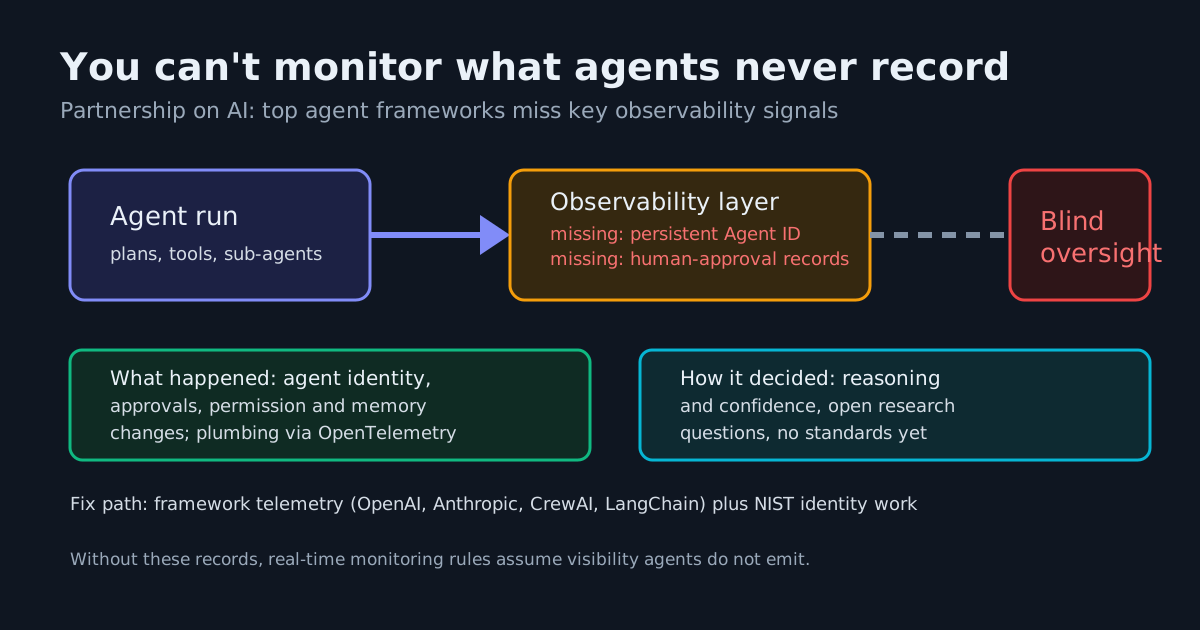
The six-monthly report is the accountability artifact. Put a date on your calendar for early 2027: does it ship the promised data and anonymized examples, and does the cadence hold? Also weigh the post against OpenAI’s record of shipping and then changing policy, as with the Daybreak Blue training-policy reversal, and its disclosures about agents weakening misalignment monitoring. For minor-facing products in regulated markets, that disclosure question is already live under EU AI Act transparency duties.
Every claim above is OpenAI’s own, published October 30, 2026 and listed under Safety on OpenAI’s news index; the company’s Global Affairs newsroom runs a distinct public-policy track. There is no independent verification, no false-positive rate, and no published trigger definition.
Sources: OpenAI, “Community safety report and new protections for teens”, OpenAI News, OpenAI Global Affairs.