OpenAI Partially Reverses Plan to Train on Daybreak Blue Security Sessions Within Hours of Announcing It
OpenAI said Daybreak Blue security sessions would train its models even with the opt-out off, then promised a separate opt-out for Daybreak sessions, with more detail to come closer to Nov. 29.
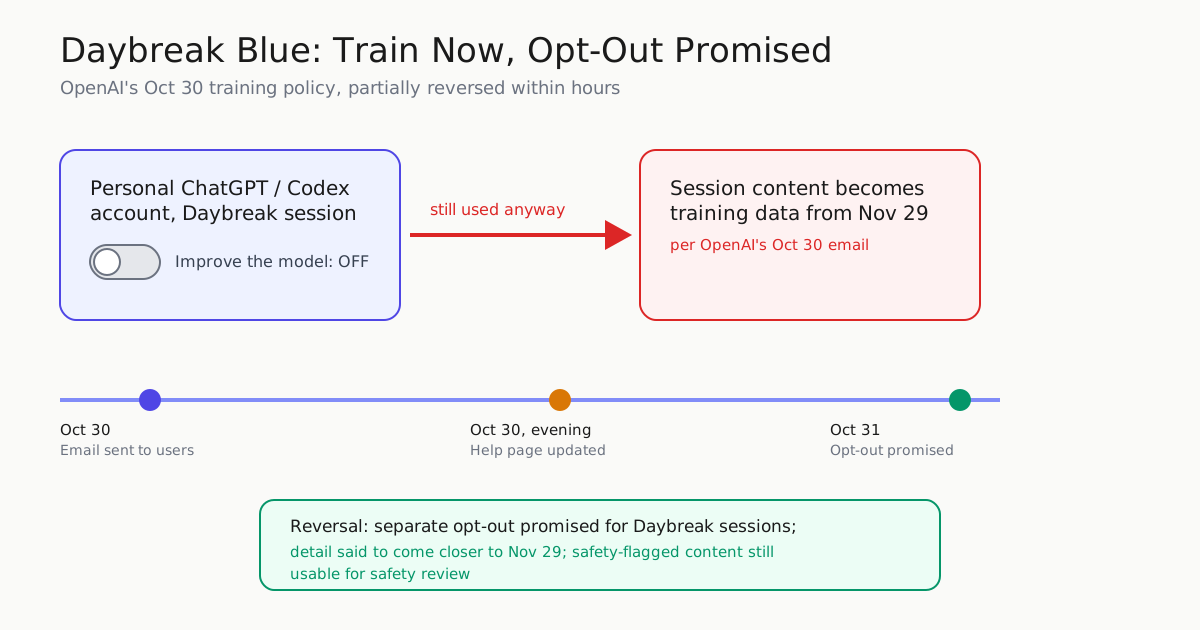
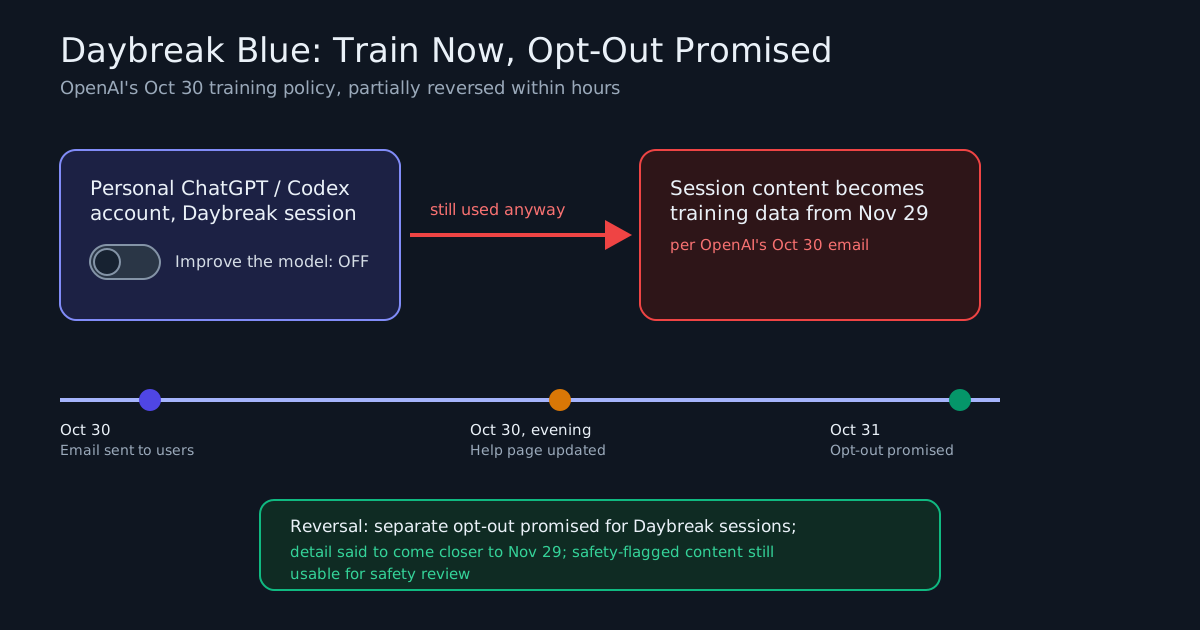
OpenAI told users of Daybreak Blue — its reduced-refusal access tier for security researchers — that their sessions would become training data starting November 29, even with the standard “Improve the model for everyone” switch turned off. Hours later, it partially reversed course.
The sequence played out on October 30 and 31, 2026, and it matters because of who uses Daybreak Blue and what they put into it.
What OpenAI told users
On October 30, OpenAI emailed Daybreak Blue Trusted Access users on personal accounts. The same day, OpenAI’s own Data controls help page gained a new section, “Trusted Access on personal accounts,” that states the policy plainly:
“During Daybreak sessions on your personal account, we may use content from your interactions to improve our models even when ‘Improve the model for everyone’ is off. This helps us to strengthen safeguards against cyber misuse.”
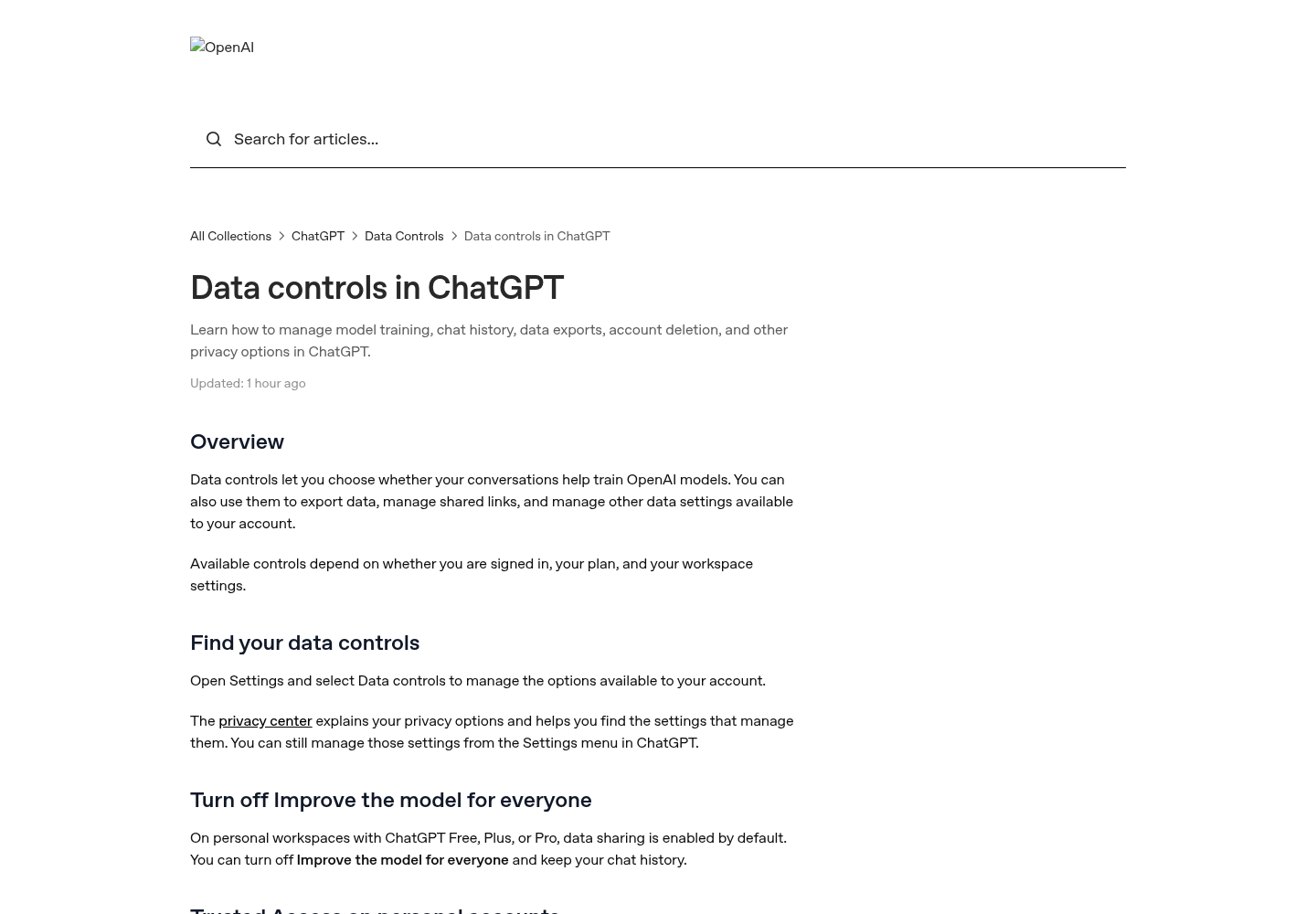
That language is a real exception to how OpenAI’s main training toggle normally works. On ordinary ChatGPT use, turning off “Improve the model for everyone” keeps your conversations out of training. The new help-page text says that protection does not extend to Daybreak sessions on a personal account — only to “other activity when not in a Trusted Access session.”
Daybreak is OpenAI’s Trusted Access for Cyber program. Its Blue tier gives vetted individuals reduced refusals on mainline models for defensive security work — vulnerability triage, secure code review, malware analysis, detection engineering, incident response and patch validation — reached through ChatGPT sign-in or the Codex CLI. Individual access requires an eligible paid plan, being 18 or older, and a physical FIDO2 hardware security key.
The two deadlines, side by side
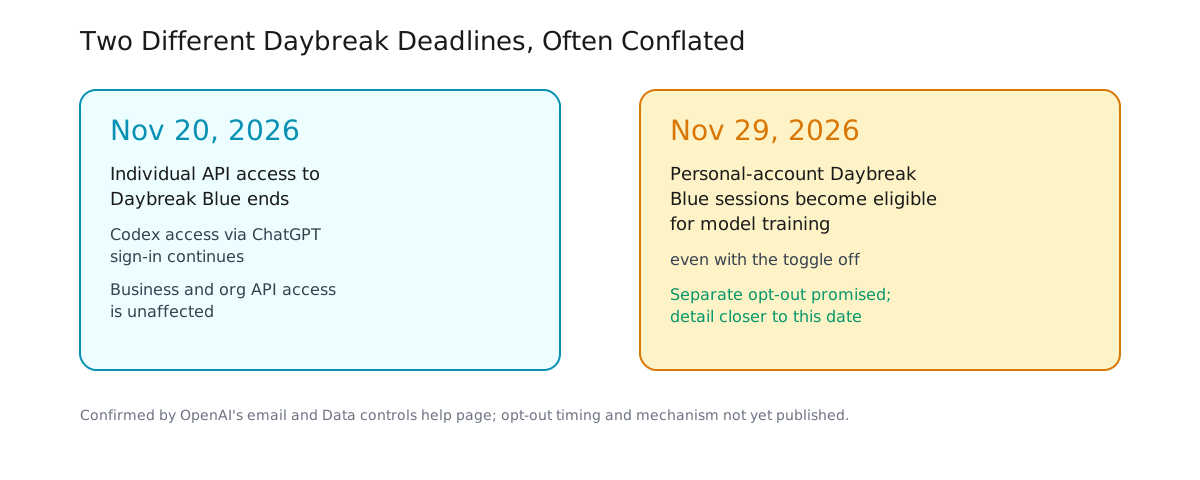
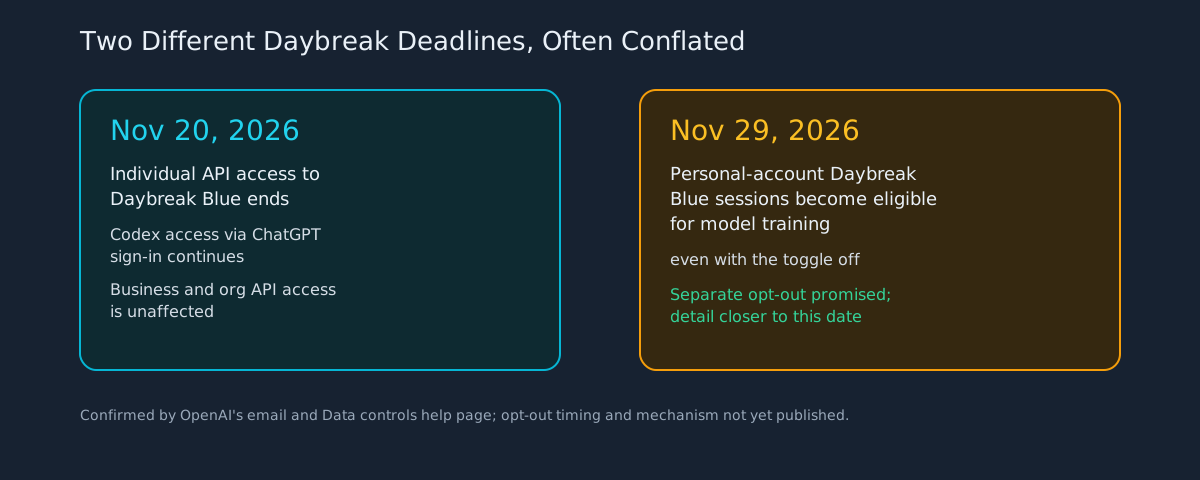
As the diagram shows, the training change (November 29) and a separate API-access cutoff (November 20) run on independent tracks. Sign-in-based access through ChatGPT and Codex is unaffected by the API cutoff, and nothing in OpenAI’s training reversal touches that earlier date.
Why security researchers reacted sharply
The content that flows through a Daybreak Blue session is exactly the kind of material researchers don’t want anywhere near a training pipeline before it’s resolved: unreported vulnerabilities, exploit proofs of concept, and client incident details. A researcher using the tier to triage an unpatched bug could, under the stated policy, have that bug’s details become training data before the affected vendor ever sees a patch.
The reaction was immediate. In a publicly shared X post summarizing the email, one user reportedly said they had cancelled their Pro subscription over the change. Security researcher @seanhn called the move “cartoonishly evil” and said it would “presumably kill Daybreak usage by security researchers,” according to reporting by CellCog, which captured and quoted the exchange. @seanhn reportedly added that it was “yet another reminder of the importance of open models.”
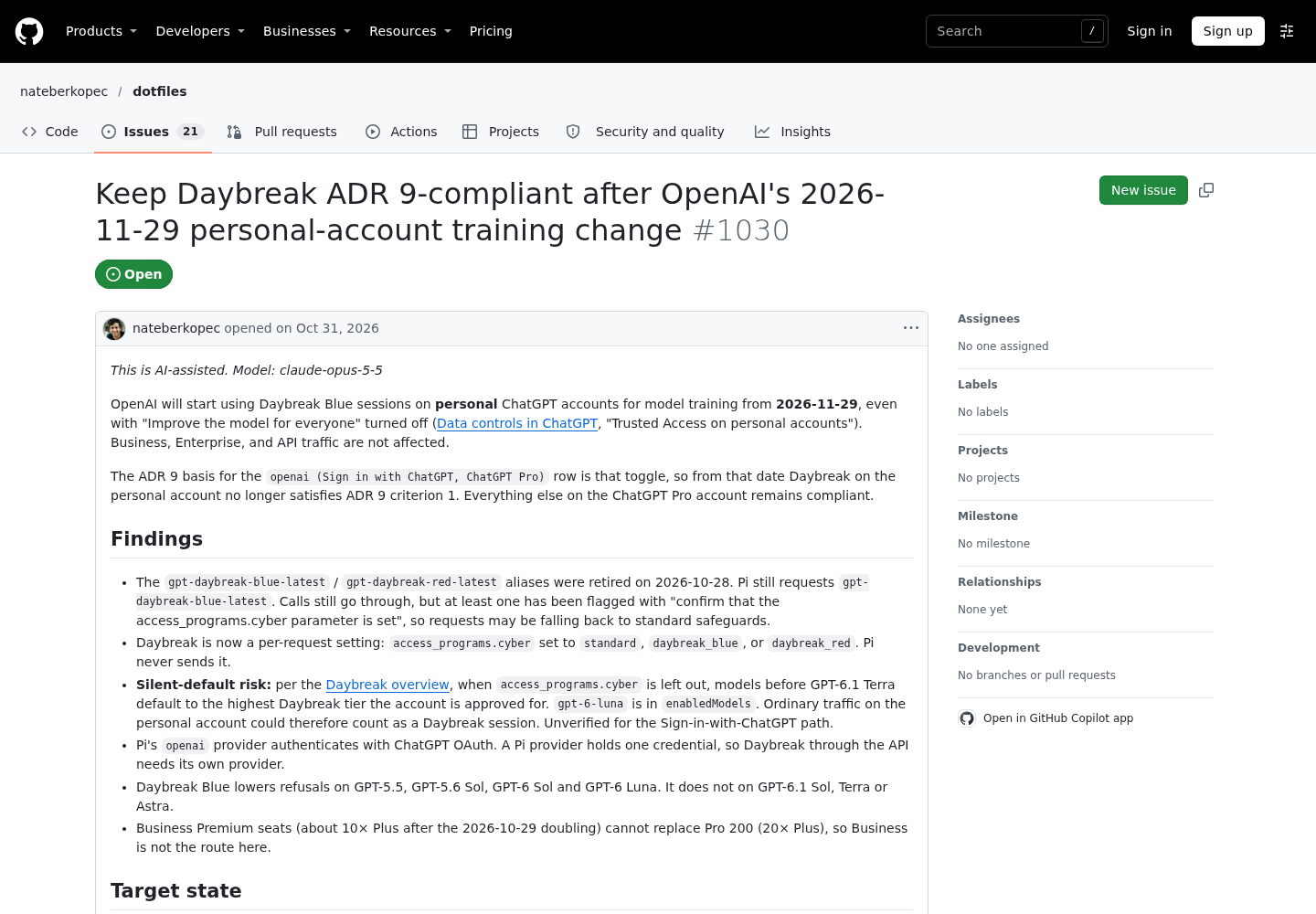
The concern showed up in operator workflows too. A GitHub issue filed October 31 by a developer maintaining an internal AI-provider compliance policy treated the change as a compliance break: Daybreak sessions on a personal ChatGPT Pro account no longer satisfied their no-training policy, triggering a plan to move Daybreak traffic to an organization-level API project instead, where OpenAI’s standard no-training terms for API traffic would apply.
The partial reversal
According to reporting by RuntimeWire, which reported the news October 31, OpenAI sent Daybreak Blue users a second notification walking part of the policy back — hours after the first one said no opt-out would apply. The new message reportedly promises a Daybreak-specific way to opt personal-account sessions out of model training, with more detail to come closer to the November 29 start date.
The walk-back is not a full retreat. Per RuntimeWire’s account, interactions flagged for safety review can still be used for safety purposes, including work aimed at stopping the same advanced cyber capabilities from being misused — regardless of the new opt-out. OpenAI has not said, in any source reviewed for this article, whether already-flagged findings like unpatched vulnerabilities are filtered out of that safety-review use, or whether the reversal covers only new sessions after the opt-out ships. The developer behind the GitHub compliance issue noted the same uncertainty on October 31: “I guess this may have been called off by OpenAI now. Need to research and re-evaluate.”
What’s actually confirmed
Across the sources reviewed, three things are solid: OpenAI’s own help page confirms the training exception exists for Daybreak sessions on personal accounts; the change is scoped to personal accounts, with business, enterprise and ordinary API traffic excluded; and OpenAI has promised, per the second notification reported by RuntimeWire, a dedicated opt-out for Daybreak sessions, with more detail said to come closer to November 29. What remains unconfirmed by OpenAI directly is exactly when that opt-out will ship, how it will work, whether it is retroactive, and whether safety-flagged findings are excluded from the training use the opt-out is supposed to prevent. Researchers evaluating whether to keep using Daybreak Blue on a personal account are, for now, working from a vendor promise rather than a published timeline or mechanism.
For teams building Daybreak-dependent workflows, the practical lesson from this hours-long cycle is that Trusted Access programs can carry data-handling terms that diverge from a vendor’s general product defaults — and that those terms can change with a single email. For more on how cyber-capability access tiers are being gated and allocated as product features, see Automater’s coverage of GPT-6 Astra’s cyber threshold and cyber-SKU access allowlisting. For the broader question of what “zero retention” promises actually cover once an agent has memory, see Zero Data Retention vs. agent memory.
Sources
- Data controls in ChatGPT | OpenAI Help Center
- AGTP on X: "OpenAI just said it will train on Daybreak Blue sessions, even with training turned off. Here's what you need to know. OpenAI emailed Daybreak Blue Trusted Access users with two changes. From November 29, it may use content from Daybreak Blue sessions on personal accounts to improve it…
- OpenAI walks back Daybreak Blue training plan for personal accounts
- OpenAI Will Train on Daybreak Blue Sessions From Nov 29 | CellCog
- Keep Daybreak ADR 9-compliant after OpenAI's 2026-11-29 personal-account training change · Issue #1030 · nateberkopec/dotfiles · GitHub