OpenAI Is Shutting Down Prism on Jan. 1, 2027: Export Your LaTeX Projects Before the Data Is Deleted
OpenAI will close Prism, its free LaTeX workspace for scientists, on January 1, 2027 and then delete all Prism data. Project files can be exported, but history, comments, collaborators and live co-editing can't.
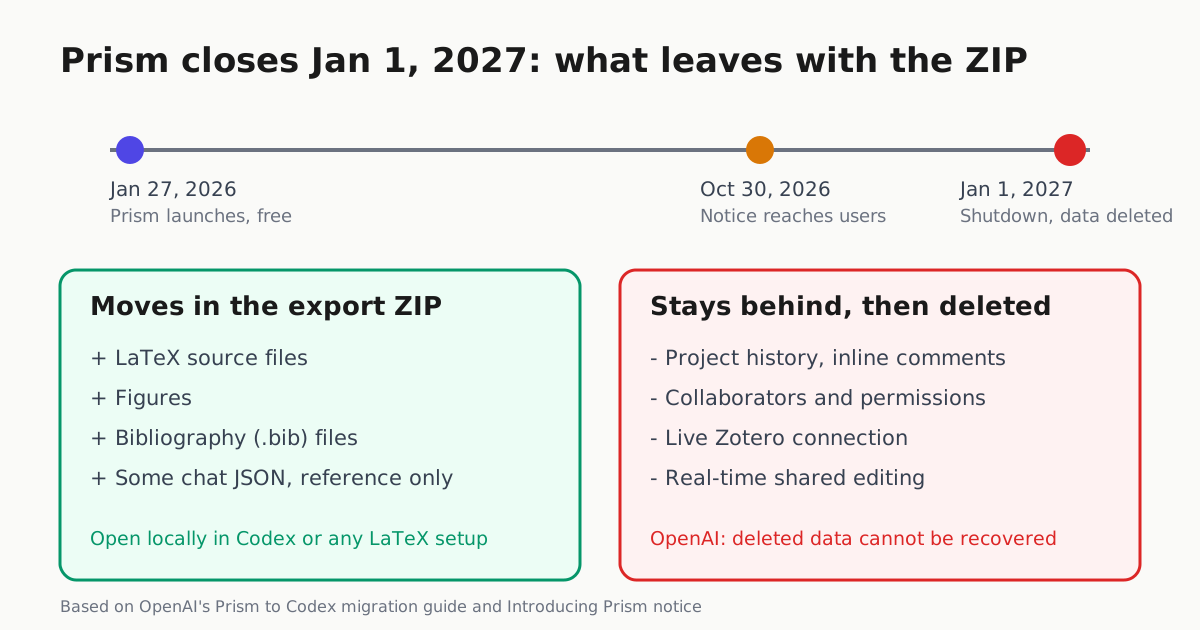
OpenAI will shut down Prism, the free LaTeX workspace for scientists it launched in January, on January 1, 2027. A notice now sits at the top of the original Introducing Prism announcement: “Prism will shut down on January 1, 2027. Export your Prism projects before the shutdown date to keep a copy of your files.”
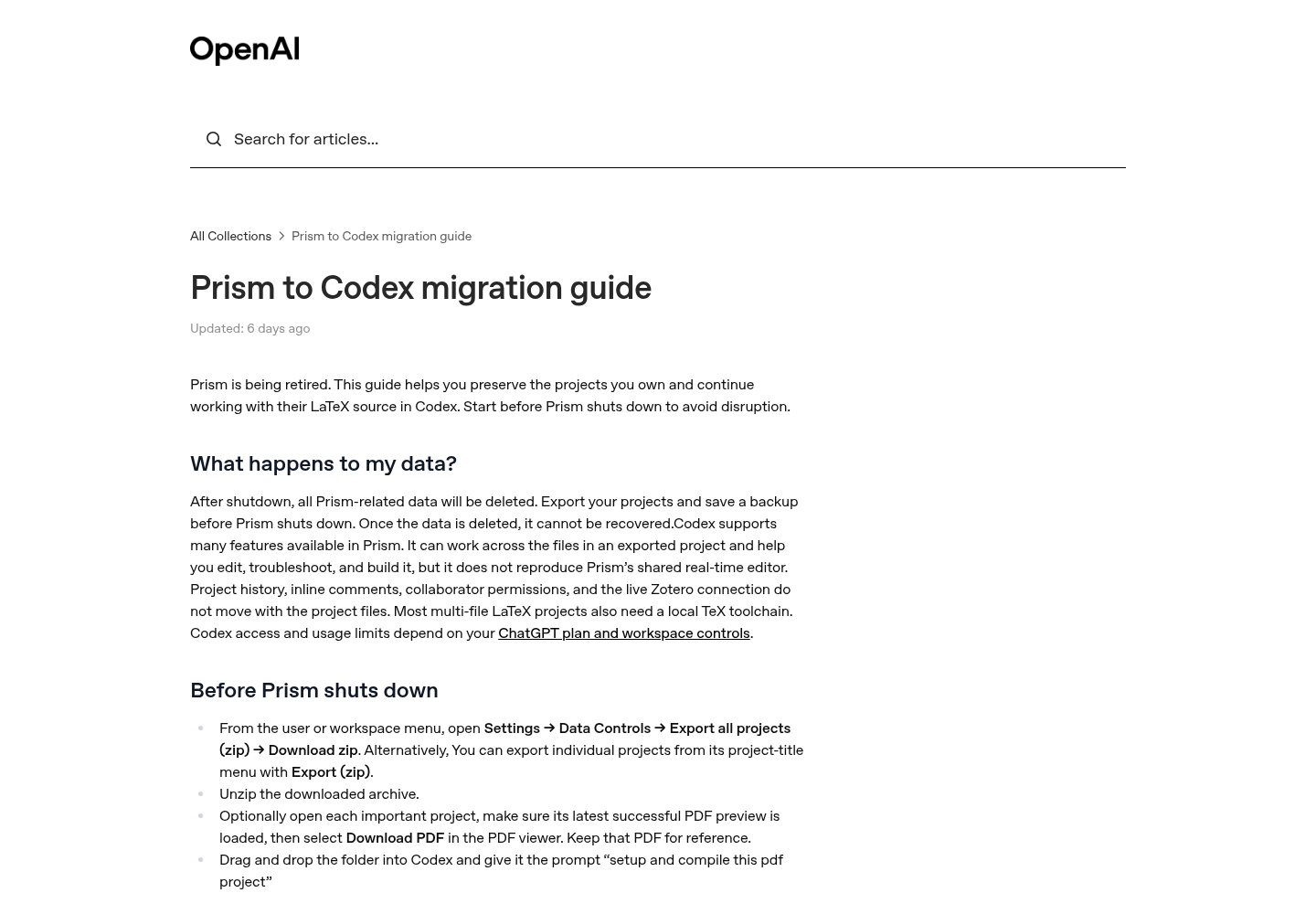
The deadline matters because of what happens next. OpenAI’s Prism to Codex migration guide says: “After shutdown, all Prism-related data will be deleted. … Once the data is deleted, it cannot be recovered.” Prism is still running, so users can export until the cutoff. After that, OpenAI keeps no copy.
When users found out
The news spread publicly on October 30, 2026. A post in the OpenAI Developer Community that afternoon warned Prism users that the service “will be retired on January 1, 2027” and that they had until then to export their files. An AGTP post on X the same day said OpenAI had emailed users about the shutdown. We have not seen the email itself. The dated notice on OpenAI’s announcement page and the help-center guide are the primary records.
The guide went up before the wider notice. When we fetched it on October 31, it carried an “Updated: 6 days ago” label. A third-party Purplelink how-to dated October 25 also says it read OpenAI’s guide that day. That puts the migration instructions online about a week before the shutdown news spread publicly.
Who is affected, and why it’s more than a product retirement
Prism launched on January 27, 2026. OpenAI called it a free, “AI-native workspace for scientists” built on GPT-5.2, with unlimited projects and collaborators, open to anyone with a personal ChatGPT account. The launch post said it grew out of Crixet, a cloud LaTeX platform OpenAI acquired. It promised real-time co-editing with “co-authors, students, and advisors” and said no local LaTeX installation was needed.
Those hosted, shared features are the ones that don’t migrate. OpenAI sends users to Codex, but its own guide says Codex “does not reproduce Prism’s shared real-time editor.” It also says most multi-file LaTeX projects “need a local TeX toolchain.” Codex has a built-in LaTeX compiler, but it handles standalone .tex files, “not a complete multi-file Prism project.” Cost changes too. Prism was free, but “Codex access and usage limits depend on your ChatGPT plan and workspace controls.” The researchers hit hardest are research groups with a shared paper still in progress, where the comment threads and edit history hold the record of who decided what.
What survives the export
The guide’s comparison table is specific. Here is a condensed version:
| Prism capability | After export, per OpenAI |
|---|---|
| LaTeX source, figures, bibliography files | Kept; Codex can read and edit them in a local folder |
| Hosted compilation | Gone; multi-file builds need a local TeX toolchain or the project’s documented container |
| Shared live editing | Gone; a local Codex folder is not a real-time shared editor |
| Project history and inline comments | Not part of the project-file export |
| Prism conversations | Some all-project exports include JSON for reference only; chats aren’t recreated |
| Zotero connection | The live connection and account metadata don’t move; export the .bib separately |
| Collaborators and permissions | Not recreated |
| Equation hover, PDF-to-source navigation | “Not equivalent to Prism” |
Ownership also limits what you get. The guide is written for “the projects you own.” If you export a shared project that someone else owns from its project menu, the ZIP “preserves the project files but does not include your Prism conversation history.”
What OpenAI tells users to do
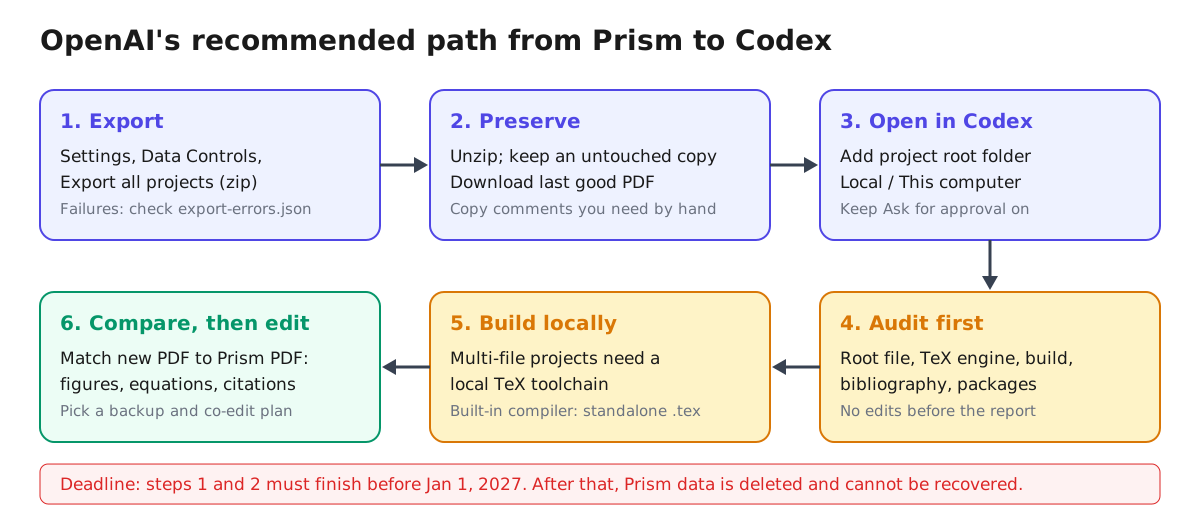
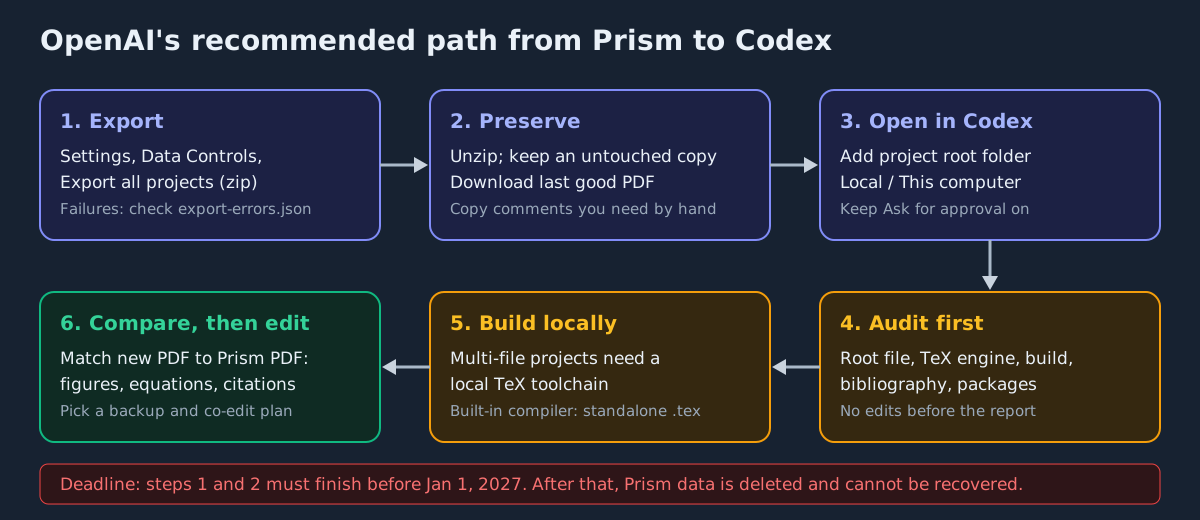
The export path is Settings → Data Controls → Export all projects (zip) → Download zip. You can also export a single project from its title menu with Export (zip). OpenAI also suggests downloading the last good PDF of each important project, so you have a reference that needs no toolchain. If an export fails, check export-errors.json in the archive, retry from the project menu, and contact support@openai.com if a project is still missing.
To open a project in Codex, the guide says to use the ChatGPT desktop app, add the project’s root folder, run the chat as Local / This computer, and keep Ask for approval on. (Our guide to Codex approval modes and sandboxing explains what that setting allows.) Before Codex changes anything, OpenAI recommends asking it to audit the project with this prompt:
Inspect this LaTeX project without changing it. Identify the root document,
required TeX engine, existing build command, bibliography workflow, figures,
custom packages, and missing prerequisites. Preserve the multi-file structure.
Report what you find in plain language before running or editing anything.
Next, the guide says to compile the project with its existing build workflow and compare the result against the last Prism PDF. Check title, authors, section order, figures, tables, equation numbering, citations, bibliography and page count before editing any source. Keep an untouched copy of the export and work on a separate copy. Codex “is not the project backup,” so you’ll need your own backup or version control.
Codex is optional. The export is a folder of ordinary .tex, .bib and figure files, so any local LaTeX setup or other editor can open it. Teams that need live co-authoring will need a separate collaborative service, which the guide itself recommends.
Why OpenAI is doing this
OpenAI’s notice gives a date and export instructions but no reason. Outside reporting gives some background. A Dealroom news item, dated April 2026 and citing Wired, reported that former chief product officer Kevin Weil, who was building Prism, was leaving OpenAI. It also reported that OpenAI confirmed it would shutter Prism and that the roughly 10-person team was moving to Thibault Sottiaux’s Codex team. We have not verified the underlying Wired report. Taken together, the reporting and OpenAI’s guide suggest a team and its users being folded into Codex.
Nothing OpenAI has published says Codex will add Prism’s LaTeX-specific features, such as hosted multi-file compilation or shared editing. The migration guide describes Codex as it works today.
Takeaway
This is a forced migration with a hard deletion date. Researchers have about two months to get their source out, save the context that won’t export (comment threads, history, who had access), and decide where co-authors will work next. Google set a similar export-and-delete deadline when it shut down Jules. If you used a free, hosted AI workspace, keep your own copy of the work and don’t count on the hosted extras surviving a shutdown.
Sources
- Prism to Codex migration guide | OpenAI Help Center
- Introducing Prism | OpenAI
- Prism will shut down on January 1, 2027 - Community - OpenAI Developer Community
- OpenAI shuts down Prism AI workspace as chief product officer Kevin Weil departs | Dealroom.co
- Move a Prism project to a Mac before it shuts down | Purplelink
- AGTP on X: "OpenAI just announced it's shutting down Prism, its writing workspace for scientists. Here's what you need to know. OpenAI emailed users that Prism, its collaborative writing workspace for scientists, will shut down on January 1, 2027. Project data is deleted after that date. Users can…