OpenAI's Agents API Adds Codex-Style Auto-Review, Background Compaction and Mid-Session Tool Swaps
OpenAI's Agents API now gates risky commands, compacts context in the background, senses elapsed time, and swaps session tools without restarting.
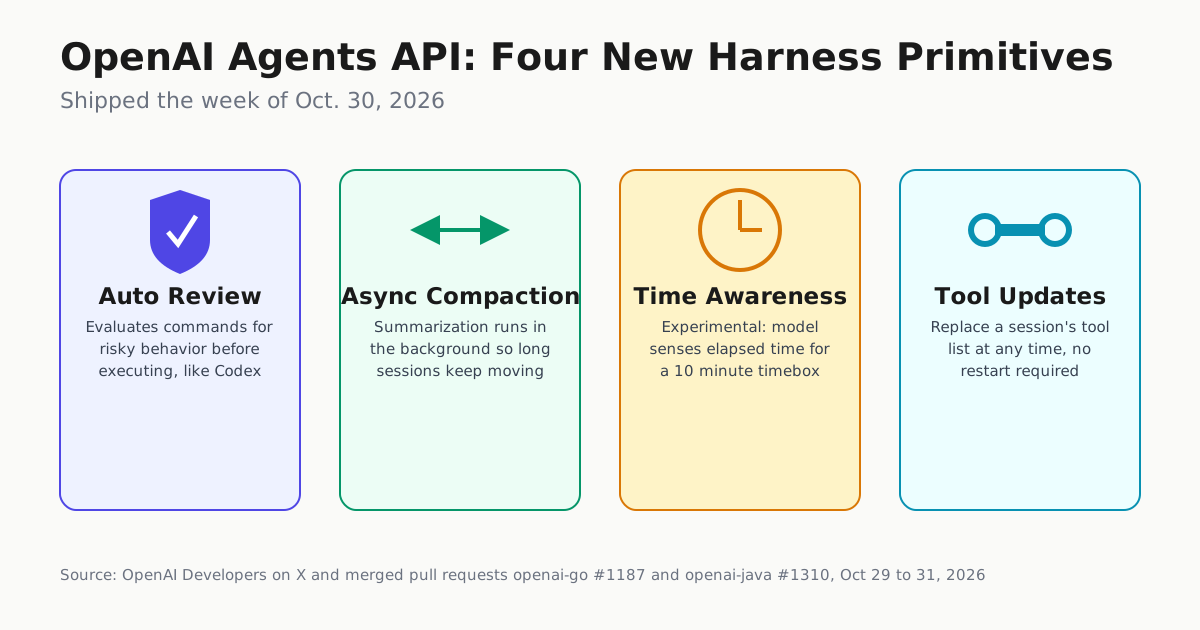
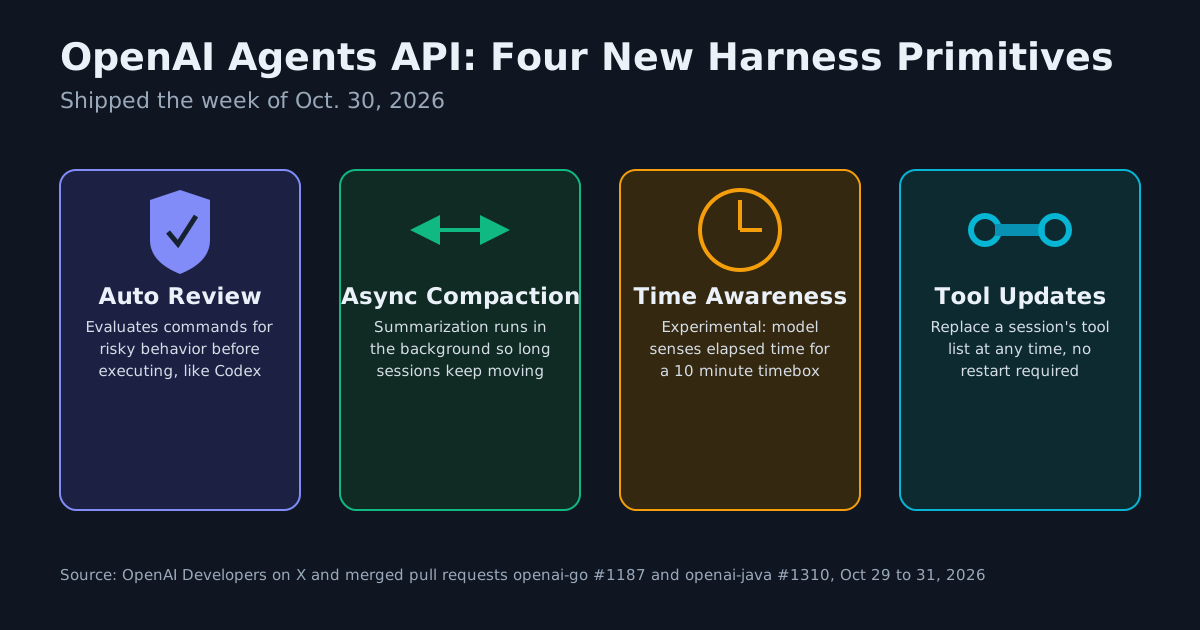
OpenAI’s Agents API team pushed four concrete harness upgrades live the week of Oct. 30, 2026: a Codex-style command review gate, background context compaction, an experimental sense of elapsed time, and the ability to swap a session’s tools without restarting it. The news surfaced in a post from Agents API engineer Steve Coffey, amplified by the official OpenAI Developers account, and it is backed by two merged pull requests on OpenAI’s own SDK repositories rather than just a marketing post.
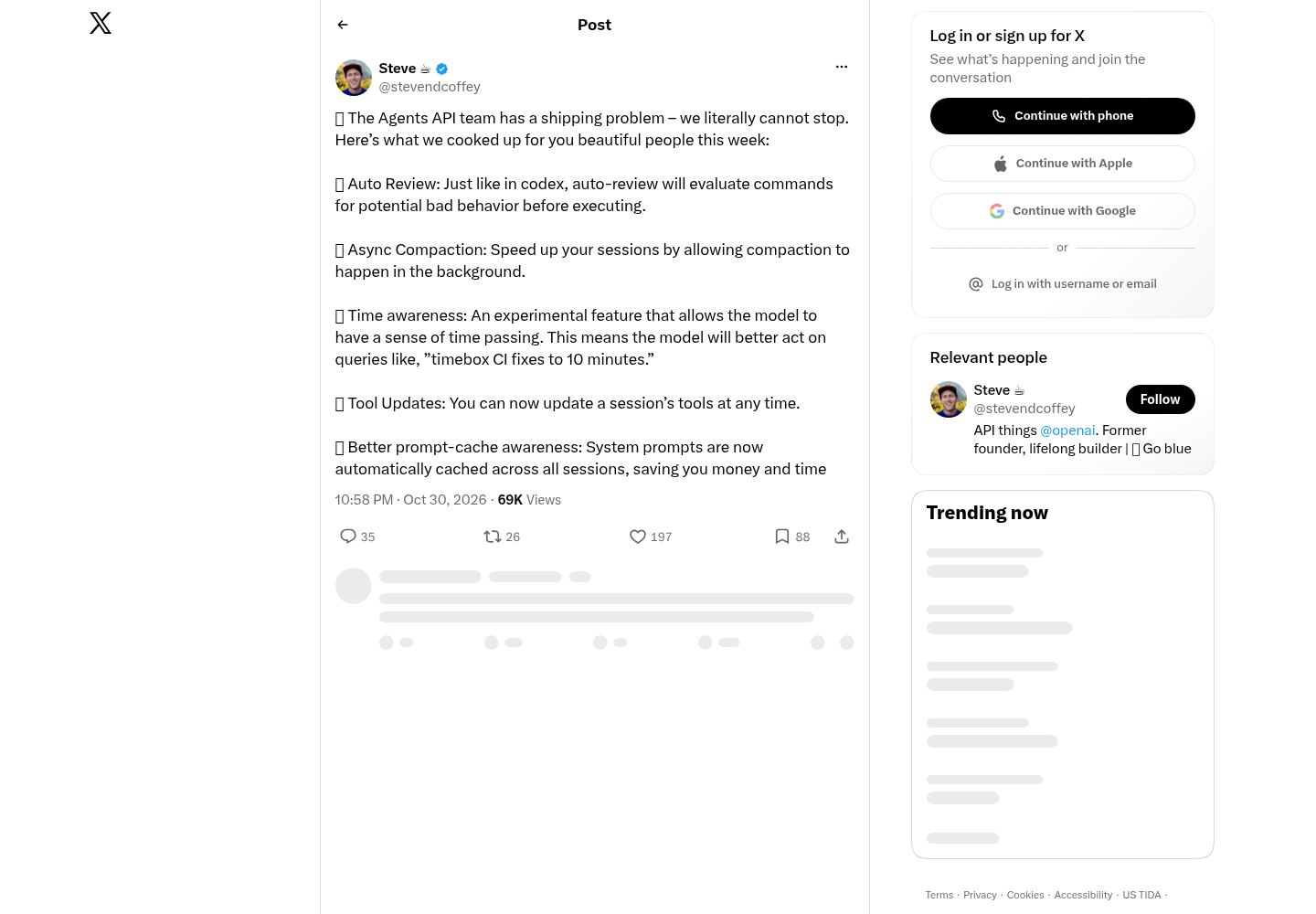
The Agents API is OpenAI’s managed option for agent workloads, as described in OpenAI’s own Agents documentation: instead of running an agent loop inside your own application the way the Agents SDK does, you hand the task to a hosted Codex harness that saves session configuration, turns and items on OpenAI’s infrastructure. That convenience trades control for whatever primitives OpenAI chooses to expose, which is exactly why this batch of updates matters to anyone running coding or ops agents on top of it.
Auto Review borrows Codex’s command gate
Steve Coffey’s post describes it directly: “Just like in codex, auto-review will evaluate commands for potential bad behavior before executing.” That is the same pre-execution screening Codex CLI already uses to catch destructive or suspicious commands before an agent runs them. Bringing it to the Agents API means hosted sessions can flag risky shell commands automatically instead of relying entirely on the application layer to gate every tool call. The openai-java SDK’s PR #1310, merged Oct. 31, 2026, backs this up in code: it adds the ability to “accept review settings when creating or updating a session” and to “read optional session review values,” which is the client-side plumbing for the new review gate.
Async compaction takes summarization off the critical path
The Agents API already performs automatic context compaction to keep long sessions within the model’s context window. This update makes that compaction asynchronous: Coffey’s post says it will “speed up your sessions by allowing compaction to happen in the background.” Previously, a session that needed to summarize old turns had to pause and wait for that work to finish before continuing. For agents running long, multi-hour coding or ops tasks, that stall is now removed from the main execution path.
An experimental sense of elapsed time
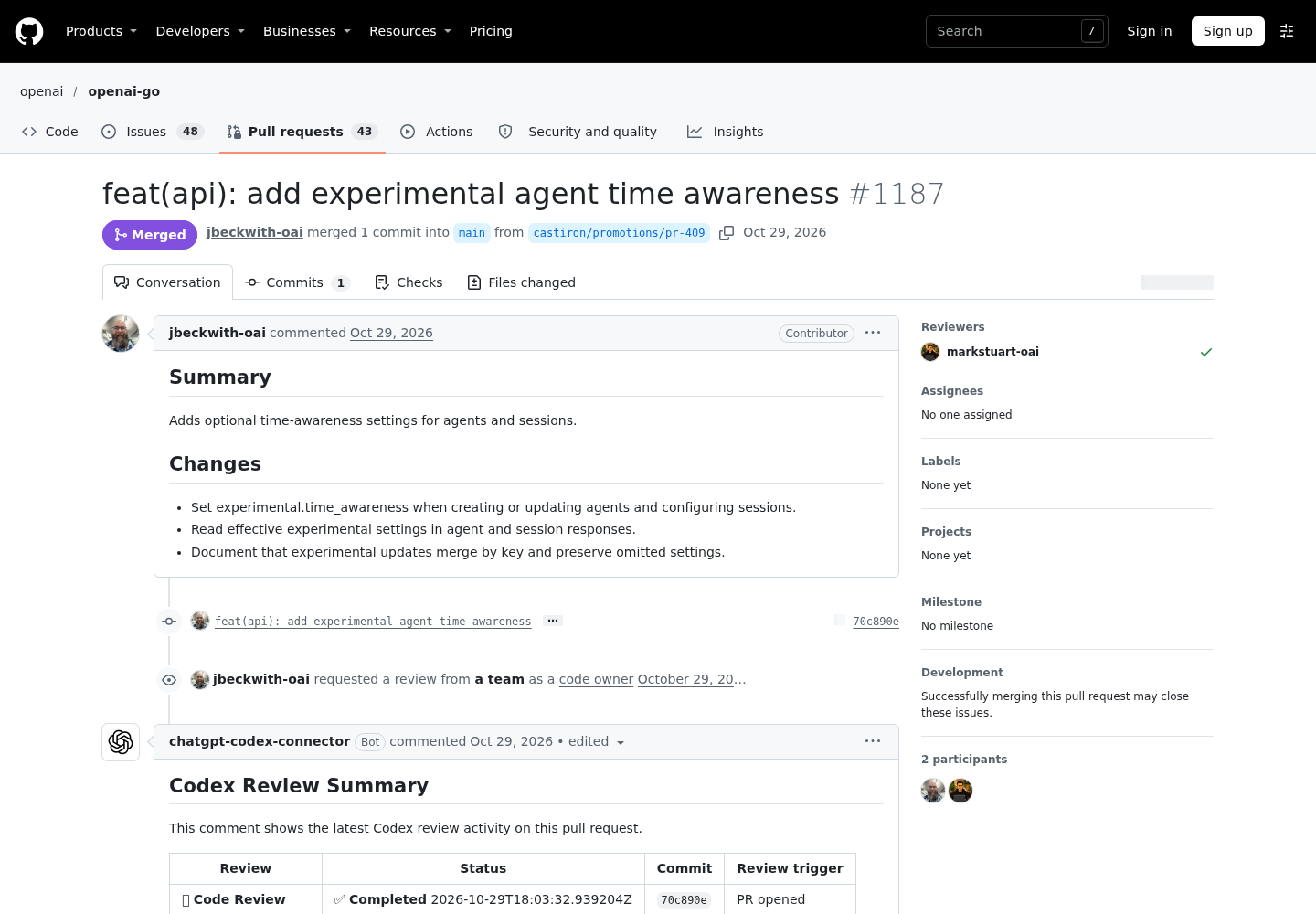
The most novel change is time awareness, which the post calls “an experimental feature that allows the model to have a sense of time passing,” useful for instructions like “timebox CI fixes to 10 minutes.” openai-go’s PR #1187, merged Oct. 29, 2026, confirms the mechanism: it adds an optional experimental.time_awareness setting that can be set when creating or updating agents and sessions, with effective settings readable back from agent and session responses. The PR’s own documentation notes that experimental settings merge by key and preserve omitted settings, so turning this on does not require resending a full configuration block. Because it ships marked experimental, expect the exact fields and behavior to keep moving before it stabilizes.
Tool updates remove the restart-the-session workaround
PR #1310 does double duty: beyond review settings, it also “replace[s] session tools through agent.tools on session updates.” In practice, that means a running session’s available tool list can be swapped at any time, which the post states plainly: “You can now update a session’s tools at any time.” Before this, changing which tools an agent could call typically meant starting a new session, losing the accumulated conversation state in the process. That workaround disappears for teams whose agents need different tools at different stages of a task, such as read-only tools during triage and write-enabled tools once a fix is approved.
What the announcement didn’t prove
The same post also claimed, “System prompts are now automatically cached across all sessions, saving you money and time.” We could not independently verify that as a feature that shipped in this specific update; no merged pull request or documentation change in this review corroborates a brand-new, always-on caching mode distinct from OpenAI’s existing prompt-caching behavior. Treat that line as unconfirmed until OpenAI’s own docs or changelog state it directly, and don’t budget for savings based on it yet.
Summary of the four confirmed changes
| Feature | What changed | Why it matters | Primary evidence |
|---|---|---|---|
| Auto Review | Commands are evaluated for risky behavior before executing, mirroring Codex’s gate | Fewer required human approvals on unattended Agents API runs | X post; openai-java PR #1310 |
| Async Compaction | Context compaction now runs in the background instead of blocking the turn | Long sessions stop stalling while old turns get summarized | X post |
| Time Awareness (experimental) | Agents and sessions carry an optional time_awareness setting |
Timeboxing instructions like “fix CI in 10 minutes” have something to act on | X post; openai-go PR #1187 |
| Tool Updates | A session’s tool list can be replaced via agent.tools mid-session |
Removes the previous restart-the-session workaround | X post; openai-java PR #1310 |
What this means for operators
If you’re already running agents on the hosted Agents API rather than the self-managed Agents SDK, these four changes are worth testing before you lean on them in production. Auto Review and the tool-replacement path both touch what a running agent is allowed to do mid-task, so confirm the new review settings actually catch the commands you care about, and check whether a tool swap preserves the context you expect it to. Time awareness is explicitly experimental, so treat any timeboxing behavior you build on it as subject to change. For a broader checklist on treating a vendor-hosted harness like infrastructure you still have to drill against, see Automater’s continuity playbook for the Agents API and the field guide to OpenAI’s agentic stack.
Sources
- Steve ☕️ on X: "🗣️ The Agents API team has a shipping problem – we literally cannot stop. Here’s what we cooked up for you beautiful people this week: 💂 Auto Review: Just like in codex, auto-review will evaluate commands for potential bad behavior before executing. 🗜️ Async Compaction: Speed u…
- OpenAI Developers on X: "Building with the Agents API? Here's what we shipped this week for you:" / X
- feat(api): add experimental agent time awareness by jbeckwith-oai · Pull Request #1187 · openai/openai-go · GitHub
- feat(api): add agent session review and tool settings by markstuart-oai · Pull Request #1310 · openai/openai-java · GitHub
- Agents | OpenAI API