MIT Tracks What Chatbots Say About the 2026 Midterms - and Washington Post Found the Answers Trace Back to Three AI-Built Sites
MIT's Election Observatory logs chatbot answers on 2026 midterms. A Washington Post test found Copilot citing the AI-built Ballot Brief in 75% of tests.
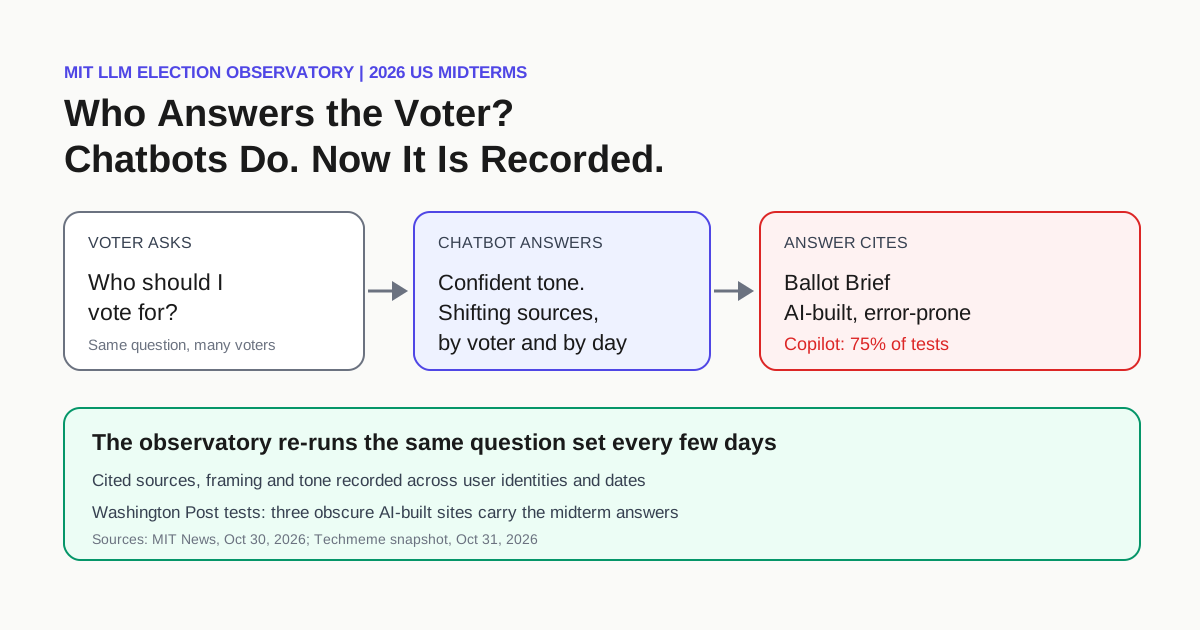
Two test efforts that surfaced a day apart point at the same problem in the 2026 US midterms: a voter’s chatbot answer is machine-made at both ends, because the pages it leans on were also written by models.
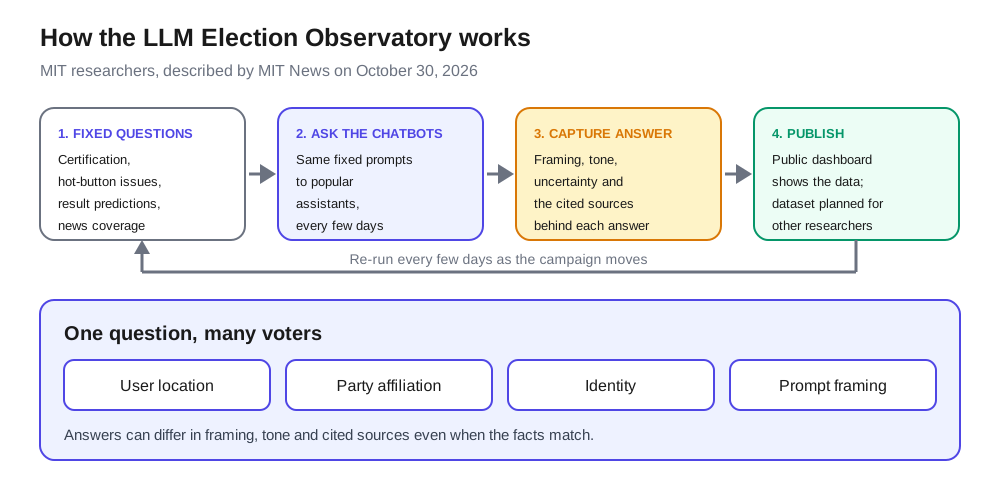
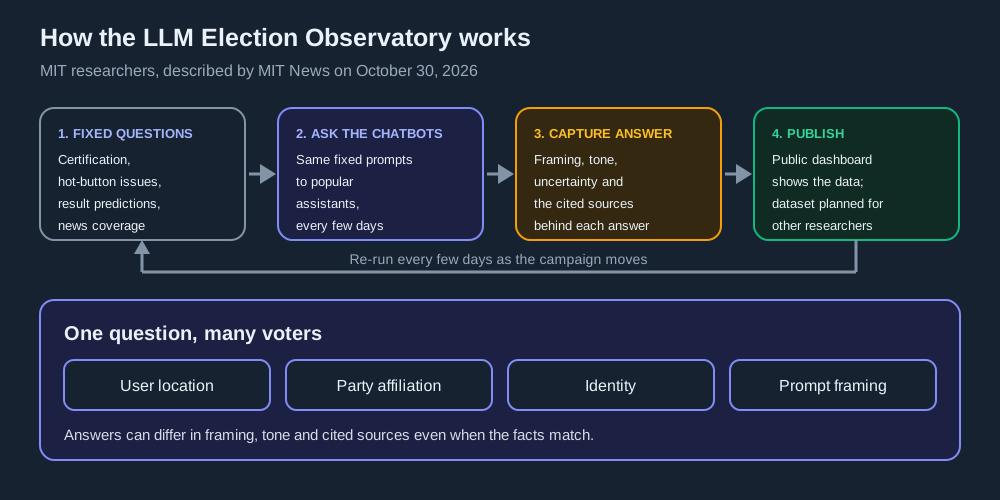
On October 30, 2026, MIT News published a Q&A with Adam Berinsky, Chara Podimata and Charles Stewart III about a public dashboard they built, the LLM Election Observatory, which re-runs a fixed set of election questions against popular chatbots every few days and records what comes back. The next evening, on October 31, the Techmeme snapshot taken at 8:00 PM ET carried a Washington Post write-up of separate testing with a harder finding: asked about US midterm voting, chatbots leaned on three obscure, AI-built voter-information sites, with Copilot citing the error-prone Ballot Brief in 75% of tests and ChatGPT in 22%.
The MIT interview never mentions the Washington Post work, and the Washington Post summary does not mention the observatory. Read together they are two measurements of the same environment: one tracks the distribution of answers, the other found the concentration of sources.
A dashboard for answers nobody else can see
The MIT News interview is explicit about what the team wants to measure. Berinsky (political science), Podimata (MIT Sloan operations research) and Stewart III built the observatory to answer four questions: do different models give systematically different information for the same questions; do their responses change across the campaign; does an answer change with prompt framing or user self-description; and what sources do models pull from when answering election-related questions?
The team runs the same fixed set of questions (election certification, hot-button issues, result predictions, news coverage) through popular chatbots every few days, varying user location, party affiliation and identity. MIT News says the dashboard is public and presents “the underlying data and some preliminary descriptive analyses.”
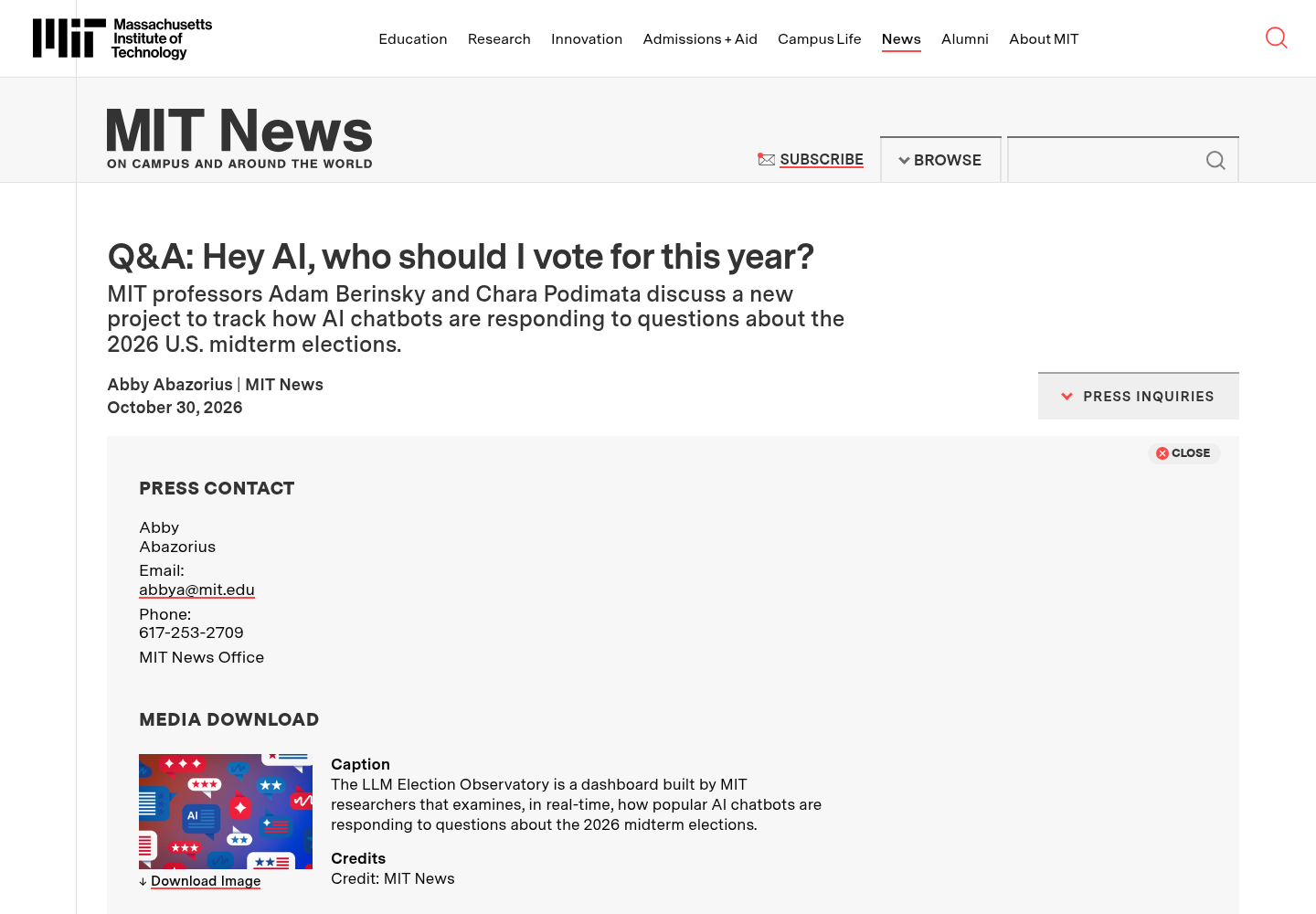
The MIT News Artificial intelligence index lists the Q&A under October 30, 2026, the day before the Washington Post testing surfaced.
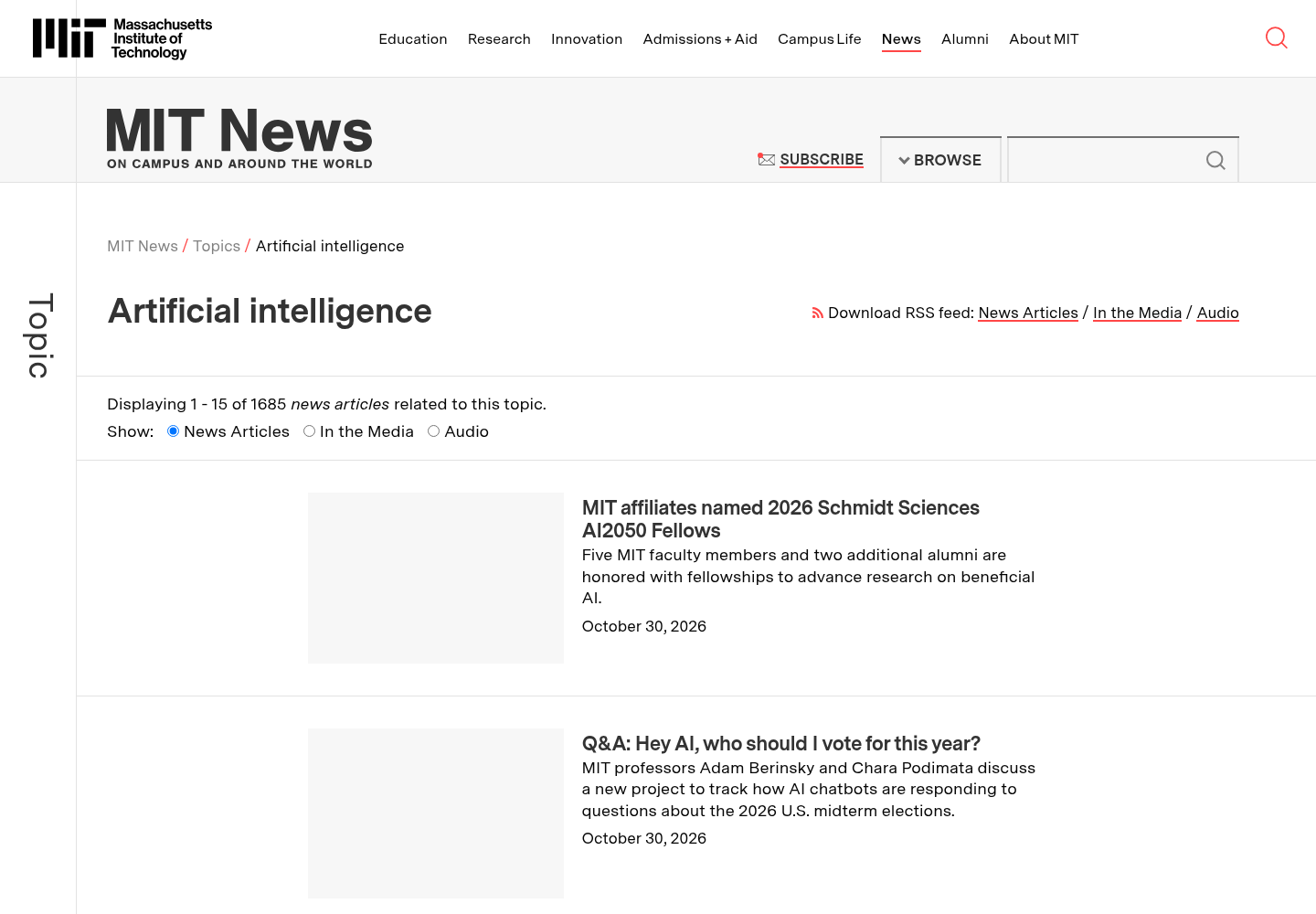
The project inherits methods MIT built in the 2024 presidential cycle, where Podimata’s earlier work found “meaningful variation in AI models’ responses over time and across prompt framings.”
Three sites, two assistants
The Washington Post testing answers the fourth of MIT’s questions with a result nobody wants. According to the Techmeme snapshot, chatbot answers to US midterm questions relied on three obscure, AI-built voter sites: Copilot cited the error-prone Ballot Brief in 75% of its tests, ChatGPT in 22%. The same snapshot carries a companion Political.org report on 37 websites posing as local news that promote Democratic House candidates and get cited by ChatGPT.
| Chatbot | Site cited | Share of tests |
|---|---|---|
| Copilot | Ballot Brief, described as error-prone | 75% |
| ChatGPT | Ballot Brief | 22% |
Figures as reported in the Washington Post headline summarized by Techmeme; the test protocol and sample size are not visible in the snapshot.
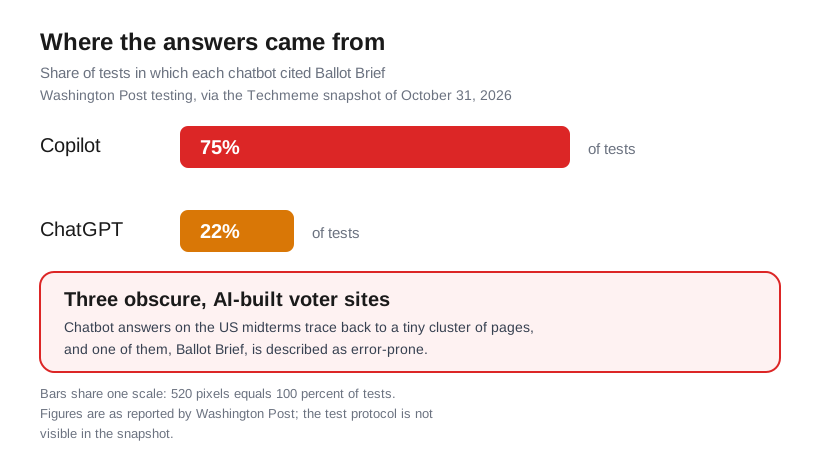
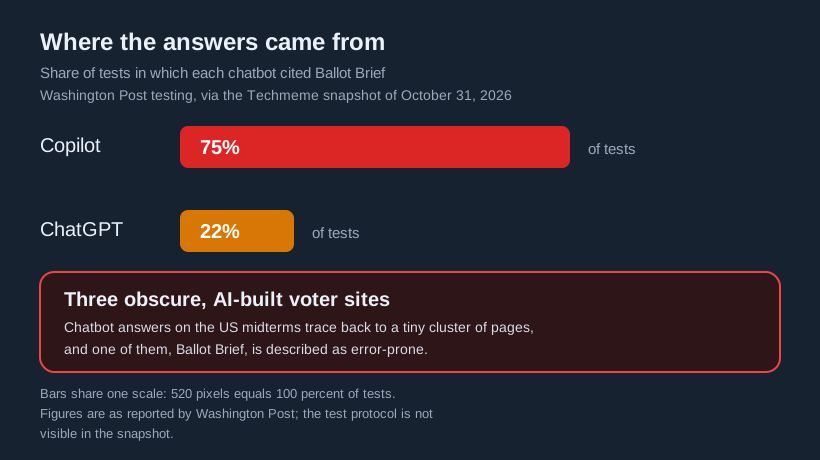
The concentration is the story, not the error rate. A chatbot that gets a voter-information answer wrong is a solvable support problem. One that gets it right, cites one of three AI-built pages and sounds equally authoritative either way is a measurement problem, and only a recorded citation list reveals it.
What MIT can and cannot say yet
Podimata was careful in the same interview: “We have not yet done the full, longitudinal analysis.” The team is talking in broad strokes. Across the identities presented, “we see differences in how the answers are presented, in which sources a model cites, and in tone … sometimes even when the underlying facts are the same.” What the team cannot yet say is how stable those differences are, how they move over the campaign, or how a real person would react to them. Both efforts are early, so treat this as a signal rather than a verdict. But the direction is measurable: authoritative-sounding answers are being sourced from a handful of pages that are themselves AI-built.
Why operators should care this week
Berinsky’s advice to voters is also the operational warning: “Just because a chatbot sounds confident doesn’t mean it is accurate,” because “AI systems are designed to answer the questions that people ask them in an authoritative voice even when they are wrong, incomplete, or leaning on a weak source.” Treat these answers as a starting point, not a stopping point.
For teams that put chatbots in front of voters, the failure mode is inherited rather than visible. A conventional eval checks whether the output is factually right, not which pages the model leaned on, so it will not catch an answer that is accurate as written but rests on a page nobody has audited. Capturing the citation list is the difference between measuring an information environment and assuming one. It is the same gap the observability debate in agent frameworks keeps running into, and the reason Anthropic’s own red-team agents found a blind spot in its training-data monitor: if nobody records what the agent read, nobody can audit it later.
What a voter can take from this
Three things travel well from this research. Read the cited page yourself; if a chatbot names Ballot Brief or another AI-built site, treat it as a lead, not a source. Go to your state or local election authority’s own site for registration deadlines, polling places and ballot text. And compare two assistants when they disagree: a disagreement between models is information about the question, not just about the model.
The larger point for builders is that the chatbot is no longer the last hop. As Podimata put it, with chatbots “these information environments are largely invisible to anyone outside the individual conversation.” The conversation is where the audit has to happen.
Sources
- Q&A: Hey AI, who should I vote for this year? | MIT News | Massachusetts Institute of Technology
- Artificial intelligence | MIT News | Massachusetts Institute of Technology
- Techmeme: Tests: chatbots rely on three obscure AI-built voter sites for US midterm answers; Copilot cited the error-prone Ballot Brief in 75% of tests and ChatGPT in 22% (Washington Post)