Anthropic Turns Claude Code Away From Game Clones: What Coding Agents Will Now Refuse
Anthropic confirmed Claude Code prompt changes steering Opus 5.5 away from recreating specific games, while original genre games and assets remain allowed.
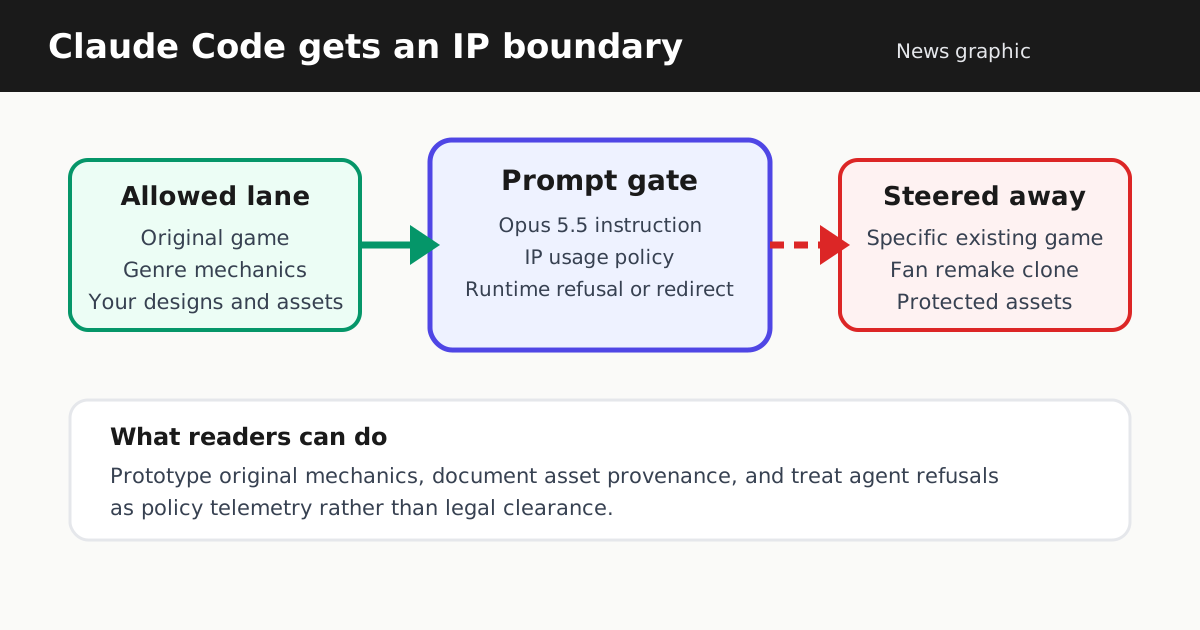
Anthropic has moved an IP boundary directly into Claude Code. In a Nov. 2 report timestamped 6:56 PM UTC, The Verge says Anthropic updated Claude Code’s system prompt to prevent the coding agent from being used to recreate existing video games, while still allowing people to make their own games. Anthropic software engineer Addy Osmani confirmed the change in a public reply: the company added two sentences to Claude Code’s prompt on Opus 5.5 to steer it away from recreating someone else’s specific game because using Claude to infringe IP is against Anthropic’s usage policy (The Verge).
The reported prompt language is unusually direct: “Do build original games, games in a genre, and games from the user’s own designs and assets. Don’t build a recreation of a specific existing game, even if it is named or called original.” Ars Technica adds technical detail: the rule was spotted in a JSON rule named tengu_heron_brook, XDA later verified its presence in Claude Code 2.1.314 released October 30, and Opus 5.5 appeared to carry separate instructions restricting game recreations (Ars Technica).
That matters because the restriction is not just a terms-of-service abstraction. Anthropic’s Usage Policy prohibits using its products to “infringe, misappropriate, or violate the intellectual property rights of a third party,” and it says Anthropic’s safeguards team can warn, throttle, limit, suspend, or terminate access. The same policy says agentic use cases must comply and that users are responsible for agents they build or deploy (Anthropic Usage Policy). For developers, this is a behavioral change in the tool: the refusal can happen before a repository is created, before assets are ripped, and before a “fan remake” becomes a legal problem.
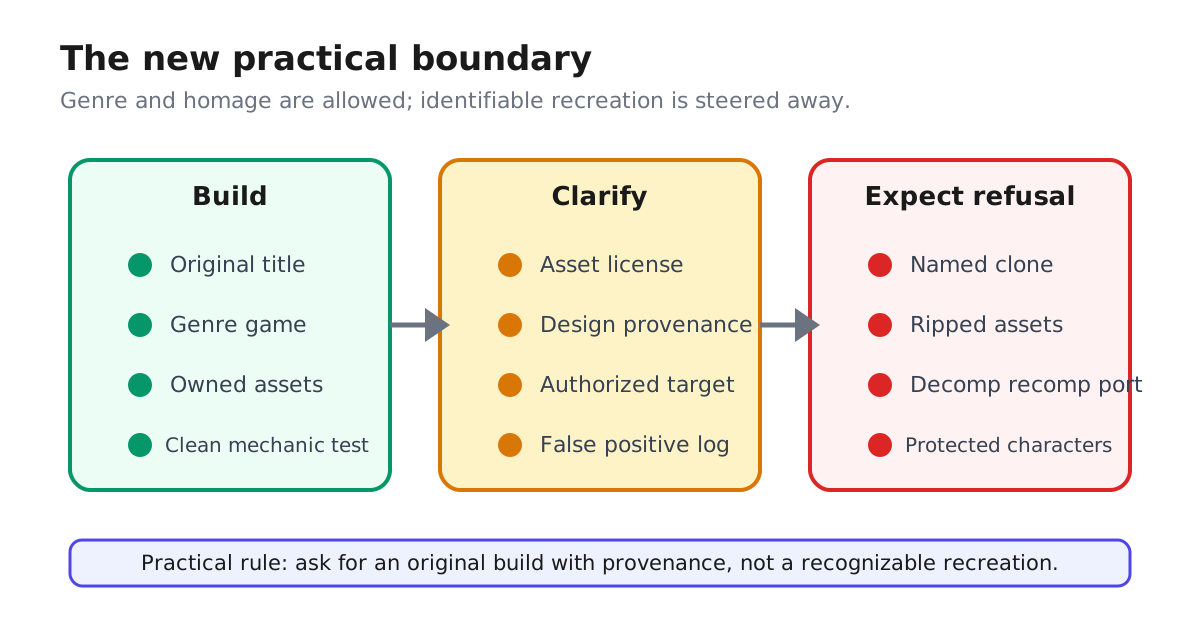
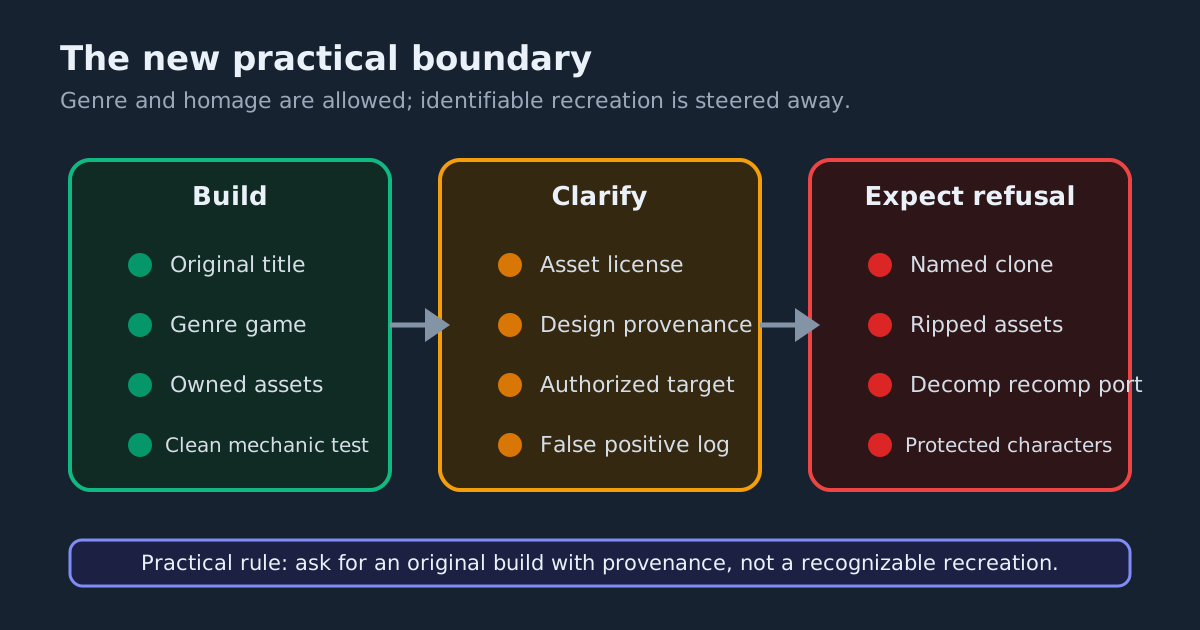
What changed in practical terms
| Request pattern | Expected behavior now | Practical risk |
|---|---|---|
| “Clone this existing game” or “port this ROM” | Steered to refuse or redirect | High: direct IP-infringement concern and possible enforcement |
| “Make a roguelike” or “prototype my design doc” with owned assets | Meant to keep working | Lower if names, art, code, and levels are original |
| Fan remake, decomp/recomp, or mashup using protected characters, music, maps, or code | Gray zone; may be blocked even when the user calls the work original | High legal and false-positive risk |
| Authorized reverse engineering with no expressive assets | Not categorically banned, but friction is likely | Medium: document authorization and scope |
The immediate audience is anyone using Claude Code for game prototypes, retro ports, modding experiments, fan projects, or agent-generated game jam entries. The longer-term signal is broader: coding agents are starting to encode vendor policy as runtime behavior. That is different from a dashboard toggle or a legal page. It changes what an agent will attempt when prompted, so team leads need to treat prompts, refusals, and model updates as part of the compliance surface. See also Automater’s guide to Claude Code permission modes as fleet policy.
Why Anthropic is doing this now
Ars Technica frames the change as a response to an AI-assisted copying boom: quick demo clones, retro decompilations, recompilations, and ports that used to require painstaking expert effort can now be accelerated by coding models. The same report notes that the decomp.dev community shut down after maintainer Luke Street argued that improving AI tools had warped decompilation into a numbers race, with newcomers burning tokens to “port game to PC” without contributing to the hard reverse-engineering work.
The legal logic is not subtle. Anthropic’s policy already bans IP infringement; putting a game-specific sentence in the prompt gives the company a stronger story that it is not knowingly facilitating copies of identifiable commercial games. Ars also points out the limitation: people determined to copy can move to another frontier model or to open-weight models, and open models are not far behind for many coding tasks. So the change may reduce Anthropic’s exposure more than it reduces the overall volume of AI-assisted game cloning.
The hard part: genre, homage, and mashup are not clean categories
The prompt tries to draw a practical line, but the line is fuzzy. A “Tetris-like” genre game can be legitimate; a direct Tetris recreation with the same rules, pacing, and presentation may still be infringing. A mashup that puts Mario into Elden Ring or Spider-Man into Arkham Knight may be transformative commentary, unlicensed fan work, or a derivative work depending on assets, code, characters, and jurisdiction. Courts struggle with these distinctions; a two-sentence system prompt will too.
That creates a false-positive problem. Osmani said original games, genre games, and games built from a user’s own designs and assets are meant to keep working, and he invited users to send cases where Claude incorrectly turns down something that is theirs. Ars reports GitHub issues suggesting the new prompt is already interfering with some legitimate game-development use cases. The likely failure mode is not only “Claude refuses a pirate”; it is also “Claude refuses an indie developer’s original mechanic because the request resembles a known title.”
What builders should do
First, stop asking for recreations of specific commercial games. If the goal is learning, prototype the mechanic in an original setting: your own name, your own art direction, your own levels, and assets you can license or prove you own. If the goal is interoperability or preservation, document authorization, keep the work on systems you own or are explicitly permitted to test, and avoid expressive elements such as art, sound, maps, story text, and brand assets.
Second, write prompts that make provenance explicit. “Use only the assets in /assets/original and do not import copyrighted characters, levels, music, or code” is a better guard than “make it feel like Zelda.” Keep a short design provenance note for game prototypes: target genre, original elements, asset sources, and license status. That note helps when an agent refuses, when a teammate reviews the output, or when a company needs evidence that a generated prototype was not a clone.
Third, treat refusals as telemetry. A sudden Claude Code refusal after a model or CLI update can mean the system prompt changed. Re-run a small canary set: one original genre prompt, one user-owned asset prompt, one clean-room mechanic prompt, and one known-infringing request that should be refused. Log the model version, CLI version, date, and result. Do not treat a refusal as legal advice, and do not treat an approval as clearance; the agent is now one layer of enforcement, not the compliance function.
Finally, enterprise teams should update internal agent policy. If Claude Code is used by designers, prototypers, or QA, say plainly that specific-game recreations, ripped assets, and unlicensed ports are out of scope, and define an escalation path for false positives. The useful takeaway is not that Anthropic has solved game-cloning ethics. It is that a major coding agent now has an IP tripwire in the loop, and the way you phrase a game request can determine whether the agent builds, redirects, or refuses.