
Qwen Code 0.25.0 Ships a Native Advisor Tool, Managed Runtime v2, and a Halved Cold Start
Qwen Code Desktop v0.25.0 and SDK TypeScript v0.1.18 landed 5 October with a native advisor tool, a v2 Managed Runtime execute/status/cancel contract, review verdicts that survive a rebase, and a claimed 2x faster fresh startup with 60 percent lower memory.
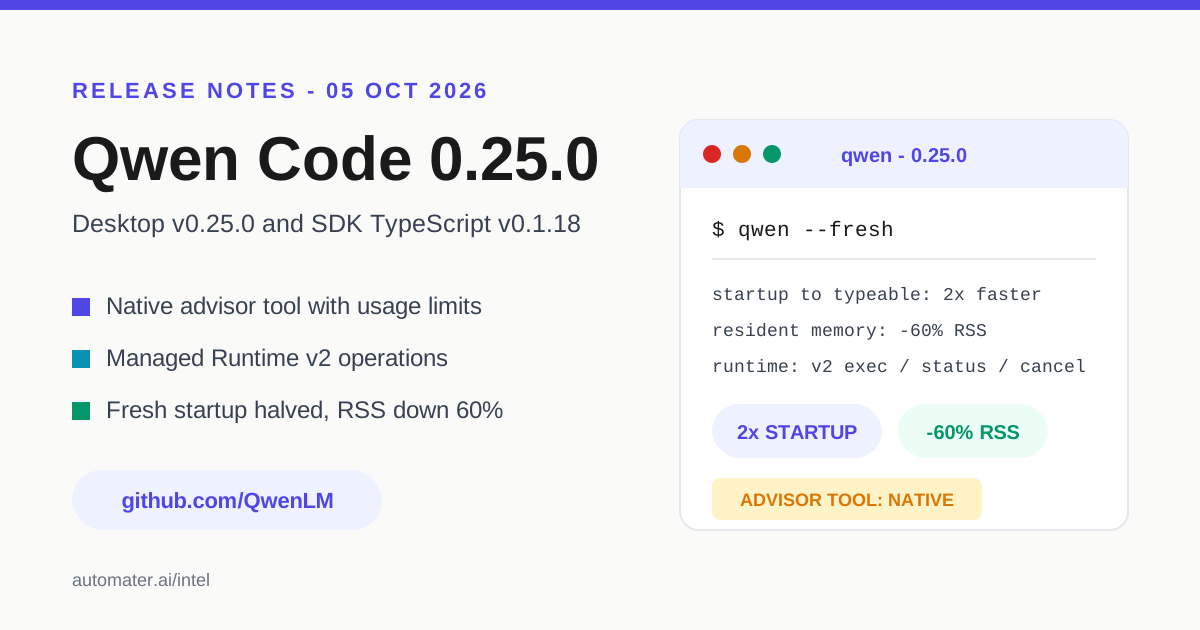
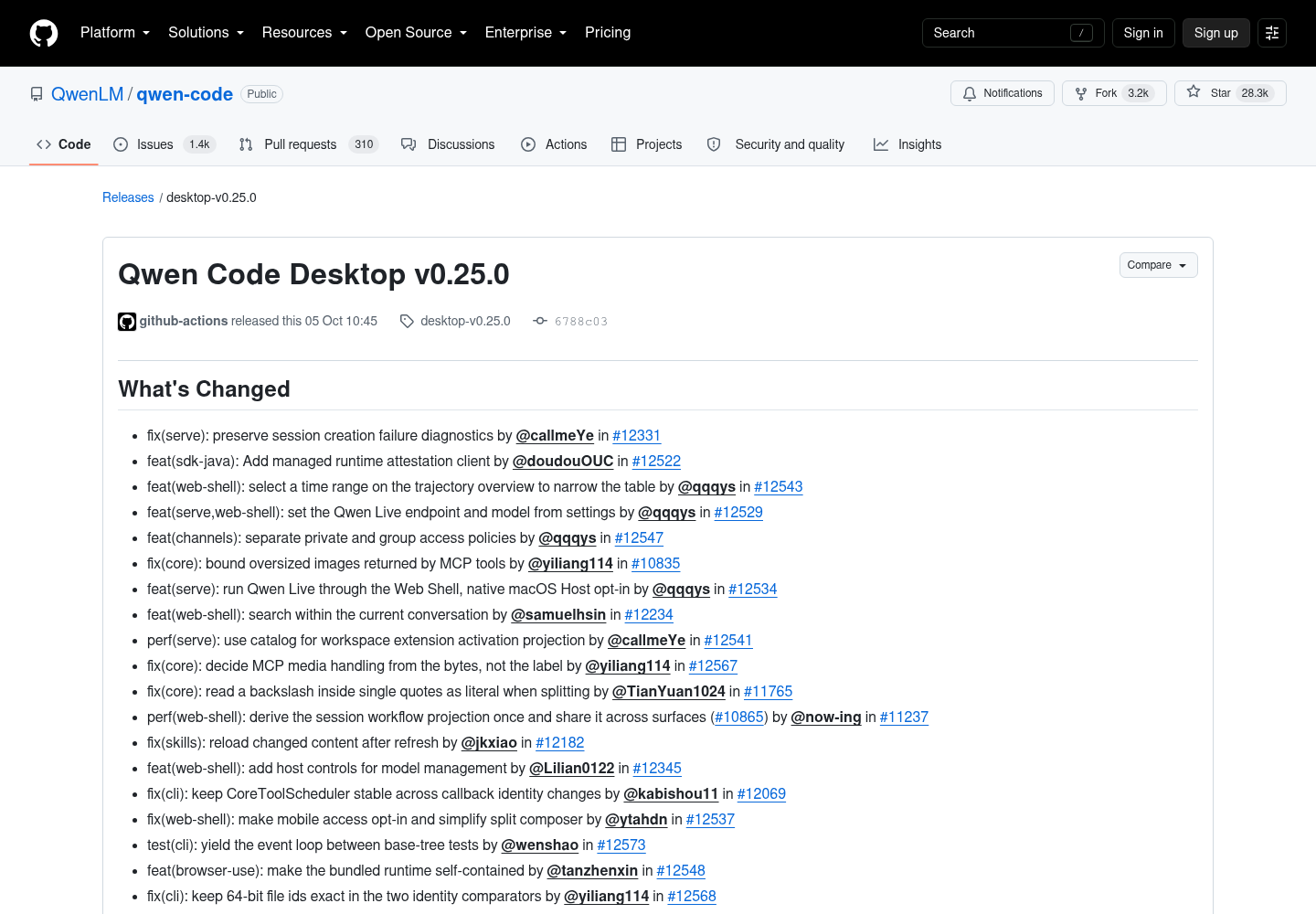
Qwen Code shipped two coordinated releases on 5 October 2026: Desktop v0.25.0 at 10:45 UTC and SDK TypeScript v0.1.18 twenty-two minutes earlier, with the SDK bundling CLI 0.25.0 built from the same branch. Both sit at the top of the project releases page. This drop is capability work, not patch noise: the v0.25.0 release notes carry a native advisor tool, a v2 Managed Runtime contract, review verdicts that survive a rebase, and a startup overhaul that claims to halve fresh-startup time while cutting resident memory by 60 percent.
A native advisor tool, with limits
The clearest signal of direction is feat: add native advisor tool (#9636), completed in the same release by consultation behavior and usage limits (#12688). Advisor-style consultation — ask a second model before acting — has mostly lived as an MCP bolt-on in coding harnesses. Shipping it native means every host that embeds the CLI inherits the same consultation semantics and, crucially, the same usage limits, instead of each integration inventing its own quota handling. If Qwen Code is one lane in a multi-harness fleet, that is the difference between an advisor you can budget and one you cannot.
Managed Runtime grows a v2 contract
The runtime layer is being formalized. This release declares a v2 Managed Runtime contract with execute, status and cancel operations (#12630), mounts those operations on the Managed Runtime worker (#12671), and adds them to the Java SDK runtime transport (#12637). Adoption is attestation-gated: the Java SDK gains a managed-runtime attestation client (#12522) and adopts a Managed Runtime only after attestation (#12552). The ordering — define the contract, wire the transport, verify before adopting — is worth copying if you operate your own runtime broker. Cancellation got specific attention too: broker cancellation is delivered after a dispatch lease lapses (#12583), and lapsed tool executions are fenced by the repository clock (#12608).
Half the cold start, 60 percent less memory
The number operators will notice: perf(cli): halve fresh-startup time to typeable and cut RSS by 60% (#12622). The claim is backed by structural changes rather than one trick — one-shot runs stop booting the CLI twice (#12602), headless startup skips interactive-only probes (#12603), and env files that only hold model credentials no longer force a restart (#12680). Just as important, the team checked in a startup benchmark harness (#12674). Treat the release note as a hypothesis: run that harness on your own machines before re-baselining fleet startup and memory expectations. On a CI runner holding twenty parallel qwen -p lanes, halved startup is real wall-clock money, and a 60 percent RSS cut directly raises how many lanes fit on one box.
Review verdicts that survive a rebase
Two changes matter for anyone letting agents touch diffs. First, per-file content verdicts that survive a rebase (#9661): findings anchor to file content rather than line positions, so a rebase no longer invalidates the review ledger. Second, the applied --fix is audited for unpinned new assumptions (#10169) — after an automated fix round, the audit asks whether the fix introduced assumptions nobody pinned. A local findings ledger is persisted when a round cannot anchor (#12660), and capture-tui means rendering claims get pixels, not prose (#9273). Together these turn review output from a comment stream into something closer to evidence you can act on after the branch moves.
Channels, Live and the Web Shell
Channel operators get separated private and group access policies (#12547), prefix-specific session routing (#12595) and bounded route-session rotation (#12616) — the separation you want before pointing one bot at both DMs and a busy group chat. Live voice sessions can receive a shared screen stream inside browser voice calls (#12623), Qwen Live runs through the Web Shell with a native macOS Host opt-in (#12534), and the Live endpoint and model are configurable from settings (#12529). In the Web Shell you can inspect session tool calls by prompt (#12466), zoom and pan the trajectory overview (#12557), see the trajectory across real time including idle gaps (#12607), and collapse it into a waterfall (#13081).
Smaller changes worth a look
/commit drafts AI commit messages (#10586), /batch-api adds an agent-prepared Batch API workflow (#12492), memory gains structured on-demand recall (#10183), and Mem0 is now bundled with the main CLI (#12891). Desktop picks up a QWEN_DESKTOP_DISABLE_UPDATES opt-out for the startup update check (#12587) and a linux-aarch64 release leg (#12833).
What you can do this week
| If you… | Do this | Why |
|---|---|---|
| Run the CLI in scripts or CI | Update, then re-run the checked-in startup harness | Startup and RSS claims are host-specific (#12622, #12674) |
| Embed the CLI through an SDK | Try the v2 execute, status and cancel operations; gate adoption on attestation | The contract is declared and mounted this release (#12630, #12671) |
| Let agents fix lint and review diffs | Read the per-file verdicts and the fix audit before merging | Verdicts survive a rebase; audits catch unpinned assumptions (#9661, #10169) |
| Serve chat channels | Split private and group policies; route by prefix | Least surprise before a group-chat incident (#12547, #12595) |
Updating follows the official docs:
curl -fsSL https://qwen-code-assets.oss-cn-hangzhou.aliyuncs.com/installation/install-qwen-standalone.sh | bash
cd your-project
qwen
The repository frames Qwen Code as an open-source, multi-protocol coding agent — OpenAI, Anthropic, Gemini and Qwen APIs, plus local models — which is why a release like this reaches past its own Desktop app. For where Qwen Code sits among its peers, see our coverage of the Chinese CLI wave and the agent harness landscape; the v2 runtime work here is a live case study in the harness engineering discipline those pieces argue for.