Claude Code 2.1.330 Makes Destructive rm Ask First, and Unattended Runs Refuse Instead of Waiting
Claude Code v2.1.330 changes four defaults that unattended lanes depend on: destructive rm now asks and is refused when nobody can answer, scheduled tasks and /loop reach 30 days, a deniedMcpServers name blocks only one connector, and claude -p exits 1 on a full disk.
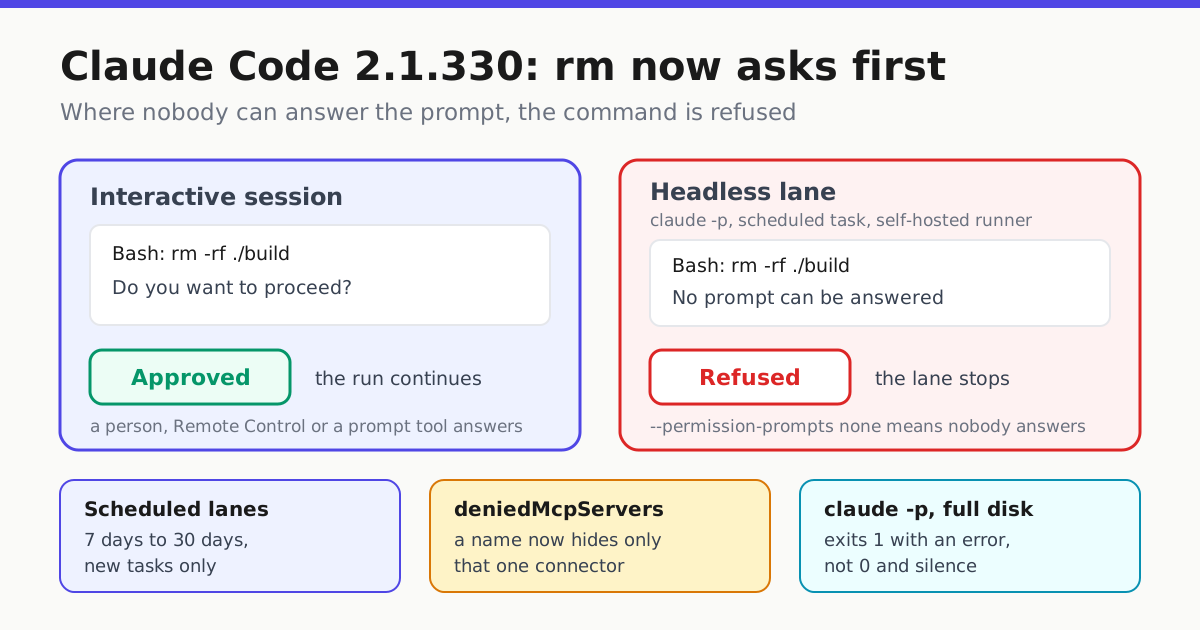
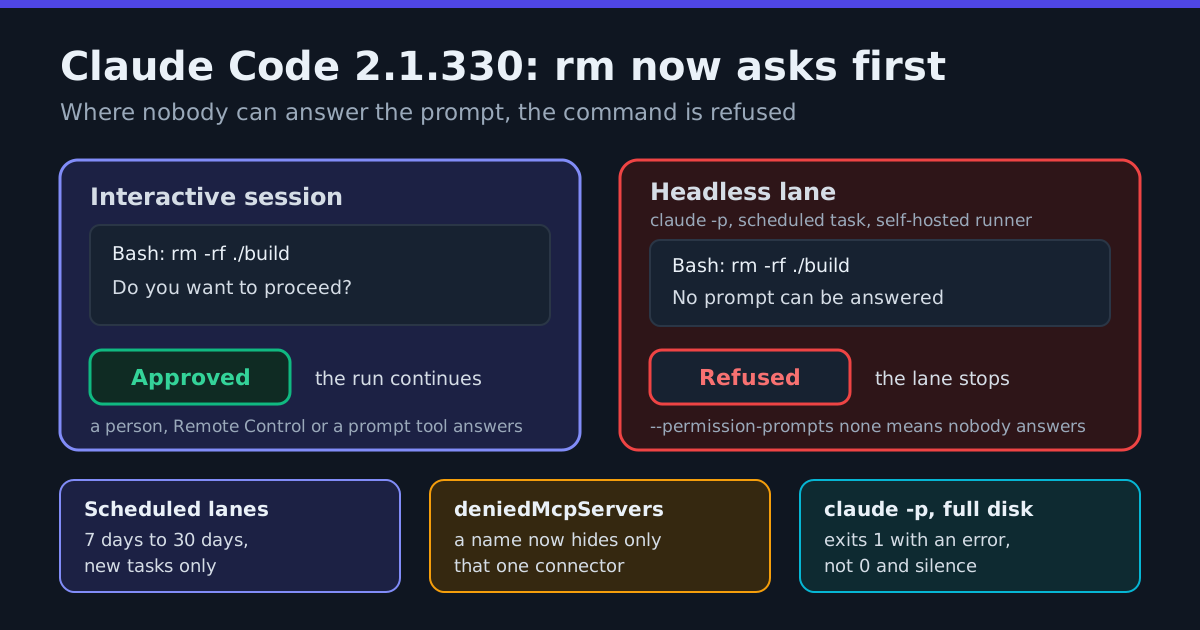
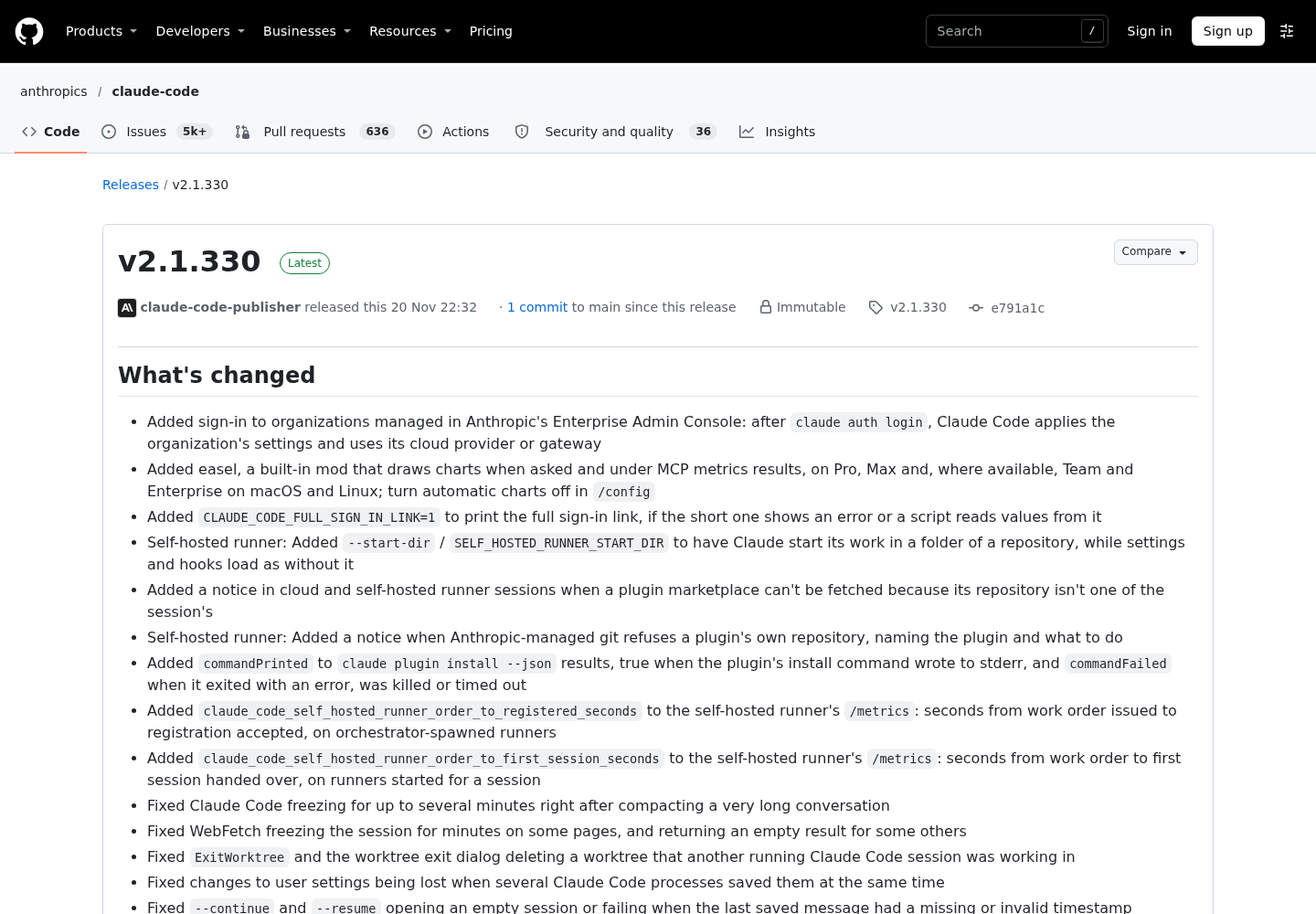
Anthropic published Claude Code v2.1.330 on Nov. 20 at 22:32 UTC. Past the long list of fixes, four entries change default behavior in ways that decide whether an unattended lane finishes its work, refuses a step, or quietly stops enforcing a block you wrote months ago. If you run claude -p in CI, keep scheduled tasks alive, or govern MCP servers through managed policy, this release changes what asking means when nobody is at the keyboard.
A destructive rm now asks, and an unattended lane refuses
The v2.1.330 release notes say that “more rm commands aimed at the root, home, a top-level folder or the working folder” now ask for approval, and that “where nobody can answer, they’re refused.” That is a fail-closed default: the same command that pops a prompt in your terminal becomes a hard stop in a headless run.
The mechanism is already documented. The CLI reference describes --permission-prompts, where passing none means nobody answers and Claude Code denies the prompt instead of hanging. Version 2.1.330 widens the set of commands that reach that gate, so lanes that previously ran a wide rm untouched will now stop mid-job.
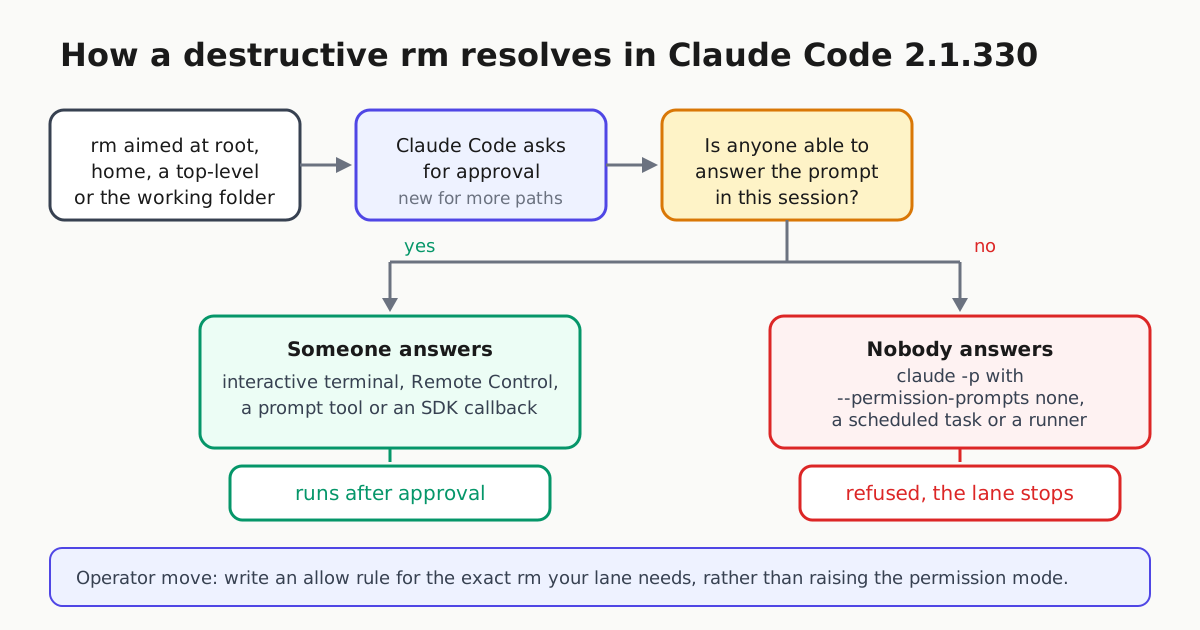
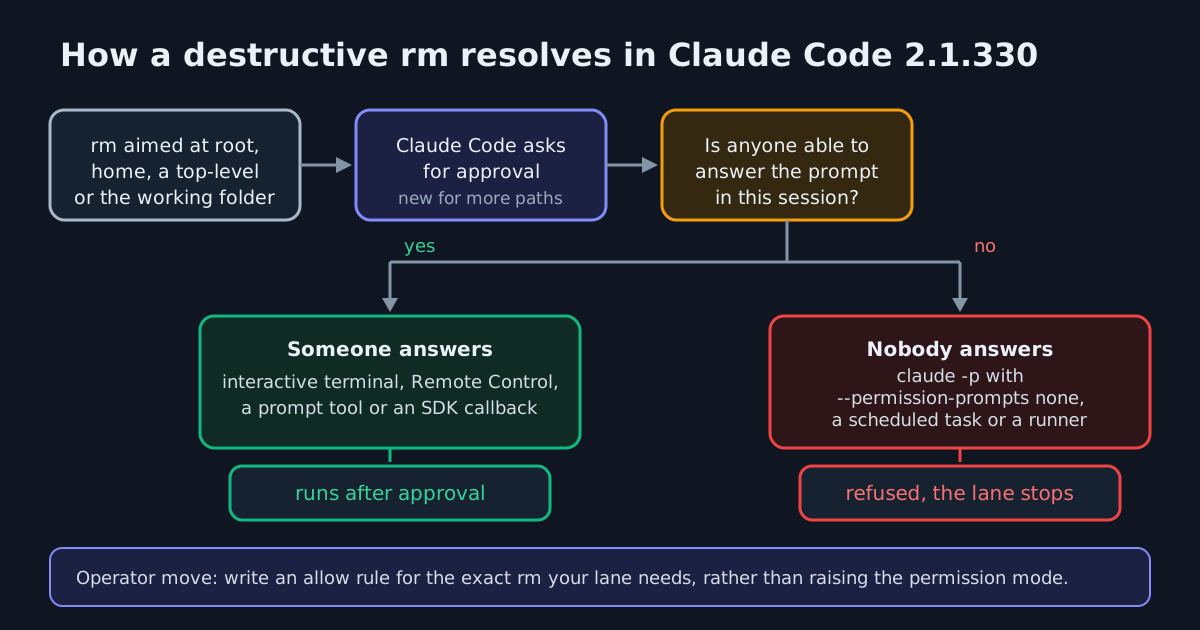
If your lane legitimately deletes a build directory, write the allowance down rather than raising the permission mode:
{
  "permissions": {
    "allow": [
      "Bash(rm -rf ./build)",
      "Bash(rm -rf ./tmp/cache)"
    ]
  }
}
Put that in ~/.claude/settings.json, in the shared .claude/settings.json, or in managed settings. The settings documentation notes that permissions.allow lists merge across files instead of overriding each other, and that a standing approval saved to .claude/settings.local.json applies without the workspace-trust step while the file stays untracked. Managed settings still sit above everything you write locally, so an organization deny rule wins. Test the exact command string your lane issues: a pattern that does not match still ends in a refusal.
Scheduled lanes stretch from 7 days to 30, but only new ones
Recurring scheduled tasks and /loop now run “up to 30 days instead of 7 while their session keeps running,” and they say when they end. Tasks created before this release still stop at day 7. The overview documentation splits the surface into cloud scheduled tasks, desktop scheduled tasks and /loop inside a CLI session, so the lane you care about may live in any of the three.
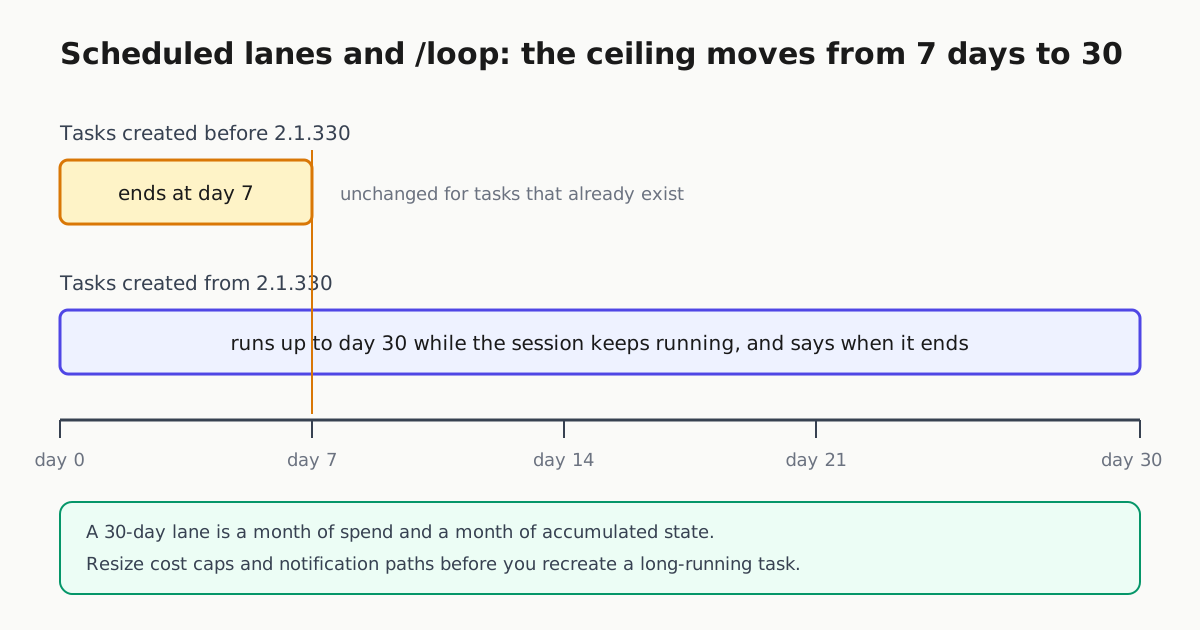
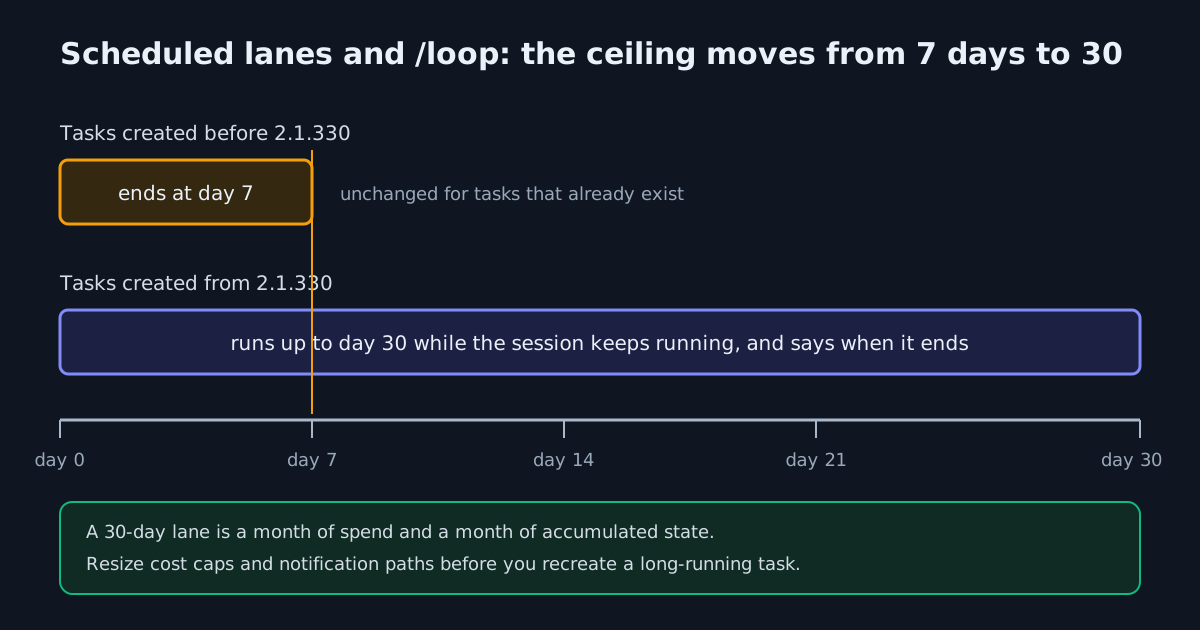
Two consequences follow. A lane you want alive past day 7 has to be recreated after the upgrade, not merely left running. And a month-long unattended lane is a month of spend and a month of accumulated state, so cost caps and notification paths sized for a weekly job need resizing. A related fix matters here: the notice for a skipped scheduled task that names no organization now tells you to start Claude Code with --resume, because /resume inside a running session does not run the task.
deniedMcpServers names got narrower
This is the quietest and most consequential governance change in the release. A deniedMcpServers entry that names a connector now “hides only the named claude.ai connector, not others at its URL; to block them all, deny its exact URL.” The MCP documentation shows the name form, where a serverName entry of "claude.ai Slack" blocks the Slack connector, and it also warns that a server blocked by an allowlist or denylist in managed MCP configuration “is hidden from both commands rather than shown with this status.”
Read those two sentences together. After this upgrade a name-based block may cover less than it did, and claude mcp list will not tell you, because blocked servers are hidden rather than labelled. If your policy leans on connector names, inventory the denylist and convert anything meant to cover a shared endpoint into an exact-URL denial. The same release stops a spurious “MCP server blocked by enterprise policy: easel” warning from printing at every start when your allowlist or denylist excludes the new built-in chart tool, which stays blocked.
Full disks now fail loudly
claude -p used to exit 0 with no message when its output went to a file on a full disk. It now prints an error and exits 1, with the caveat in the release notes that “a full NFS export may go unnoticed.” Expect jobs that were falsely green to turn red, and treat that red as the fix working rather than a new regression. Self-hosted runners get the parallel change: a runner that starts on a full disk now waits for room and exits 1 after a minute with no session, instead of claiming sessions and failing them.
Two more lines belong in the same audit. claude --teleport now prints the git commands for switching branch instead of running them in some setups, and with -p it exits 1 until you switch. And incomplete backups of ~/.claude.json no longer displace good ones when the disk fills.
Enterprise sign-in and runner transcripts
Signing in to an organization managed in Anthropic’s Enterprise Admin Console now applies that organization’s settings and uses its cloud provider or gateway after claude auth login. Under the precedence rules in the settings documentation, managed keys beat anything in your own files, so confirm with /status that the Setting sources line names the source you expect before you debug a policy that seems ignored.
On self-hosted runners, Bash commands now skip the file diff when nothing needs it, “so transcripts can lack it”; set bashEditDiffEnabled to true in managed settings if your audit trail requires every diff. A 403 from an IP allowlist is no longer logged as a bad secret or token, which will break log alerts that match the old wording. Warn mode for repository settings no longer stops at the first finding either, reporting up to 50 per session.
Before you roll it out
| Change in 2.1.330 | Who feels it | What to do |
|---|---|---|
Destructive rm asks, and is refused when nobody can answer |
CI, cron, self-hosted runners | Add an allow rule for each rm the lane needs |
Scheduled tasks and /loop reach 30 days |
Long-lived lanes | Recreate lanes that must outlive day 7; resize spend caps |
deniedMcpServers names hide one connector |
Orgs with connector denylists | Deny the exact URL to keep blocking everything behind it |
claude -p exits 1 on a full disk |
Pipelines writing output to a file | Expect newly red jobs; watch disk, distrust NFS |
| Runner transcripts can omit Bash diffs | Audit and compliance lanes | Set bashEditDiffEnabled in managed settings |
Anthropic also reverted 2.1.329’s removal of the automatic retry when max_tokens exceeds a model’s or gateway’s limit, so if you held back from 2.1.329 for that reason, 2.1.330 is the version to move to. This is the second release in a row that tightens an unattended default: Claude Code 2.1.325 made sandboxed Bash ask for permission by default. For scheduling mechanics see Claude Code cron job setup, for headless scripting see Claude Code headless mode, and for connector scopes see Claude Code MCP setup.