AWS Quick Turns a Described Process Into a Team-Wide Agent Flow
AWS Quick now builds flow automation from a chat description, runs several agents on one request, and adds admin guardrails. What operators can do with it, plus same-day KV caching and HyperPod news.
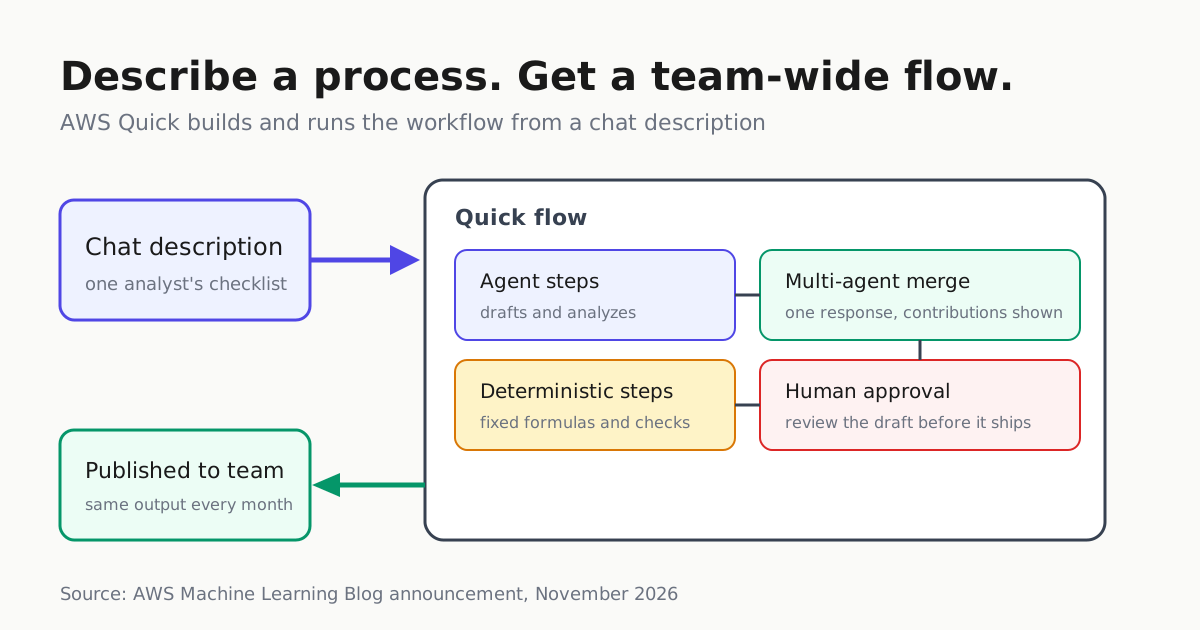
AWS Quick has shipped its most consequential update since the reusable-skills release earlier this month, and the change is not a feature count — it is who can build agent automation. The new release lets a business user describe a process in chat and have Quick construct a flow that orchestrates agents, skills, tools and data, then publish it for the whole team. Alongside it, several specialized agents can now work on one request at the same time and merge into a single answer, and administrators get prompt guardrails and group-scoped controls.
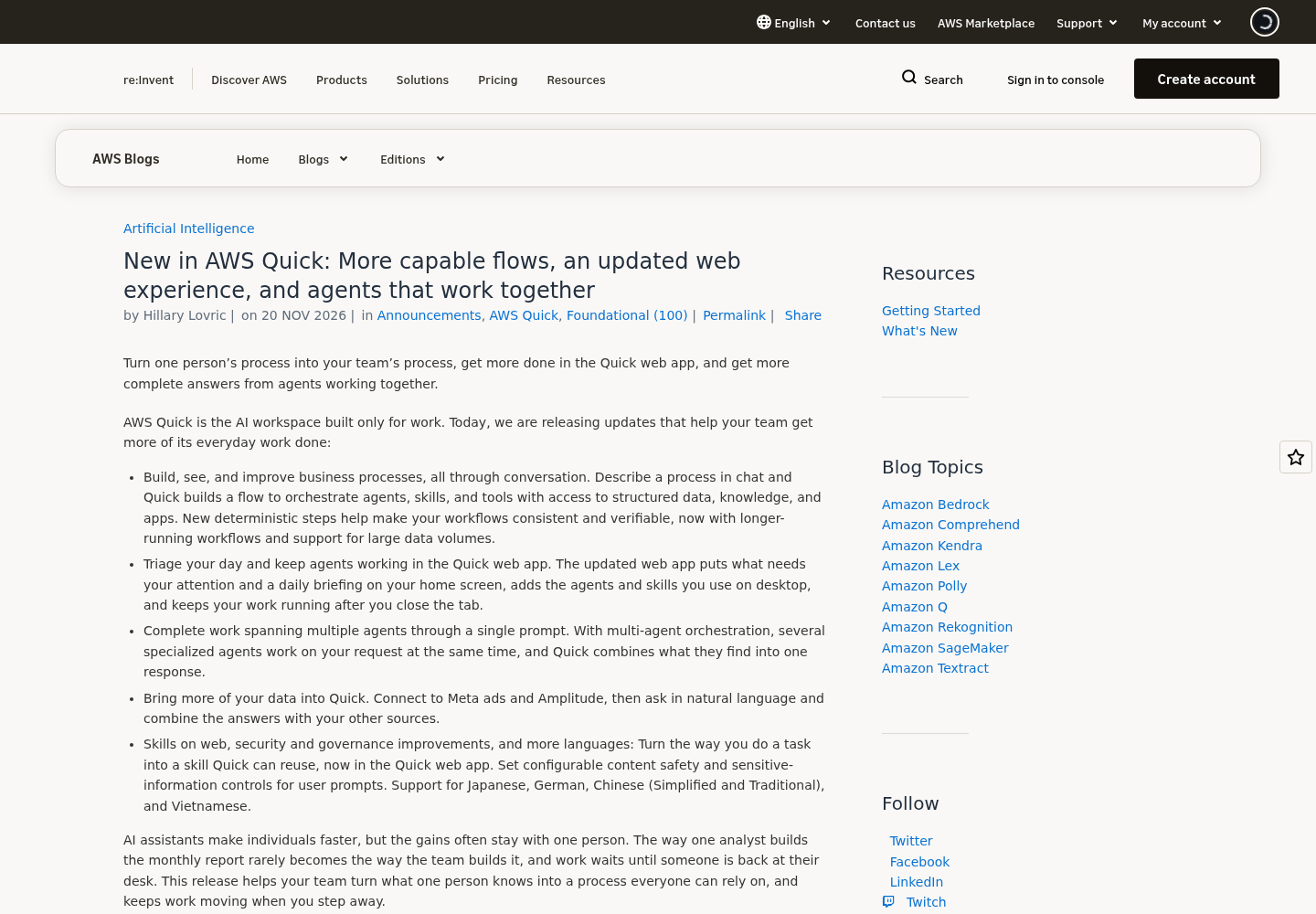
From one person’s checklist to a team flow
The core pattern AWS demonstrates is familiar to any operations team: a monthly report that lives in one analyst’s memory and personal checklist. When that person is out, a teammate rebuilds the report from scratch, and it looks different every time. With the updated Quick Flows, the analyst describes the process the way they would explain it to a new employee, Quick builds the flow, and a diagram beside the chat shows each step for confirmation.
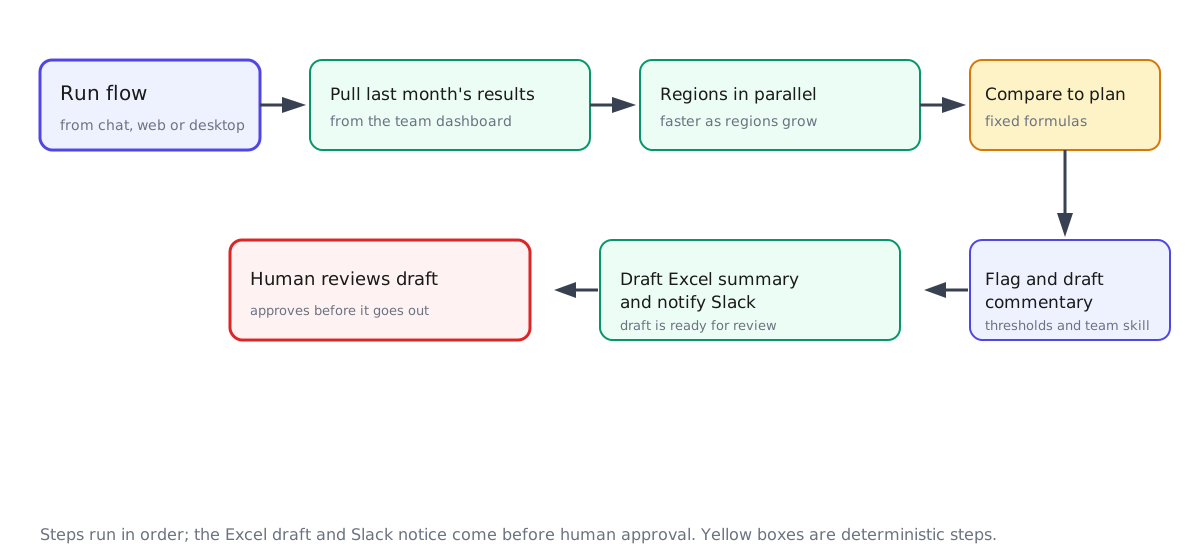
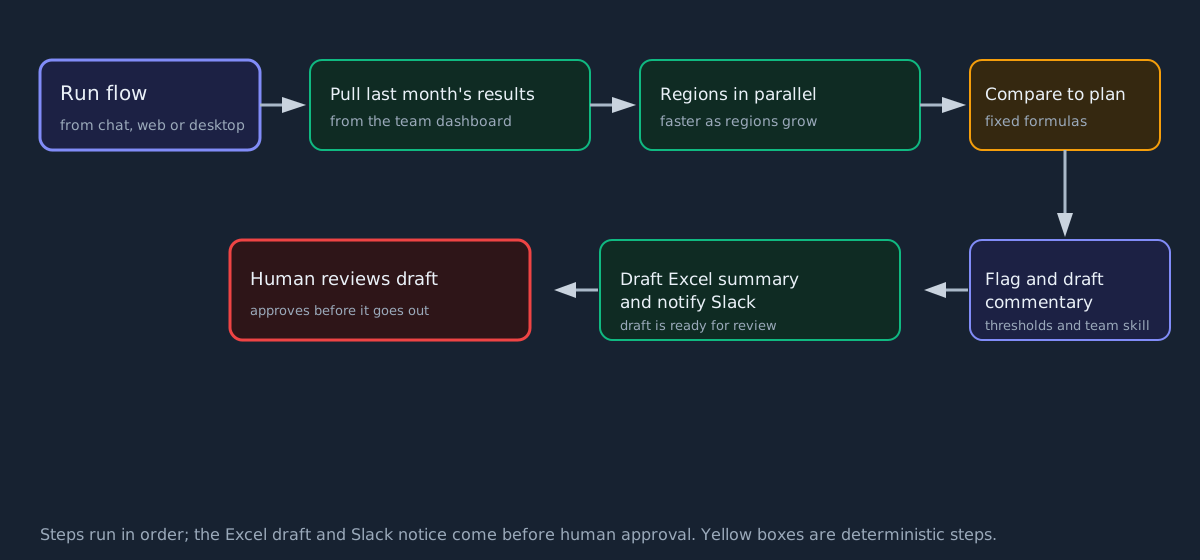
What makes this more than a chat-to-workflow gimmick is the mix of step types AWS added. Flows can now combine deterministic steps — fixed calculations and checks that make results consistent and verifiable — with agent steps that draft and analyze. Flows also handle longer-running work and larger data volumes. In the worked finance example, each run pulls last month’s results from a Quick dashboard, processes several regions in parallel, compares them to the annual plan with set formulas, flags deviations against thresholds, drafts commentary via a team skill, writes an Excel summary, and notifies the team in Slack — with a human approving before the report goes out.
AWS’s customer evidence for the broader claim is the most interesting part. Pomelo, a Latin American fintech, reports that before Quick, every analysis or automation depended on the data team; now nearly four times as many people work with data each month, and a single use case saves 80 hours per month. That is the actual significance of chat-built flows: the population that can encode a repeatable process expands from engineers to the people who own the process.
Multi-agent orchestration, with attribution
The second capability addresses a real limitation of single-agent designs. With multi-agent orchestration, the agent you ask can bring in several specialized agents at once — AWS’s example pairs a forecasting agent built on planning data with a procurement agent built on vendor contracts to explain a regional shipping-cost increase. Each agent keeps its own instructions, knowledge and context, so the domain owners maintain their own agents rather than one team maintaining a monolith. The response shows what each agent contributed, which is the detail that makes the combined answer auditable rather than a black box.
Operators running multi-agent patterns elsewhere will recognize the tradeoffs AWS is encoding: specialized context per agent, a coordinating prompt, and a merged output where provenance is visible. It is the same architecture question we covered in Claude Code subagents — restrict each agent’s scope and tools, and make the coordinator’s merging step reviewable.
The web app becomes a place work happens
The updated Quick web app moves from a viewing surface to an operating surface. The home screen now opens on what needs your attention, with a daily briefing that prioritizes email and messages; Quick can draft replies for review. Agents keep working after you close the browser, and a Library consolidates recent work, favorites and files, syncing across web, desktop and mobile. For teams that run scheduled flows, the practical change is that reviewing an agent’s output no longer requires the desktop app.
Connectors, guardrails and the governance layer
Two new MCP-based connectors extend what flows can read: Meta ads (through Meta’s ads MCP server) and Amplitude for product usage and conversion data. The permission model is the part worth copying: connectors respect each person’s existing access, Quick asks before any write action such as changing an ad budget, and administrators choose which connectors teams may add.
The admin controls arriving in this release matter more than they first appear. Prompt guardrails (preview) let administrators filter content, block denied topics, detect prompt attacks and protect selected personal information types — testable in detect-only mode before enforcement, then applied per user, identity-provider group or account. Permissions and agent-hour limits can now be assigned by identity-provider group, and administrators can restrict which data-source types people can create or share (for example, allow Redshift, block file uploads). These three are available on Professional and Enterprise plans. Together they turn Quick from a per-team tool into something a security organization can actually gate, which is usually the precondition for enterprise-wide agent rollout.
Skills — reusable task instructions — are now manageable in the web app as on desktop, and Quick adds Japanese, German, Chinese (Simplified and Traditional) and Vietnamese.
The same-day context: cost and cluster operations
AWS published two other substantive posts the same day that frame where its agent stack is heading. The distributed KV caching agent skill works with Kiro, Claude Code, OpenAI Codex and other Agent Skills-compatible agents to evaluate, size and set up shared KV caching for self-hosted LLM fleets — with a fit check before any spend, KVTrace-based savings estimates from your own traffic, and up to 40% cost and 80% time-to-first-token reductions where the workload qualifies. Notably, it treats tenant isolation as a first-class constraint: tenants sharing a cache add their own ID to the KV hash.
And SageMaker HyperPod Slurm cluster extensions bring declarative, validated, observable management to the software layer on running nodes — observability and user management first, schema-checked at submit time, applied consistently to new and replacement nodes, with per-node health reporting, at no additional charge. Teams running training infrastructure for agent models get script-drift relief without losing SSH access to the controller.
What to do with this
If your team already uses Quick, the highest-value move is to pick one process that currently lives in one person’s head, have them describe it in chat, and run it once in parallel with the human version. Use deterministic steps for any calculation that must be identical month to month, and keep the human approval step before anything customer-facing ships. Administrators should enable prompt guardrails in detect-only mode first and set group-level agent-hour limits before flows scale beyond the team that built them.
The release is available today in all Regions where AWS Quick is available.
Sources: AWS Machine Learning Blog — New in AWS Quick, AWS Machine Learning Blog — Distributed KV caching agent skill, AWS Machine Learning Blog — HyperPod cluster extensions.
Sources
- New in AWS Quick: More capable flows, an updated web experience, and agents that work together | Artificial Intelligence
- Cut self-hosted LLM cost and latency with the distributed KV caching agent skill | Artificial Intelligence
- Introducing managed cluster extensions for observability and user management in Amazon SageMaker HyperPod Slurm | Artificial Intelligence