Alpöge's Riemann Claim With Claude, and a Human Draft, Still Await Acceptance
On 20 November 2026 Levent Alpöge said work with Claude had formalized a Riemann hypothesis proof, including the generalized form. Ravi Vakil the same day shared a separate human draft. A Lean compile report is a different record from Clay acceptance.
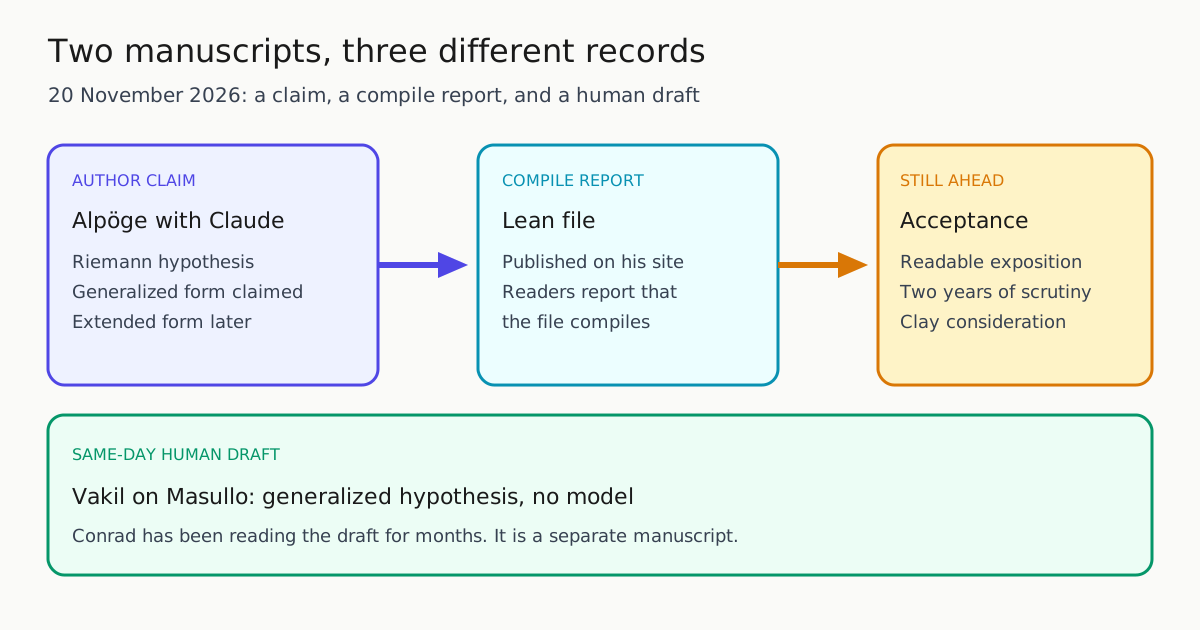
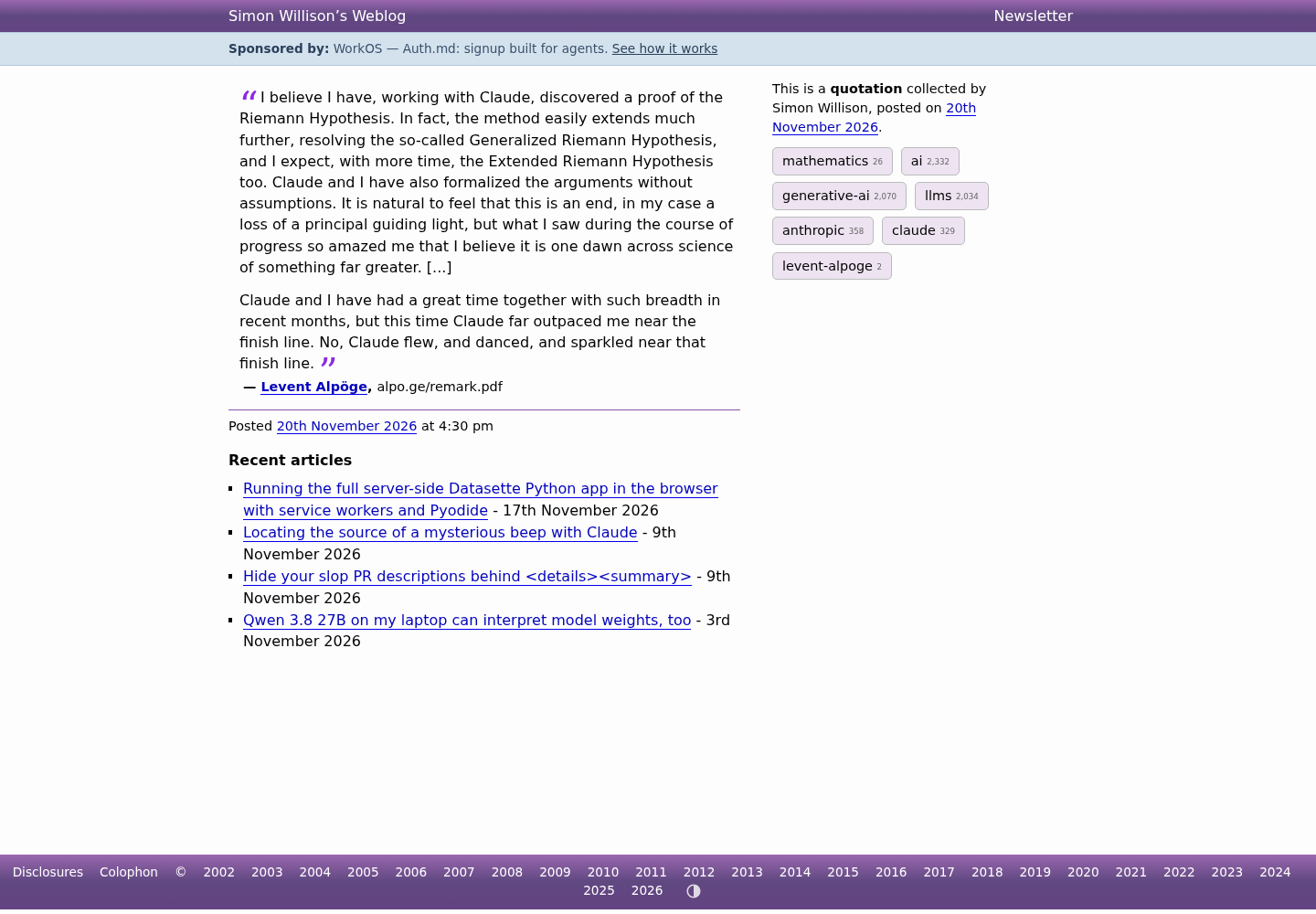
On 20 November 2026, Simon Willison published a quotation in which Levent Alpöge says he believes that, working with Claude, he has discovered a proof of the Riemann hypothesis, that the method extends to the generalized Riemann hypothesis, and that the arguments have been formalized. The same day, The Verge, TechCrunch and SiliconANGLE reported the claim. What those pages establish is an announcement by a mathematician at Anthropic. Clay Mathematics Institute acceptance is a later step, and Anthropic has published no announcement of its own.
Willison’s page marks the quotation as posted at 4:30 pm and attributes it to a PDF at alpo.ge/remark.pdf. The sentences he reproduces are direct. Alpöge writes, “I believe I have, working with Claude, discovered a proof of the Riemann Hypothesis.” The method, he writes, “easily extends much further, resolving the so-called Generalized Riemann Hypothesis,” and he expects, with more time, the extended Riemann hypothesis as well. He adds that he and Claude “have also formalized the arguments without assumptions,” and that at the end “Claude flew, and danced, and sparkled near that finish line.”
Read in order, the quotation assigns a different status to each statement. The classical hypothesis and the generalized hypothesis are offered as results in hand. The extended hypothesis is offered as later work. Formalization is his description of how the argument was recorded.
The Verge, timestamped 4:34 PM UTC, reports material outside that excerpt. Robert Hart and Emma Roth write that Alpöge’s document says he texted Anthropic chief executive Dario Amodei “late Sunday night” and waited to publish until after the company’s IPO on Thursday. They report that Anthropic has not commented and did not involve itself in the announcement, and that their inquiry had drawn no immediate reply. The listing is a separate corporate fact: The Verge says Anthropic went public on 19 November 2026. Earlier coverage of that listing is in Anthropic’s Nasdaq debut and the Class N close. The Riemann document is Alpöge’s, and the company has not adopted it as an official result. A related note on the formalization claim is Alpöge Says Claude Helped Formalize a Riemann Hypothesis Proof in Lean.
The Verge reports that the solution is presented in Lean, published on Alpöge’s website, and not yet publicly accepted by the Clay Mathematics Institute. Clay administers the Millennium Prize and a $1 million award for each problem. The rules, as The Verge states them, require a proposed solution to be published, to withstand at least two years of scrutiny, and to receive “general acceptance in the global mathematics community” before the institute considers the prize. In The Verge’s account, the Poincaré conjecture remains the only problem officially solved under that prize.
SiliconANGLE, updated at 16:28 EST, reports no official Anthropic post. Maria Deutscher adds two scale claims absent from the Willison quotation: a prose proof of more than 250,000 pages that Alpöge had not yet released, and a published Lean development of millions of lines. SiliconANGLE describes a Lean program that runs as establishing the mathematical argument encoded in that program. A compile is evidence about the file that was checked. Reviewers still have to settle whether that statement is the Riemann hypothesis, whether the background assumptions are ones the field accepts, and whether a person can explain the argument.
TechCrunch reports that Zulip participants, including MIT mathematician Andrew Sutherland, said the solution compiles, and the story was updated to record that independent sources had checked the Lean proof. Tim Fernholz quotes number theorist Chris Birkbeck describing a cohomology bound that looks like an automorphy-lifting argument built from Galois representations and classical theorems. Fernholz also writes that Alpöge seemed uneasy about publishing before a human-intelligible explanation existed, and that he has committed to write one. That gap is the practical consequence. A development described as millions of lines can be machine-checked and still be hard to teach or to referee. The Verge adds an August baseline: Anthropic said it was working on the Riemann hypothesis with Claude and did not expect the techniques Claude used then to lead to a proof. The company has not restated the November claim.
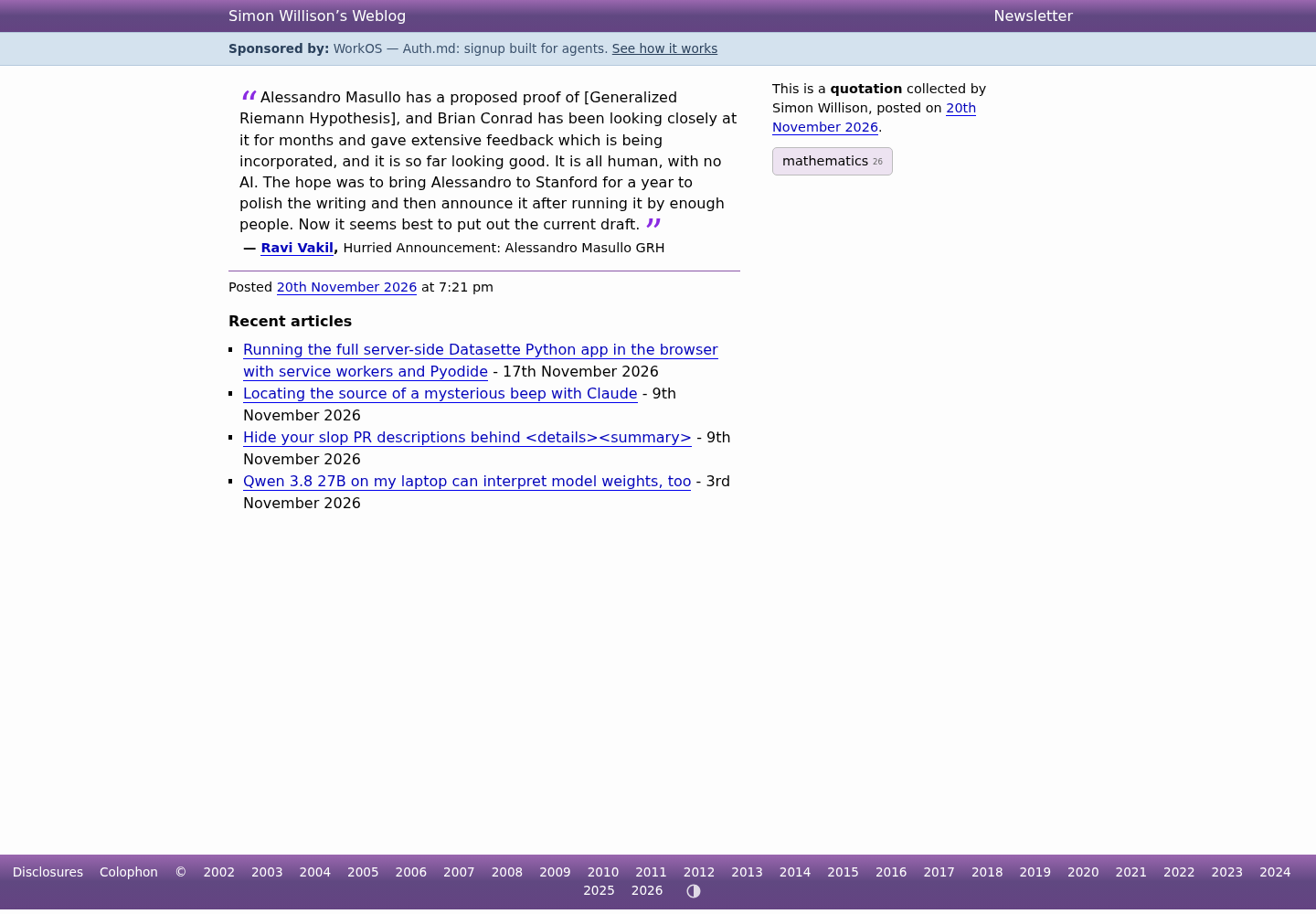
A second manuscript moved on the same day, and it is a different text. At 7:21 pm Willison published a quotation from Ravi Vakil. Alessandro Masullo, Vakil writes, has a proposed proof of the generalized Riemann hypothesis. Brian Conrad “has been looking closely at it for months,” feedback is still being incorporated, and “it is so far looking good.” Vakil writes that the draft is “all human, with no AI,” that the hope had been a year at Stanford to polish the writing before any announcement, and that the current draft should come out now. TechCrunch, identifying Vakil as a Stanford professor, reports that Masullo called the work the result of 12 years and told mathematicians discouraged by the field’s pace that they are still here. Without Lean, TechCrunch writes, it is too early to say the proof checks out.
| Record | Alpöge with Claude | Masullo draft |
|---|---|---|
| Statement | Riemann hypothesis; generalized form claimed; extended form later | Generalized Riemann hypothesis |
| Where it surfaced | Alpöge’s site, quoted by Willison; same-day reports from The Verge, TechCrunch and SiliconANGLE | Vakil’s note, quoted by Willison and reported by TechCrunch |
| Role of a model | Alpöge says Claude carried the closing work | Vakil says the draft uses no AI |
| Check described | Lean compile reported by Sutherland and other readers | Months of reading by Brian Conrad, with feedback still going in |
| Acceptance | Clay acceptance still ahead, after publication and two years of scrutiny | TechCrunch: too early to say it checks out |
TechCrunch also reports that Alpöge and NYU mathematician Tristan Buckmaster released a further argument tied to the Navier-Stokes equations. The Verge reports that OpenAI claimed a Navier-Stokes solution in September and that formal recognition is still outstanding. That claim sits beside the Riemann file. It does not verify either manuscript.
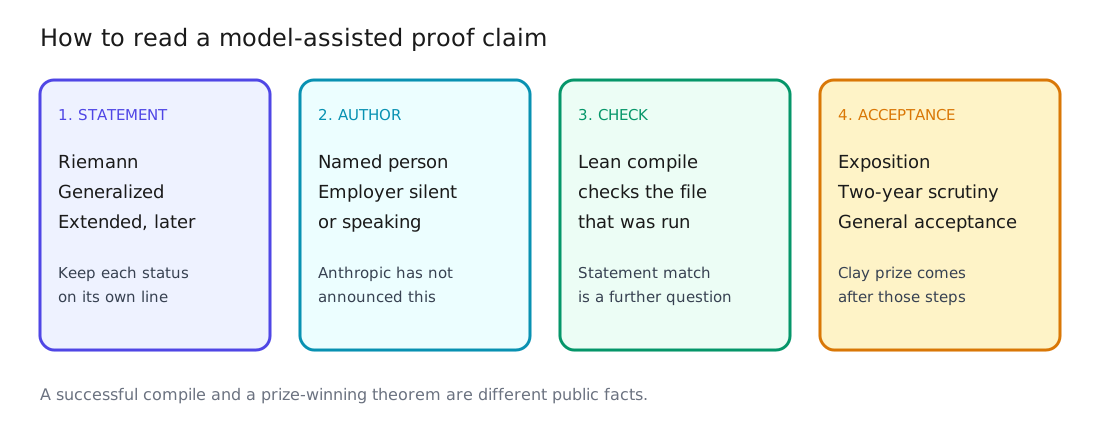
Labs and journals can already read a working standard in this record. Name the person asserting the theorem, and keep an employer’s silence visible when the employer has not spoken. Say which conjecture is claimed, with a deferred extension kept outside the proved column. Treat a compile report as news about a specific file, and ask for an exposition a referee can challenge. Clay’s clock still runs through publication, two years of scrutiny, and general acceptance. On that standard, 20 November placed two Riemann-family manuscripts in public, and both now wait on readers.
Sources
- A quote from Levent Alpöge
- Anthropic mathematician claims to have solved prestigious Millennium Prize problem with Claude | The Verge
- AI claimed a solution to the 167-year-old Riemann hypothesis — and a human did, too | TechCrunch
- Anthropic researcher claims to have proven Riemann hypothesis using Claude - SiliconANGLE
- A quote from Ravi Vakil