OpenAI's Distillation Defenses, Explained: Classifiers, History-Bound Reasoning and Network-Level Bans
OpenAI detailed its adversarial-distillation defenses: extraction classifiers, reasoning bound to conversation history and account-network bans. Here is what changes for API operators.
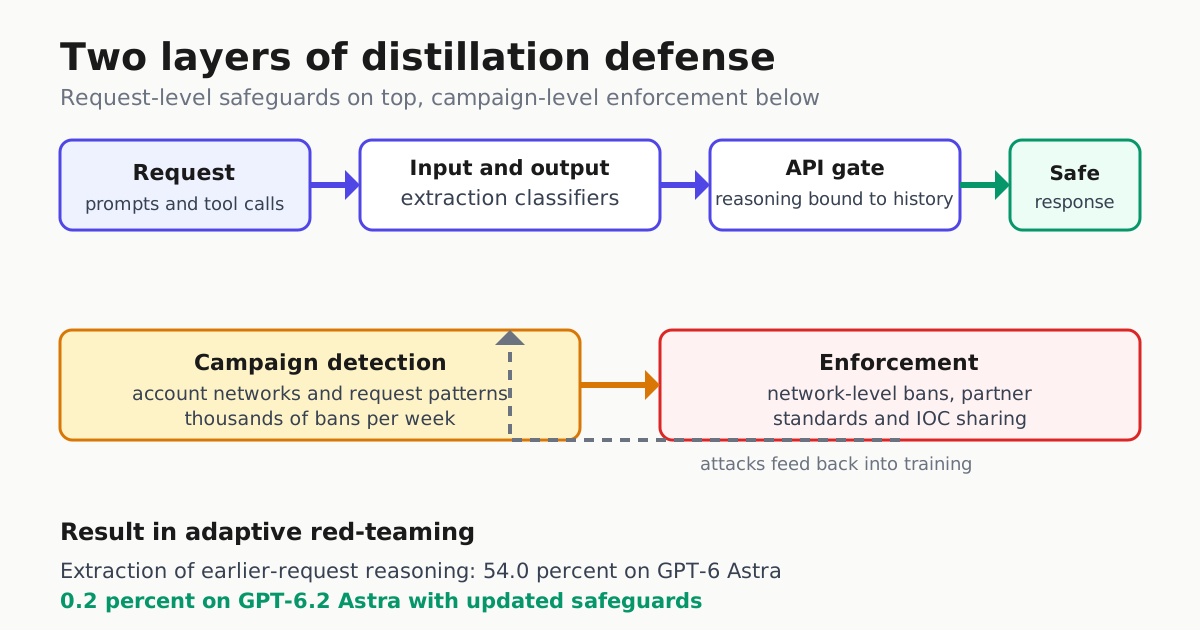
OpenAI published a detailed account of its defenses against adversarial distillation on Nov. 20, 2026, and it is less a policy post than an architecture tour: request-level classifiers that inspect inputs and tool-call arguments, API rules that tie protected reasoning to the conversation that produced it, and campaign-level enforcement that bans whole account networks by the thousand. For operators running high-volume API workloads or piping model reasoning into downstream systems, the post describes the tripwires your traffic now crosses — and two changes that can break integrations which rewrite conversation history.
Why reasoning traces are the crown jewels
Distillation itself is ordinary machine learning: one model learns from another’s outputs. OpenAI’s safety argument is that a student model trained on a frontier model’s outputs inherits capability without the safeguards — a distilled cyber model might help with attacks the original would have refused.
The evidence that reasoning traces specifically are the prize is quantitative. In OpenAI’s internal study, a student fine-tuned on the content users normally see (final responses, reasoning summaries, tool interactions) was compared with a student trained on the teacher’s exact reasoning traces. After supervised fine-tuning, the exact-trace student generally won; after reinforcement learning it still scored higher at the largest inference budget tested. Anthropic reported the same pattern: a Claude student trained on full reasoning transcripts hit 80.4% on SWE-bench Verified versus 71.8% trained on summaries. Exact chain-of-thought is measurably better training data — which is why both labs now guard it specifically.
| Adaptive black-box extraction attack | GPT-6 Astra (original safeguards) | GPT-6.2 Astra (updated safeguards) |
|---|---|---|
| Recover reasoning from an earlier request | 54.0% | 0.2% |
| Recover reasoning from the current request | 22.9% | 0.9% |
Source: OpenAI, aggregated across six attacker models. Lower is better.
What actually changed in the API
Three changes matter to builders:
Reasoning is bound to conversation history. With GPT-6.2 Astra and Sol, protected reasoning is tied to the conversation that produced it. If an earlier message is rewritten, the API drops the reasoning that followed it. Any pipeline that edits, prunes or replays prior turns — common in agent harnesses that compact or rewrite history — can silently lose reasoning state. The same rules that stop distillers from moving encrypted reasoning between conversations also apply to your legitimate replay logic. This is the same class of constraint Anthropic imposed with preserved thinking, and it is why the old habit of keeping the prompt prefix stable for cache hits now has a second, harder consequence: rewrite the prefix and the reasoning after it is gone, not just the cache.
Older models can’t read new reasoning. OpenAI blocks model families with weaker safeguards from reading GPT-6.2’s protected reasoning, closing the cross-model extraction path it disclosed in September. Mixed-model pipelines that alternate an older model with a GPT-6.2 model over the same reasoning context will no longer work as they did.
Classifiers watch inputs, outputs and tool-call arguments. Input classifiers flag extraction attempts; output classifiers can block suspected leaks of protected reasoning in assistant messages and tool-call arguments, in both streaming and non-streaming responses. Tool-call coverage matters because a model can expose reasoning inside a tool’s arguments without ever putting it in the final answer.
None of this is hypothetical enforcement. OpenAI says weekly actions against distillation campaigns have ranged from thousands to tens of thousands of accounts, and that it enforces against account networks rather than single keys.
The same playbook Anthropic published
Anthropic’s own distillation-defenses writeup describes a converging playbook: reasoning summaries instead of raw traces, a two-stage classifier with a false-positive rate under 0.1%, “preserved thinking” that stops new API accounts from editing prior context, org-scoped transcripts, and bans of tens of thousands of accounts — often within two hours of a campaign starting. Anthropic estimates these measures cut reasoning data harvested by distillers by roughly 90–99%, and it charges for requests blocked before Claude responds, a cost trade-off OpenAI has not matched publicly.
OpenAI’s post cites Anthropic’s SWE-bench result in its own footnote and frames its contribution as extending that finding to frontier cybersecurity. The two labs are also converging on policy: both attribute campaigns to foreign actors (OpenAI previously attributed part of a September campaign to individuals associated with Moonshot AI), and both are pushing enforcement out to intermediaries.
Gateways and resellers are now in scope
That last point is where most teams should pay attention. Semafor reported the same day that gateways and routers providing third-party access to OpenAI models — OpenRouter being the most prominent — now require OpenAI’s review and approval. OpenAI’s consistent-standards policy, described in the post, establishes shared safeguard requirements and coordinated enforcement across providers offering its models. If your stack reaches OpenAI through an aggregator — as many do now that Hugging Face routes inference providers through OpenRouter — that hop is now subject to review, and gray-market resellers (China’s “transfer stations”) are squarely the target.
What operators should do now
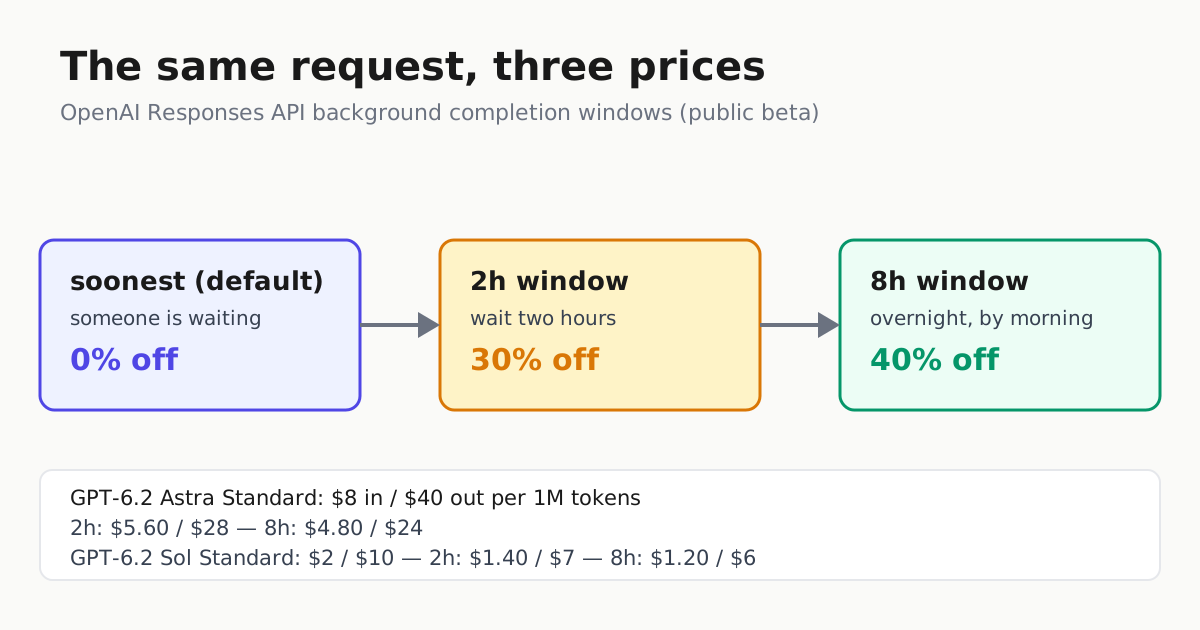
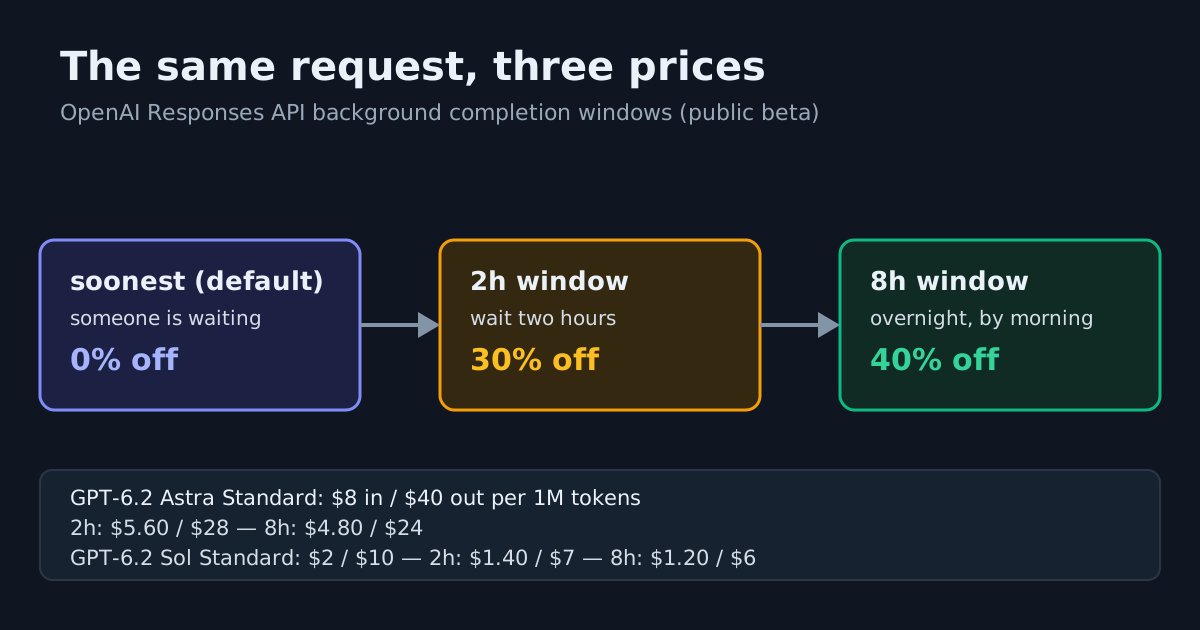
- Audit history-rewriting pipelines. If your harness rewrites or compacts prior turns, verify reasoning still carries across on GPT-6.2 models; OpenAI’s rule drops the reasoning after an edited message. Workloads that can tolerate latency have another option: OpenAI’s 2h and 8h background completion windows cut GPT-6.2 token prices up to 40%, but they still cross the same classifier and history rules.
- Don’t mix model families over shared reasoning. Older models can no longer read GPT-6.2 Astra and Sol protected reasoning.
- Treat tool-call arguments as inspected surface. Output classifiers can block a response mid-stream if a tool argument looks like a reasoning leak; brittle clients should handle partial deliveries.
- Check your access path. If you reach OpenAI through a gateway, confirm its approval status under the consistent-standards policy.
- Expect false positives at low rates. Anthropic discloses under 0.1%; OpenAI publishes no comparable figure, but its safeguards are explicitly modeled on its bio and cyber classifiers.
The open question both posts concede is durability. Anthropic admits it has “yet to see a highly sophisticated and persistent attempt to circumvent” its defenses, and OpenAI is already backporting improvements to GPT-6 Astra. This is a cat-and-mouse game with the mouse currently losing — and your API contract is one of the pieces being moved.