Palo Alto Networks Buys Applied Compute for $4.5 Billion to Secure Enterprises' Own Open-Weight AI Models
Palo Alto Networks is paying $4.5 billion in stock for Applied Compute, betting enterprises will train and run their own open-weight AI models securely.
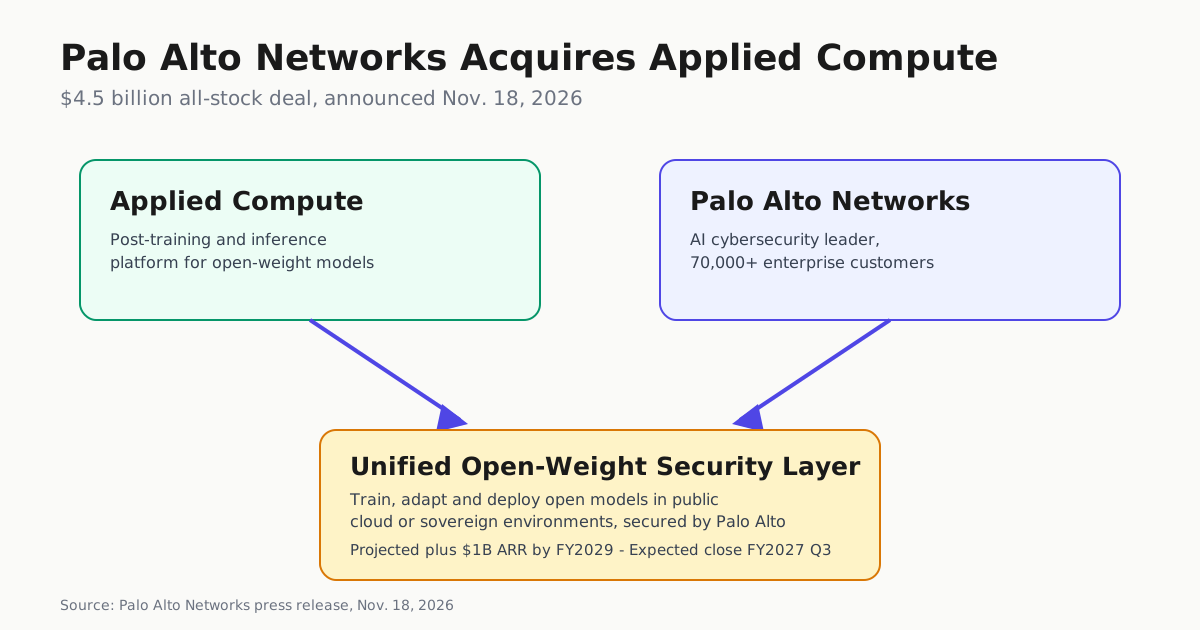
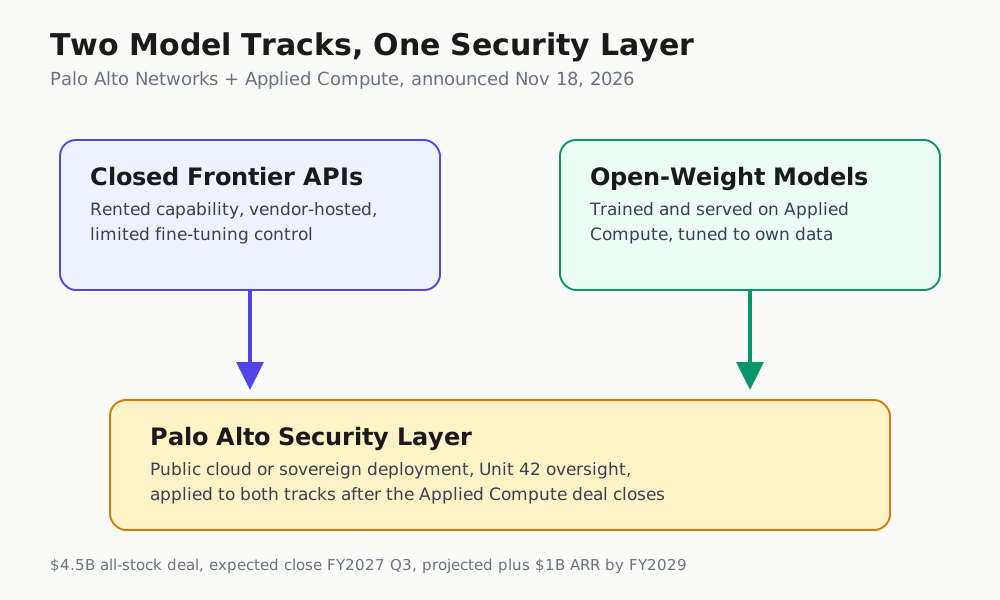
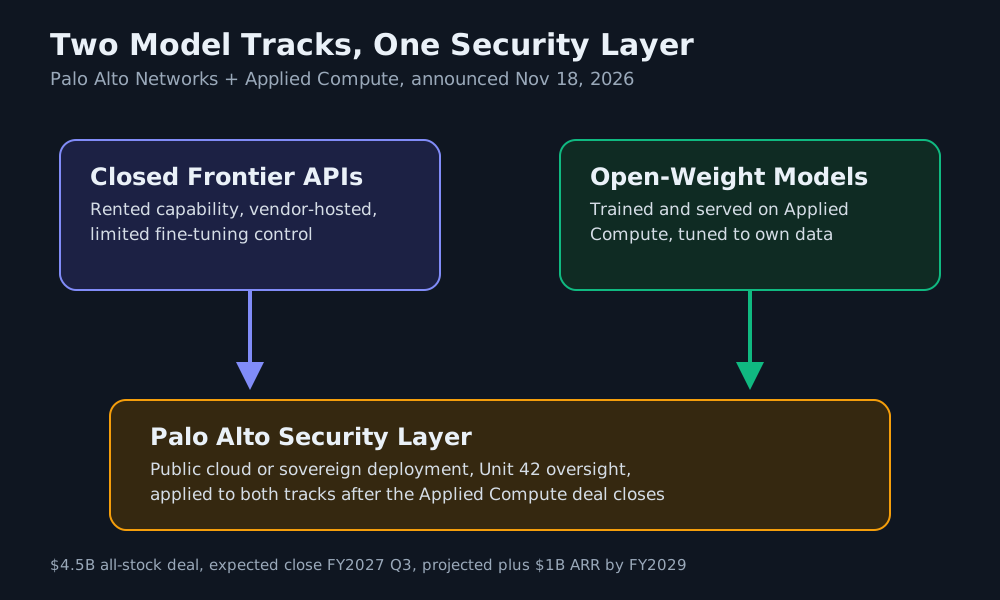
Palo Alto Networks announced on November 18 that it has agreed to acquire Applied Compute, a platform for post-training and serving open-weight AI models, in an all-stock deal valued at $4.5 billion. The move pairs a security vendor with a model-training company and signals a bet that a large share of enterprises will end up running and customizing their own open-weight models rather than relying solely on closed frontier APIs, according to the official press release.
What Palo Alto Is Actually Buying
Applied Compute is not a point security product. It is infrastructure for training, adapting and running open-weight models — the layer enterprises need if they want to fine-tune a model on their own data and then serve it in production, whether in a public cloud or a sovereign environment. Palo Alto’s framing, in the SEC exhibit filed alongside the earnings release, is that “no large provider is delivering those models securely” today, and that it intends to become that provider by bolting its security stack onto Applied Compute’s training and inference platform.
The deal also changes Palo Alto’s leadership structure: Applied Compute co-founder and CEO Yash Patil becomes Palo Alto Networks’ Co-Chief AI Officer once the transaction closes, and the Applied Compute research team moves in to help train Palo Alto’s own proprietary models. The company says an internal Unit 42 Frontier AI Assessment of Applied Compute — conducted while Palo Alto was still a prospective customer — found a strong security foundation, which CEO Nikesh Arora cited directly in the release as a factor in the acquisition decision.
Announcement, Not Availability
The transaction is all-stock, subject to customary closing conditions including regulatory clearance, and Palo Alto expects it to close in its fiscal third quarter of 2027 — more than a year from now. Nothing about the combined product is shipping today; the companies will share more detail on Palo Alto’s fiscal Q1 2027 earnings call. That gap matters: a definitive agreement is not a closed deal, and a closed deal is not a shipped integration. Enterprises evaluating how to secure fine-tuned open-weight deployments today still need to rely on existing tooling in the interim.
Why the Timing and Numbers Matter
Palo Alto announced the acquisition alongside its fiscal first-quarter results, in which revenue grew 39% year-over-year and the company raised its full-year guidance, as Bloomberg reported. Shares rose as much as 9% in extended trading on the combined earnings beat and deal news. CNBC’s coverage quotes Arora telling CNBC’s “Mad Money” that recent high-profile outages at Microsoft, banks and the FAA are pushing businesses to consolidate security spending with “the best players in the market,” and that Palo Alto wants to be “the one player” delivering both secure compute and security capability rather than one vendor among many serving compute alone.
Palo Alto’s own projection is that the deal adds more than $1 billion in annual recurring revenue to its next-generation security business by fiscal year 2029 — a specific, falsifiable target rather than a vague synergy claim. Analysts at Bank of America and Citigroup, cited by CNBC, described the acquisition as consistent with Arora’s “long game” of expanding beyond core cybersecurity into the broader AI value chain, rather than a one-off tuck-in.
The Open-Weight Counter-Narrative
The deal lands the same week much of the industry’s attention has been on closed frontier-model launches and Anthropic’s Nasdaq debut. Palo Alto’s bet runs the other direction: that enterprises adopting AI at scale will increasingly want models they can train on proprietary data, run in their own cloud or sovereign infrastructure, and audit — and that the security vendor controlling that pipeline, not just the API gateway in front of it, captures durable value. It is a direct wager on a hybrid future where open and closed models coexist inside the same regulated environments, with security embedded at the training and serving layer rather than bolted on afterward.
Whether that bet pays off depends on execution Palo Alto has not yet demonstrated: integrating a research-heavy AI startup into a compliance-driven security business, retaining Applied Compute’s talent through a roughly year-long close, and proving the $1 billion ARR figure is more than a guidance slide. For now, the concrete facts are the price, the all-stock structure, the expected FY2027 Q3 close, and Patil’s new co-chief role — everything else is the company’s own stated intent.
For teams already running or evaluating self-hosted open-weight models, this is worth tracking alongside existing practices in securing AI agents and choosing open-weight models for agent work, since Palo Alto is effectively promising to become a vendor in that exact stack. It also sits in the same week as Anthropic’s Nasdaq debut, underscoring how differently the closed-API and open-weight camps are positioning for enterprise AI spend.