'AI With No Restrictions' Usually Means Local
Most people searching for AI with no restrictions don't want jailbreaks. They want local: models, transcripts, and installs no vendor can cap or cut off.

Go deeper. Build your own.
“AI with no restrictions” is ambiguous. If it means a model that ignores safety training, this is not a jailbreak guide. The operational reading is more useful: reduce dependencies a vendor can meter, revoke, or move, while keeping the licenses, security controls, and legal obligations that still apply.
Operators often use those words after a weekly cap, a model-availability change, or an installer that requires an account. The restriction that bites is operational, and the durable fix is architectural.
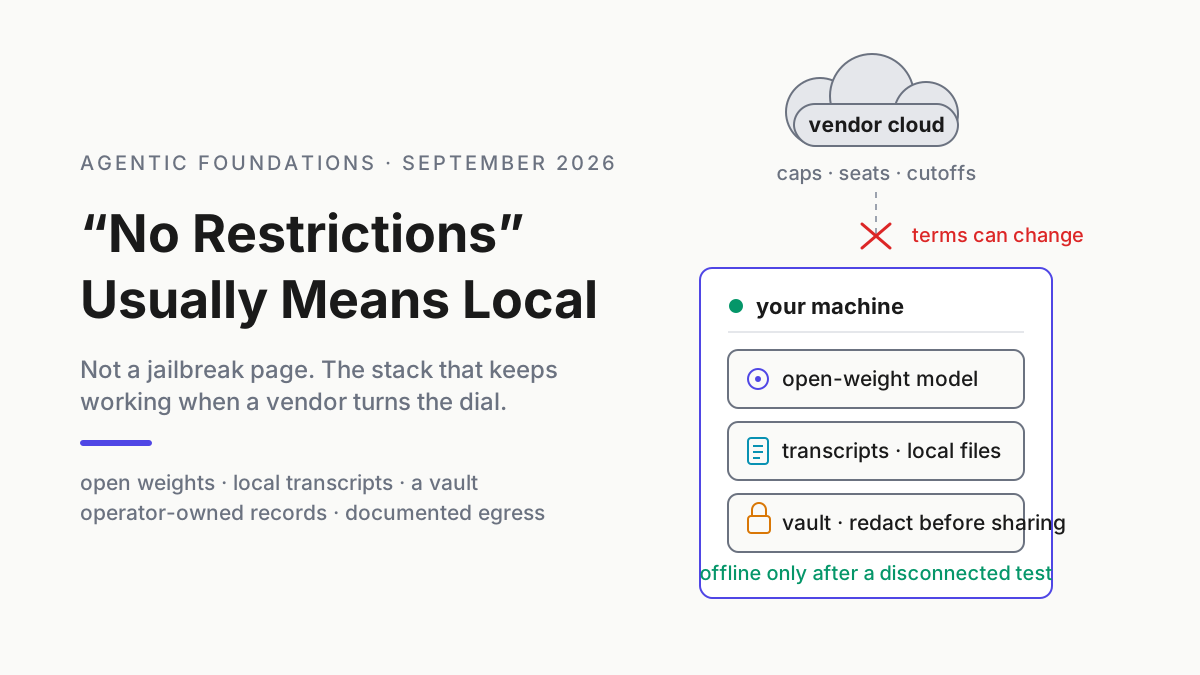
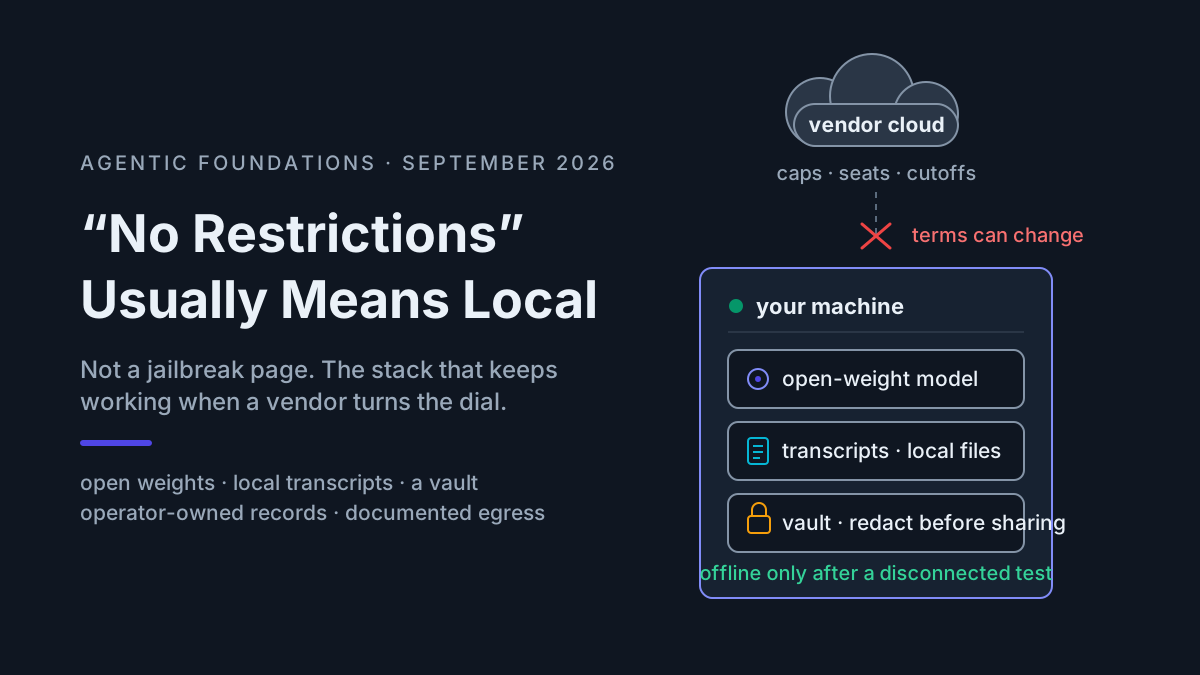
AI with no restrictions, in practical terms, usually means AI with fewer vendor-controlled dependencies: open-weight models on hardware you control, session records stored locally, installers and model files cached for offline use, a redaction boundary for what you share, and capacity that is not governed by a hosted-seat quota. It does not remove model licenses, trained-in behavior, law, or your responsibility for what the system does.
The rest of the page translates that definition into two dated object lessons and separate checklists for a home lab and a corporate airgap.
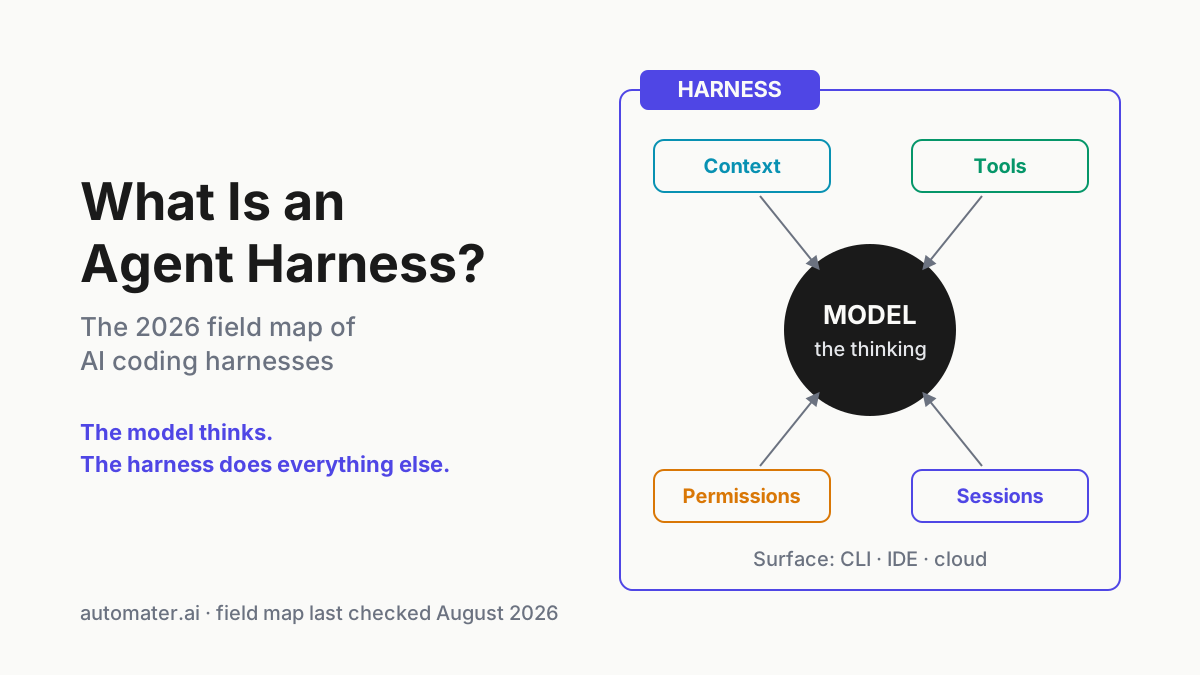
Start by separating the record from the runtime. The local-first vault governs what can enter a durable archive or leave it through a deliberate export; the companion-harness split explains why monitoring local and hosted workers does not make their inference paths local. That distinction keeps “unrestricted” from becoming an unverifiable network promise.
What “AI with no restrictions” actually means at a desk
Four things, in the order people usually discover them.
Session records you control. A local transcript can be searched and retained without depending on a vendor’s history UI. That does not prove the agent itself sends no telemetry or inference data; storage location and network behavior are separate controls. The Windows tray archive is an example of local-first records, not a blanket claim about every upstream CLI.
A tested offline path. Cache the installer, runtime, model weights, and dependencies, then run the workflow with the network disabled. An installer completing offline is useful evidence, but it does not prove that authentication or inference will continue offline afterward.
A vault for what you do share. Even the most local setup leaks on purpose — a snippet to a teammate, a transcript attached to a bug report. The restriction worth engineering is on what rides along: API keys, hostnames, customer names. Redact before anything leaves, every time. That is the local-first vault problem, and it gets its own piece.
Capacity that survives the vendor. Caps, seats, model cutoffs — the restrictions that arrive by email. This is the one the market spent August teaching, so it gets its own section with dates attached.
Two object lessons, both dated
SpaceX closed its acquisition of Anysphere on August 14. On August 28, OpenAI said it intends to wind down Cursor’s access to OpenAI models and proposed November 12 as the cutoff. OpenAI’s own post describes a limited cancellation window, so the date should be treated as a planning boundary rather than a guaranteed final outcome. The continuity implications are in Cursor after SpaceX.
Claude Code is the second lesson. The official Claude Developers announcement says the temporary +50% weekly usage boost ends September 14 and settles at a permanent +25% over the old baseline. Indexed at 150 during the boost and 125 afterward, that is about 17% less than the temporary allowance. The full arithmetic and routing checklist are separate.
Every hosted budget lane still has a dial: published rates, quotas, model availability, and terms can change. Cheaper is not the same as owned.
Neither event requires scandal framing. Vendors reprice, supplier contracts change after acquisitions, and temporary capacity ends. The point is simpler: on a hosted seat, pricing, quota, and model availability remain external dependencies. Local execution moves some of those controls onto the operator’s hardware.
The home tinkerer’s checklist
Same instinct, smaller blast radius: you want a lab that no one can switch off. Short list, in order.
- An open-weight model that honestly fits your box — do the RAM-and-bandwidth math before the hardware, and if there is no workstation budget, home AI without a workstation covers the software-first route.
- A local runtime such as Ollama, with a compatibility layer your chosen client actually supports.
- Weights cached locally from a repository such as Hugging Face Hub, with the model card and license saved beside them.
- One directory for the assistant records and exports the stack supports, plus a written list of tools that do not expose a durable local record.
- An actual offline drill: pull the cable, run a session end to end, write down what broke.
The market has noticed this buyer. Perplexity Portable Computer runs its core agent stack on NVIDIA DGX Spark, whose 128 GB unified memory is very different from an ordinary 24 GB graphics card. The first release is on Linux, with Windows described only as “coming soon.” It can also escalate to Perplexity’s cloud with user permission, so “local-first” is more accurate than “never uses cloud.”
The corporate-airgap checklist
Same instinct again, now with an estate attached. The buyer here is not chasing capability — they are removing dependencies. The list is the desktop side of the companion-harness-computer split, compressed.
- Signed installers that complete without open internet, staged from an internal source.
- Transcript directories enumerated per assistant, per machine — retention decided, not discovered.
- Session-archive egress and telemetry enumerated per tool, blocked by policy where required, and verified rather than inferred from a “local” label.
- Vault redaction on anything that crosses the boundary — tickets, pastes, exports.
- A per-vendor exit drill: model cut or seat revoked, the archive still opens, and a critical workflow has a tested fallback in another supported tool.
Two different buyers, one architecture. The tinkerer and the airgap admin are both buying the same three properties: local weights, local records, local control.
What local does not get you
Honesty section, because “no restrictions” oversells even the local version.
The model’s own behavior travels with the weights. Open-weight models carry their training, refusals, and weaknesses; running one on your own GPU changes who controls the infrastructure, not what the model learned. The model’s license can also restrict use or redistribution, and local execution does not waive law, contracts, or security policy.
There can also be a capability tradeoff. Open-weight models vary widely by task, and benchmark strength does not guarantee reliable multi-hour agent work on your stack. You trade a vendor’s dial for physics: context length, throughput, memory, power, and the quality of the harness around the model.
Many practical stacks are mixed: hosted frontier models for some agentic work, local weights for private or repeatable tasks. The local half can provide a capability floor, but only when its runtime, weights, dependencies, and records have passed a disconnected test. The checklists above are portability controls rather than purity tests.
What local can give you is a floor no hosted seat controls: no per-request metering for on-device inference, no model-access cutoff imposed by an API vendor, and local records when you configure them that way. Operational autonomy, not omnipotence.
Where the tray sits in a local stack
Automater Lite is one ledger for the stack: it normalizes supported local histories into the Library, provides search and redaction controls, and exposes fleet and usage signals where the upstream provider makes them available. The archive stays on disk by default; optional sharing and cloud features require deliberate enablement. “Supported” matters — no companion can infer a provider’s private quota or transcript format when the provider exposes neither.
Bounded claim: it serves no models and replaces no runtime. Current downloads cover Windows x86_64, Apple silicon macOS, and Linux x86_64, while record, meter, and resume coverage still depends on each assistant adapter. Automater Lite is a free download for Windows, macOS and Linux at automater.ai/downloads.
FAQ: AI with no restrictions
Is there an AI with no restrictions?
No system is literally restriction-free. Hosted models carry service policies; open-weight models keep their trained behavior and licenses; all use remains subject to law and your environment’s controls. What local execution offers is operational autonomy: local inference, local records, offline operation after setup, and no vendor-metered inference cap.
What is the difference between unrestricted AI and local AI?
“Unrestricted” is what people type; “local” is often what they need. A local, open-weight model on owned hardware has no hosted inference seat or weekly API cap. Transcript uploads and telemetry disappear only if the chosen runtime and surrounding tools are configured and verified not to send them.
Can I run AI completely offline?
Yes. Open-weight models can run offline after the runtime, weights, and dependencies are cached, and compatible clients can point at a local endpoint. The catch is hardware fit, model licensing, and a real disconnected test; a successful download is not proof the whole workflow is offline-ready.
Do local AI models have usage limits?
Local inference has no vendor-metered request cap. Its limits are hardware capacity, speed, power, context, model behavior, and license terms. Optional cloud escalation, connected tools, or hosted embedding and search services can reintroduce quotas, so label each component and boundary honestly.
Sources
- OpenAI — Our decision on Cursor following its acquisition by SpaceX
- Claude Developers — temporary and permanent weekly-limit update
- Ollama — quickstart and local runtime documentation
- Hugging Face Hub — downloading models
- Hugging Face Hub — repository licenses
- Perplexity — Introducing Portable Computer for local-first AI