Signal Blocks Screenshots by Default to Starve Screen-Reading Agents, and Says the Fix Is Incomplete
Signal now blocks screenshots by default on Android and iOS 27 to starve screen-reading AI agents, and calls the fix incomplete. What operators should do.
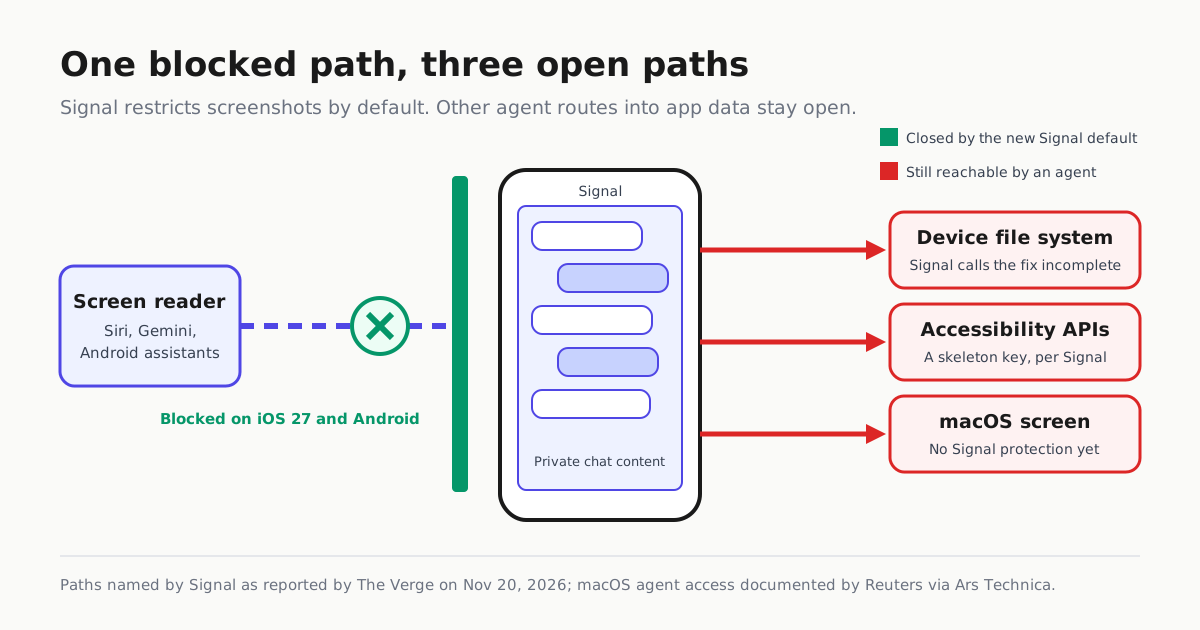
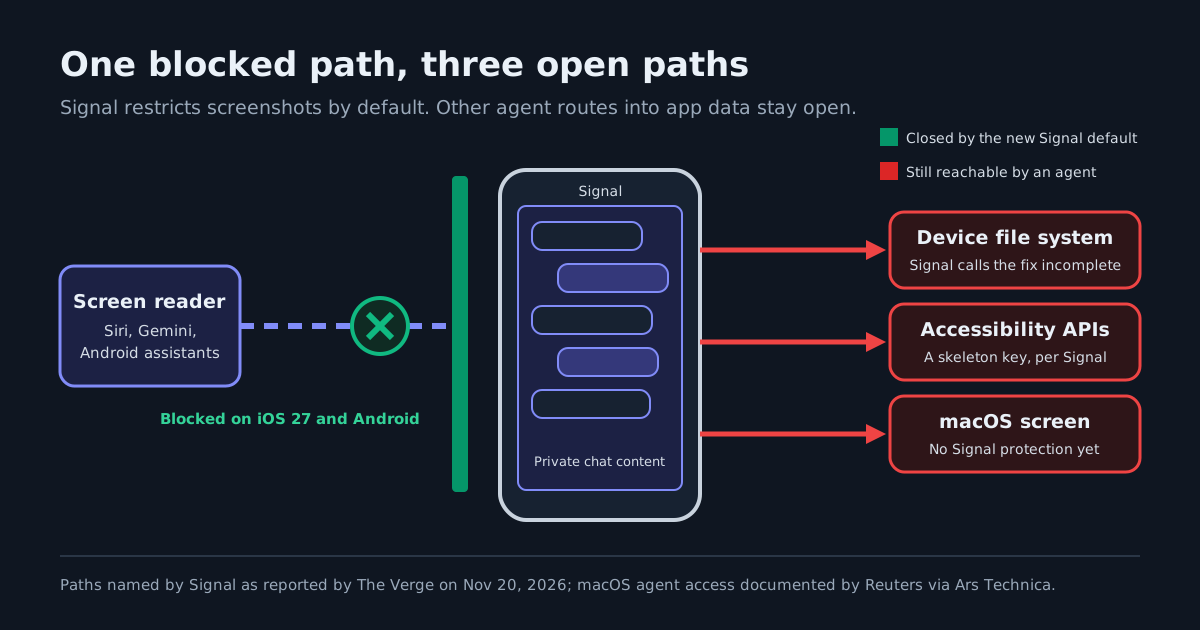
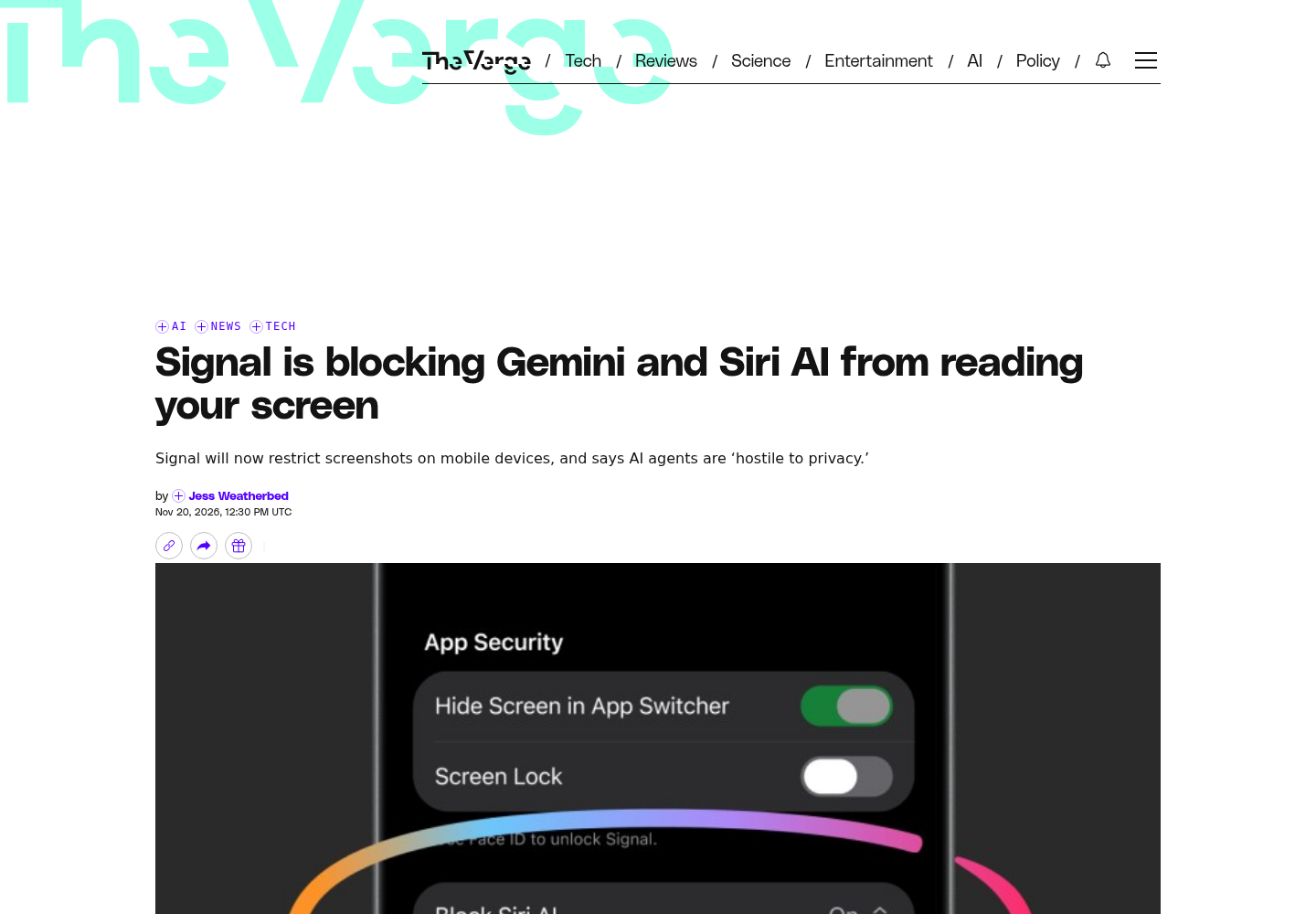
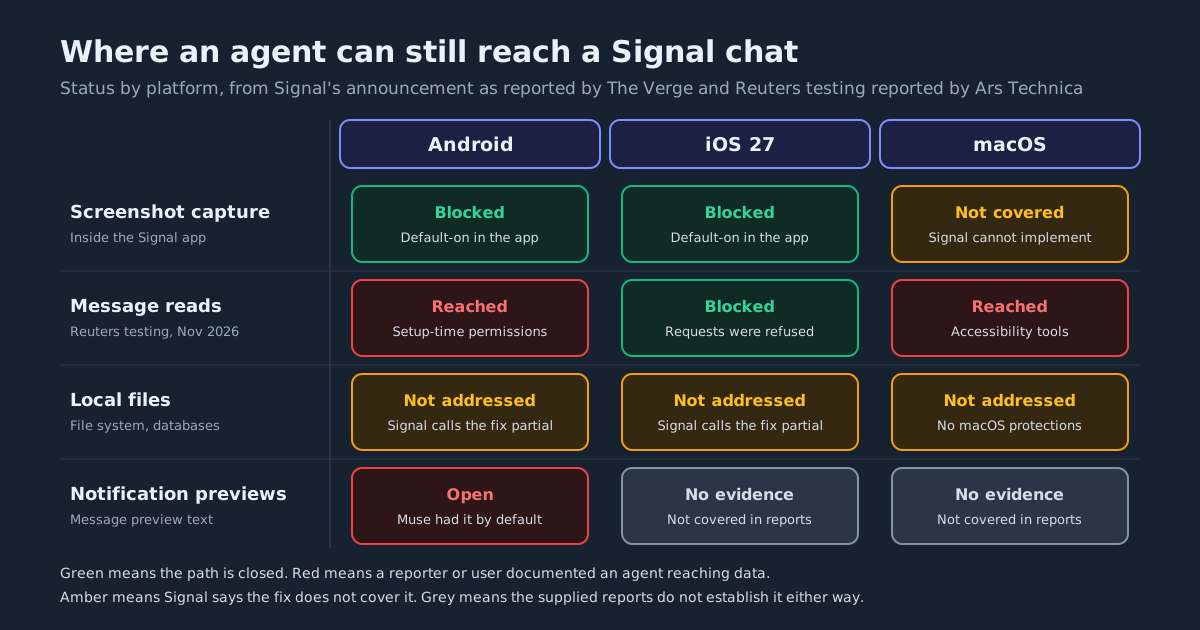
Signal is restricting screenshots by default in its Android and iOS 27 apps to stop operating-system AI agents from harvesting private conversations out of the screen buffer, The Verge reported on Nov. 20. Signal president Meredith Whittaker wrote in a blog post that the agentic capabilities built into operating systems are “undermining Signal’s ability to independently guarantee privacy,” and urged OS providers to give developers real control over what agents can read. The Verge’s framing of Signal’s position is blunter: AI agents are “hostile to privacy” (The Verge).
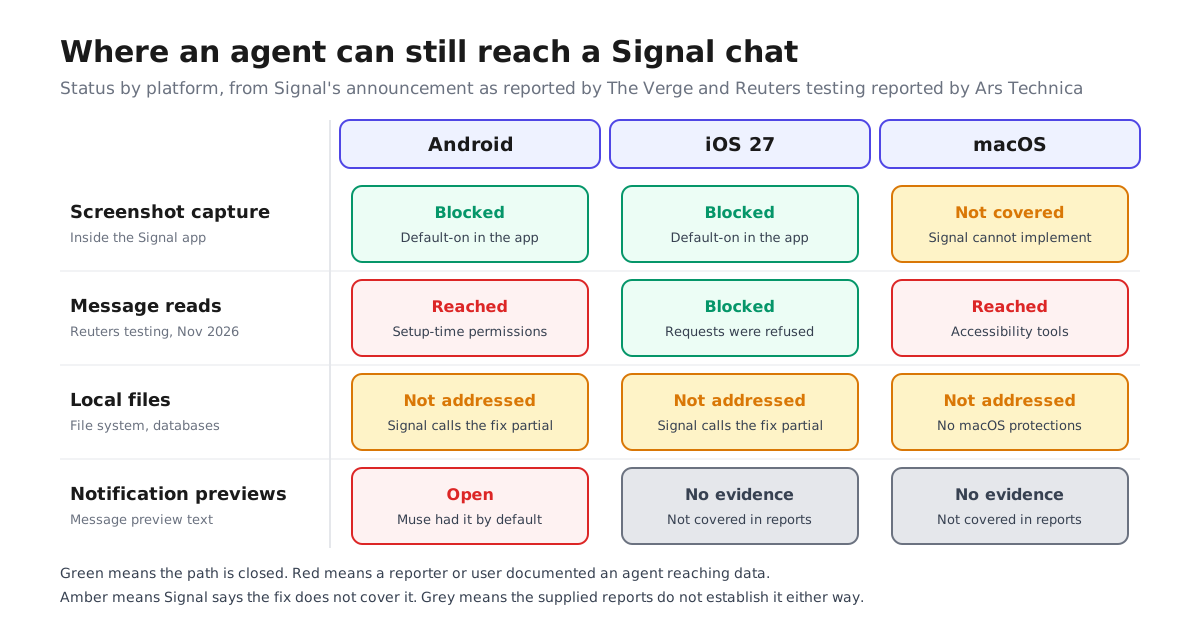
The caveat matters more than the feature. Whittaker calls the screenshot remedy “incomplete” because it does not address other routes into app data, “such as retrieving it via the device file system.” A privacy-first messenger is now stating in writing that an app-level capture block is not a trust boundary, which is the assumption most computer-use agent deployments rest on.
What Signal shipped
- Screenshot capture is restricted inside Signal on iOS 27 and Android, which Signal says “should prevent Siri, Gemini, and other Android AI assistants from reading on-screen content.”
- It ships on by default. Users can restore screenshots in settings, and Whittaker warns that doing so will “potentially expose your (and your contacts’) Signal content to these AI agents, and break our privacy guarantees.”
- macOS is excluded. Google, Apple and Microsoft “do not provide ways for developers to easily restrict such AI data access without making drastic compromises to the core user experience,” which is why Signal “is currently unable to implement these protections on macOS.”
- Signal wants “simple technical tools and accurate documentation” from those three vendors, plus a way to stop third-party agents such as Meta’s Muse from using deep accessibility settings as a “skeleton key.” It blocked Microsoft’s Recall from capturing secured chats the same way last year.
The hole is on the desktop
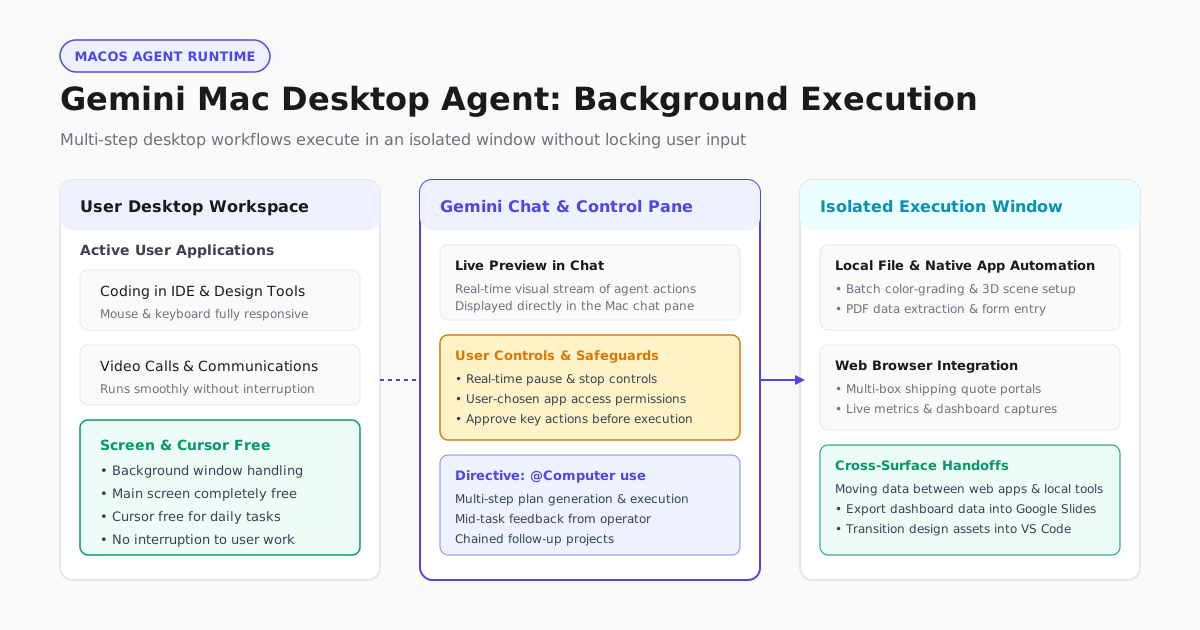
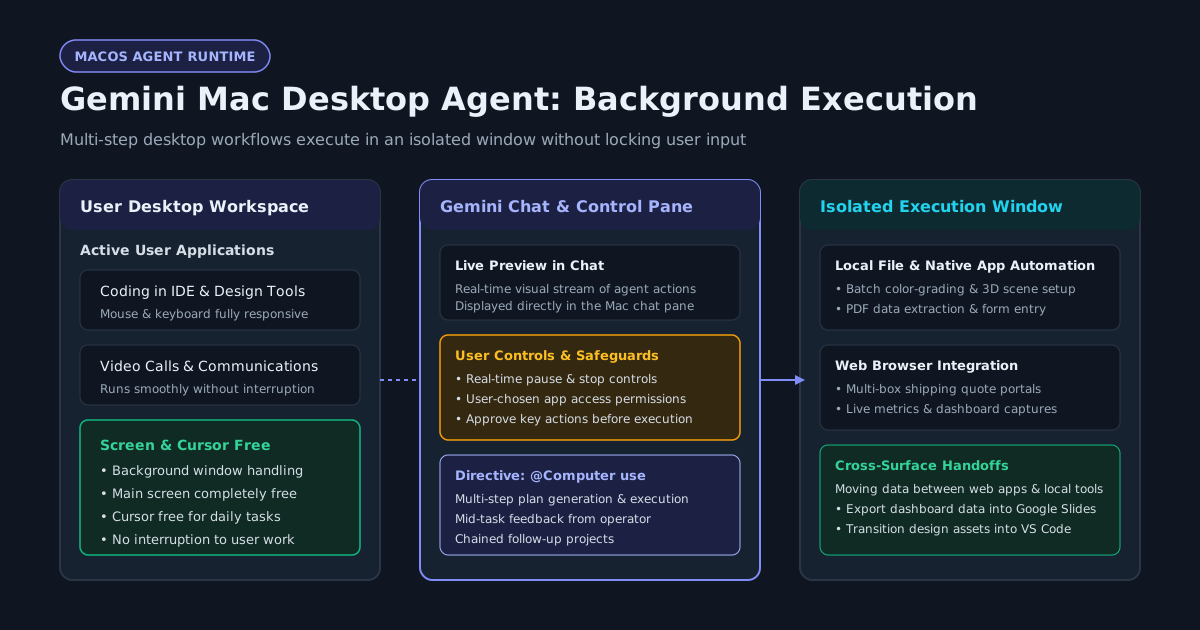
The exclusion follows Google’s Nov. 19 launch of computer use in the Gemini Mac client. Users invoke it with “@Computer use” in a prompt; Gemini finds the local app it needs, plans the work and runs it in a background window, and the feature requires a Google AI subscription. Michael Friedman, Google’s group product manager for the Gemini app, wrote that “you choose which apps Gemini can access, watch every step live, pause at any time, and approve key actions before they happen” (SiliconANGLE). Meta’s Mac Muse does the same class of work and can keep running in a cloud virtual machine, as we covered in our Gemini Mac computer-use report. The platform where Signal says it cannot protect content is the platform where desktop agents just gained a first-party launcher.
How agents got in anyway
Ars Technica’s account of Reuters’ testing, run with Signal and AI Now Institute staff, names the mechanisms. On Android, Muse read Signal messages by bypassing Meta’s Connector tool and relying on permissions granted during initial setup; one staffer found Muse had push-notification access by default, exposing private message preview text. On iPhone, requests were blocked. On macOS, Muse “repurposed settings Apple offers to help people with disabilities operate their computers,” including screenshot tools, to retrieve messages (Ars Technica). We broke that down in our analysis of the Reuters testing.
Read those results as a design fact: an agent’s published connector list is not its data reach. Setup-time entitlements are the real boundary, and they are granted once, at install, by someone who is not thinking about agents.
What to do if you drive screens with agents
- Inventory capture surfaces, not connectors. Screenshot, screen recording, accessibility, notification listeners and file access are five grants with five blast radii; the Windows version of that exercise is Computer Use Agent Windows Policy: Entitlements Before the Mouse Moves.
- Treat a blank frame as unknown, never as empty. A capture block typically returns a black or empty buffer instead of an error, so an agent can report “no messages” when it was refused. Gate vision reads on a variance check:
def capture_looks_blocked(frame, threshold=8.0):
    # A blocked capture usually returns a near-uniform buffer.
    # Fail the step loudly instead of reading meaning into it.
    gray = frame.mean(axis=2)
    return float(gray.std()) < threshold
- Re-scope setup-time grants. Audit which provisioned devices still give an agent notification or accessibility permission from an onboarding prompt nobody re-read. Apple has told reporters it will add controls so Full Disk Access requires “very explicit user action” (per Ars Technica).
- Do not flip the user toggle as a workaround. Re-enabling screenshots is exactly the compromise Signal says breaks its guarantees for you and your contacts. If your agents do capture screens, audit where the images travel next: AI Agent Screenshot Leak: Audit Where Your Agents Publish Images.
- Make refusal fail closed. A capture block is a stop signal, not a routing hint; the state machine is in Declined Means Stop: An AI Agent Consent State Machine and Fail-Closed Test Matrix.
Why the pressure is rising
Consumer agents already act on personal data at scale. WIRED documents Muse users running mass-unfollow campaigns on Instagram: one asked who did not follow him back, and Muse returned 151 accounts in a spreadsheet with usernames, names and profile links before asking whether to proceed. Meta later pulled an ad campaign promising users could “see who unfollowed you each week” (WIRED). Ars notes Muse has passed 10 million downloads since September, and that Apple and Google are weighing changes to what people authorize with AI agents.
Whittaker calls Signal “the canary in the coal mine.” The operator translation is narrower: one major app just proved it can refuse your agent, and said which doors it could not close. If you ship the app instead, expect a declarative “no agents” flag well before a robust technical one, the same drift mapped in Websites Are Blocking AI Agents: The Operator Playbook for Keeping Access.