Tencent Launches Hy4: 770B MoE Adds Native Vision, Desktop Computer Use, and Engine Tooling
Tencent launched Hy4, a 770B MoE model with 49B active parameters, 1M context, native vision, and computer use, with open weights promised in the coming days.
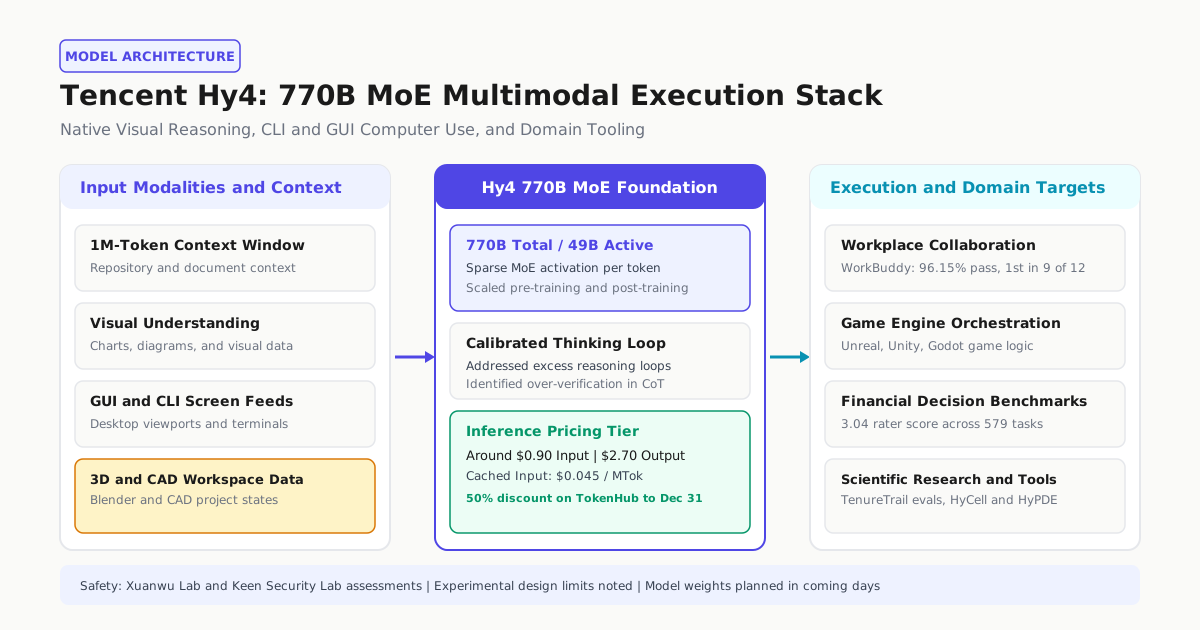
Tencent has officially launched Hy4, its latest flagship large language model, introducing native visual understanding and computer-use capabilities to its model family for the first time. Detailed in Tencent’s official announcement, Hy4 represents a significant leap in performance over the Hy4 Preview released in late August. Built as a 770-billion-parameter Mixture-of-Experts (MoE) system that activates 49 billion parameters per forward pass, the model pairs a 1-million-token context window with direct tool execution across command-line and graphical interfaces. Tencent plans to publish model weights and technical system cards in the coming days, intensifying competition among Chinese AI models for agent work.
As independent reporting from SiliconANGLE and TechNode highlights, Hy4 marks Tencent’s push into practical enterprise automation and software engineering. Rather than simply pursuing synthetic benchmark gains, the development team focused on co-designing the foundational model with workplace software, professional creative suites, and interactive developer environments.
Architecture, Context, and Calibrated Inference
Hy4 balances extreme scale with inference efficiency, operating 770 billion total parameters with 49 billion active parameters and a 1-million-token context window. SiliconANGLE noted this scale aligns Hy4 with open-weights frontier models from European and Chinese developers including Mistral AI, Moonshot, and Z.AI. Scaled pre-training and post-training targeted instruction following and long-horizon reasoning.
During intermediate chain-of-thought phases in earlier previews, Tencent identified excessive reasoning and over-verification loops. Standard API pricing remains approximately $0.90 per million input tokens, $2.70 per million output tokens, and $0.045 for cached input (reported by TechNode as $0.834 and $2.501 after currency conversion). Through December 31, 2026, Tencent Cloud TokenHub offers a 50 percent discount, reinforcing how open-weight models that drive harnesses affect inference economics.
| Parameter | Specification | Practical Implication |
|---|---|---|
| Total Parameters | 770B (MoE) | Broad multi-domain knowledge base |
| Active Parameters | 49B | Sparse routing balancing compute |
| Context Window | 1,000,000 Tokens | Full repository and document ingestion |
| Standard API Price | ~$0.90 input / $2.70 output | Cost-effective scaling for agent loops |
| Desktop Interfaces | CLI and GUI Native Control | Direct execution in OS suites |
Native Desktop Computer Use and Office Automation
Hy4 introduces native computer use across terminal and graphical desktop environments, processing screen states, charts, and diagrams alongside text. Tencent conducted targeted training on professional tools including Blender and CAD suites.
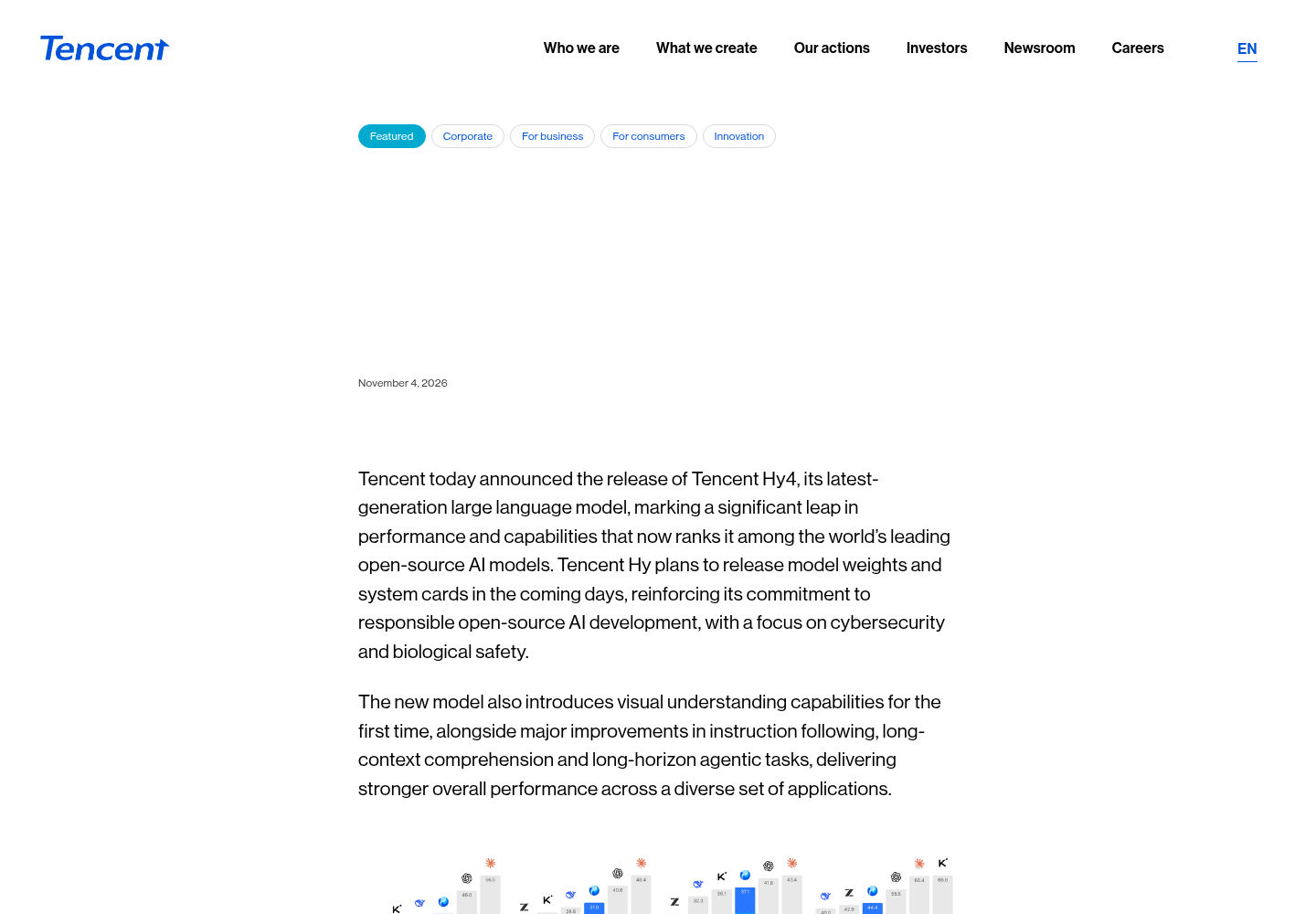
Tencent integrated Hy4 into Tencent WorkBuddy, connecting WeCom workflow data across chats, emails, calendars, and documents. On WorkBuddy benchmarks across twelve mainland Chinese office scenarios, Hy4 scored an 83.18 average with a 96.15 percent pass rate, ranking first in nine scenarios. Teams preparing for automated workplace agents can assess readiness against a desk-job inventory for computer-use workflows.
Game Development and Engine Orchestration
Front-end architecture and interactive logic often challenge standard assistants. To address this, Tencent Interactive Entertainment Group (IEG) developers collaborated on training Hy4 with native support for Unreal Engine, Unity, and Godot.
The model supports intricate business logic, state management, and multiplayer implementations, delivering a 19.1 percent gain on internal GameDev benchmarks and 9.8 percent on GameLogic over Hy4 Preview. SiliconANGLE reported that developer interest in game creation persists even after game-cloning activity prompted Anthropic’s game cloning restrictions in Claude Code. Tencent trained Hy4 directly alongside game engineers to navigate engine-level logic.
Domain Specialization: Financial Analysis and Scientific Research
Tencent subjected Hy4 to rigorous domain evaluations in finance and scientific computing. In a vendor-run blind evaluation conducted by the Tencent Hy team in partnership with Tencent Financial Technology, 213 financial professionals—including 153 external industry experts—evaluated models across 579 real-world tasks:
- Hy4: 3.04 overall evaluation score
- DeepSeek-V4.1-Flash-1017: 2.97 overall score
- Kimi K3.1 Pro: 2.68 overall score
- GLM-5.3: 2.68 overall score
In the Rabyte Investment Research Agent Benchmark (iRaB), Hy4 gained 12.03 percentage points over its preview. Search retrieval and factual verification reduced hallucinations from 12.95 percent to 7.2 percent and unsupported assumptions from 23.1 percent to 5.6 percent. Teams adopting these tools often weigh cost per completed task versus raw token price when evaluating agent productivity.
In scientific benchmarks, TenureTrail evaluated Hy4 across seven disciplines and 123 executable tasks, noting strong performance in mathematical construction, physical modeling, environmental and earth sciences, and systems engineering. Using the Hyra 2.0 harness, Hy4 optimized pre-training infrastructure for smaller derivative architectures. Separately, Tencent open-sourced two foundational models developed with Hy4 and Hyra 2.0: HyCell for single-cell representations and HyPDE for physics fields.
Defensive Safeguards and Practical Developer Guidance
Tencent framed Hy4 with defensive security guardrails, incorporating proof-of-concept development, vulnerability remediation, and reverse engineering analysis into training data while excluding offensive exploitation payloads. Post-training security assessments by Tencent Xuanwu Lab and Keen Security Lab across reverse engineering, binary deobfuscation, and vulnerability exploitation found no significant offensive concerns in evaluated areas. In biological domains, internal reviews noted that while foundational knowledge remains strong, Hy4’s capabilities in open-ended experimental design are more limited than frontier models.
Developers can access Hy4 immediately via Tencent Cloud TokenHub, WorkBuddy, CodeBuddy, OpenRouter, Hermes, and OpenCode, with TechNode noting a limited free usage quota on WorkBuddy and CodeBuddy through November 15. For coding-agent builders, immediate testing should determine whether desktop computer-use tools are exposed over external API endpoints or confined to Tencent applications. Once promised weights and system cards arrive in the coming days, teams should independently evaluate Hy4 in production agent harnesses rather than relying on vendor benchmarks.