OpenAI Sells Patience: 2h and 8h Background Windows Cut GPT-6.2 Token Prices up to 40%
OpenAI's Responses API cuts GPT-6.2 Astra and Sol token prices 30% or 40% when work can wait 2 or 8 hours. What the beta covers, and the fine print.
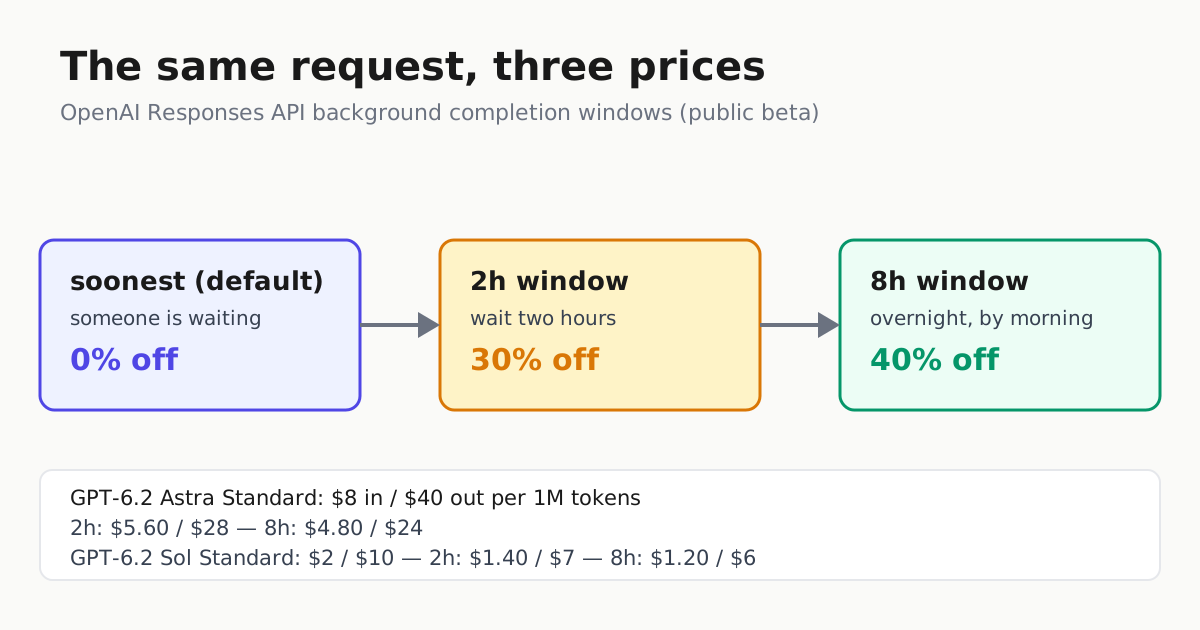
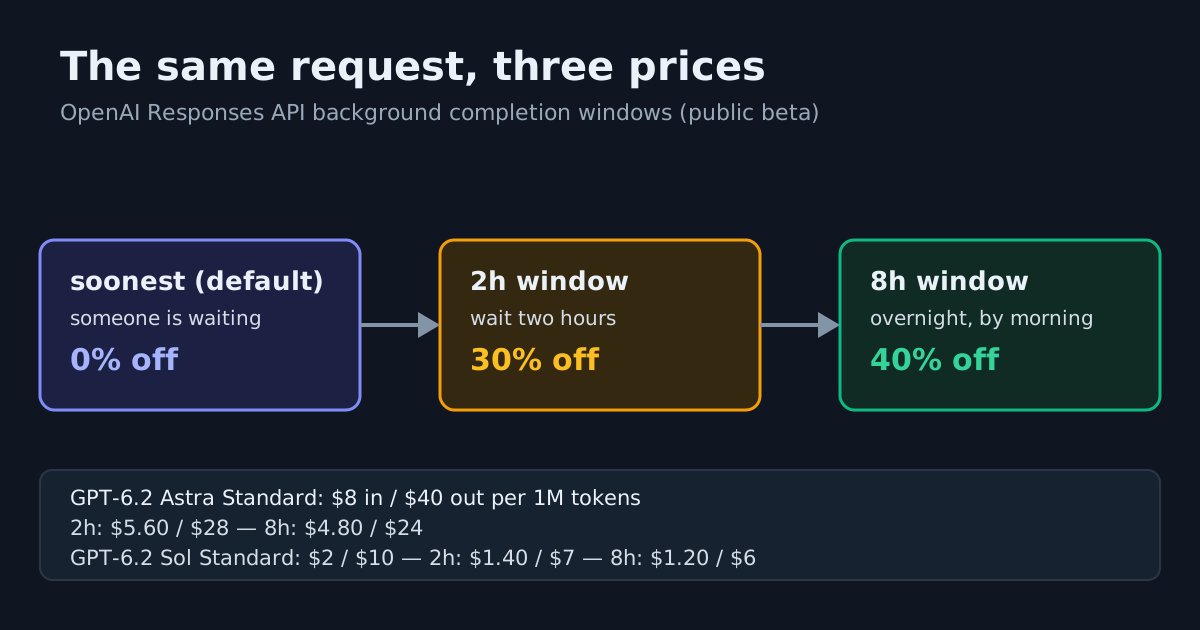
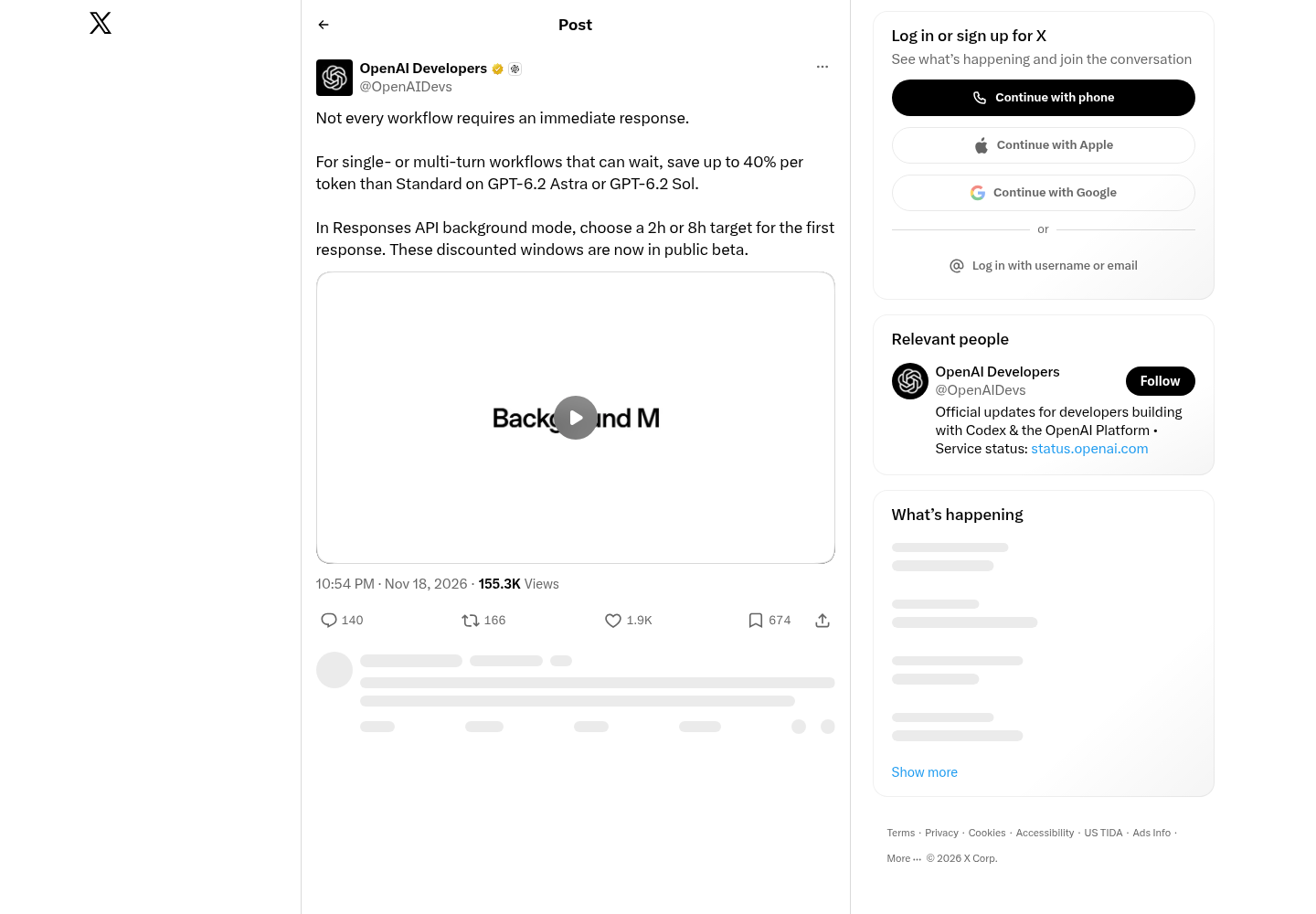
OpenAI has turned latency itself into a discount dial. A post from its developer account on Nov 18 announced that Responses API background mode now offers two-hour and eight-hour completion windows in public beta, cutting token prices on GPT-6.2 Astra and GPT-6.2 Sol by up to 40% for workflows that don’t need an immediate reply: “For single- or multi-turn workflows that can wait, save up to 40% per token than Standard on GPT-6.2 Astra or GPT-6.2 Sol.”
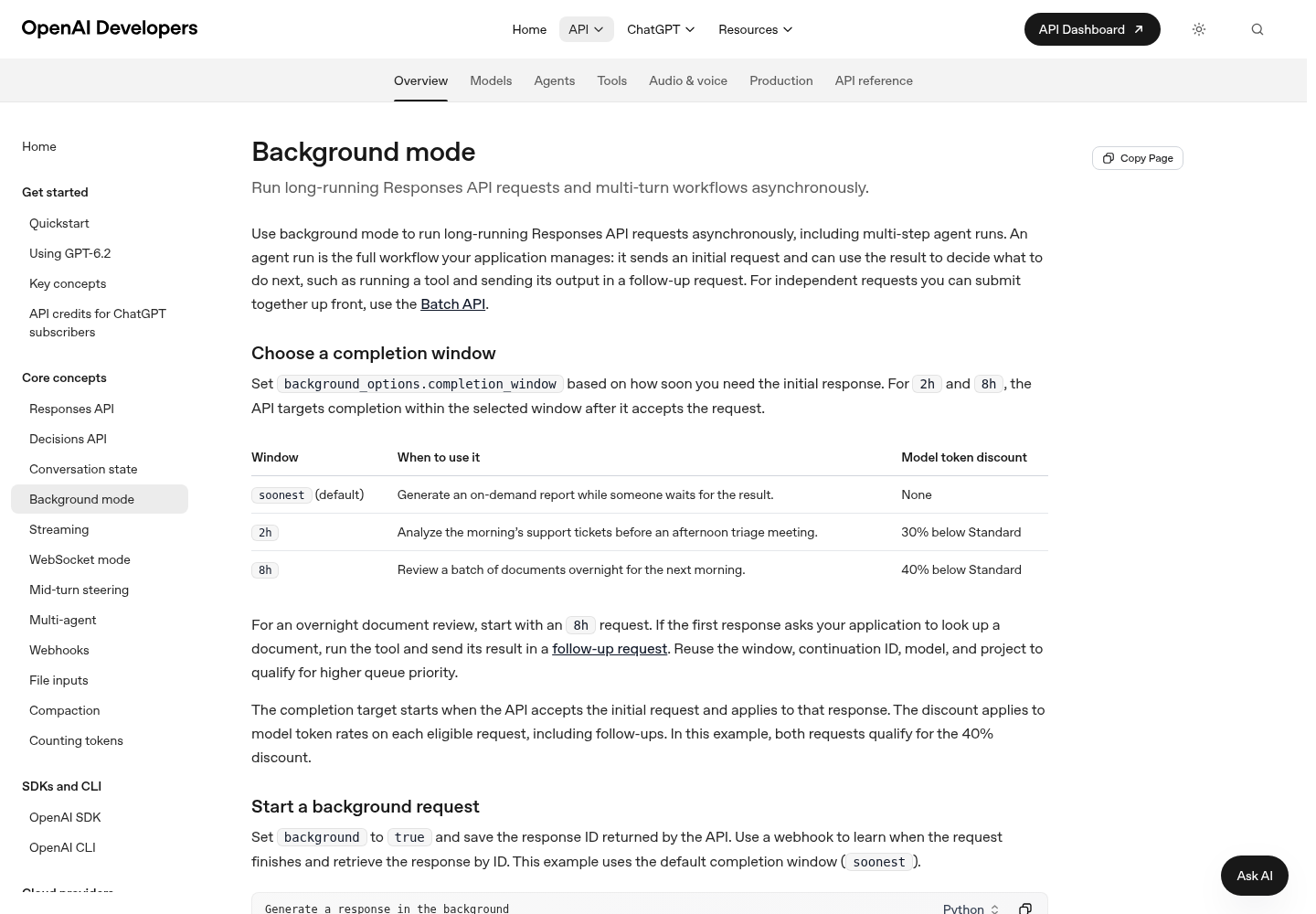
The announcement is a pricing event, not a model launch — the same frontier models, sold cheaper if you let OpenAI schedule them. The background mode documentation puts the ladder plainly:
| Completion window | Use when | Token discount |
|---|---|---|
soonest (default) |
Someone is waiting on the result | None |
2h |
Morning support tickets analyzed before an afternoon triage | 30% below Standard |
8h |
Overnight document review, ready the next morning | 40% below Standard |
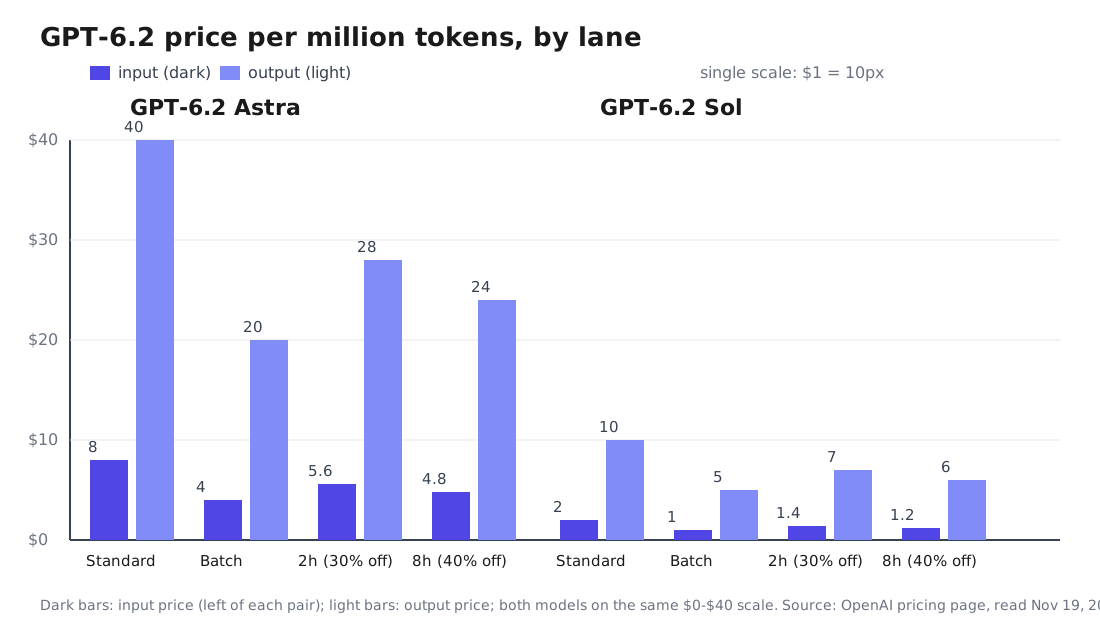
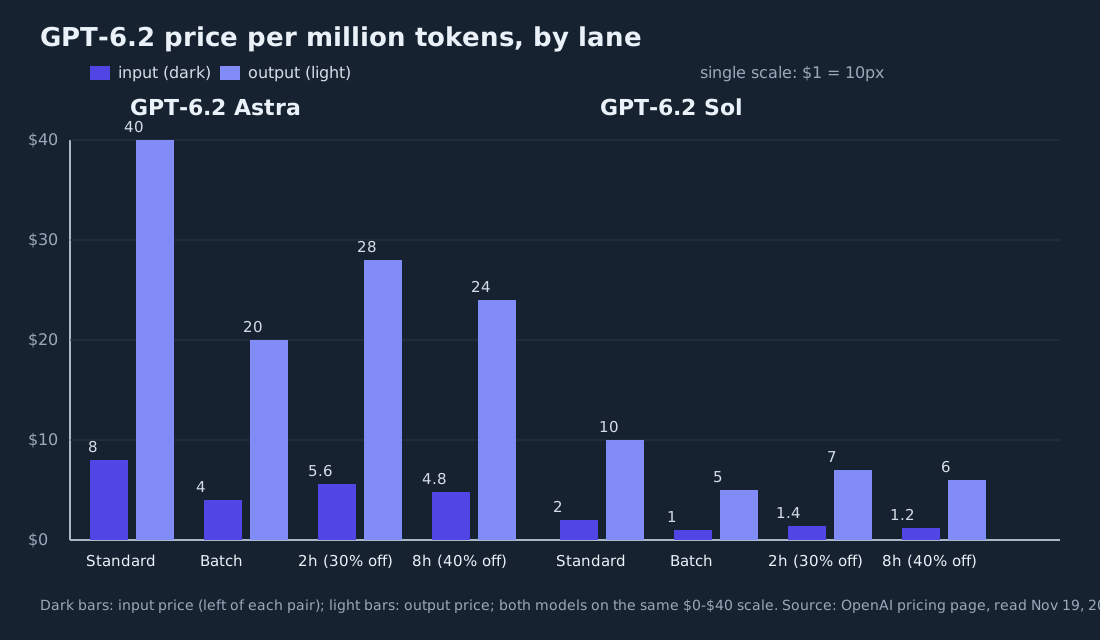
The pricing page confirms the rates and makes the arithmetic concrete. GPT-6.2 Astra Standard short-context lists at $8 input and $40 output per million tokens. A 2h window at 30% off is $5.60/$28; the 8h window at 40% off is $4.80/$24. GPT-6.2 Sol drops from $2/$10 to $1.40/$7 (2h) or $1.20/$6 (8h). Notably, the 8h Astra rate ($4.80/$24) sits above the Batch rate ($4/$20) — but background mode buys something Batch cannot: a multi-turn agent loop.
What qualifies, and what the docs actually promise
Three contract details matter before you route a lane onto this.
First, the window is a target for the first response, measured from when the API accepts the request. Second — and this is the part agent operators should read twice — the discount applies to every eligible request in the run, including follow-ups. The docs give the example of an overnight document review whose first response asks the application to fetch a document: run the tool, send the result as a follow-up request reusing the same window, continuation ID, model and project, and “both requests qualify for the 40% discount.” That is what separates this from the Batch API, which handles independent requests submitted up front. An agent loop with tool calls in the middle can now run at 40% off, end to end.
Third, the delivery mechanism is webhooks (or polling) rather than a held connection: set background: true, save the response ID, and handle response.completed plus the failure events. Streaming is not available on 2h/8h requests.
The fine print
- Models: the beta covers GPT-6.2 Astra, GPT-6.2 Sol, GPT-6.1 Terra and GPT-6 Luna. Per the docs, models from GPT-6.2 onward launch without Flex processing; discounted windows replace Flex as the cheap lane.
- Rate limits: 2h/8h requests share the Batch/Background Rate Limit pool with Batch API jobs, with input tokens counted at submission. A fleet already spending that pool on Batch jobs will feel the contention.
- Cache isolation: Standard requests outside the discounted windows cannot reuse prompt-cache entries created by 2h/8h background requests, even for an identical prompt. A lane that flops between windowed and on-demand runs re-pays its prefix.
- Service tier: the discount requires Standard processing (
service_tier: default). Withauto, the request qualifies only when the API selects Standard. - Data handling: background mode temporarily stores response data even with
store: falseor Zero Data Retention (encrypted at rest), which matters for compliance-sensitive lanes.
Where it fits in a routing table
This is the third discount dialect in the market, and it does not displace the other two. DeepSeek prices by the clock — off-peak hours cost half, so a scheduler that routes flexible work by the clock wins. Anthropic’s discount is a cache timer — keep calls within five minutes or buy the one-hour write. OpenAI’s is now a deadline: you promise the answer can wait, and the provider keeps the discount even though completion may come early. A router that understands all three picks per job: one-shot bulk goes to Batch, clock-flexible research goes off-peak, and multi-turn agentic work that nobody reads until morning goes to an 8h window.
The deadline dialect is also the mirror image of the speed tiers: fast mode is a meter you pay extra to turn on when a person is waiting, and this is a meter you get paid to leave off when nobody is. A lane that runs headless overnight was already the worst customer for a speed tier; it is now the best customer for an 8h window.
And the evaluation rule from earlier coverage holds here too: price the finished job, not the token. A 40% discount on tokens is only a real saving on tasks that finish, and the queue-priority behavior of continuation IDs means a well-formed overnight loop gets more of the discount than a naive one.
The chart below puts the lanes side by side on one scale: Standard, Batch at half, and the two windowed rates for each model.
The windows are in public beta and pricing pages move; stamp a read date on every rate file you keep. But the structural change is already legible: OpenAI is now explicitly auctioning its customers’ impatience, and agent pipelines — the workloads with the least impatience of all — are the natural buyers.
Sources
- OpenAI Developers on X: "Not every workflow requires an immediate response. For single- or multi-turn workflows that can wait, save up to 40% per token than Standard on GPT-6.2 Astra or GPT-6.2 Sol. In Responses API background mode, choose a 2h or 8h target for the first response. These discounte…
- Background mode | OpenAI API
- Pricing | OpenAI API