Kimi Code Desktop 1.4.0 Opens Its Doors to Claude Code, Codex and Cursor Sessions
Moonshot's Kimi Code Desktop 1.4.0 connects Claude Code, Codex and Cursor for session handoff, plus SSH projects and a Qwen plan provider. Here is what operators should test.
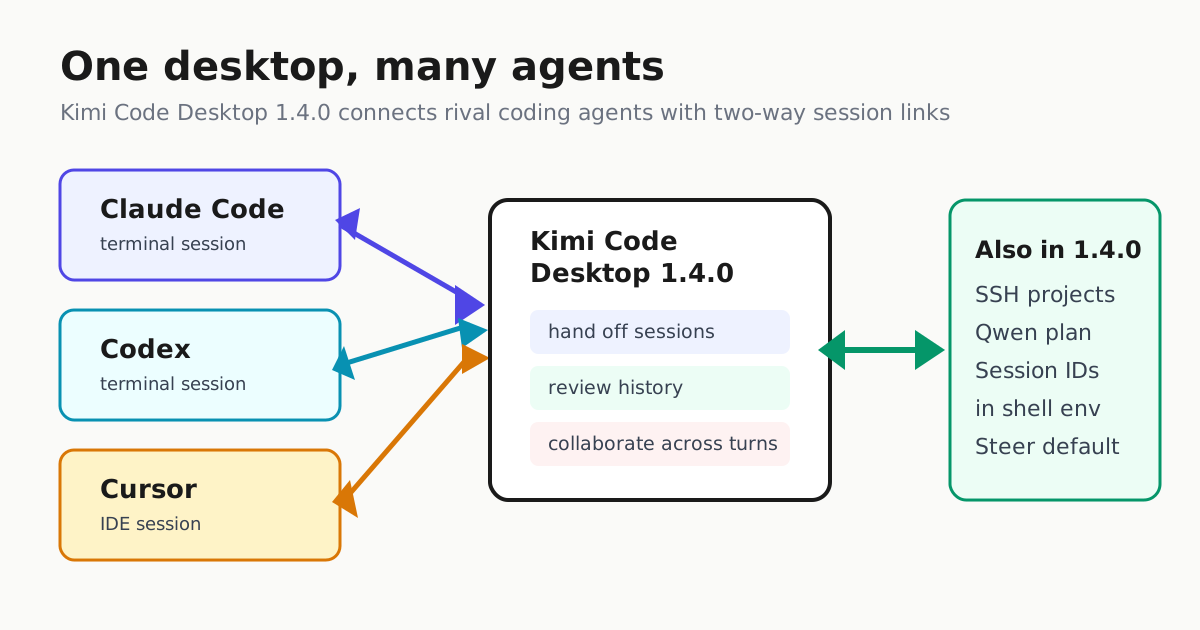
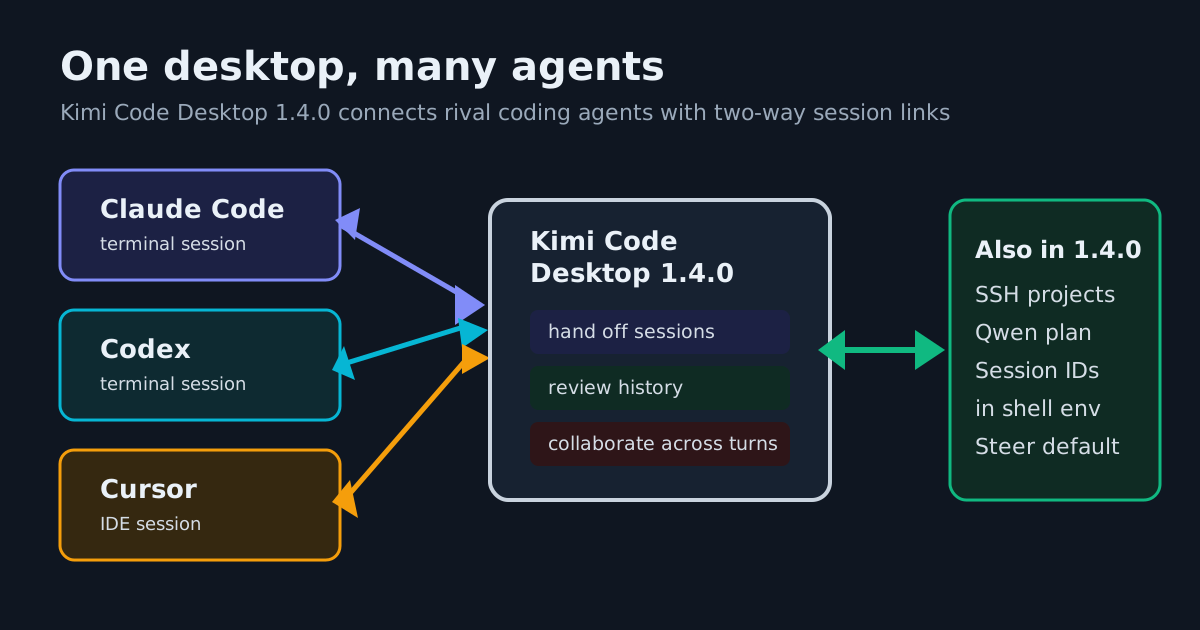
Moonshot’s Kimi Code Desktop 1.4.0, released November 19, does something unusual for a vendor’s own desktop app: it invites the competition in. The headline change lets external coding agents such as Claude Code, Codex and Cursor connect to the desktop app to hand off sessions, review history and collaborate across turns. Instead of competing purely on model quality, Moonshot is positioning its app as neutral ground where sessions from rival harnesses can meet, be inspected and continue.
What actually shipped
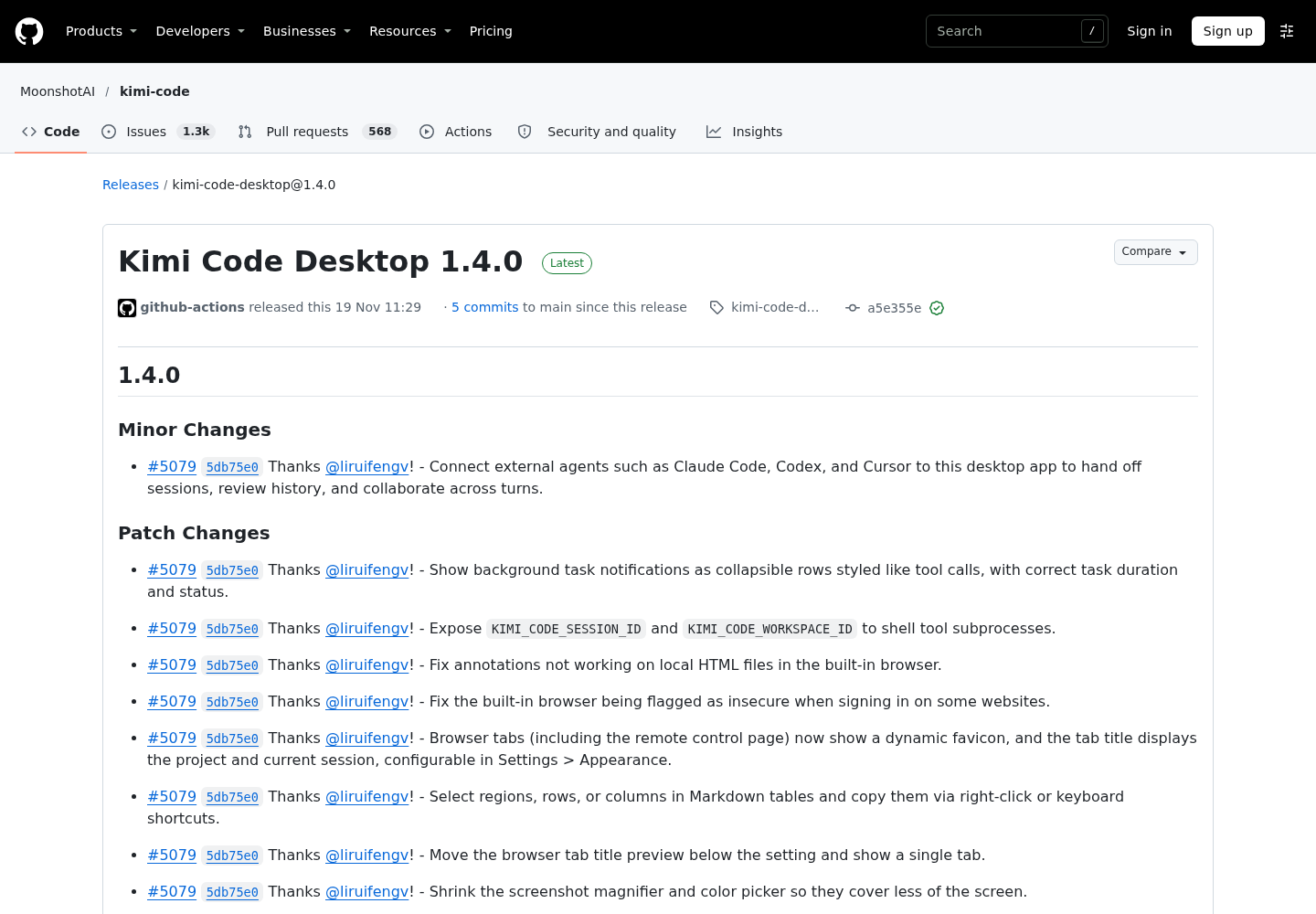
The external-agent handoff is the release’s only minor-version change, carried in PR #5079 — the repository-migration PR that brought the desktop app into the kimi-code monorepo, not a PR that itself implements or documents the feature. The official release notes say exactly one sentence about it: connected external agents can “hand off sessions, review history, and collaborate across turns.” That is the whole specification — the notes do not document which direction sessions flow, how each agent connects, or what survives a handoff.
That lands in a market where most harnesses treat session state as a retention lock-in. Exporting a Claude Code or Codex session into another vendor’s viewer is normally a lossy, file-copy affair (see our earlier session-import fidelity test). A first-class handoff path, whatever its eventual fidelity quirks, is a structural change worth testing.
The operational upgrades underneath
Beyond the handoff, several patch entries matter more to daily operators than their “patch” label suggests:
- SSH projects. The app can now connect to SSH hosts and create projects on them. Each host uses its own Kimi account, and remote sessions keep running while the local machine is asleep or offline — turning a laptop into a supervisory console for always-on remote agents.
- Qwen Coding Plan. Alibaba’s Qwen Coding Plan (global and China sites) is now a selectable provider, so a Kimi-branded app can bill and route through a rival Chinese model plan — the same cross-vendor openness Qwen Code 1.0 preview showed when it merged Qoder into one open-source agent.
- Session identifiers in the shell.
KIMI_CODE_SESSION_IDandKIMI_CODE_WORKSPACE_IDare exposed to shell tool subprocesses, which lets scripts and hooks key their logging or artifact storage to the session that invoked them. - Steering by default. Messages sent while the agent is running now steer the current turn immediately by default, with a first-time hint; users can switch back to queueing in Settings.
The CLI moved the same day: Kimi Code CLI 2.7.0 added Amazon Bedrock providers, experimental next-prompt predictions, a /tasks view of running foreground agents and HTTP automation endpoints — a reminder that the desktop app and CLI now move as one train.
Why one release suddenly carries thirty changes
The unusually large changeset has an engineering explanation. PR #5079 merged the desktop app (previously the separate code-app repository) into the main kimi-code monorepo as four stacked PRs (#5074–#5077): the source snapshot import, the CLI’s bundled web UI now built from the desktop renderer, the desktop CI workflows, and a single release pipeline that ships both CLI and desktop. Roughly 31 unconsumed changesets accumulated since desktop v1.3.7 were translated and flushed into this release, which is why 1.4.0 bundles so many fixes at once. The desktop release tag is now kimi-code-desktop@x.y.z, and existing clients keep auto-updating through the unchanged CDN channel.
The merge also left open pipeline issues, flagged by an automated Codex review on the merged head commit: a missing nightly-canary cron trigger, a Canary build-link pointing at the old repository, and a macOS update-floor gap in the local packaging fallback that could offer an incompatible update to readers still on macOS 12 — the kind of pipeline edges that surface exactly when two release systems become one.
What this means for multi-harness operators
If you run several agents on one codebase, the interesting question is not “is Kimi’s model better” but “does a shared session surface help.” A cross-harness hub gives you one place to watch what Claude Code, Codex, Cursor and Kimi each did, which is the supervision problem we’ve argued multi-agent setups actually have. The caveats are real: the release notes do not specify how each external agent connects, what fidelity survives a handoff, or how credentials are scoped per connected harness — all worth verifying before pointing production sessions at it.
The release ships installers including Linux (deb, AppImage, rpm) and macOS (arm64 dmg/zip), all listed on the releases page.
Moonshot, joining the Chinese CLI wave, is betting on openness rather than enclosure — accepting rival harnesses inside its own app to become the meeting point. Whether operators reward that depends on details the changelog doesn’t yet prove, but the direction is notable: session portability as a feature, not a lock-in to defend.